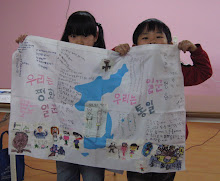
'저는 그들의 땅을 지키기 위하여 싸웠던 인디안들의 이야기를 기억합니다. 백인들이 그들의 신성한 숲에 도로를 만들기 위하여 나무들을 잘랐습니다. 매일밤 인디안들이 나가서 백인들이 만든 그 길을 해체하면 그 다음 날 백인들이 와서 도로를 다시 짓곤 했습니다. 한동안 그 것이 반복되었습니다. 그러던 어느날, 숲에서 가장 큰 나무가 백인들이 일할 동안 그들 머리 위로 떨어져 말과 마차들을 파괴하고 그들 중 몇몇을 죽였습니다. 그러자 백인들은 떠났고 결코 다시 오지 않았습니다….' (브루스 개그논)


For any updates on the struggle against the Jeju naval base, please go to savejejunow.org and facebook no naval base on Jeju. The facebook provides latest updates.
Showing posts with label No Gun-ri. Show all posts

Saturday, August 28, 2010

Photo Fwd: [From the VfP Convention, U. S.] A Banner for the Solidarity bet. the Veterans for Peace in Corea & U.S. [미 평군 회담] 한미 평화 재향 군인회 연대를 위한 배너

* Image source: Bruce Gagnon blog브루스 개그논 블로그:
Click the image for larger view 이미지를 클릭하시면 화면이 확대 됩니다.

________________________________________________

* The above photo is uploaded, too, in the
website of the Veterans for Peace, Corea (by Mr. Kim Hwan-Young, Secretary of the VfP, Corea): Click
위의 사진은 평화 재향 군인회 웹사이트에도 올려져 있읍니다 (김환영 평군 사무 국장님)
: 클릭
________________________________________________
* See also Bruce Gagnon blog, here.
여기 브루스 개그논 블로그를 또한 보시길.

________________________________________________

On Aug. 28, 2010, Bruce Gagnon has thankfully informed the above photo for the members of the Veterans for Peace, Corea, after the below workshop during the VfP national convention in Portland, Maine, United States, Aug. 25 to 29. The No Gun Ri movie is also screened during the convention. The members of the VfP, Corea could not join the convention for financial reason. The VfP members in the photo above are holding the banner of the VfP, Corea that the members of the VfP, Corea had presented to the members of the Veterans for Peace, Maine chapter, through Bruce Gagnon, as an expression of thanks to Tom Sturtevant who had brought the banner of the VfP, U.S., for the Corean members during the International Conference against the Asia Pacific Missile Defense and for the End of Arms Race, last April 16-18, 2009. The Maine state is where the Veterans for Peace movement first started 25 years ago. The small letters in the upper side of the banner says, ‘Army for Nation, Army for Democracy, [and] Army for Peaceful Unification.’ The bigger green letter at the bottom side of banner reads, Veterans for Peace, [Corea]. For more information on it, please see here.

2010년 8월 28일, 브루스 개그논은 8월 25일부터 29일에 걸쳐 진행되고 있는 메인주 포틀랜드 미 전역 평화 재향 군인회 회담 기간에 있었던 아래의 워크샵 이후 한국 평화 재향 군인회에 사진을 보냈읍니다. 노근리 영화가 회담 동안 또한 상영됩니다. 한국 평화 재향 군인회는 재정적 이유로 그 회담에 참여할 수 없었읍니다. 위의 사진의 회원들은 지난 2009년 4월 16일부터 18일까지 아시아 태평양 미사일 방어망 반대와 군사 경쟁 종식을 위한 국제 회담 기간동안 한국 평화 재향 군인회 회원들을 위해 미 평화 재향 군인회 깃발을 가져온 탐 스터트번트에 대한 감사의 표시로 한국 평화 재향 군인회 회원들이 브루스 개그논을 통하여 메인 지부 평화 재향 군인회 회원들에게 전한 한국 평화 재향 군인회의 배너를 들고 있읍니다. 메인주는 25년 전에 평화 재향 군인회 운동이 처음 시작된 곳입니다. 배너 윗쪽의 작은 글자들은 ‘민족 군대, 민주 군대, [그리고] 평화 통일을 위한 군대’ 입니다. 아래의 더 큰 녹색 글자는 [한국] 평화 재향 군인회 입니다. 더 많은 정보는 여기를 보시길.


* Image source 이미지 소스: Click here 여기 and 와 here 여기를 클릭

Bruce Gagnon and Veterans for Peace, Corea, holding the banner of the Veterans for Peace, United States, presented to the VfP, Corea by Tom Sturtevant,
Aug. 20, 2009
2009년 8월 20일 탐 스터트번트가 함국 평화 재향 군인회에 증정한 미 평화 재향 군인회의 깃발을 들고 있는 브루스 개그논과 한국 평화 재향 군인회 회원.

Citation from Bruce Gagnon's blog 브루스 개그논의 블로그 일부를 인용하면:

'Korean war veteran, and Maine VFP member, Tom Sturtevant has been the keeper of the banner since I brought it back from Korea.

'한국 전쟁 베테란이며 메인주 평화 재향 군인회 회원인 탐 스터트번트는 제가 그 배너를 한국에서 갖고 온 이후 배너를 계속 보관해왔었읍니다.

Most of the VFP members in the workshop yesterday had served in Korea during the war or since then. They all feel a strong sense of duty to help bring true peace and reunification to Korea. But as one of the guys said yesterday, "It's hard to convince people today that Korea is still an important issue after 60 years."


어제 워크샵의 대부분의 회원들은 [한국 전쟁중] 또는 그 이후에 한국에 있었읍니다. 그들은 모두 Korea에 진정한 평화와 통일을 가져오는데 도울 수 있길 강한 의무감을 느낍니다. 그러나 어제 한 사람이 말하듯, “[전쟁 이후] 60년이 지나도 한국이 아직도 중요한 이슈라고 오늘날 많은 사람들을 확신시키는 것이 어렵습니다.”

I tried to address this problem in my words during the workshop as I put Korea into the larger context of U.S. military strategy in the Asian-Pacific region. I talked about NATO expansion into the region and U.S. military moves to surround China.

저는 워크샵 기간동안 한국 아시아 태평양 지역 미국 군사 전략의 더 큰 콘텍스트 안에 한국을 위치함으로서 이 문제를 제 말로 역점을 두어 풀어가려고 노력했읍니다. 저는 그 지역으로의 나토 확장 및 중국을 봉쇄하기 위한 미국 군대의 움직임에 대해 말했읍니다.

The U.S. pretense about concern over North Korea is only a justification for the Pentagon to dramatically escalate its operations throughout the Asian-Pacific. U.S. bases are being expanded in Guam, Okinawa, Japan, and South Korea - including major deployments of "missile offense" systems.'

미국이 북한에 대해 염려하는 젠 체를 보이는 것은 단지 아시아 태평양에 걸쳐 극적으로 작전들을 점증시키려는 것입니다. 미국 기지들은 “미사일 공격” 시스템들 배치를 포함, 괌, 오키나와, 일본, 그리고 남한으로 확장되고 있읍니다.'


________________________________________________

Workshop on Korean War, in the VfP convention
평군 회담 한국 전쟁 관련 워크샵:

*Quote from the convention workshop site 회담워크샵 사이트에서 인용

'U.S. MILITARISM IN THE ASIA PACIFIC: A DISCUSSION ON UNENDING WAR WITH A FOCUS ON KOREA: PETER BRONSON, WOODY POWELL, TOM STURTEVANT, BRUCE GAGNON, GEORGE MCANAMAS, AND VIRGINIA RODINO [SOMERSET ROOM]

‘아시아 태평양에서의 미 군사 주의: 한국 전쟁에 촛점, 끝나지 않은 전쟁에 대한 토론: 피터 브론슨, 우디 파웰, 탐 스터트번트, 브루스 개그논, 조지 맥나마스와 버지니아 로디노 [서머셋 룸]

In observing the 60th anniversary of the outbreak of the Korean War, this workshop will reflect on the continuing tragedy and costs of this lingering war. The presenters believe that it is urgent now to replace the Korean War cease-fire agreement with a peace treaty. After showing a short video about the Korean War, members of VFP-Korea Peace campaign will lead a roundtable discussion about the hidden history of the war, obstacles to ending the war, and what we can do to end it. Participants are encouraged to bring any pictures, art work, or mementoes of the war to share in the workshop.'

한국 전쟁 발발 60 주년을 맞아, 이 워크샵은 계속되는 비극 및 이 끌어지는 전쟁의 비용을 돌아볼 것이다. 참여자들은 한국 전쟁 정전 협정을 평화 조약으로 바꾸는 것이 현재 절박하다고 생각한다. 한국 전쟁에 대한 짧은 비디오를 보인 후 평화 재향 군인회 한국 평화 캠페인 회원들은 전쟁의 숨은 역사, 전쟁 종식의 장애들, 그리고 우리가 무엇을 할 수 있는 지에 대한 대등한 토론을 끌어갈 것이다. 참가자들은 이 워크샵에서 공유하기 위해 전쟁에 관한 어떤 그림들, 예술품들, 기념품들을 가져올 것을 격려받는다.
________________________________________________

About No Gun Ri Movie in the VfP convention 평군 회담 중 노근리 영화 상영:

Dr. Chung Koo-Do, Director of the No Gun Ri Institute, advisor of documentary says:
(*From the description site of movies screened during the workshop)

노근리 연구소 소장이자 다큐멘타리 자문 위원 정구도 박사는 말하길:
(*워크샵 동안 상영되는 영화들 소개난에서)


'The No Gun Ri incident is a civilian massacre incident happened around late July, 1950 during the early Korean War. Many civilians were massacred and I am one of the bereaved family members of those victims. Due to the No Gun Ri incident, my elder brother and sister (at the age of five and two, respectively) were killed and my mother was seriously wounded and narrowly escaped the death.

'노근리 사건은 한국 전쟁 초기 1950년 7월 말경 일어났던 사건이다. 많은 시민들이 학살되었으며 나는 그 희생자 유가족들 중 한 사람이다. 노근리 사건으로 인해 나의 형과 여동생(각각 5살과 2살이었던)이 살해되었으며 나의 어머니는 심하게 상처를 입고 가까스로 죽음을 탈출했다.

For such a long time, I've considered the No Gun Ri incident as one of the most significant cases that teach the importance of human rights and peace. In that sense, I've always though it's very important to make the No Gun Ri documentary. While making the documentary, I had a chance to serve as an adviser.'

오랜 세월동안, 나는 노근리 사건을 인권과 평화의 중요성을 가르키는 가장 중요한 사건의 하나로 고려해 왔다. 나는 노근리 다큐멘터리를 만드는 것을 항상 매우 중요하게 생각했다. 다큐멘타리 제작시 나는 자문 위원으로서 일할 기회를 가졌다.'

________________________________________________________


* Related sites and blogs 관련 사이트 및 블로그들 :

Veterans for Peace_Corea 한국 평화 재향 군인회

Veterans for Peace, United States 미국 평화 재향 군인회

VFP National Convention - 25th Year Anniversary Celebration!
미 평화 재향 군인회 국가 회담- 25주년 창설 축하!

Aug. 25 to 29, 2010 2010년 8월 25일 ~29일

[Upon 6oth anniversary of the Korean War]
Veterans of the Korean War Call for a Real Peace Treaty
[국문 번역][60주년 기념] 한국 전쟁 [미] 재향 군인들, 진정한 평화 조약을 요구하다.
June 25, 2010 2010년 6월 25일


[Bruce Gagnon blog] VIDEO OF VFP CONFAB MARCH [on Aug. 29, 2010]
[브루스 개그논 블로그] 또 다른 비디오: [2010년 8월 29일] 평군 회담 행진

September 08, 2010 2010년 9월 8일


[Bruce Gagnon blog]Video: ANOTHER SPEAKER AT VFP RALLY: Lisa Savage, Code Pink[on Aug. 29, 2010]
[브루스 개그논 블로그]비디오: [2010년 8월 29일]평군 회담의 또 한 명의 연설자: 리사 새비지, 코드 핑크
Friday, September 03, 2010 2010년 9월 3일


Text Fwd: Antiwar rally by Veterans for Peace caps convention
[국문 번역] 반전 집회가 [미] 평화 재향 군인회의 회담을 마무리하다.
Aug. 30, 2010 2010년 8월 30일

Video Fwd: Two Videos from the Veterans for Peace Convention,
Maine, Aug. 28, 2010

2010년 8월 29일, 미국 메인주 평화 재향 군인회 회담 관련 2 개의 비디오


[Bruce Gagnon blog], Tuesday, August 24, 2010
[Video]VFP CONFAB COVERAGE CONTINUES
브루스 개그논 블로그: [비디오]평군 회담 기사 계속되다, 2010년 8월 24일


[Bruce Gagnon blog] Sunday, August 22, 2010
PROMOTING VFP CONFAB
브루스 개그논 블로그: 평군 회담 홍보, 2010년 8월 22일

Video Fwd: [Bruce Gagnon blog] Tom Sturtevant from Maine Veterans for Peace
비디오 포워드:[ 브루스 개그논 블로그] 탐 스터트번트: 메인주 평화 재향 군인회


[Three International Petitions] to End the Korean war and peace treaty
(or peace resolution)

한국 전쟁 종식과 평화 협정(또는 평화 결의안) 실현을 위한 [세 개의 국제 서명]


[국문 번역][Bruce Gagnon blog 브루스 개그논 블로그] Massacre at No Gun Ri 노근리의 학살
Oct. 14, 2010 2010년 10월 14일


No Gun Ri Incident 노근리 사건
_ English, 영문,
_ Korean, 국문

No Gun Ri related Chungjoo MBC programs (Sorry, only Korean!)
노근리 관련 청주 MBC 프로그램들은 여기서 보실 수 있읍니다.


No Gun Ri fiction movie 노근리 픽션 영화:
"작은 연못 (A Little Pond. 2009)"


[Japan Focus] The Truth and Reconciliation Commission of Korea:Uncovering the Hidden Korean War
Kim Dong choon
The Other War: Korean War Massacres
[재팬 포커스] 한국 진실과 화해 위원회: 숨겨진 한국 전쟁을 열며
김동천
또다른 전쟁: 한국 전쟁의 학살


Korean War Armistice Agreement, July 27, 1953 (English)
한국 전쟁 정전 협정, 1953년 7월 27(영문)

For Korean above, see Here or Here
국문은 여기
또는 여기를 클릭

Peace Agreement for the Korean Peninsula (English, proposed draft)
by the Solidarity for Peace And Reunification of Korea
평화와 통일을 여는 사람들 한반도 평화 협정 제안 (영문, 제안 초안)

Peace Agreement for the Korean Peninsula (Korean, proposed draft)
by the Solidarity for Peace And Reunification of Korea

평화와 통일을 여는 사람들 한반도 평화 협정 제안 (국문, 제안 초안)


여기를 또한 보시길.

Wednesday, March 3, 2010

Movie, ‘A Small Pond’ on the No Gun-Ri Massacre Finally Opens on April 15.


* All the original image sources: No Gun Ri Production and twitchfilm.net


* All the original image sources: No Gun Ri Production and twitchfilm.net


The Jeju Sori article on March 2 reports a movie, 'A Small Pond' (Director: Lee Sang-Woo, production by No Gu Ri production) that is on the No Gun Ri massacre is finally open in eight years of the movie production decision

The opening date was decided to be April 15, eight years after the Movie production decision. It is also after 60 years of the No Gun Ri massacre and after 11 years when the whole truth was known to the world, thanks to the AP reporters. In reference, this year is the 60th anniversary of the Korean War.

However, it can be said that it was dominantly by the persistent efforts by the survivors and their families of the No Gun-Ri massacre, who made the breakthrough in late 90s, after the end of the military dictatorship for decades in South Korea that had oppressed people’s freedom of speech including the truth of Korea war, that the truth could be finally made as a movie.

The No Gun Ri massacre story was also translated in Swedish. See Here.

Thursday, February 4, 2010

Text Fwd: South Korea, “The most Dangerous Country in the World”

_____________________________________________________________________________________
*The text below was sent from Torbjörn Björkman, a Sweden journalist who visited South Korea from Dec. 1 to 7, 2009, thanks to introduction by Agneta Noberg who has visited South Korea last April when there was the International Conference against the Asia Pacific Missile Defense and for the End of Arms Race. Torbjörn Björkman works for the Swedish Friendship Organisation, Sweden, which has a long time history, and founded after the end of the Korean war. When the organization was set up, it was centred around the Swedish investigators who had visited the North Korea and investigated the indiscriminate U.S. bombings against the civilians during the Korean war, 1950 to 1953.

His organization publishes the magazine four times a year (In the below image, a photo of Pyeongyang, North Korea is in cover). He has also translated Bruce Gagnon’s No Gun Ri visit report in last October, 2009 in Swedish
Torbjörn Björkman has himself visited the North Korea four times before. It was his first visit to South Korea, this time and he has met the activists from various organizations to interview them (Photo below).
Bruce Gagnon has also met many of them in Torbjörn Björkman’s article here, in August 2009. The emphases below are by No Base Stories of Korea.

Click the images for larger view
_____________________________________________________________________________________
Torbjörn Björkman says on Feb. 3, 2010

"This is a translation of the article in the weekly paper Proletären no 3 in January and Korea Information, the paper from the Swedish Friendship Organisation, Sweden. Proletären is printed in 4.000 copies. The Swedish Friendship Organisation in 400 copies. It´s nearly the same article in the two papers."


Click the image for larger view
_____________________________________________________________________________________

South Korea, “The most Dangerous Country in the World”
by Lena Thomsson based on the talk with Torbjörn Björkman

Click the image for larger view

North Korea gets some attention in Swedish mass media, but there have been very few reporters from Western countries to North Korea. But North Korea couldn’t exist without it’s antipole South Korea. However, no Swedish reporter gives any interest to South Korea, this big country with more than 50 millions inhabitants.

In December 2009, Torbjörn Björkman visited Seuol to learn more about South Korea.

- I made an interview with Agneta Noberg this autumn, Torbjörn Björkman says. She works with spreading information about Nato and took part in an Conference in South Korea. During the discussion with her, I got the idea to go there. Our knowledge about South Korea is very bad. We know less about South Korea, than about North Korea, despite our knowledge about North Korea comes from the imperialistic propaganda.

- My visit in Seoul turned to be quite different to what I have thought and could expect, continue Torbjörn Björkman. Many persons in organisations that I meet see South Korea as a prison.

One of them Torbjörn Björkman met in Seoul was Kim Young-je working as unification director of the KCTU, Korean Confederation of Trade Unions.

- We must get human rights, Kim Young-je said. The division between North and South is one of the big problems of the humanity.

Is caught in two sentences the Korean problem, in a new way for me. The construction of the Korean peninsula in two separate stats; The Democratic Peoples Republic Korea and The Republic [of] Korea, is a product of the US Imperialism and is total undemocratic. The most of the Koreans had [chosen a] united Korea. Without to understand the US oppressing of South- and North Korea we can’t see the questions of the human rights. The US-imperialism is the problem. This is the background to that the Korean peninsula is one of the most militarized areas in the world, were the government force an expansion of the already very large military exercise areas and where US now are expanding there bases. South Korea has 40 times more military investments than North Korea. It is easy to se[se] the grotesque proportions in armaments of South Korea, one of the most armed military in Asia. One of the representatives of Veterans for Peace in Korea proclaimed that South Korea is the most dangerous country in the world. The best way to describe the Korean peninsula is to describe the US-imperialistic tyrannize over the Korean people. In South Korea, it occurs through agents in the South Korea government. Against North US all the time have trade restrictions and an alert political blockade that affect the country with brutal power.

Torbjörn Björkman knows the problem. The journey to Seoul was his first to South Korea, but he has visited North Korea several times. The people in South and North suffer hard through the 38th degree. South Koreas formal democratic freedom, have great restrictions through the National Security Act, implemented after the war and give no different political opinions any space. Any contact with North Korea and North Koreans is prohibited. Any, that break this law, can be put in prison. Under the president Kim Dae Jung, they used a smoother use of this act, but now the mode of application now is harder. The acts make the two formal resolutions between North and South unlawful. The lay make North Korea to an anti nation, a treachery state and an enemy.

- US make a mistake in the division of the Korean peninsula and the prevent of the unification, says Lee Kyeong-won from PKAR, Pan Korean Alliance for reunification of Korea, when he let Torbjörn Björkman to make his first interview after got away from prison, accused for broken the National Security Act when he visited the North Korea. Through this act the US continue to dominant the country.

2008 it was still possible to go to North Korea, but not any more. The only way to get permission is to travel in groups, for instance a sport club.

In a party organised by Solidarity for Peace and Reunification of Korea, SPARK, Torbjörn Björkman was invited to say some worlds. He says:

- I got enthusiastic applause from the 200 gests when I told them that I love North Korea and that it’s a very nice country and nice people and that I have been in Pyongyang 4 times. I said that I worked for the united Korea and for better relations between North and South. They saw it important what I said, that I spoke positively about North Korea. I got greetings with me to give to there relatives in North, the next time when I go there. They saw it important that I spoke positively about North Korea.

- South Korea is a prison for the people, says Torbjörn Björkman, because they cannot speak free or cannot contact there relatives or friends in the North.

- The right wing in South Korea has been strong since the Japanese colonial time. In 1997 started a broad people movement that chose Kim Dae Jung to president. His ”sunshine politic” pushed North and South near to another and ended in a summit with him and Kim Jong Il in Pyongyang 2000 and gave Kim Dae Jung the Nobel Peace Price this year.

The first real opening in the contacts between North and South was not in the political field, but through the sport. The trade unions that worked for unification decides to organise a football match with workers from South and North. The right wing didn’t dare to oppose it and the match accomplished in Pyongyang the 15th of August 1999.

- The South Korean workers are forbidden to speak, said Kim Young-je. We are forbidden to discuss about socialism and communism. We have censure against our thinking. We in South are prisoners. In North are 25 millions forced to isolate themselves.

- Even if South Korea has a high economical standard, we cannot speak of human rights in a country that control of the minds.

Unavoidable, a discussion about the Korean peninsula must include the question about nuclear weapons. What is the South Koreans saying in that question?

- This question is very important in South Korea, says Torbjörn Björkman. All the organisations I met had it in there program. PKAR have the nuclear weapon as the central question.

Lee Kyeong-won says:
- The central question in the Korean peninsula is the nuclear weapons. US have the nuclear umbrella in South. We must have a peace treaty, we must have collaboration between US and North Korea, but US do not want peace. That is why there will be no honest discussions.

- The SPARK started 1994 just because the nuclear question, under the first crisis about the North Korean nuclear weapons, said Oh Hye-Ran, one of the investigators in SPARK, when the meet Torbjörn Björkman in her office in central Seoul. We are fighting against the hostile politic against North Korea and we want peace and unification between North and South. We want that the South break the connections with US and that US leave the Korean peninsula. We want that the armistice will chance to a peace treaty.

In the SPARK's Office also works the peace investigator [K]o Yong-Dae. He wants to discuss the classification of weapons that started under the 90th. The weapons were divided into protection weapons and aggressive weapons, defensive and offensive, a theory that disappeared among the investigators when Nato expanded eastward.

The Korean Peninsula is a centre for develop new systems of weapon, says Yo Yong-Dae. It is important to let people know about this, to get them to understand the train of thought.

Trade unions, the peace movement and the movement for the united Korea are in different ways connected to each other. Even the trade unions have an opinion in the question of nuclear weapon.

The majority of the South Koreans be aware of that North Korea has nuclear weapons because the treat from US, says Kim Young-je. The trade unions are against nuclear weapons. They want them to be liquidated, but they are aware of that North Korea has them against the US threat.

Cheong Wook-sik from the organisation Peace Network says:
- The central question is not if North Korea are threatening with nuclear weapons, but that we have to built the Korean Peninsula as a zone without nuclear weapons and in the long run create a world without nuclear weapons.

- The militarism is central for the Korean question in south, where the government se[se] North Korea as the main enemy, he continues. Men it’s an asymmetric threat. South Koreans military investments with US support are much bigger than North Koreas. North Korea wants a peace agreement, not this armistice. However, US do not accept this. There is an unbalance in military power. South Korea-US has the initiative in the case of conventional weapon. Therefore North Korea has to built nuclear weapons and missiles.

- I cannot understand the critic against North Korea, accused in lack of democratic rights, says Cheong Wook-sik, if you at the same time accused China or South Korea in those deficits.

Torbjörn Björkman have a great memory from the journey; a protest meeting on the way to another meeting in the question for unification between South and North. The protest meeting was outside of the KCTU and was to support the ongoing streak among the railway workers. To catch the trade unions leader stood many police officers outside the building. The right wing government Lee Myung-bak sees all streaks as illegal and the trade unions leaders arrested. Björkman says:

- There is no accident occurrence that we met police officers against workers in streak when we went to a meeting about unification between North and South. The solution of two stats and the workers fight in South is a direct result of that US made South Korea to there vassal state. This is also a product of the Japanese colonial power, there fascism and there fight against the communism, that is the people influence.

In the meeting about unification, we put ourselves with enthusiasm behind a big photo with Kim Jung Il and Kim Dae Jung in the summit the year 2000.

Kim Bung Tae is a represent for Veterans for Peace in Korea. He says:
- I have a brother [in law] who is artist in North Korea. He recently got a gold medal in Beijing for his art. As South Korean, I have no possibility to meet or to get in contact with my brother [in law]. That is why I ask you, that the next time you come to Pyongyang, give my brother [in law] a greeting from me.

We let the old soldier get the last word before, we say “Good Bye”:
- I am glad to meet real friends for peace.

Lena Thomsson (* Lena Thomsson is wife of Torbjörn Björkman)
_____________________________________________________________________________________

* Sent from
Agneta Noberg on Wed, Feb 3, 2010


National Security Archive Update, February 2, 2010

Seeing human rights in the "proper manner"
The Reagan-Chun Summit of February 1981

For more information:
202/994-7000 or wampler@gwu.edu

http://www.nsarchive.org


Washington, DC, February 2, 2010 - Twenty-nine years ago today, less than two weeks after his inauguration, President Ronald Reagan rolled out the welcome mat at the White House for South Korean president and strongman Chun Doo Hwan, despite internal U.S. government concerns about Chun's poor human rights record. Over the previous year, Chun's regime had brutally suppressed the Kwangju student protests and thrown dissident leader Kim Dae Jung into prison. Nevertheless, the new administration, keen to send a strong signal of support for key anti-Communist allies, decided to reverse the previous U.S. policy of voicing public criticism of South Korean repression of its domestic opposition.

Today, the National Security Archive is posting a set of formerly classified documents that provide a revealing window into this pivotal moment in U.S.-South Korean relations. The materials include the memorandum of conversation of Reagan's meeting with Chun on February 2, 1981, Reagan's State Department briefing book, as well as White House memos and State Department cables. The records illuminate the delicate balancing act Reagan's advisers chose to follow in squaring the White House's eagerness to reinvigorate the security relationship with Seoul with the need to avoid the impression of uncritical approval of Chun's repressive human rights policies.

Among other insights into the risky new policy, the documents (acquired through the Freedom of Information Act and from presidential libraries) describe:

* Secretary of State Alexander Haig's acknowledgement that Reagan's invitation to Chun "spoke louder than words" about the administration's desire to strengthen ties to South Korea.


• National Security Advisor Richard V. Allen's euphemistic take on the state of play in South Korea: "Human rights survives as a concept, but in a broadened context."

* Chun's response to Reagan's assurance about potential U.S. approaches to Pyongyang: "I take your words as a gift, and they will allow me to return home with an easy mind."

* U.S. assurances that South Korea can rely on it for supplies and technology for its nuclear power program.

Reagan's warm reception of Chun was the public side of a strategy that favored handling human rights concerns behind closed doors. In the short term, the new U.S. approach engendered deep mistrust and suspicion of the U.S. for its role in legitimizing the South Korean government. Over the longer term, the combination of public political support and private encouragement of reform yielded mixed results.

This year, the National Security Archive will publish through ProQuest a major document collection, "U.S.-Korean Relations, 1968-2000," which explores the complex history of the two countries' ties.

http://www.nsarchive.org/


_____________________________________________________________________________________
THE NATIONAL SECURITY ARCHIVE is an independent non-governmental research institute and library located at The George Washington University in Washington, D.C. The Archive collects and publishes declassified documents acquired through the Freedom of Information Act (FOIA). A tax-exempt public charity, the Archive receives no U.S. government funding; its budget is supported by publication royalties and donations from foundations and individuals.

_________________________________________________________________________________________________________________

PRIVACY NOTICE The National Security Archive does not and will never share the names or e-mail addresses of its subscribers with any other organization. Once a year, we will write you and ask for your financial support. We may also ask you for your ideas for Freedom of Information requests, documentation projects, or other issues that the Archive should take on. We would welcome your input, and any information you care to share with us about your special interests. But we do not sell or rent any information about subscribers to any other party.
_____________________________________________________________________________________

* Two videos about Gwangju

1. Kwangju Uprising - news cast
(Youtuve URL)
'American news casts on the 1980 Kwangju Uprising in South Korea.'


2. Resurrection of Oppression: May, Month of Uprising (Link is HERE)


'The video informed at the PKAR (Pan-Korean Alliance for Reunification) was screened on the May 12 press interview for the release of the six arrested unification activists under the National Security Law. The press interview was participated by more than 100 people from the 80 organizations.

The video compares the current situation of the oppression by the Lee, Myung Bak government, South Korea to the oppression of the military dictatorship, in the city of Kwangju during the two weeks since May 18, 1980 when the general and soon-self-becoming President, Chun, Doo-Hwan murdered more than 2000 Kwangju citizens for cementing his regime, against the Korean people’s wish of the Democracy, called “The Spring of Seoul”, after the death of the precedent military dictatorship, Park, Jung-Hee who had been murdered by his staff months before.'


Sunday, October 25, 2009

[국문 번역] MASSACRE AT NO GUN-RI

Click to enlarge this depiction of the No Gun-ri massacre
노근리 학살을 묘사한 위를 클릭하시길.


Ninety-four year old Chung Eun Yong points out the bullet holes from US 7th Cavalry rifle fire
94세 정은용 옹이 미국 제 7 기병대의 소총 발화들로 생긴 총탄 구멍들을 가르키고 있다.
Bold

* Bruce Gagnon blog 브루스 개그논 블로그
Wednesday, October 14, 2009 2009년 10월 14일
MASSACRE AT NO GUN-RI 노근리의 학살


Yesterday I spent most of the day visiting the site of the US Army 7th Cavalry Regiment's massacre of more than 225 innocent Korean civilians on July 26, 1950 at No Gun-ri during the Korean War.


는 어제 대부분의 날들을 한국 전쟁 기간 1950년 7월 26일 미 육군 제 7 기병대 연대가 225명 이상의 무고한 시민들을 학살한 노근리 현장을 방문하며 보냈읍니다.

In the days before July 26, 1950 the North Korean army was pushing
US military forces southward. The US Army ordered two villages of peasant farmers in the No Gun-ri area to evacuate. There were taken by the US military to a nearby railroad track and ordered to walk along it. At one point the 500-600 refugees were instructed to bunch up and sit on the tracks. Two US military aircraft then circled overhead and dropped 7-8 bombs on their heads.

1950년 7월 26일 전 북한군은 미군을 남쪽으로 밀어내고 있었읍니다. 미군은 노근리 일대 농부들이 사는 두 마을에 떠날 것을 명령했읍니다. 그들은 미군에 의해 근처 철도 선로로 이동되었고 그 길을 따라 걷도록 명령 받았읍니다. 한 지점에서 500~600여명의 피난민들은 한 데 묶여져 선로에 앉을 것을 명령 받았읍니다. 그리고 나서 두 미군 비행기가 머리 위를 날았고 그들의 머리 위에 7~8개의 폭탄을 떨어 뜨렸읍니다.

This story was told to me yesterday by a 72 year-old woman, Yang Kae-suk, who was 13 years-old at the time of the attack. Her father was carrying her grandmother on his back. The body of her grandmother was never found as body parts flew in every direction.

이 이야기는 어제 공격 당시 13세 였던 72세 양[해]석 할머니로부터 들은 것입니다. 그 분의 아버지는 그의 등에 그 분의 할머니를 엎고 있었읍니다. 그 분 할머니의 몸은 산산 조각으로 흩어져 결코 찾지 못했읍니다.

Her other family members tried to hide near a tree and her mother was severely wounded. A bomb fragment hit Yang in the back of the head and her left eye ball blew out of the socket and she tossed it on the ground.

그분의 다른 가족 구성원들은 근처 다리에 숨으려 했지만 그 분의 어머니는 심하게 상처를 입었읍니다. 폭탄 조각이 양할머니의 머리 뒤를 치자 왼쪽 눈동자가 동공에서 튀어나왔고 [양할머니는] [순간] 그것을 땅으로 던졌읍니다.

Soon 7th Cavalry soldiers began firing their rifles at the defenseless crowd and they hid for cover under a nearby train tunnel. For the next four days and three nights the people inside the tunnels were fired on from four different directions by the US soldiers who had them surrounded. US planes reappeared and strafed them with machine gun fire. More people, who were crammed inside the tunnels, were killed as they tried to sneak out for water or tried to escape. Some number did escape the madness that surrounded them.

곧 제 7기병대 군인들이 그들의 소총을 무방비 상태의 군중들을 향해 쏘기 시작했고 그들은 근처의 철도 터널 아래로 몸을 숨겼읍니다. 세 밤 네 낮 동안 그 터널의 사람들은 그들을 에워쌌던 미군들의 총을 사방 서로 다른 방향에서 맞았읍니다. 미군 비행기가 다시 나타나 그들에게 기계총으로 소총 사격을 했읍니다. 더 많은 사람들이 터널 속에 꾹꾹 채워졌다가 물을 찾아 살짝 나오려 하거나 탈출하려 할 때 죽임을 당했읍니다. 몇몇은 그들을 에워쌌던 광기로부터 탈출했읍니다.

Finally in the dark of night the Army's 7th Cavalry withdrew as the North Korean Army advanced. Then early on the fourth morning the North Koreans told the people they were free.

제 7 기병대는 북한군이 진입하면서 마침내 밤의 어둠을 타 퇴각했읍니다. 그리고 네 번째 이른 아침 북한군이 그들에게 자유라 말했읍니다.

This was not the first time the 7th Cavalry had been associated with a mass slaughter of civilians. The Regiment perpetrated the Wounded Knee Massacre in South Dakota on December 29, 1890, at the end of the Indian Wars.

제 7 기병대가 시민 대량 학살에 연루된 것이 이번이 처음은 아닙니다. 그 기병대는 인디언 전쟁의 끝, 1980년 12월 29일 사우스 다코타 주 운디드 니(Wounded Knee) 학살을 범했읍니다.

Yang's mother was in terrible need of medical care but there was none available. Maggots had begun to appear inside her wounds. Her father made medicines from the rye seed and bandages from the persimmon tree that grows abundantly in the area. Her mother was to survive.

양할머니의 어머니는 의술 치료를 몹시 필요로 한 상태였으나 이용할 수 있는 것이 아무것도 없었읍니다. 구더기들이 그녀의 상처에서 나타나기 시작했읍니다. 양할머니의 아버지는 보리 씨앗으로 약을 만들었고 그 지역에서 넘치게 자라는 감나무로부터 붕대를 만들었읍니다.

For many years the No Gun-ri massacre remained a US Army secret as the successive right-wing governments in South Korea, under the control of the US, kept a lid on the story. But then in 1999 the Associated Press broke the story and the BBC followed with a documentary (entitled "Kill 'em All") a few years later. This film reveals orders coming from the highest levels of the Army instructing the field commanders to kill all civilians who got in the way.

많은 세월 동안 노근리 학살은 미국의 통제하에 계승된 남한 우익 정부들이 그 이야기를 덮는 것을 고수해왔기에 미국 군대의 비밀로 남아 있었읍니다. 그러나 1999년 연합 통신이 그 이야기를 폭로하고 BBC가 몇 년 후 그 이야기를 다큐멘터리로 만들었읍니다. (‘모두 죽여라’하는 제목으로요.) 이 필름은 그 명령이 군대 최고위급들에게서 온 것으로 그들이 현장 사령관들에게 갈 길에 방해되는 모든 시민들을 죽이라고 했던 것을 밝힙니다.

Over the years the survivors and their supporters had been trying to bring justice to those who were killed or wounded at No Gun-ri. They organized the "Committee for Unveiling Truth about the No Gun-ri Massacre" and finally helped force the creation of a joint South Korea-US investigation. (The US for a long time tried to down play the size of the killing field.) The final reported conservatively acknowledged the deaths of 228 people and the tunnel where people hid was surveyed and all bullet damage was marked to show the places where US troops had fired-on the tunnel. At both ends of the tunnel there are now triangles (showing where bullets still remain embedded in the concrete) and circles (where bullets created marks).

많은 세월, 그 생존자들과 지지자들은 노근리에서 학살되거나 부상입은 사람들에게 정의를 찾아 주려 노력했읍니다. 그들은 노
리 학살 진상 규명 위원회”를 조직했고 남한-미국 공동 조사단을 꾸리도록 압력을 가하는 데 일조했읍니다. (미국은 오랫동안 그 학살의 규모를 애써 축소하려 했읍니다.) 최종 보고는 보수적이나마 228명의 죽음을 인정했고 사람들이 숨었던 터널은 조사되었으며 총탄 흔적들은 미군 부대가 터널 안으로 소총 사격을 했던 장소들을 보이기 위해 표시되었읍니다. 현재 터널의 양 끝에는 삼각형들 (총알들이 아직도 콘크리트에 박혀 있는 곳을 보임)과 원들(총알들이 흔적을 남긴 곳)이 표시되어 있읍니다.

I asked Yang how she felt today about the US military. She said she could never go to school because of her missing eye. Today she grows grapes and persimmons in the small farming village where she lives. "War should not be," she told me.

저는 양할머니께 현재 미국 군대에 대해 어떻게 느끼느냐 말했읍니다. 그 분은 잃어버린 눈때문에 전혀 학교를 다닐 수 없었다 말했읍니다. 현재 그 분은 사시는 곳 작은 농촌 마을에서 포도와 감을 재배합니다. “전쟁은 있어서는 안된다.”고 저에게 맣씀하셨읍니다.

To this day there has been no financial compensation to the victims or their families. About 50 survivors of the No Gun-ri massacre are still alive.

오늘날까지도 희생자들이나 그들의 가족들에게 재정적 보상이라곤 전혀 없었읍니다.약 50 여명의 노근리 학살 생존자들이 아직 살아 있읍니다.

Chung Koo Do is the Director of the No Gun-Ri Institute for Peace Studies and is dedicated to ensuring that the memory of the massacre is not lost and that justice prevails. His mother was a survivor of the slaughter by the 7th Cavalry. He told me that there were over 500 incidents of killing of civilians during the war but No Gun-ri was the only case investigated by a joint South Korean-US government team. After the No Gun-ri investigation the US said it would not look into any other case.

정구도님은 노근리 평화 연구소의 소장으로 학살의 기억이 잊혀지지 않고 정의가 승리하기 의해 헌신합니다. 그의 어머니는 제 7 기병대의 학살 생존자였읍니다. 그는 저에게 전쟁동안 500 여개가 넘는 민간 학살 사건이 있었지만 노근리가 남한-미국 정부에 의해 유일하게 조사된 경우라 말했읍니다. 노
리 조사후 미국은 다른 사건들을 찾아 보지 않겠다 말했읍니다.

2010 will be the 60th anniversary of No Gun-Ri. Chung told me his organization is planning to sponsor several important events to commemorate the massacre. He hopes that US soldiers who were involved in the Korean War will come for the events and he particularly hopes that Veterans for Peace in the US will send a delegation to Korea during this time. He asked me to help them make that possible and I told him I would do my best.

2010년은 노군리 60주년이 되는 해입니다. 정선생님은 저에게 그의 조직이 그 학살을 기념하기 의한 몇몇 중요한 행사들을 주최하러 준비하고 있다 말했읍니다. 그는 한국 전쟁에 참여했던 미국 군인들이 행사들에 오고 특히 미국의 평화 재향 군인들이 그 기간에 한국에 대표단을 보내길 원합니다. 그는 저에게 그 일이 가능하도록 도와 줄 것을 부탁했고 저는 그에게 제 최선을 다하겠다 말했읍니다.

Chung pointed out with great pride the large area surrounding the No Gun-ri massacre site that will become a peace park. The South Korean government is now building a peace museum, educational facilities, and memorials. The survivors, and their descendants, are determined to keep the memory of No Gun-ri in the forefront of international peace movement efforts.

정선생님은 노근리 학살 현장을 에워싼 큰 지역이 평화 공원이 될 것이라고 자랑스럽게 가르켰읍니다. 남한 정부는 현재 평화 박물관, 교육 시설들, 그리고 기념관들을 짓고 있읍니다. 생존자들과 그들의 자손들은 국제 평화 운동 노력의 앞장에서 노근리의 기억을 지켜나가기 위해 굳은 결의에 있읍니다.

It is a sad moment in history that should be remembered by all of us.

그 것은 우리 모두에 의해 기억되어야 할 역사의 슬픈 순간입니다.


* 역주 노트 (Translator's note):
No Gun-Ri Institute for Peace Studies, 노근리 평화 연구소 는 click here