'저는 그들의 땅을 지키기 위하여 싸웠던 인디안들의 이야기를 기억합니다. 백인들이 그들의 신성한 숲에 도로를 만들기 위하여 나무들을 잘랐습니다. 매일밤 인디안들이 나가서 백인들이 만든 그 길을 해체하면 그 다음 날 백인들이 와서 도로를 다시 짓곤 했습니다. 한동안 그 것이 반복되었습니다. 그러던 어느날, 숲에서 가장 큰 나무가 백인들이 일할 동안 그들 머리 위로 떨어져 말과 마차들을 파괴하고 그들 중 몇몇을 죽였습니다. 그러자 백인들은 떠났고 결코 다시 오지 않았습니다….' (브루스 개그논)


For any updates on the struggle against the Jeju naval base, please go to savejejunow.org and facebook no naval base on Jeju. The facebook provides latest updates.
Showing posts with label total information awareness. Show all posts

Tuesday, December 21, 2010

Text Fwd:[Bruce Gagnon] TOP SECRET AMERICA - POLICE STATE UNDERWAY

* Image source: same as the link
The Washington Post has an important story today about the expansion of domestic surveillance by local police agencies across the country in connection with the Department of Homeland Security (DHS). Below are a few bits from the article:

On a recent night in Memphis, a patrol car rolled slowly through a parking lot in a run-down section of town. The military-grade infrared camera on its hood moved robotically from left to right, snapping digital images of one license plate after another and analyzing each almost instantly.
At the same time that the FBI is expanding its West Virginia database, it is building a vast repository controlled by people who work in a top-secret vault on the fourth floor of the J. Edgar Hoover FBI Building in Washington. This one stores the profiles of tens of thousands of Americans and legal residents who are not accused of any crime. What they have done is appear to be acting suspiciously to a town sheriff, a traffic cop or even a neighbor.
In response to concerns that information in the database could be improperly used or released, FBI officials say anyone with access has been trained in privacy rules and the penalties for breaking them.
But not everyone is convinced. "It opens a door for all kinds of abuses," said Michael German, a former FBI agent who now leads the American Civil Liberties Union's campaign on national security and privacy matters. "How do we know there are enough controls?"

The vast majority of terrorism leads in the United States originate from confidential FBI sources and from the bureau's collaboration with federal intelligence agencies, which mainly work overseas. Occasionally a stop by a local police officer has sparked an investigation. Evidence comes from targeted FBI surveillance and undercover operations, not from information and analysis generated by state fusion centers about people acting suspiciously.

"It's really resource-inefficient," said Philip Mudd, a 20-year CIA counterterrorism expert and a top FBI national security official until he retired nine months ago. "If I were to have a dialogue with the country about this . . . it would be about not only how we chase the unknowns, but do you want to do suspicious activity reports across the country? . . . Anyone who is not at least suspected of doing something criminal should not be in a database."

Ramon Montijo has taught classes on terrorism and Islam to law enforcement officers all over the country.

"Alabama, Colorado, Vermont," said Montijo, a former Army Special Forces sergeant and Los Angeles Police Department investigator who is now a private security consultant. "California, Texas and Missouri," he continued.

What he tells them is always the same, he said: Most Muslims in the United States want to impose sharia law here.

"They want to make this world Islamic. The Islamic flag will fly over the White House - not on my watch!" he said. "My job is to wake up the public, and first, the first responders."

Like Montijo, Walid Shoebat, a onetime Muslim who converted to Christianity, also lectures to local police. He too believes that most Muslims seek to impose sharia law in the United States. To prevent this, he said in an interview, he warns officers that "you need to look at the entire pool of Muslims in a community."

When Shoebat spoke to the first annual South Dakota Fusion Center Conference in Sioux Falls this June, he told them to monitor Muslim student groups and local mosques and, if possible, tap their phones. "You can find out a lot of information that way," he said.

A book expanding on what Shoebat and Montijo believe has just been published by the Center for Security Policy, a Washington-based neoconservative think tank. "Shariah: The Threat to America" describes what its authors call a "stealth jihad" that must be thwarted before it's too late.

The book's co-authors include such notables as former CIA director R. James Woolsey and former deputy undersecretary of defense for intelligence Lt. Gen. William G. Boykin, along with the center's director, a longtime activist. They write that most mosques in the United States already have been radicalized, that most Muslim social organizations are fronts for violent jihadists and that Muslims who practice sharia law seek to impose it in this country.

The DHS also provides local agencies a daily flow of information bulletins.

These reports are meant to inform agencies about possible terror threats. But some officials say they deliver a never-ending stream of information that is vague, alarmist and often useless. "It's like a garage in your house you keep throwing junk into until you can't park your car in it," says Michael Downing, deputy chief of counterterrorism and special operations for the Los Angeles Police Department.
The vast majority of fusion centers across the country have transformed themselves into analytical hubs for all crimes and are using federal grants, handed out in the name of homeland security, to combat everyday offenses.

This is happening because, after 9/11, local law enforcement groups did what every agency and private company did in Top Secret America: They followed the money.

Friday, October 15, 2010

Photo Fwd: Personal information protection 개인 정보 보호


Hankyoreh, Oct. 15, 2010
Personal information protection

Human rights activists put on a performance to voice objections to the revised bill of the Resident Registration Act, submitted by the government to the National Assembly, to adopt an electronic card system of resident registration in front of the Central Government Complex in Seoul, Oct. 14.

They have disputed the government’s plan to adopt a new system, saying, “personal information included in the electronic card will increase and accordingly, the danger of leaking an individual’s personal information will be much greater.”

The Ministry of Public Administration and Safety has made strong moves to push the adoption of electronic card system. The government scrapped the system in 1998 in response to concerns infringement of human rights pertaining information and wasting budget money.  

South Koreans must enroll in the resident registration system by which a 13-digit number is issued to all Korean nationals.  

(Photo by Rhee Jong-chan)

Wednesday, July 21, 2010

Text Fwd:[Bruce Gagnon blog] SOME SPICY BITS FROM "TOP SECRET AMERICA"

* Bruce Gagnon blog
Tuesday, July 20, 2010
_________________________________________________________
* Update on July 22, 2010. Please see here.
_________________________________________________________

SOME SPICY BITS FROM "TOP SECRET AMERICA"

Knowing that many of you won't have time to read the long Washington Post expose on privatizing intelligence and war I thought I'd post a few interesting bits from the series.

In the end the story is not a surprise but the rich details give some insight into how the corporations have taken near total control of foreign policy and are becoming fat rich bastards to boot.

  • In the Department of Defense, where more than two-thirds of the intelligence programs reside, only a handful of senior officials - called Super Users - have the ability to even know about all the department's activities. But as two of the Super Users indicated in interviews, there is simply no way they can keep up with the nation's most sensitive work.

  • The result, he added, is that it's impossible to tell whether the country is safer because of all this spending and all these activities. "Because it lacks a synchronizing process, it inevitably results in message dissonance, reduced effectiveness and waste," retired Army Lt. Gen. John R. Vines said. "We consequently can't effectively assess whether it is making us more safe."

  • With so many more employees, units and organizations, the lines of responsibility began to blur. To remedy this, at the recommendation of the bipartisan 9/11 Commission, the George W. Bush administration and Congress decided to create an agency in 2004 with overarching responsibilities called the Office of the Director of National Intelligence (ODNI) to bring the colossal effort under control.

  • "You can't find a four-star general without a security detail," said one three-star general now posted in Washington after years abroad. "Fear has caused everyone to have stuff. Then comes, 'If he has one, then I have to have one.' It's become a status symbol."

  • When hired, a typical analyst knows very little about the priority countries - Iraq, Iran, Afghanistan and Pakistan - and is not fluent in their languages. Still, the number of intelligence reports they produce on these key countries is overwhelming, say current and former intelligence officials who try to cull them every day.

  • Within the Defense Department alone, 18 commands and agencies conduct information operations, which aspire to manage foreign audiences’ perceptions of U.S. policy and military activities overseas...... And all the major intelligence agencies and at least two major military commands claim a major role in cyber-warfare, the newest and least-defined frontier.

  • So great is the government's appetite for private contractors with top-secret clearances that there are now more than 300 companies, often nicknamed "body shops," that specialize in finding candidates, often for a fee that approaches $50,000 a person, according to those in the business.

  • "This is a terrible confession," Robert Gates said. "I can't get a number on how many contractors work for the Office of the Secretary of Defense," referring to the department's civilian leadership.

  • The privatization of national security work has been made possible by a nine-year "gusher" of money, as Gates recently described national security spending since the 9/11 attacks....
    With so much money to spend, managers do not always worry about whether they are spending it effectively....."Someone says, 'Let's do another study,' and because no one shares information, everyone does their own study," said Elena Mastors, who headed a team studying the al-Qaeda leadership for the Defense Department. "It's about how many studies you can orchestrate, how many people you can fly all over the place. Everybody's just on a spending spree. We don't need all these people doing all this stuff."

  • The National Security Agency, which conducts worldwide electronic surveillance, hires private firms to come up with most of its technological innovations. The NSA used to work with a small stable of firms; now it works with at least 484 and is actively recruiting more.

  • Contractors can offer more money - often twice as much - to experienced federal employees than the government is allowed to pay them. And because competition among firms for people with security clearances is so great, corporations offer such perks as BMWs and $15,000 signing bonuses, as Raytheon did in June for software developers with top-level clearances.

  • Hiring contractors was supposed to save the government money. But that has not turned out to be the case. A 2008 study published by the Office of the Director of National Intelligence found that contractors made up 29 percent of the workforce in the intelligence agencies but cost the equivalent of 49 percent of their personnel budgets. Gates said that federal workers cost the government 25 percent less than contractors.

  • [General Dynamics] embraced the emerging intelligence-driven style of warfare. It developed small-target identification systems and equipment that could intercept an insurgent's cellphone and laptop communications. It found ways to sort the billions of data points collected by intelligence agencies into piles of information that a single person could analyze.....It also began gobbling up smaller companies that could help it dominate the new intelligence landscape, just as its competitors were doing.....The company reported $31.9 billion in revenue in 2009, up from $10.4 billion in 2000. Its workforce has more than doubled in that time, from 43,300 to 91,700 employees, according to the company.

  • Another official, a longtime conservative staffer on the Senate Armed Services Committee, described it as "a living, breathing organism" impossible to control or curtail. "How much money has been involved is just mind-boggling," he said. "We've built such a vast instrument. What are you going to do with this thing? . . . It's turned into a jobs program."

  • From the road, it's impossible to tell how large the NSA has become, even though its buildings occupy 6.3 million square feet - about the size of the Pentagon - and are surrounded by 112 acres of parking spaces. As massive as that might seem, documents indicate that the NSA is only going to get bigger: 10,000 more workers over the next 15 years; $2 billion to pay for just the first phase of expansion; an overall increase in size that will bring its building space throughout the Fort Meade cluster to nearly 14 million square feet.

  • Loudoun County, ranked as the wealthiest county in the country, helps supply the workforce of the nearby National Reconnaissance Office headquarters, which manages spy satellites. Fairfax County, the second-wealthiest, is home to the NRO, the CIA and the Office of the Director of National Intelligence. Arlington County, ranked ninth, hosts the Pentagon and major intelligence agencies. Montgomery County, ranked 10th, is home to the National Geospatial-Intelligence Agency. And Howard County, ranked third, is home to 8,000 NSA employees.

  • The schools, indeed, are among the best, and some are adopting a curriculum this fall that will teach students as young as 10 what kind of lifestyle it takes to get a security clearance and what kind of behavior would disqualify them.

My Comments:

All this reenforces for me the whole notion that America's role under corporate globalization of the world economy will be "security export".

I am reminded of the Crown family from Chicago that have been significant owners of General Dynamics. They were early supporters of Obama's campaign for president and early on did national fundraising for him. They also opened the door to national Jewish community support for him. You could say they have an investment in Obama.

As one line above says, this is becoming a jobs program. And good paying jobs, with huge perks, for those hired. All you have to do to be hired is bury your judgement and your conscience. You have to be willing to advocate and lobby for a continuation of this massive gravy train. This puts you in league with fascist elements who are then using people's greed to help construct a global military machine whose principal purpose is to advance the interests of corporate capital.

I'd love to see the "fiscal conservatives" and Tea Baggers take a crack at this one. Instead of complaining about immigrants getting treatment at the hospital emergency room they ought to be publicly taking on the corruption, waste, fraud, and abuse that is now at unheard of levels.

More than that the conservatives and Tea Baggers should be first in line to question our "liberty and freedom" being lost as we lose our democracy to the forces of denial, secrecy, greed, and imperialism.

All being funded by working class people who won't get anything out of all this except the tax bill and fewer rights.

_____________________________________________________

* Related blogs from Bruce Gagnon's Organizing Notes

http://space4peace.blogspot.com/2010/07/top-secret-air-and-space-ops.html
Monday, July 19, 2010
TOP SECRET AIR AND SPACE OPS

'434 results for Air and satellite operations
27 government organizations/50 companies

Government Organization/HQ Location/Number of Locations/Number of Contracting Companies'

To see the Frontline trailer click below:


http://space4peace.blogspot.com/2010/07/outsourcing-intelligence-and-war.html
Monday, July 19, 2010
OUTSOURCING INTELLIGENCE AND WAR

Tuesday, January 12, 2010

Text Fwd: WAIHOPAI SPYBASE PROTEST SATURDAY JANUARY 23rd:

* Image source/caption: www.converge.org.nz/abc/

'The Waihopai satellite spy station near Blenheim, New Zealand.

On April 30, 2008, three Ploughshares activists gained access to the base
and slashed one of the rubber protective domes with a sickle.

The giant balloon deflated slowly and draped over the satellite dish.

The rubber has since been removed and the dish is is now exposed,
directed at an Intelsat satellite and intercepting international communications.'
____________________________________________________________________

* Text from cafca (at) chch.planet.org.nz through NoUS Bases on Jan. 11, 2009

Chief Reporter

WAIHOPAI SPYBASE PROTEST SATURDAY JANUARY 23rd:
END NZ INVOLVEMENT IN US WARS

People from all around New Zealand will be converging on Blenheim and the super-secret Waihopai satellite interception spybase, in Marlborough, on the weekend of January 22-24. The war in Afghanistan, in which the NZ military is directly involved, has got dramatically worse and President Obama’s surge of 30,000 extra US troops will escalate it further. Already it has spread across the border into Pakistan. Hillary Clinton’s NZ visit this week is aimed at whipping America’s allies into shape and to get more troops out of the Key government, whilst simultaneously dangling a Free Trade Agreement as the “reward” – nothing has changed since Holyoake’s “guns for butter” catch cry of the Vietnam War years.

The theme of our activities, both at the spybase and in Blenheim, will be anti-war. The US says that Intelligence is the key component of all the wars that it is fighting, or planning to fight, throughout the world (Yemen is the latest target in this endless war). The Anti-Bases Campaign points out that Waihopai, an important source of intelligence for the Pentagon, is New Zealand’s most important contribution to the American war machine and it means that we New Zealanders have blood on our hands. To symbolise that, our props will include crosses, coffins and white masks.

This will be the first protest at the spybase since the April 2008 deflation of one of its domes by the Ploughshares peace activists. In solidarity with them, we will be popping white balloons at the base (and we will be at their Wellington trial, for the week starting March 8).

Waihopai, of course, is a “New Zealand” base – or so the Government says. The fact is, however, that in everything but name it is an outpost of American Intelligence – paid for by the long suffering NZ taxpayer. More than $500 million of public money has been spent on the NZ Government Communications Security Bureau (the agency which runs Waihopai) in the 22 years of Waihopai’s operation. That money could have been much better utilised on health and education, not spying on behalf of Uncle Sam.

On Saturday 23rd we will meet in Blenheim’s Seymour Square at 11 am. From there we will march through central Blenheim, with speeches at the band rotunda in the Forum.

This will be followed by a visit to the Waihopai spybase itself at 2 pm. Information will be provided on the function of the base and there will be a peaceful protest, calling for its closure. Speakers, either in Blenheim and/or the spybase, will be: Keith Locke, Green MP; John Minto, of Global Peace and Justice Auckland; and Murray Horton of ABC.

Waihopai does not operate in the national interest of New Zealand. In all but name it is a foreign spybase on NZ soil, paid for with hundreds of millions of our tax dollars, and directly involves us in America’s wars. Waihopai must be closed. (For details on Waihopai and what it does, go to our Website www.converge.org.nz/abc).

Murray Horton,
for ABC

Anti-Bases Campaign
Box 2258, Christchurch, New Zealand
cafca@chch.planet.org.nz
www.converge.org.nz/abc


* related blog

http://nobasestorieskorea.blogspot.com/2010/01/text-fwd-waihopai-spybase-january-22-24.html
Wednesday, January 6, 2010
[국문 번역] Text Fwd: WAIHOPAI SPYBASE PROTEST, January 22-24, 2010
와이호파이 스파이 기지 폐쇄를 위한 시위, 2010년 1월 22~24일

Sunday, June 7, 2009

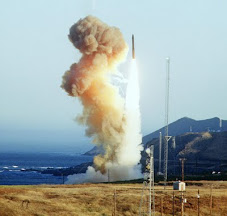
Text Fwd: Prompt Global Strike: Pentagon Plans Series Of 5-10 Year Wars

* Text informed by StopNATO and Bruce Gagnon on June 6, 2009

Prompt Global Strike: Pentagon Plans Series Of 5-10 Year Wars

http://www.defensenews.com/story.php?i=4123641&c=AME&s=LAN
Defense News, June 4, 2009

Cartwright: U.S. Force-Sizing, Basing Strategy Need Overhaul
By JOHN T. BENNETT

-The Marine Corps general said he has concluded conventionally armed bombers are "too slow and too intrusive" for many "global strike missions."
Cartwright for several years has advocated for a "prompt global strike" weapon, which would be ultra-fast and fitted with a conventional warhead.
Congress, due largely to worries that other nations, like Russia, would be unable to quickly determine whether an in-flight warhead was nuclear, has refused to fund the program.
-The military might need a "hypersonic" weapon that would travel in the exoatmosphere to take out a limited number of fleeting targets....


Over the next few years, the U.S. military is likely to become engaged in a number of hot and cold conflicts, each spanning five to 10 years, meaning the Pentagon must "adjust" its decades-old force sizing and basing constructs, says Gen. James Cartwright, vice chairman of the Joint Chiefs.

But the world has changed in major ways, meaning the two conventional war-based approach is no longer a good fit, according to defense officials. Those changes are the reason senior Pentagon officials are examining whether the 2010 Quadrennial Defense Review (QDR) should include a new force-planning construct, as well as a new plan for how American bases, troops and combat equipment are located around the globe.

"It is clear we are going to have conflicts whose character will not be the same" as the ones on which the Pentagon has for decades based its force planning and global basing postures, Cartwright said. "It's clear [U.S. forces] will be engaged in operations that [each] last five or 10 years - and that is fundamentally different that in the past."

Such conflicts are the "most likely" ones the U.S. military will fight in coming years, he said during an appearance at a Center for Strategic and International Studies forum. Senior Pentagon officials are mulling whether these conflicts - not conventional ones against peer militaries - should garner the majority of the military's planning focus.

Plus, he said, officials have concluded that "the level of lethality" potential U.S. foes bring to the fight is no longer tilted so excessively toward conventional threats.

For those reasons, Cartwright said, "it is my opinion … that we have to adjust the balance" between focusing resources and effort on the "most likely" and "most deadly" threats as part of the QDR process.

The QDR will examine what future threats the U.S. military will have to combat, "and how we must be postured to do those things."

Altering the force-sizing construct will affect which weapons the services buy and how the U.S. military is positioned around the world.

Cartwright said QDR study participants must look at the benefits and drawbacks of how American forces and gear are based, including: permanent, prepositioned and rotational basing.

Acquisition "Crossroads"

The vice chairman also said the U.S. military must shift from developing new and expensive weapons aimed at taking out a specific threat to focusing on how platforms fit into "the IT world."

On defense acquisition, "we're at a crossroads" that incorporates all of American society. The nation is fundamentally "an industrial society," but must adjust to a global change that "the competitive advantage is on the IT side."

The same is true for DoD, he said.

"When [the services] build a plane, you build it for a threat," Cartwright said. "You can only update it every four or five years....So the utility of that plane is limited in an IT world."

The model for where the military must go in terms of new weapon systems lies in how it has come to use unmanned aircraft.

Like with UAVs in Iraq and Afghanistan, the most important feature of future U.S. weapon systems will be their "ability to gather information to help solve problems," the vice chairman said. He also touted the ability of UAVs to take on multiple missions, depending on a commander's needs like ISR gathering today and targeting tomorrow.

Prompt Global Strike

Additionally, Cartwright said he continues to press for development of a new weapon that would allow Washington to take out a fleeting target in a manner of minutes.

The Marine Corps general said he has concluded conventionally armed bombers are "too slow and too intrusive" for many "global strike missions."

Cartwright for several years has advocated for a "prompt global strike" weapon, which would be ultra-fast and fitted with a conventional warhead.

Congress, due largely to worries that other nations, like Russia, would be unable to quickly determine whether an in-flight warhead was nuclear, has refused to fund the program.

Cartwright said even congressional skeptics of the idea realize there is a "military requirement" for such a fast weapon to take out fleeting targets.

The requirements for such a weapon are "starting to emerge," he said.

"At the low end," a PGS weapon would probably need to be launched and hit a target within "one hour," Cartwright said. "At the high end," the time frame could be as short as "300 milliseconds."

The military might need a "hypersonic" weapon that would travel in the exoatmosphere to take out a limited number of fleeting targets, he said.

Finally, Cartwright told the audience the Pentagon is examining a new concept, called "extended deterrence," something "we're trying to force into the QDR."

The idea would be to field a weapon so effective that it would dissuade enemies from carrying out a specific activity, while also "not starting a nuclear arms race" and "giving allies comfort."

The options for an "extended deterrence" capability, he said, are not limited to nuclear-armed weapons.
===========================
Stop NATO

Friday, March 20, 2009

Text Fwd: North Korea rejects U.S. food assistance


* Image source/ caption*
Same as the original article below

‘In this photo released by the World Food Program, sacks of U.S. wheat are discharged from the MV Baltimore in the port of Nampo, North Korea, on Sunday, June 29, 2008. (AP Photo)’

http://english.hani.co.kr/arti/english_edition/e_northkorea/345002.html
North Korea rejects U.S. food assistance: Refusal of aid could be another way for North to object to South Korea-U.S. military drills or respond to criticism about its satellite launch

North Korea has notified the United States that it does not want to receive any additional U.S. food assistance. The United States has been sending shipments of food to the North since last year, but disagreements over distribution and monitoring have cause interruptions and delays in aid delivery.

In a regular briefing on March 17 (EST), U.S. State Department spokesman Robert Wood said, “North Korea has informed the United States that it does not wish to receive additional U.S. food assistance at this time,” adding that “This was a program intended to try to help get food to needy North Koreans, and we’re obviously disappointed in that.”

Wood said North Korea had sent notice to the United States “over the past couple of days,” but added that he did not know which channel North Korea had used to deliver the message or why the North was refusing to receive additional food aid from the United States.

The North usually uses the state-run Korean Central News Agency whenever it wants to deliver a strong message, so the fact that the North has used other channels to deliver the message makes this an unofficial notification.

North Korea’s rejection of U.S. food assistance is somewhat unexpected. It does not seem likely that the North would be using the move to pressure the United States, given that it is something that would be used as a bargaining chip for aid providers, not aid recipients.

North Korea has suffered chronic food shortages in the past, so the North’s refusal of aid from the United States has raised questions that neither country has yet been able to answer.

The North may have decided to reject food assistance because of the continued friction between the two sides over how the distribution of food shipments should be monitored. Diplomatic sources in Washington say that the United States has been wanting North Korea to issue entry visas for nine aid workers, in addition to the current three, citing the agreement it has with the North in which there is no limit on the number of aid workers allowed, and that out of the 59 World Food Program aid workers in North Korea, it needs 12 who can speak Korean. The North has rejected the request.

There has also been friction over the pace of food assistance, which may have been another reason for the North’s rejection of aid. The United States agreed to send 500,000 tons of food to North Korea last May, but has only shipped 169,000 tons up to this point. This has raised the possibility that North Korea, seeing the slow pace in aid shipments from the United States, may even have accused the United States of trying to spy on it under the guise of monitoring food distribution.

It is also possible that North Korea made a political decision amid the heightened tensions on the Korean Peninsula, which have flared over the North’s objections to Key Resolve, the joint military drill being conducted March 9-20 by South Korean and U.S. forces, and the North’s plan to launch what it says is a satellite sometime between April 4 and 8.

In a public debate on North Korea held Wednesday, South Korean Unification Minister Hyun In-taek said he viewed North Korea’s rejection of U.S. food aid as a response to Key Resolve and growing criticism from the international community, as well as from South Korea, the United States and Japan, about the North’s announcement that it plans to go ahead with the satellite launch.

Some say the North’s rejection of food assistance could be viewed as a sign that it will take a harder line as relations with the United States and South Korea. Professor Yang Moo-jin of the University of North Korean Studies said the North may be trying to show that it is not going to kowtow to South Korea and the United States because of its food shortage.

However, it remains uncertain whether North Korea can continue to reject U.S. assistance in the future because Pyongyang is so reliant upon outside assistance.

Please direct questions or comments to [englishhani@hani.co.kr]


* Related article*
http://english.hani.co.kr/arti/english_edition/e_northkorea/345203.html N. Korea detains two female American journalists The women, one of whom is Korean-American, were filming video near the Chinese-North Korean border along the Tumen River Posted on : Mar.20,2009 09:44 KST
© 2006 The Hankyoreh Media Company

Wednesday, March 18, 2009

Text Fwd: [Information and psychology War?]Leaflet launch 2


* Image Source/ caption*
'Leaflet launch 2' Photo by Kim Jin-su/The Hankyoreh
Same as the original article below

http://english.hani.co.kr/arti/english_edition/e_entertainment/344761.html
Leaflet launch 2 Posted on : Mar.18,2009 11:43 KST

Anti-North Korea organizations, including Fighters for Free North Korea, prepare to send northward balloons carrying anti-Kim Jong-il leaflets and North Korean money at Imjingak near the demilitarized zone in Paju, Gyeonggi Province, on March 17.

The groups first tried to send the balloons in February, but failed to send them all due to the direction of wind.
© 2006 The Hankyoreh Media Company.

* Related article*

http://english.hani.co.kr/arti/english_edition/e_northkorea/344759.html
[Analysis] Will the North close the border again?
North’s future course of action will depend on how it evaluates the effects reaped thus far compared with its initial goals
Posted on : Mar.18,2009 11:17 KST
© 2006 The Hankyoreh Media Company.

Tuesday, March 17, 2009

Fwd fromCordaro: A book review of U.S. space policy history & Bulletin of the Atomic Scientist article "The proliferation of space warfare technology


* Image Source*
http://www.secureworldfoundation.org/index.php?id=55&pid=2&page=Book_reviews


Text fwd from Frank Cordaro


Tue, Mar 17, 2009 at 7:53 PM [ Reply to Cordaro A book review of U.S. space policy history & Bulletin of the Atomic Scientist article "The proliferation of space warfare technology."

March 2, 2009 Michigan War Studies Review Review by Bill Astore of the book "Harnessing the Heavens: National Defense through Space" by
http://www.michiganwarstudiesreview.com/2009/20090302.asp

"Ably edited by Paul Gillespie and Grant Weller, this volume consists
of fourteen papers presented at the twenty-first Military History
Symposium at the U.S. Air Force Academy (USAFA) in Colorado Springs in
2006.[1] The theme of this symposium was "national defense through
space," and the volume itself is dedicated "To those who defend
America through space." It has a strong military flavor and is all the
more valuable for it, because it reveals aggressively one-sided
American attitudes toward the militarization and weaponization of
space..."

* "The Bulletin of the Atomic Scientists recently published ]'s article
titled "The proliferation of space warfare technology." The article
can be found at the following link:
http://thebulletin.org/web-edition/features/the-proliferation-of-space-warfare-technology"

--~--~---------~--~----~------------~-------~--~----~
subscription to the Google Groups "STRATCom / Offutt AFB List" group: frank.cordaro@gmail.com
To post to this group, send email to Offitt-list-one@googlegroups.com
For more options, visit this group at
http://groups.google.com/group/Offitt-list-one?hl=en