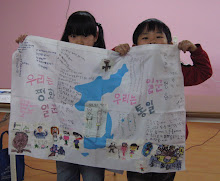
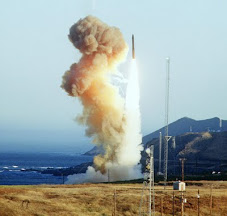
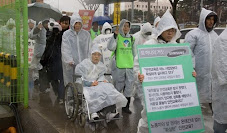
'저는 그들의 땅을 지키기 위하여 싸웠던 인디안들의 이야기를 기억합니다. 백인들이 그들의 신성한 숲에 도로를 만들기 위하여 나무들을 잘랐습니다. 매일밤 인디안들이 나가서 백인들이 만든 그 길을 해체하면 그 다음 날 백인들이 와서 도로를 다시 짓곤 했습니다. 한동안 그 것이 반복되었습니다. 그러던 어느날, 숲에서 가장 큰 나무가 백인들이 일할 동안 그들 머리 위로 떨어져 말과 마차들을 파괴하고 그들 중 몇몇을 죽였습니다. 그러자 백인들은 떠났고 결코 다시 오지 않았습니다….' (브루스 개그논)


For any updates on the struggle against the Jeju naval base, please go to savejejunow.org and facebook no naval base on Jeju. The facebook provides latest updates.
Showing posts with label Iran. Show all posts

Saturday, March 12, 2011

Text Fwd: U.S. announces six-party talks precondition


'affairs with the South Korean Ministry of Foreign Affairs and Trade, right, greets Robert Einhorn, U.S. State Department special advisor for nonproliferation and arms control, at the Central Government Complex in Seoul, Mar. 2. (Photo by Kim Tae-hyeong) '

Hankyoreh
U.S. announces six-party talks precondition
The U.S. says the U.N. and other countries must recognize N.Korea’s UEP is a violation of Security Council resolutions
Posted on : Mar.11,2011 14:42 KST
By Kwon Tae-ho, Washington Correspondent 
  
The U.S. announced Wednesday that it would be unable to proceed with a resumption of the six-party talks without addressing North Korea’s uranium enrichment program (UEP).

Robert Einhorn, U.S. State Department coordinator for Iran and North Korea sanctions, met with journalists Wednesday (local time) after attending a U.S. Arms Control Association-sponsored seminar in Washington on sanctions against Iran.

“In order for the talks to resume, the United Nations and international community would have to clearly indicate that the uranium enrichment in Yongbyon and outside of Yongbyon are violations of existing Security Council resolutions and of the September 2005 six-party joint statement,” Einhorn said.

He added, “The North Korean program cannot and should not be legitimized, and clearly establishing the illegality of the UEP is the only sound basis for resuming six-party talks.”

Einhorn also said Washington was awaiting the results of discussions on the UEP issue that are currently under way with the United Nations Security Council.

During a visit to South Korea on Mar. 2, Einhorn said that Seoul and Washington were pursuing a UNSC president’s statement in response to North Korea’s uranium enrichment.

However, when asked whether resolution of the UEP issue was a prerequisite for resuming the six-party talks, Einhorn declined to give a concrete answer, saying that he did not want to talk about the conditions. At the same time, he reiterated, “If the six-party talks are to be promising and successful, it is important to recognize that this enrichment program is a violation of North Korea’s commitment.”

This indicated a determination by the Barack Obama administration that even if the UEP issue is not completely resolved prior to the six-party talks, it should at least be clearly stipulated as a “violation.” The Obama administration has been carefully pushing for dialogue with Pyongyang through the medium of humanitarian aid to the country, which has reportedly been in the throes of a serious food crisis.

Please direct questions or comments to [englishhani@hani.co.kr]

Tuesday, February 8, 2011

Text Fwd: Is 1848 Repeating Itself in the Arab World?


* Image source: same as the link

Global Research
Revolution: Is 1848 Repeating Itself in the Arab World?
PART I: The Dynamics of Global Capitalism
by Mahdi Darius Nazemroaya
February 5, 2011

Is history repeating itself? Have the events of 1848 in Europe repeated themselves in the Arab World? Will 2011 see the same outcomes as 1848? Only the Arab people can decide. Their fate is in their hands, but they should learn from the mistakes of 1848 and seriously address the role of the capitalist class.

PART I

The European Spring of 1848 and the Arab Spring of 2011

In 1848, revolutionary fervour broke across continental Europe. The waves of revolution were set in motion in France. It did not take long before the rest of Europe was hit with a tsunami of popular uprisings and revolts. Like a domino effect, country after country would be hit by revolt. Denmark, the German States, the Italian States, Belgium, Wallachia, and the Habsburg's Austrian Empire would all be shaken by popular revolt. The bases of the European revolts were the same as those in the modern-day Arab World.

Economic disparity, abuse of workers rights, and a lack of political equality were all causes for the wave of revolutions in 1848 Europe. Industrialization and economic and technological leaps were causing major socio-economic changes in European societies before and up to 1848. While in a very different historical context, this has also been occurring in today's Arab World.

In 19th Century Europe, fundamental economic changes, characterized by the consolidation of wealth, caused massive unemployment as well as the outbreak of famines.

This has also occurred in recent years in the Arab World, largely as a result of the brunt of neo-liberal reforms and rising food prices. Anger over lack of employment, lack of opportunities, corrupt government practices, and rising bread and food prices have actually been igniting riots and protests in the Arab World, specifically those states around the Mediterranean Sea, for several years before 2011. These past riots and protests were preludes to the highly tense situations in Egypt, Tunisia, and the Arab World.


The French Revolution of 1848: Europe's Tunisia or Iran?

1848 France was ruled by the landed property class, big industry, and the banking class. It was the working class that brought about the rise of this triad (landed property, big industry, and the banking class) through the French Revolution of 1789. In turn, this triad or "big capital" would systematically disenfranchize the working class by eliminating universal suffrage.

A new residency criterion was imposed in France by King Louis-Philip I who served the interests of big capital and was appropriately called the "Bourgeoisie King." French citizens had to prove that they lived in a riding for three years. To prove residency, the French working class needed letters of authentication from their employers. Thus, the working class and an overwhelming majority of the French were disenfranchized from voting and held hostage by big capital. French workers would also migrate from one place and riding to another place and riding for employment, because of the changing economic conditions, which would also make qualification for voting impossible. Unemployment would grip France and there would be a massive surplus of labour that would be readily exploited by organized capital. These unbearable conditions would led to the French Revolution of 1848.

In the French Revolution of 1789, the working class allied itself with big capital (big industry, the banking class, and landed property), but this would change in 1848. While big capital was fighting amongst itself, the working class was becoming an ally of the petty bourgeoisie in demanding a share in governing France and directing the course of French society. The House of Orléans was overthrown and the monarchy brought to a final end with the establishment of the Second French Republic.

Yet, the working class did not secure their rights after 1848. They held briefly the seat of power. The new taxation system failed and the capitalist class retained its control, thereby neutralizing efforts for genuine socio-economic reform in France. This led up to the 1851 Paris coup that was to make Charles Louis-Napoléon Bonaparte the emperor of the Second French Empire. The other outcome, after the defeat of Emperor Bonaparte in the Franco-Prussian War, was the 1871 establishment of the short-lived French government known by historians as the "Paris Commune." [1] Under the Paris Commune and its mixed socialist and anarchist government, France became history's first socialist republic, more than seventy years before the establishment of the Soviet Union. Under the Prussian occupation of France, the Paris Commune was ultimately crushed by an agreement and strategic understanding reached between the Germans and French organized capital.

What lessons can be learned from 1848?

The French Revolution of 1848 illustrates how capital can manipulate the desires of the working class and mainstream society. It also illustrates that the capitalist class was predominately in control of the state, despite the changes in political leadership. Finally, the outcome of 1848 in France illustrates that policies are deliberately fluctuated by organized capital as a means to lull mainstream society. In this context, history could repeat itself in the Arab World.


READ MORE

Thursday, January 13, 2011

Text Fwd: Israel calls for attack on Iran

* Image & caption source: same as the link
Israeli Prime Minister Benjamin Netanyahu


* Informed at the CGL News

Press TV
Israel calls for attack on Iran
Wed Jan 12, 2011 3:25AM

Israeli Prime Minister Benjamin Netanyahu has called for “a credible military option against Iran” to force Tehran to end its nuclear energy program.


On Tuesday, Netanyahu said that military action should be taken by the international community and headed by the United States.

"You have to ratchet up the pressure and… I don't think that this pressure will be sufficient to have this regime change course without a credible military option that is put before them by the international community led by the United States," he stated.

He went on to say that sanctions are not enough to stop Iran's nuclear energy program, and they should be backed by some military action.

He has made similar bellicose remarks in the past, but they were always rejected by US Defense Secretary Robert Gates.

Netanyahu made the comments a week after Tehran announced Iran's nuclear sites were being opened to envoys representing "geographical and political groups" in the Vienna-based International Atomic Energy Agency (IAEA).

The invitation came ahead of the multifaceted talks between Iran and the P5+1 group — Britain, China, France, Russia, the United States, and Germany — that are scheduled to be held in Turkey from January 21 to 22.

Iran and the P5+1 group wrapped up two days of comprehensive talks in Geneva on December 7, during which the two sides agreed to hold the next round of negotiations in Turkey.

Supreme National Security Council Secretary Saeed Jalili represented Iran at the talks and EU foreign policy chief Catherine Ashton represented the P5+1 group.

The UN Security Council imposed a fourth round of sanctions on Iran last year.

But Tehran says sanctions have failed to hamper its efforts to master peaceful nuclear technology.

And the IAEA continues to conduct regular inspections and camera surveillance of Iran's nuclear facilities.

Iranian officials say the talks provide an opportunity to display Iran's policy of nuclear transparency to the international community.

Monday, December 13, 2010

Text Fwd:[Mahdi Darius Nazemroaya] The March to War: Was September 11 2001 the Start of World War III?

Global Research
The March to War: Was September 11 2001 the Start of World War III?
by Mahdi Darius Nazemroaya

The tragic attacks of September 11, 2001 have resulted in almost ten years of perpetual war. September 11, 2001 was the first drum beats, or the opening salvos, of a much wider conflict. The deployment of U.S. and NATO troops in Afghanistan has secured a bridgehead into the Eurasian Heartland, which is geographically positioned on or near the borders of Iran, China, India, Pakistan, Russia, and the former Soviet republics of Central Asia. Was Afghanistan the starting battle of a global war? The invasion of Afghanistan can be compared to the landing of the Western Allies, specifically the Americans, in North Africa as a bridgehead into Italy and Europe. At the same time NATO has been pushing from Europe towards the Eurasian Heartland, like the landing of the invading forces of the Western Allies in France.

Was September 11th, 2001 the start of the Third World War?

Historically speaking, it should be noted that distinctions between times of war and peace are not always clear-cut and conflicts do not always correspond to the dates set and standardized by historians. War was not even declared in the cases of many past conflicts, such as in the early 1700s when Augustus II of Saxony-Poland invaded Livonia or when Frederick IV of Denmark invaded Holstein-Gottorp. Also, in the cases of many conflicts, attempts were always made to cloak or hide the nature of the conflict as being a war or an act of aggression. The Romans and other imperial powers regularly engaged in this type of conduct.

Examples in history are the abstract chronological dates customarily used by historians to note important points in the Second World War and the start of the Cold War. In Western Europe and North America, the starting date for World War II is considered to be September 1, 1939, when Germany invaded Poland. For the former Czechoslovakia, March 16, 1939 (the date Germany invaded Czechoslovakia) was the starting date for the Second World War. In Russia and the former U.S.S.R. the start date of the Second World War is 1941, the date the Germans invaded the Soviet Union. Even the end date for World War II in Europe is different, because Germany officially surrendered to the Western Allies (namely the U.S., Britain, and France) on May 8, 1945 and to the Soviet Union on May 9, 1945.

The above dates are all set from an ethnocentric European perspective, which leaves out Asia. The history of World War II starts much earlier in Asia. Many consider the start of the Second World War to have been when Japan invaded China in the Second Sino-Japanese War in 1937, two years before 1939. Even before 1937, since 1931 the Chinese and Japanese were in conflict and 1931 too can be seen as the start of World War II.

The various dates and events for the start of the Cold War also vary, because of the identification of various events as the Cold War’s opening salvo(s). The 1945 American-Soviet tensions over the occupation of the Korean Peninsula, the Azerbaijan Crisis (1947-1948) arising from the Soviet occupation of Iranian provinces, the near wins for the Communists in national elections held in France and Italy (1947-1948), the struggle for power between the Communists and the non-Communists in Czechoslovakia (1947-1948), and the West Berlin Blockade (1948-1949) are also viewed as starting dates for the Cold War. Even events taking place during the Second World War, such as the Yalta Conference, the Tehran Conference, and the dropping of the atom bomb on the Japanese in Hiroshima and Nagasaki by President Harry Truman as a threat to the Soviets (about U.S. supremacy in the post-war order) are considered as the starting dates of the Cold War.

This question about dates also gives rise to another point in historiography. The nature of history is seamless and not the arbitrary one unintentionally made out by historians and history textbooks. One set of events leads to another. Just as how the First World War led to the Second World War and the Second World War led to the Cold War, the Cold War has led to the “Global War on Terrorism.”

READ MORE

Sunday, December 12, 2010

Text Fwd: Could Domestic Politics Tie Obama's Hands on Iran Diplomacy? 미 국내 정치가 이란 외교에 대한 오바마의 손을 묶을 수 있는가?

* Image & caption: same as the link

Iran's chief negotiator Saeed Jalili attends a press conference in Geneva, where Iran and six world powers ended talks on Dec. 7, 2010, with an agreement to meet again early in 2011
Anja Niedringhaus / AP


* Text informed at Just Foreign Policy and M.S. on Nov. 11, 2010

TIME
Could Domestic Politics Tie Obama's Hands on Iran Diplomacy?,
Tony Karon, Time Magazine, Friday, Dec. 10, 2010

It has long been clear that Iran's domestic political power struggle impedes prospects for any diplomatic breakthrough on the nuclear standoff — just a year ago, a confidence-building fuel swap agreed between Western and Iranian negotiators in Vienna was shot down in Tehran by conservative and reformist rivals to President Mahmoud Ahmadinejad. But U.S. domestic politics too may be coming into play to restrain President Barack Obama from embracing a deal reportedly being discussed with the Iranians by European negotiators.

On Monday, as Iran's nuclear negotiator Saeed Jalili met in Geneva with E.U. foreign policy chief Catherine Ashton, a group of prominent U.S. Senators — including John Kyl, Joe Lieberman, Kirsten Gillebrand and John McCain — wrote to President Obama urging him to reject any proposal under which Iran would maintain a uranium-enrichment capability. "It is critical that the United States and our partners make clear that, given the government of Iran's patterns of deception and noncooperation, its government cannot be permitted to maintain any enrichment or reprocessing activities on its territory for the foreseeable future," the Senators wrote. "We would strongly oppose any proposal for diplomat [sic] endgame in which Iran is permitted to continue these activities in any form." (View images of Iran's official media coverage.)

The Senators' letter followed a statement made by Secretary of State Hillary Clinton the previous week that seemed to indicate a change in the U.S. negotiating position. She suggested that a diplomatic solution would include Iran exercising its right to enrich uranium for peaceful purposes, once it had "restored the confidence of the international community" that its program had no military objective. "They can enrich uranium at some future date once they have demonstrated that they can do so in a responsible manner in accordance with international obligations," she told a BBC interviewer.

Although the Bush Administration had taken the same zero-enrichment position demanded in the Senators' letter, until now the Obama team has been vague on whether it would accept Iran keeping a uranium-enrichment capability in a certifiably peaceful nuclear program. But Clinton's comments seemed to correspond with proposals reportedly put to the Iranians by Ashton. Media reports suggested European diplomats were offering a deal in which Iran could continue to enrich uranium if it satisfied transparency concerns raised by the U.N.'s nuclear watchdog, the IAEA, and agreed to a tighter and more intrusive inspection regime than the one currently in effect. Although Iran is not accused of currently building nuclear weapons, it is required by U.N. Security Council resolutions to suspend enrichment until it has satisfied the IAEA's concerns. But according the Nuclear Non-Proliferation Treaty (NPT), to which it is a signatory, once the IAEA has resolved the disclosure issues that had raised questions about its intentions, Iran has the right to enrich uranium for energy purposes under international scrutiny. (Watch TIME's 2009 interview with President Mahmoud Ahmadinejad.)

READ MORE

Text Fwd: Pentagon Talks Advance U.S.-China Military Ties 미 국방부 대화, 미-중의 군사 유대를 진일보

* Image & caption: same as the link
Under Secretary of Defense for Policy Michele Flournoy holds a press briefing at the Pentagon, Dec. 10, 2010, at the conclusion of a full day of bilateral defense consultative talks with defense officials of the People's Republic of China. The U.S. is seeking a more transparent defense relationship with China and Flournoy indicated that the talks were candid and open. DOD photo by R. D. Ward

* Text informed from Corazon Valdez Fabros through no AP bases on Dec. 11, 2010

U.S. Dept of Defense
Pentagon Talks Advance U.S.-China Military Ties
By Jim Garamone
American Forces Press Service

WASHINGTON, Dec. 10, 2010 – The Pentagon’s policy chief believes the Defense Consultative Talks between the U.S. and China here today moved the ball forward in fostering Chinese candor and transparency.

Michele Flournoy, the undersecretary of defense for policy, said her talks with General Ma Xiaotian in the Pentagon really re-started the U.S.-China military-to-military relationship. Ma is the deputy chief of the Peoples’ Liberation Army’s General Staff. It was the 11th round of the U.S.-China Defense Consultative Talks.

“We discussed the relationship itself, an integral part of our positive, cooperative and comprehensive bilateral relationship with China,” the undersecretary said. “We also discussed how to develop a more durable framework to shift the military–to-military relationship to a more sustained and reliable and continuous footing.”

The two sides discussed maritime safety and regional issues including security concerns about Africa, North Korea, Afghanistan-Pakistan and Iran. Flournoy thanked the Chinese for their efforts in the United Nations on the Security Council sanctions against Iran and its nuclear ambitions.

Ma and Flournoy exchanged views on the U.S. nuclear posture review and ballistic missile defense report. They discussed the importance of China continuing to make progress in improving its openness and transparency in defense matters, Flournoy said.

The talks pave the way for Defense Secretary Robert M. Gates’ visit to China in January.

“These were positive discussions,” she said. “While I won’t say we agreed on every issue, where we did differ we had a very candid, frank and productive exchange. These talks form the basis for a more productive relationship between our two countries and our two militaries over time.”

Tuesday, December 7, 2010

Text Fwd: U.S. And NATO Allies Escalate Military Buildup Against Iran 미국과 나토 동맹국들, 이란에 대항해 군사 증강 증대

* Text sent from Rock Rozoff on Dec. 6, 2010

Stop NATO

Rick Rozoff blog
U.S. And NATO Allies Escalate Military Buildup Against Iran
Rick Rozoff
December 6, 2010

The new Strategic Concept adopted by the North Atlantic Treaty Organization at its summit in Lisbon, Portugal on November 19-20 reiterated the U.S.-led military bloc's determination to expand military partnerships and deployments throughout the so-called Greater Middle East, including in the Persian Gulf. [1]

The Alliance's doctrine for the next decade contains the assertion that "we attach great importance to peace and stability in the Gulf region, and we intend to strengthen our cooperation in the Istanbul Cooperation Initiative,” [2] the reference being to the decision reached at the bloc's 2004 summit in Turkey to upgrade partnerships with the seven members of NATO's Mediterranean Dialogue program - Algeria, Egypt, Israel, Jordan, Mauritania, Morocco and Tunisia - and the six members of the Gulf Cooperation Council - Bahrain, Kuwait, Oman, Qatar, Saudi Arabia and the United Arab Emirates - to the status of the Partnership for Peace program used to graduate 12 Eastern European nations to full NATO membership over the last 11 years.

Bahrain, Kuwait, Qatar and the United Arab Emirates have formally responded to the initiative by forging bilateral relations with NATO, and Oman and Saudi Arabia have cooperated with the military alliance in ad hoc endeavors ranging from conferences to hosting visits of NATO naval groups. [3]

The United Arab Emirates (UAE) is also one of NATO's 48 Troop Contributing Nations for the war in Afghanistan and provides air bases to NATO member states for the war in that country. Until recently Canadian aircraft and troops operated out of Camp Mirage in Dubai, reportedly at the Al Minhad Air Base, where Dutch, Australian and New Zealand military forces have also been based for the Afghan war and operations in the Arabian Sea.

Britain also employs the Al Minhad Air Base as a "final hopping point" for transport planes to "carry troops and supplies to Afghanistan." In addition, the base supplies logistical support to British warships in the Persian Gulf. In the words of a British military official, "It's the right distance from the UK and the right distance from Afghanistan, in a safe country." [4]

As is evident by the location of the 13 nations targeted by the Istanbul Cooperation Initiative, from Mauritania on the west coast of Africa to the monarchies and sheikdoms of the Persian Gulf, NATO is complementing and reinforcing U.S. military objectives and deployments from the Atlantic Ocean to the Indian Ocean. There is a NATO overlay to the Pentagon's Africa Command and Central Command, converging in Egypt, the only African nation still in the second command which reaches to the Chinese and Russian borders in Kazakhstan to the east.

The USS Abraham Lincoln and USS Harry S. Truman nuclear-powered supercarrier strike groups are currently in the Arabian Sea along with the only non-American nuclear aircraft carrier in the world, France's Charles de Gaulle [5], conducting operations from the Horn of Africa to Afghanistan.

Over 150,000 troops under U.S. and NATO command are waging war in Afghanistan, including in the provinces of Herat, Farah and Nimroz on Iran's eastern border.

In 2004 NATO airlifted Afghan government troops loyal to President Hamid Karzai to Herat province to depose the province's governor, Ismail Khan, whose son was killed in the process, and seize the Shindand Air Base, 20 miles from the Iranian border.

Earlier this year the Pentagon announced plans to spend $131 million to upgrade the air base. As a press report last May put it, the expansion and modernization of the base is occurring "as the U.S. works to strengthen the militaries and missile defenses of allies in the region and presses at the United Nations for a new round of sanctions aimed at forcing Iran to curb its nuclear program." [6]

READ MORE

Saturday, November 20, 2010

Text Fwd: NATO Meeting to Expand Missile Offense Systems 나토 회담, 미사일 공격 시스템 확장할 것임

* Text sent from Bruce Gagnon on Nov. 19, 2010

NTI
NATO Won't Cite Iran in Missile Defense Plan
Thursday, Nov. 18, 2010

NATO this week does not intend to explicitly make the connection between its proposed missile shield and fears of an Iranian missile strike, alliance head Anders Fogh Rasmussen told the Financial Times (see GSN, Nov. 16).

The move is intended to win the support of Turkey, which could host part of the system and which has voiced strong reservations against singling out its neighbor.

"We do not want to single out particular countries," Rasmussen said. "More than 30 countries already have -- or are aspiring to acquire -- missile technologies with a range that can hit NATO territory. So there is no need to single out or name specific countries, because this is an evolving threat."

Leaders from the 28 NATO nations are meeting tomorrow and Saturday in Lisbon, Portugal, to consider a new mission statement that would address strategies for dealing with modern-day security challenges. The heads of state are anticipated to determine whether to officially include missile defense among NATO objectives, paving the way for an initiative to integrate and augment the protective systems of member states.

An Obama administration plan to gradually field land- and sea-based missile interceptors around Europe would be incorporated into NATO missile defense plans. A draft of the organization's new mission statement reportedly calls for shield infrastructure to be deployed in Romania, Poland and Turkey.

Even if Tehran is not specifically identified as a missile threat, Ankara might still oppose allowing a radar base to be located on its soil while giving its backing to missile defense as a core NATO objective, alliance diplomats said. That could require further talks down the line (James Blitz, Financial Times, Nov. 17).

Ankara wants the missile shield's command-and-control architecture to be established on Turkish soil, Politico reported today.

Turkish Prime Minister Recep Tayyip Erdogan said this week if command-and-control was not located in Turkey then it would be impossible for his government to agree to host the radar base.

Obama administration officials, however, do not want wish to see foreign nations hosting the command infrastructure. They anticipate instead it would be situated at U.S. military installations in Germany.

READ MORE

Global Network Against Weapons & Nuclear Power in Space
PO Box 652
Brunswick, ME 04011
(207) 443-9502
globalnet@mindspring.com
www.space4peace.org
http://space4peace.blogspot.com/ (blog)

Sunday, November 14, 2010

Video Fwd: [Hani TV] Beneath the Surface: the investigation into the sinking of the Cheonan 天安艦事件調査の矛盾を暴く ハンギョレ系TV [심층리포트] 천안함 사건 5대 미스터리


* Representing image courtesy: Hani TV 대표 이미지는 한겨레 하니 TV 에서 온 것입니다.

___________________________________________________

Attention

* The below English/ Korean scrip was thankfully provided by Mr. Kim Do-Sung, the PD of the below movie, Hankyoreh, on Nov. 15, 2010. Please respect the courtesy of Hani-TV when you need to use it.


* 아래 영/한 다큐멘터리 원고는 한겨레 하니 TV 김도성 PD 님에 의해 2010년 11월 15일 감사히 제공되었읍니다. 필요해 쓰실 경우 하니 TV 출처를 분명히 해주시면 고맙겠읍니다.


Hani_TV_Cheonan_nar_eng_final.docx

36K View Download


* Thanks to M. S. who translated it in Japanese and manages the Anatakara site in Japan, We have a Japanese translated script with images. HERE(click)!
Thanks to Peace Philosophy Center, you can also see the Japanese script HERE(click)!

* 일본에서 아나타카라 사이트를 담당하는 M. S. 가 이미지와 함께 일본어로 스크립트를 번역했읍니다(클릭)!
평화 철학 센터 덕분에, 여기서 일본 번역본을 또한 보실 수 있읍니다(클릭)!

__________________________________________________

* See also a press interview statement(translated) by the Joint Action for the Truth Examination of the Cheonan ship Incident and Peace in the Korean Peninsula on Nov.11, during the G20 summit meetings. The title is, 'Obama, President of the United States should open all the materials related to the Cheonan Ship incident and should not deny people’s demand of truth examination on that any more!!(click)'
* 한편, G20 기간 정상 회담이 있었던 11월 11일, 발표된 천안함 사건 진실규명과 한반도 평화를 위한 공동행동기자 회견문이 영문 번역되었읍니다. 제목은 '오바마 미국 대통령은 천안함 사건과 관련된 모든 자료를 공개하고, 진실규명 요구를 더 이상 거부하지 말라!!' 입니다.(클릭)
__________________________________________________

* 아래 비디오의 국문 버젼 (2010년 9 월 14일 올려짐)은 여기에서 볼 수 있읍니다.(클릭)

* The original Korean version of the below video can be seen HERE ( posted on Sept. 14, 2010)

* 천안함에 관한 모든 한겨레 비디오는 여기에서 볼 수 있읍니다.(클릭)

* You can see all the Korean language video on Cheonan ship, made by the Hankyoreh, HERE.
__________________________________________________


The video was thankfully shared with many overseas sites: Peace Philosophy Center, Anatakara, DMZ Hawai’i, Reality Zone and Organizing Notes. Apologize if I missed some sites.

이 비디오는 많은 해외 사이트들에 의해 감사히 공유되었읍니다: 평화 철학 센터 (재 캐나다 영어/일어 사이트), 아나타카라 (일본 영어/ 일어 사이트), DMZ 하와이 (하와이), 리얼리티 조운(미국), 그리고 브루스 개그논의 조직 노트 (미국)
. 혹 빠진 사이트가 있다면 사과드립니다.
__________________________________________________


Hankyoreh Notice, Nov. 13, 2010
[Hani TV]Beneath the Surface: the investigation into the sinking of the Cheonan
天安艦事件調査の矛盾を暴く ハンギョレ系TV
[심층리포트] 천안함 사건 5대 미스터리
(Video URL)

-The below video is an English language version.


hanitv | November 11, 2010

'A documentary about unknown story behind the mysterious sinking of the warship. On March 26, 2010, the South Korean Navy's patrol combat corvette Cheonan sank, and with it took the lives of 46 of the 104 sailors aboard. Journalists have worked to uncover the facts behind what happened, and this documentary is a gathering of our investigation findings to date. Our findings uncovered significant flaws in the Civilian-Military Joint Investigation Group's report, and suggest that the next necessary step is a reinvestigation.'
___________________________________________________________

For more info, See the Hankyoreh notice (Nov. 13), HERE

Excerpt

The film also frames the ship’s sinking in a political context, and contends that tensions between the South Korea-U.S. and North Korea-China alliances in addition to the June 2 local elections were both factors in the rush to release the JIG’s findings, after a short two-month investigation.

_________________________________________________
* See also

Tuesday, August 31, 2010
Video Fwd: [Al Zazeera] SHIP SINKING MYSTERY STILL NOT SOLVED IN KOREA 비디오: [알 자지라 방송] 아직도 풀리지 않은 한국 침몰함 미스테리


Letter to Call Upon the Truth Examination of the Cheonan Ship, Stop of the ROK-US War Exercise, And Conclusion of the Peace Agreement
(by theJoint Action for the Truth Examination of the Cheonan ship Incident and Peace in the Korean Peninsula
on July 25, 2010)
천안함 진실규명, 한미 군사훈련 중단, 평화협정 체결 촉구 서한
(천안함 사건 진실규명과 한반도 평화를 위한 공동행동 2010년 7월 25일
발표)

Monday, November 8, 2010

Text Fwd: [Translation] Koreans' response on the Lee Myung Bak government's plan to dispatch troops to the UAE [번역] 정부의 유나이티드 아랍 에미레이츠 파병 계획에 대한 한국 반응


* Image source: Pan Korean Alliance for Reunification (PKAR), South Korean branch, Aug. 31, 2010

'No sanction on Iran!' by 48 organizations, Seoul, South Korea, on Aug. 31, 2010
___________________________________________________________
* Related blogs/ articles 관련 블로그/ 기사

Stop NATO
Xinhua News Agency, Nov. 6, 2010
South Korean Special Forces In Persian Gulf Raise Questions

남한 특전부대 페르시아만 군대 파견, 의문을 일으킴

Friday, November 5, 2010
Text Fwd: [Hankyoreh Editorial] Opportunistic troop deployment
[한겨레 논평] 기회적인 유나이티드 아랍 에미레이츠 군대 파병안


Thursday, November 4, 2010
Text Fwd: Seoul to dispatch troops to UAE
서울, 유나이티드 아랍 에미레이츠에 군대 파견 계획


Sunday, September 12, 2010
[In update] Some collections on the Koreans’ protests against the sanction & war on Iran

이란에 대한 경제 제재와 전쟁에 반대하는 한국인들의 시위

___________________________________________________________

* The below is some summary translations from the various South Korean organizations' statements and commentaries upon the subject. Please be generous to any of my possible mistakes with which I might have missed some important points by the Korean activists.

In reference, ROK means Republic of Korea (South Korea), while UAE, United Arab Emirates.

..............................................................................................................................................

Referred:

1. Nov. 4 statement by the People's Solidarity for Participatory Democracy (PSPD)

참여 연대 논평 국문 원문은 여기를 클릭

2. Nov. 4 statement by the Anti-War Peace Solidarity* (composed of about 45 organizations)

반전 평화 연대 국문 원문은 여기를 클릭

3. Nov. 4 statement by the People's Solidarity for Social Progress (PSSP) and Nov. 6 commentary by Cheong Wooksik, Peace Network

사회 진보 연대 논평 원문(국문 클릭), 정욱식, 평화넷트워크 글 클릭

..............................................................................................................................................

1. One of them is by the People's Solidarity for Participatory Democracy (PSPD), which I made translation of only some parts and put in the blog on Nov. 5, 2010, as the below:

People's Solidarity Participatory Democracy (PSPD),
[PSPD commentary] The baseless plan to dispatch troops to the UAE should be withdrawn!
Nov. 4, 2010

-[ROK government’s plan to] deploy troops to a non-conflict area without reason or basis [hides its] intention of military power extension.
-[The government and Grand National Party] should withdraw their troop-dispatch plan and clarify whether there was a secret agreement on the export of the nuclear power plant and dispatch of troops.

: We cannot but be shocked by the [ROK] government that has unilaterally and secretly driven the [plan to] dispatch combat troops to the United Arab Emirates and at its attitude with which it attempts to impurely extend [ROK] military power, under its blind cause of national interest.

: We greatly concern about the [prospect] that the troop dispatch to the United Arab Emirates could be a launching sign to open the way to dispatch troops to non-conflict areas.

: Further, [the plan] itself to dispatch troops to the geopolitically very sensitive middle east region and to strengthen military power with it is dangerous. One should not overlook the political, diplomatic waves that would be caused by the dispatch of combat troops to the United Arab Emirates.

: If one looks at the documents by the Ministry of National Defense, it is confirmed that [the ministry] has vigorously discussed with the UAE about the cooperation on military power since its process of the contract on nuclear power plant [with the latter] last year and it has even dispatched the [practical affairs committee] on troop dispatch [to the UAE] last month. The [ROK] government has, all these days, constantly denied the claim that there was its promise on the military support [to the UAE] at the price of receiving contact on nuclear power plant. However the [revealed] plan to dispatch troops this time shows that such suspicion could be a truth with high possibility.

: The People’s Solidarity for Participatory Democracy (PSPD) demands that [the ROK] government should immediately withdraw such plan of no cause nor basis to dispatch troops to the UAE. The National Assemble should resolutely reject the government’s request to pass the bill on it. What the government and National Assembly should do is to make clear the detailed contents of the contract around the export of nuclear power plant to the UAE, which it is hiding now, and [the suspicion] of whether it promised the troop dispatch for the price of the receiving the contract on nuclear power plant [from the UAE].

..............................................................................................................................................

2. The 2nd is by the Anti-War Peace Solidarity that is composed of about 45 organizations on Nov. 4, 2010. The whole translation of its statement is as the below. For the original Korean statement, click HERE or HERE.

Immediately stop the drive for the dispatch of the special forces to the UAE!

The Ministry of National Defense issued [on Nov. 3] that it would dispatch the 130 personnel of the special troop units to the UAE. The [ROK] government is saying that after it would go through the review & resolution on it in the cabinet meeting on [Nov.] 9 and pass the bill on it in the National Assembly, it would dispatch troops within this year, even before the purpose and justice of the dispatch [plan] this time is debated.

Ever since the [ROK] exported the nuclear power plant to the UAE, various suspicions such as those from the contract size to military cooperation [between the two nations] have been raised. Nevertheless, the [ROK] government hasn’t ever openly made public of any information on that. Currently, the Middle East is being afflicted by the domination policy of the United States. Especially since the United States is applying double standards [to Iran] on her construction of nuclear power plant, to contain her, the U. S. -friendly nations in the Middle East are competitively constructing nuclear power plants that are possible even for the development of nuclear weapons. In addition to it, the Lee Myung-Bak government is driving for an aggressive sale plans toward the Middle East region, announcing that [the ROK] should leap to the 7th nation among the arms export countries.

While the Lee Myung-Bak government that has enforced the re-deployment to the invasive war like that of Afghanistan and has sent the military to the Gulf of Aden, Somalia, where ‘the 2nd war against terror’ is occurring, it attempts to sale nuclear power plant [to the UAE] even with troop-dispatch now!

The Ministry of National Defense saying that, “Different from the dispatch [as the participating nation of] the UN PKO or of the multi-national, the dispatch [to the UAE] comes from a new concept that would contribute to strengthen military cooperation and create national interest in the non-conflict regions of non combat-danger but of safety,” is covering its dispatch [plan] to the UAE this time. However, different from the Ministry’s saying, there still remains the possibility that [the ROK] would be caught in conflicts any time. Especially if the dispatch-planned troops are in charge of the responsibility for the works related to the security of nuclear power plant, they could be caught in arms collisions. The Ministry of National Defense and Lee Myung-Bak government who are again betraying their people, by saying that the dispatch to the UAE is safe, should immediately stop the drive for the dispatch of their special forces to the UAE!

Nov. 4, 2010

Anti-War Peace Solidarity*:

Imagination for International Solidarity; International Center for Labor Solidarity; Christian Social Mission Solidarity Council; Solidarity for the Practice of the SK-NK Joint Statement*; The Association for Migrant Workers’ Human Rights; Farmers’ Pharmacy*; All Together; Solidarity for LGBT Human Rights of Korea; Rangzen; Supporting Committee for Prisoners of Conscience; Democratic Labor Party; Central Council for the Nation’s Self-Reliance, Peace, and Reunification*; Korean Democratic Workers’ Council*; Association of the Family Movements for Democracy Practice*; Institute for Research in Collaborationist Activities; Korea Council for Democratic Martyr; Korean Federation of Medical Groups for Health Rights; Buddhism Peace Solidarity*; Pan Korean Association for Reconciliation(Inc.); Revolution 4.19 Committee*; Pan Korean Bereaved Families’ Association for Democracy Movement (Inc.)*; Socialist Party of Korea; People’s Solidarity for Social Progress; Council for the Drive on Our Nation’s Unification through Federation System*; Living with Jesus; June 15 Youth and Student’s Solidarity*; 21st Century Pan Korean University Students’ Association*; Hunger Strike Comrades’ Council for the Withdrawal of Troops, 2005*; Korean Peasants League; Pan Korean Bereaved Families’ Association for Nation and Democracy*; Pan Korean Public Service Workers’ Union*; Korean Confederation of Trade Unions; Pan Korean Poor People’s Association for Liberation*; Pan Korean Women’s Solidarity; Pan Korean Students’ March*; Pan-Korean Alliance for Reunification of Korea, South Korea branch; New Progressive Party; Unification Square; Intifada Korea (Peace Solidarity with Palestine*); Solidarity for Peace And Reunification of Korea; Friends for Peace*; Veterans for Peace, Corea; Pan Korean University Students’ Association*; Workers Institute of Social Science; Korean Alliance of Progressive Movements; Corea Catholic Farmers' Movement)

(* Marked are temporary translations)

..............................................................................................................................................

3. The third is the translations of some excerpts from the statement by the organization called People's Solidarity for Social Progress (PSSP) on Nov. 4 and from the commentary by Cheong Wooksik, representative of Peace Network on Nov. 6.

Like the above translated statements, the People’s Solidarity for Social Progress (PSSP), through its four-points statement titled, ‘Immediately stop the attempt on a dispatch to the UAE, without any basis!’ on Nov. 4, 2010, also raises the issue of ambiguous dispatch to the UAE, citing the remarks of the Ministry of National Defense who said that, “The UAE, not our special forces who would not take part in, is in charge of patrol for the nuclear power plant whose construction will be started from January next year,” and that “ The stationing site of the dispatched special forces is remote more than 300Km from the nuclear power plant construction site.”

The PSSP also concerns about that the dispatch to the UAE would heighten military tension in the Middle East. In the third point of its statement, it says as below:

‘The Arab Emirate is in face to face with Iran. The Arab Emirate and Iran have been in the territory conflicts on the three Islands of Abu Musa, Greater Tunb and Lesser Tunb. Especially as the United States has strengthened sanction against Iran and the UAE has ordered to all the financial groups in the UAE to freeze 41 accounts related to the personnel/ institutes of Iran and to stop financial transaction with her last June, the conflicts between [the UAE and Iran] are being amplified. In a situation when the relationship between Iran and South Korea is being aggravated as the ROK government has taken part in [the United States’] sanction against Iran, the [ROK plan] to dispatch special forces to the UAE that has historically and politically been in conflict [with Iran] and to help her military power build-up is far from the ‘dispatch to a safe non-conflict area’ that is an explanation by the Ministry of National Defense and is predicted of [the ROK’s] deep involvement in the complicated political situation of the Middle East. It is like a kindling beside a powder magazine.’

Cheong Wooksik, representative of Peace Network also raises same concern. In his Nov. 6 commentary he says:

'Early in last July, the UAE ambassador to the United States, saying, “We cannot live with the nuclear armed Iran,’ stated that the mid and long term interests following the attack on Iran would be bigger than short term loss, bringing about a big ripple around his remarks. Upon [his remarks], the Iranian government threatened the UAE that she would make economical & militaristic retaliation against the UAE. The UAE is showing the most active steps for the sanction against Iran among all the nations in the Middle East.’

'The South Korea, adding her own additional sanction [on Iran] by the demand of the United States, separately from the UN Security Council’s sanction on Iran, has already arisen repulsion from her. In such situation, the dispatch of South Korean troops to the UAE who is in hostile relationship with Iran will more aggravate Iran’s cognition on South Korea. It is because [Iran] will have discontent of “ how we (Iranians) can understand the facts that South Korea would even dispatch troops to [the UAE] following her export of nuclear power plant [to the UAE] while she puts strong sanction on us on our peaceful use of nuclear power.” It is nothing but like South Korea’s sending to Iran a message that says, ‘South Korea will stand on behalf of the UAE, if needed, ”

With an warning that “If the Lee Myung Bak government carries out even the plan of dispatch as the price for the export of nuclear power plant to the UAE, which it makes as its most accomplishment, after it has already mobilized the nation’s troops in four river project [* which destroys all the ecology system in Korea], the [President, Lee Myung-Bak], supreme commander of the [ROK] military, would amplify the suspicion that he is abusing the nation’s military for his regime’s interest,” Cheong also demanded the immediate withdrawal of the defense ministry’s dispatch plan to the UAE.

___________________________________________________________

* Otherwise about South Korean’s statement and commentary against the Lee government’ joining MD, please see the below. Thanks, Bruce Gagnon for distribution on them and thanks, M. S. for translating those in Japanese.
__________________________________________________________

Friday, November 5, 2010

Text Fwd: [Hankyoreh Editorial] Opportunistic troop deployment [한겨레 논평] 기회적인 유나이티드 아랍 에미레이츠 군대 파병안

Hankyoreh
[Editorial] Opportunistic troop deployment
Posted on : Nov.4,2010 15:21 KST

Excerpt

However, this latest deployment is problematic first and foremost because it lacks a strong rationale that can be explained directly to the international community. According to the Lee government’s explanation, the military cooperation card likely contributed to South Korea’s earning the construction bid. But however beneficial it may be in terms of moneymaking, traveling from country to country without any concern for justification is something that a mercenary squad would do. In short, this deployment bears no connection with the mission of the Republic of Korea’s armed forces, nor has there been any social consensus formed that it is acceptable to hand such duties to the nation’s armed forces.

This deployment is also likely to have major side effects in light of the thorny political situation in the Middle East. One immediate result will be alarm from Iran, which is located just across the Persian Gulf from the UAE and has maintained a tense relationship with the country. If South Korean forces are positioned there, Iran’s military forces will be designated as a hypothetical enemy. Diplomatic relations between South Korea and Iran, already severely strained due to our participation in the U.S.-led sanctions against the country, are very likely to become even more uncomfortable. Nor is the attack on a South Korean oil pipeline in Yemen a few days ago a matter to be passed over lightly.

_________________________________________________________
Related blogs 관련 블로그

Thursday, November 4, 2010
Text Fwd: Seoul to dispatch troops to UAE
서울, 유나이티드 아랍 에미레이츠에 군대 파견 계획


Friday, November 5, 2010
Text Fwd: [Boris Volkhonsky] Yemen_ New Venue For U.S. Geopolitical Great Game
[보리스 볼콘스키] 예멘_ 미국의 큰 지리정치학적 게임의 새로운 장소

Thursday, October 28, 2010

Text Fwd: Mahdi Darius Nazemroaya: War and the Conquest of Eurasia: Iran 유라시아 전쟁과 정복: 이란

* Image source: same as the link

Global Research
War and the Conquest of Eurasia: Iran’s "Green Wave" Opposition and its Ties to Global Geopolitics
by Mahdi Darius Nazemroaya
Oct. 25, 2010

The Russian and Chinese need for a strategic Iranian partner is a component of any defensive strategy or viable alternative against American and European Union encroachment into their geopolitical spheres of interest.

In 2009, the Russian and Chinese need for having a government in power in Tehran that would be allied to them became apparent during the 2009 period of post-election restlessness in Iran. Moscow, Beijing, and many other capitals worldwide all kept close eyes on Iran when riots and protests spilled into Iranian streets.

The “Green Wave” or Green Revolution pertains to the riots by a segment of the opposition after Iran’s 2009 presidential elections. The movement gets its name from the colour of the Iranian flag that presidential candidate Mir-Hussein Mousavi selected. This event could have become a geo-political coup against the political entity of Eurasia. It very well could have become a bona fide geo-political threat to the interests of Russia and China. Inversely, the Green Wave was welcomed by America, Britain, France, Germany, Israel and their allies.

In order to understand the Sino-Russian need for Iran, the geo-political dimensions of the Green Wave need to be discussed, as well as how these factors are linked to Iran as a geo-strategic pivot and its policy options as a political player on the international stage. A related dimension is the cohesive development of a unified order in Eurasia that the U.S. and its allies are trying to halt. Iran is crucial in the process of Eurasian cohesion which involves a core triple alliance consisting of the Russian Federation, the People’s Republic of China, and Iran.

The Green Wave and the political riots that broke out in Iran emerged for a large number of inter-linked reasons. There were different motivations amongst its members and organizers. There are different explanations and perspectives on the causes and motivations of the Green Wave. All these factors are part of a broader understanding of the relationship between internal Iranian politics and global geo-politics.

Amid the descriptions of the Green Wave as a democratic struggle or a fight for greater civil liberties, however, is the fact that it reflects an element of in-fighting amongst the Iranian elites. This point is crucial. For all intents and purposes, this key feature of the Green Wave is what must be kept in mind when discussing it at the geo-political level.

Utilitarian Geo-Strategy and the War Preparations of Eurasia

It is easy to overlook the impact of geographic factors in historical, political, social, and economic development.

Most scholars and analysts correctly try to avoid the simplistic fallacies of geographical determinism. Yet, the role of geography should not be overlooked in the course of human development. For example, energy production is tied to the physical reality of a land and in the past a people living on a coastline would be oriented towards the sea and fishing in most, if not all, aspects of their collective lives, from the economic to the socio-cultural. By the same token human actions should not be attributed to geography alone. Human agency has always had a role to play in the developmental path of humans and their societies.

In regards to the matters at hand, they are inescapably tied to a geographic reality that is too strong to be ignored. The drive to control Eurasia by the Periphery is part of this. This drive, which has been pushing inwards towards the Eurasian Heartland, has been framed in many different ways throughout modern history. The Periphery is a conceptual term applied to the U.S., Britain, the E.U., Japan, Australia, and their allies, which are essentially states outside of Eurasia or on its outskirts.

A new term must also be applied at this point: utilitarian geo-strategy. Utilitarian geo-strategy, a term coined herein, is the application or projection of utilitarianism or utilitarian values to geo-politics. The term is new, but this mode of thinking is not. This term captures both the spirit and the basis of modern geo-strategy and gives it a tangible form. Today it is utilitarian geo-strategy, with its materialist basis, that is the dogma behind the march to war in the Middle East and the rest of Eurasia.

Halford J. Mackinder also understood this reality in terms of what he called strategic geography. Mackinder stated that every organized state, which he called a civilized nation, was related to the physical land that it occupied in two ways: “Whatever the exchanges effected by trading, [a country] is (I) ultimately dependent upon the past and present [products] of its own territory, and (2) [a country] must be prepared to defend that territory against the intrusion of covetous neighbours.”[1] It is precisely in preparation for these phenomena that Eurasia’s countries are preparing themselves for; they are preparing to defend their territories against intrusion in all its forms, ranging military occupation to economic colonization.

READ MORE

Friday, October 15, 2010

Text Fwd: NATO's 21st Century Priorities: Missile Shield, Cyber Warfare 나토의 21세기 우선권은 미사일 방패와 사이버 전쟁이 될 것임

StopNATO on Oct. 15, 2010

Radio Netherlands
October 14, 2010
NATO to lay out vision for cyber, missile defence


NATO defence and foreign ministers meet Thursday to reshape the alliance into a
modern force against cyber and missile threats, at a time of tough fighting in
Afghanistan and budget cuts at home.

The diplomatic and defence chiefs hold a rare joint meeting at NATO headquarters
in Brussels to deliberate on a draft of the "strategic concept" that will lay
out the alliance's vision for the next decade.

The mission statement will then be endorsed by NATO leaders meeting in Lisbon
next month, replacing a document written in 1999, two years before the September
11 attacks on the United States sparked the war in Afghanistan.

"My firm intent is that the Lisbon summit will put in place an alliance that is
more modern, more efficient and better able to work with our partners around the
globe," NATO Secretary General Anders Fogh Rasmussen said this week.

The 11-page blueprint, drafted by Rasmussen, has not been made public but it is
expected to touch on 21st century threats including cyber attacks, missiles from
"rogue" states, global terrorism and piracy off the Somali coast.

The ministers will also discuss proposals to reform NATO's command structure and
cut the number of agencies, an idea pushed by Rasmussen to make the 28-nation
alliance "leaner and more efficient."

At the same time, Rasmussen and US officials have urged allies to resist cutting
too deeply into their own national defence budgets despite austerity drives
across debt-laden Europe.

"My worry is that the more our allies cut their capabilities, the more people
will look to the United States to cover whatever gaps that are created, at a
time when we're facing" fiscal pressures, US Defence Secretary Robert Gates told
reporters travelling with him to Brussels late Wednesday.

Rasmussen has emphasised that despite tough economic times, allies should invest
in a missile shield amid concerns about the intentions of Iran and North Korea.

The NATO chief also wants allies to invite Russia to cooperate in the
anti-missile shield in order to ease Russian concerns about the aims of the
system.

Gates said there was "broad agreement" on missile defence plans and that the
cost of linking NATO members into a common network was "relatively modest."

Diplomats, however, say France and other nations want more details about how
much the system would cost and how it would work.

© ANP/AFP
===========================
Stop NATO
Blog site:

[Petition Fwd]: SIGN ON! SI - Solidarity with Iran! Appeal [서명] 이란과의 연대 호소!

International Action Center - iacenter.org


SIGN ON! (Click HERE)

SI - Solidarity with Iran! Appeal

A project of House of Latin America - Iran

Please Circulate Widely--

On the invitation of an Iranian non-governmental organization dedicated to the building of solidarity with the people of Latin America and in response to increasing threats and continuing sanctions on Iran by the United States, delegates from international solidarity, anti-war and women's organizations, including the International Action Center, met in Iran to coordinate efforts to defend the people of Iran in this urgent hour.

As a result of that meeting, House of Latin America (HOLA), an Iranian NGO, has initiated the following Appeal.

Please SIGN ON to the SI - Solidarity with Iran Appeal now at iacenter.org/iran/SISolidaridadIran

Send emails to President Obama, Vice President Biden, Secretary of State Clinton, U.N. Secretary-General Ban, Congressional leaders and the media with your signed "SI - Solidarity with Iran" Appeal demanding

* Lift the Sanctions!
* Recognize Iran's Right to Peaceful Nuclear Power!
* Stop the Military Threats!

Text of the appeal:

To: President Obama, Vice President Biden, Secretary of State Clinton
cc: U.N. Secretary-General Ban, Congressional leaders and members of the media

I hereby add my voice and sign on to the following international appeal:

Whereas, the escalating sanctions and threats of military intervention against Iran are intended to deprive the Iranian people of their internationally recognized right to live as an independent and free nation;

Whereas, the sanctions and threats are clear violations of Article 2 of the UN Charter, according to which member states must "refrain in their international relations from the threat or use of force against the territorial integrity or political independence of any state";

Whereas, the United States is unequivocally obligated under the bilateral 1981 Algiers Treaty to refrain from interfering in the internal affairs of Iran;

Whereas. sanctions often pave the way to war;

Whereas, Iran, as a signatory of the Nuclear Non-Proliferation Treaty, has an "inalienable right" to develop and use nuclear technology for peaceful purposes;

Whereas, according to the International Atomic Energy Agency, there is no evidence to back up the charge that Iran is "planning to produce nuclear weapons";

Whereas, the hegemonic lobbies that portray Iran as a threat to peace today also lied about imaginary weapons of mass destruction in Iraq to convince the public that war was necessary;

The people of the world cannot allow such a crime against humanity.

Therefore, I join with all who stand for justice, peace, sovereignty and self determination in raising my voice to demand:

- Lift economic sanctions against Iran.

- Recognize the right of Iran to develop and use nuclear energy for peaceful purposes.

- Stop military threats against Iran.

SI - Solidarity with Iran!

Sincerely,
(your signature here)

Please SIGN ON to the SI - Solidarity with Iran Appeal now at iacenter.org/iran/SISolidaridadIran


International Action Center
c/o Solidarity Center
55 W 17th St Suite 5C
New York, NY 10011
212-633-6646
iacenter@iacenter.org
www.iacenter.org

Wednesday, September 29, 2010

Text Fwd: Media Disinformation:The Facts About Ahmadinejad's UN Speech [의도적인 언론 왜곡] 아흐메디자네드의 유엔 연설과 관련된 사실들

Global Research
Media Disinformation: The Facts About Ahmadinejad's UN Speech
By Jack A. Smith
September 26, 2010

The Iranian leader did not accuse the U.S. of conspiring to murder thousands of its own people to create a pretext for launching wars as conveyed by the US media.

A large portion of the American people, on the basis of media reports, probably think that during his UN speech Sept. 23 Iranian President Mahmoud Ahmadinejad declared that the U.S. government secretly arranged for the 9/11 attacks. He did not say that, however.

In its Sept. 24 article about the speech The New York Times headline read: "Iran Leader Says U.S. Planned 9/11 Attacks." The first paragraph declared: "President Mahmoud Ahmadinejad of Iran made a series of incendiary remarks in his speech to the United Nations General Assembly on Thursday, notably the claim that the United States orchestrated the Sept. 11 attacks to rescue its declining economy, to reassert its weakening grip on the Middle East and to save Israel."

On the basis of his remarks the U.S. led 33 nations in theatrical walk out from the General Assembly while he was talking. And the next day, in an interview with the BBC's Persian service, President Barack Obama said Ahmadinejad's 9/11 remarks were "offensive. It was hateful. And particularly for him to make the statement here in Manhattan, just a little north of Ground Zero, where families lost their loved ones, people of all faiths, all ethnicities who see this as the seminal tragedy of this generation, for him to make a statement like that was inexcusable.”

On Sept. 25, the Times published a correction: "A headline on Friday with an article about an incendiary speech in the United Nations General Assembly by President Mahmoud Ahmadinejad of Iran summarized his remarks about the Sept. 11 terror attacks incorrectly. In his speech, Mr. Ahmadinejad asserted various theories about the origin of the attacks, including the possibility that they had been planned by the United States. He did not say that the United States had planned the attacks."

The Times was one of many U.S. newspapers, TV and radio news reports that suggested Ahmadinejad accused the U.S. government of secretly instigating the attack — a conspiracy theory believed by some Americans and others. Following are the few paragraphs pertaining to this matter from the Iranian leader's text:

"It was said that some three thousands people were killed on the 11 September for which we are all very saddened. Yet, up until now, in Afghanistan and Iraq hundreds of thousands of people have been killed, millions wounded and displaced and the conflict is still going on and expanding.

"In identifying those responsible for the attack, there were three viewpoints.

READ MORE

Sunday, September 19, 2010

Text Fwd: Fidel Castro Ruz: The Strategic Counteroffensive

Global Research
The Strategic Counteroffensive
By Fidel Castro Ruz
September 16, 2010
Cuba Debate - 2010-09-10

We Are Living Through an Exceptional Moment in Human History.

The deadlines established by the United Nations Security Council for Iran to yield to the demands imposed by the United States regarding nuclear research and uranium enrichment for medical purposes and to generate electricity will be expiring in these days.

This is the only nuclear use that has been documented in Iran.

The fear that Iran is looking forward to producing nuclear weapons is only based on an assumption.

With regard to this delicate issue, the United States and its western allies, among them two of the five nuclear powers with veto power -France and the United Kingdom- supported by the richest and most developed capitalist powers of the world, have promoted an increasing number of sanctions against Iran, a rich, oil-producing Muslim country. Today, the measures adopted include the inspection of Iran’s merchant vessels and severe economic sanctions aimed at suffocating its economy.

I have been following very closely the grave dangers that may result from that situation, because if a war breaks out in that region, it could very quickly go nuclear, and this will have lethal consequences for the rest of the planet.

In referring to such danger I was not looking for publicity or sensationalism. I just wanted to warn the world public opinion hoping that, being advised of such grave danger it could contribute to avoid it.

At least we have managed to draw attention to a problem that was hardly mentioned by the big world media.

This has made me use part of the time scheduled for the launching of this book, on which we worked diligently. I did not want this to coincide with the dates of September 7 and 9. September 7 marks the end of the 90 days term established by the Security Council to know whether Iran complied or not with the requirement of authorizing the inspection of its merchant vessels. September 9 marks the expiration of the three months term fixed by the Resolution adopted on June 9. Quite possibly the establishment of this last term was what the Security Council intended to do originally.

So far we have only had the weird statement made by the Director General of the IAEA (International Atomic Energy Agency), the Japanese Yukiya Amano, a man who serves the interests of the Yankees. He added all the fuel to the flames and then, like Pontius Pilate, he washed his hands of the issue.

A spokesperson from the Foreign Ministry of Iran commented his statements with a well earned contempt. According to a news report published by EFE, Amano’s assertion that “‘our friends should not worry, because we don’t believe our region is in the position to engage in new military adventures’ and that ‘Iran was fully prepared to respond to any military invasion’ was an obvious reference to the Cuban leader Fidel Castro, ‘who warned about a possible Israeli nuclear attack against Iran with the support of the United States’”.

News on this topic are pouring and get mixed with others of remarkable repercussion.

READ MORE