Showing posts with label nuclear deterrence. Show all posts
Showing posts with label nuclear deterrence. Show all posts
Tuesday, March 29, 2011
Text Fwd: [Translation] The SPARK, “Discussion on the TTX will be retrogressive to the non-nuclearization of the Korean peninsula”
* The below is the arbitrary translation of the Tongil News article(클릭) * 확장억제정책위원회 첫 본회의 개최에 대한 평통사의 입장(클릭) The SPARK, “Discussion on the TTX will be retrogressive to the non-nuclearization of the Korean peninsula” The Solidarity for Peace And Reunification of Korea stated its opposition on the ‘TTX’ practice measure (ROK-US application exercise on the extended deterrence measure) that would be discussed in the 28th Security Proliferation Initiative (SPI) that would be held in Hawai’I from March 28 for two days. In the SPI meeting this time, the ‘extended deterrence committee’ meeting will be first held and concrete agreement on the TTX practice measures will be processed. The SPARK statement on March 28, 2011 reads that “Knowing the United States’ active will to make South Korea joint the United States MD, there is a high possibility that the main contents of the TTX will be the Missile Defense exercise between the ROK and US or among the ROK-US-Japan.” The SPARK claimed that “It means that the matter of the ROK-US MD would be not just simple cooperation but be leveled-up to that of joint exercise.” It also reads that, “In the sense that the US MD is the method for pre-emptive nuclear attack, South Korean participation into the US MD and combined exercise are dangerous that intensify the nuclear war danger in the Korean peninsula,” and states that, “That would bring the strengthening of nuclear arming by North Korea and China and would provoke nuclear arms race in the North East Asia. That would be retrogressive to the non-nuclearization of the Korean peninsula and would make remote the peace agreement conclusion that is connected to the former.” The SPARK saying that, “The South Korean joining of the US MD and combined exercise do more than harm than good because it would bring nuclear war and nuclear arms cost competition therefore would seriously threaten the peace in the Korean peninsula & North East Asia; deepen South Korean military subjugation into the United States; and hand over tremendous financial burden to her people,” demanded that “We demand to immediately stop the related negotiation, resolutely opposing ROK’s dangerous and unnecessary participation of the US MD, and the extended deterrence committee meeting in which the TTX practice measure would be discussed.”

Saturday, February 26, 2011
Text Fwd: Chung calls for redeployment of nukes in South
Korea Times
Chung calls for redeployment of nukes in South
Feb. 25, 2011
By Kang Hyun-kyung
A senior lawmaker called on the United States, Friday, to redeploy tactical nuclear weapons to South Korea _ which were withdrawn in 1991 _ to thwart any nuclear threat from North Korea.
The remarks made by Rep. Chung Mong-joon of the ruling Grand National Party (GNP) were expected to cause a stir as a nuclear-free Korea has been a core U.S. policy toward the peninsula.
During a parliamentary session, Chung told Defense Minister Kim Kwan-jin that South Korea had no other cards to play to convince North Korea to give up its nuclear ambitions.
“Earlier, U.S. Secretary of State Hillary Clinton said North Korea has six nuclear bombs,” he said.
Chung went on to say that he overheard that former Secretary Condoleezza Rice told former U.S. nuclear negotiator Christopher Hill that “Don’t try to solve it (North Korea’s nuclear weapons program). Try to manage it.”
The lawmaker took these remarks made by the two U.S. officials as meaning that the U.S. government may accept the North as a nuclear state.
Chung said Seoul cannot accept Pyongyang as a nuclear state under any circumstances.
“But the problem is our hands are tied. We have no options to frustrate the North’s nuclear ambitions,” he said. “That explains why some people here say that South Korea needs to be armed with nuclear weapons. This reflects that we have few other options to tackle North Korea’s nuclear weapons program.”
Last November, then Defense Minister Kim Tae-young told a parliamentary committee that South Korea would consider asking the United States to redeploy nuclear weapons. The defense chief’s remarks sparked debate.
Hours after this, an official from the presidential office tried to control the damage. He told reporters on condition of anonymity that there had been no discussion about the redeployment of nuclear weapons to the South and it would never be an agenda item between Seoul and Washington.
Rep. Chung, a presidential hopeful, reignited the controversy months after the former defense minister started it. The lawmaker also questioned China’s motives over the dismantlement of North Korea’s nuclear program.
“China looks as if it opposes a nuclear-armed North. But this may not be its real intention,” he said. “Even though the North has one or two nuclear bombs, China would not feel threatened by this because it also has two other nuclear-armed neighbors in India and Pakistan,” Chung said.
“Some pundits say having a nuclear-armed North Korea as its neighbor is not so bad for China because it will pose a joint threat to the United States and Japan.”
Minister of Foreign Affairs and Trade Kim Sung-hwan disagreed. Mentioning his recent talks with Chinese Foreign Minister Yang Jiechi, Kim stressed that there was no question that Beijing stood firm on the dismantlement of Pyongyang’s nuclear program.
Chung calls for redeployment of nukes in South
Feb. 25, 2011
By Kang Hyun-kyung
A senior lawmaker called on the United States, Friday, to redeploy tactical nuclear weapons to South Korea _ which were withdrawn in 1991 _ to thwart any nuclear threat from North Korea.
The remarks made by Rep. Chung Mong-joon of the ruling Grand National Party (GNP) were expected to cause a stir as a nuclear-free Korea has been a core U.S. policy toward the peninsula.
During a parliamentary session, Chung told Defense Minister Kim Kwan-jin that South Korea had no other cards to play to convince North Korea to give up its nuclear ambitions.
“Earlier, U.S. Secretary of State Hillary Clinton said North Korea has six nuclear bombs,” he said.
Chung went on to say that he overheard that former Secretary Condoleezza Rice told former U.S. nuclear negotiator Christopher Hill that “Don’t try to solve it (North Korea’s nuclear weapons program). Try to manage it.”
The lawmaker took these remarks made by the two U.S. officials as meaning that the U.S. government may accept the North as a nuclear state.
Chung said Seoul cannot accept Pyongyang as a nuclear state under any circumstances.
“But the problem is our hands are tied. We have no options to frustrate the North’s nuclear ambitions,” he said. “That explains why some people here say that South Korea needs to be armed with nuclear weapons. This reflects that we have few other options to tackle North Korea’s nuclear weapons program.”
Last November, then Defense Minister Kim Tae-young told a parliamentary committee that South Korea would consider asking the United States to redeploy nuclear weapons. The defense chief’s remarks sparked debate.
Hours after this, an official from the presidential office tried to control the damage. He told reporters on condition of anonymity that there had been no discussion about the redeployment of nuclear weapons to the South and it would never be an agenda item between Seoul and Washington.
Rep. Chung, a presidential hopeful, reignited the controversy months after the former defense minister started it. The lawmaker also questioned China’s motives over the dismantlement of North Korea’s nuclear program.
“China looks as if it opposes a nuclear-armed North. But this may not be its real intention,” he said. “Even though the North has one or two nuclear bombs, China would not feel threatened by this because it also has two other nuclear-armed neighbors in India and Pakistan,” Chung said.
“Some pundits say having a nuclear-armed North Korea as its neighbor is not so bad for China because it will pose a joint threat to the United States and Japan.”
Minister of Foreign Affairs and Trade Kim Sung-hwan disagreed. Mentioning his recent talks with Chinese Foreign Minister Yang Jiechi, Kim stressed that there was no question that Beijing stood firm on the dismantlement of Pyongyang’s nuclear program.
Tuesday, December 14, 2010
Photo Fwd: [SPARK] One-man protest to denounce the 27th SPI
* Image source: Solidarity for Peace And Reunification of Korea
One-man protest to denounce the 27th SPI (Security Proliferation Initiative)
:Stop the SPI talk that infringes peace and national interest
11am, Dec. 13, 2010, In front of Ministry of National Defense
One-man protest to denounce the 27th SPI (Security Proliferation Initiative)
:Stop the SPI talk that infringes peace and national interest
11am, Dec. 13, 2010, In front of Ministry of National Defense
 * Image source: Solidarity for Peace And Reunification of Korea
The sign reads:
One-man protest to denounce the 27th SPI (Security Proliferation Initiative):
No offensive and local warfare-readiness plan!
No ‘Extended Deterrence Committee’ that heightens the nuclear war danger!
Abolish the ‘strategic alliance 2015’ that makes [ROK into]permanent military subordination!
No ROK’s whole burden of the relocation cost for the USFK(United States Forces of Korea)!
___________________________________________
Related blog
Tuesday, December 14, 2010
Text Fwd: S. Korea, U.S. launch joint committee to deter N. Korea's nuclear threats
Text Fwd: S. Korea, U.S. launch joint committee to deter N. Korea's nuclear threats
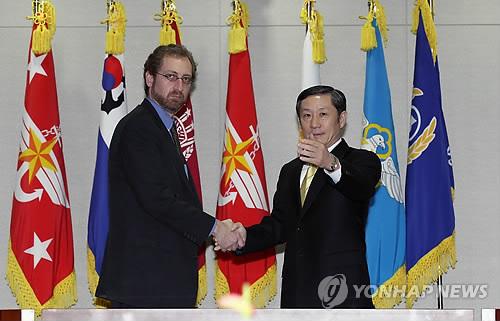
* Image & caption: same as the link
'Deputy Defense Minister Chang Kwang-il (R) shakes hands with Michael Schiffer, U.S. deputy assistant secretary of defense for Asia and Pacific affairs, before starting the SPI talks in Seoul on Dec. 13. (Yonhap)'
Yonhap News
S. Korea, U.S. launch joint committee to deter N. Korea's nuclear threats
2010/12/13
SEOUL, Dec. 13 (Yonhap) -- South Korea and the United States have formed a joint committee to make decisions about the alliance's nuclear policy, stepping up their commitment to deterring threats from North Korea's nuclear programs and other weapons of mass destruction, officials here said Monday.
The Extended Deterrence Policy Committee was officially set up at a meeting of the Security Policy Initiative (SPI) forum in Seoul earlier in the day between senior defense officials from the two nations, the South's defense ministry said in a statement.
"The Extended Deterrence Policy Committee was launched as the two sides signed terms of reference to systemize it," said a senior ministry official.
"Institutionalizing the committee is meaningful for the alliance because it paves the way for the two governments to draw up countermeasures against North Korea's nuclear threats and weapons of mass destruction," the official said on the condition of anonymity.
South Korea and the U.S. agreed to hold the first meeting of the committee in February or March of next year in Washington, headed by Deputy Defense Minister Chang Kwang-il and his U.S. counterpart, Michael Schiffer, deputy assistant secretary of defense for Asia and Pacific security affairs.
South Korea and the U.S. agreed to form the committee at their annual defense ministers' meeting in October.
Extended deterrence means the U.S. can provide tactical and strategic nuclear weapons, conventional strike and missile defense capabilities to defend South Korea in case of an attack from North Korea. It is the first time for the U.S. to create such a committee with a non-NATO ally.
During the SPI talks, the allies also reaffirmed their commitment to respond firmly should North Korea strike the South again, after its Nov. 23 artillery on the South's border island of Yeonpyeong.
The SPI talks, the 27th of their kind, come as tensions run high on the Korean Peninsula following the North's island attack that killed four people.
The bombardment also injured 18 people and destroyed dozens of homes, marking the first attack by the North on a civilian area on the South's soil since the end of the 1950-53 Korean War.
South Korea and the U.S. have held SPI talks regularly since 2005 to discuss a wide range of military and defense issues. The U.S. has about 28,500 troops in South Korea to help defend its ally against North Korea.
______________________________
Related articles
Korea Times
12-13-2010
Allies set up body on extended deterrence The Kyunghyang Sinmun
President Lee's Perception of North Korea is Highly Dangerous
Posted on : 2010-12-13
Hankyoreh
S. Korea - U.S. to organize a joint committee for extending nuclear deterrence
The committee will provide U.S. nuclear umbrella against “North Korean provocation”
Oct. 9, 2010
______________________________
Sunday, October 31, 2010
Text Fwd: Translation: [Cheong Wooksik] Would South Korea fall down into a ‘swamp of MD’?[on Oct. 25, 2010]
[영문 번역] MB 정부, 결국 ‘MD의 늪’으로 빠져드나?
Sunday, October 31, 2010
Text Fwd: Translation: Korean civic organizations’ joint press Interview against ROK’s joining of MD [on Oct. 25, 2010]
[영문 번역] 한국의 미사일 방어망 참여 반대, 한국 단체 공동 성명
Saturday, May 8, 2010
Text Fwd: Pentagon: Asia-Pacific Region "At Pivotal Point In History"
* Text from Stop NATO
Pentagon: Asia-Pacific Region "At Pivotal Point In History"
Fri May 7, 2010
Defense News
U.S. Department of Defense
American Forces Press Service
May 7, 2010
Asia-Pacific Region Stands at Pivotal Point
By Donna Miles
-Gregson...cited new, cross-border threats: the challenge of rising powers and failing states, the proliferation of nuclear and ballistic missile technologies and extremist violence, among them.
“Because we face a far more complex range of threats, the strength of our mutual commitments is more critical than ever before,” Gregson said.
-The United States must instill confidence among its regional partners that it stands by its security commitments and will maintain deterrence against the full range of potential threats and aggression, Gregson said. He noted steps the United States is taking to strengthen its deterrent capabilities, particularly in light of destabilizing activities in North Korea and China.
-He emphasized the need to overcome limitations in the United States’ security assistance system and to reform export control laws to enable partners and allies to play a greater role in their own defense and in regional affairs.
____________________________________________________________________
WASHINGTON: The Asia-Pacific region stands at a pivotal point in history as it draws on the strength of regional alliances and partnerships to contend with a broad range of threats and challenges, a senior defense official said yesterday.
In remarks at the East-West Center’s Washington office, Wallace “Chip” Gregson, assistant secretary of defense for Asia and Pacific security affairs, cited the dramatic transformation in the region since the East-West Center’s main campus was established in Hawaii 50 years ago at a time of regional uncertainty.
“Yet while this dynamism continues to fuel tremendous progress and growth, there are also tectonic shifts taking place in the region that create a continued sense of uncertainty,” he told the U.S.-Asia Pacific Council’s annual conference.
Asia is home to four of the world’s five largest military powers and some of its most-advanced military capabilities, Gregson noted. In light of ongoing territorial disputes and contested sovereignty claims, “the potential impact of a large-scale conflict would be unprecedented in scope,” he said.
But Gregson also cited new, cross-border threats: the challenge of rising powers and failing states, the proliferation of nuclear and ballistic missile technologies and extremist violence, among them.
“Because we face a far more complex range of threats, the strength of our mutual commitments is more critical than ever before,” Gregson said.
....
Gregson emphasized the need to build on existing alliances and partnerships in the region and to foster more multilateral cooperation. “If we are to successfully meet the challenges ahead, we must bring a renewed sense of purpose to the concept of regional cooperation,” he said.
The United States must instill confidence among its regional partners that it stands by its security commitments and will maintain deterrence against the full range of potential threats and aggression, Gregson said. He noted steps the United States is taking to strengthen its deterrent capabilities, particularly in light of destabilizing activities in North Korea and China.
Gregson noted the United States’ efforts to promote stronger multilateral, rather than simply bilateral, relationships in the region. This includes helping partners and allies build their own security capacities.
Yet, the United States must do a better job of providing this support in a timely, reliable manner, Gregson told the audience. He emphasized the need to overcome limitations in the United States’ security assistance system and to reform export control laws to enable partners and allies to play a greater role in their own defense and in regional affairs.
“If we are to build deep and enduring partnerships, we must ensure that this assistance is reliable, and that our partners know we will not be a fair-weather friend,” Gregson told the audience.
Looking toward the future, Gregson offered assurance that the United States will provide greater support to its partners – but emphasized that it also will expect more in return. The United States, he said, will expect its partners in the Asia-Pacific region to increase their capability in a transparent, responsible, way, and to begin taking the lead in regional security dialogue and initiatives.
“Finally, we also expect that as America fulfills our commitment to building greater partner capacity, our partners will in turn take greater leading roles in their own defense, and in regional and global security affairs,” he said.
The United States and its Asia-Pacific partners face an incredibly important series of choices in the years ahead, Gregson said. He noted years of discussion about the need to recalibrate existing partnerships and develop a broader set of roles, missions and capabilities to address a wider range of threats. “Our ability to implement this commitment will be the true test of our mettle in the next several years,” he said.
....
===========================
Stop NATO
Blog site
Pentagon: Asia-Pacific Region "At Pivotal Point In History"
Fri May 7, 2010
Defense News
U.S. Department of Defense
American Forces Press Service
May 7, 2010
Asia-Pacific Region Stands at Pivotal Point
By Donna Miles
-Gregson...cited new, cross-border threats: the challenge of rising powers and failing states, the proliferation of nuclear and ballistic missile technologies and extremist violence, among them.
“Because we face a far more complex range of threats, the strength of our mutual commitments is more critical than ever before,” Gregson said.
-The United States must instill confidence among its regional partners that it stands by its security commitments and will maintain deterrence against the full range of potential threats and aggression, Gregson said. He noted steps the United States is taking to strengthen its deterrent capabilities, particularly in light of destabilizing activities in North Korea and China.
-He emphasized the need to overcome limitations in the United States’ security assistance system and to reform export control laws to enable partners and allies to play a greater role in their own defense and in regional affairs.
____________________________________________________________________
WASHINGTON: The Asia-Pacific region stands at a pivotal point in history as it draws on the strength of regional alliances and partnerships to contend with a broad range of threats and challenges, a senior defense official said yesterday.
In remarks at the East-West Center’s Washington office, Wallace “Chip” Gregson, assistant secretary of defense for Asia and Pacific security affairs, cited the dramatic transformation in the region since the East-West Center’s main campus was established in Hawaii 50 years ago at a time of regional uncertainty.
“Yet while this dynamism continues to fuel tremendous progress and growth, there are also tectonic shifts taking place in the region that create a continued sense of uncertainty,” he told the U.S.-Asia Pacific Council’s annual conference.
Asia is home to four of the world’s five largest military powers and some of its most-advanced military capabilities, Gregson noted. In light of ongoing territorial disputes and contested sovereignty claims, “the potential impact of a large-scale conflict would be unprecedented in scope,” he said.
But Gregson also cited new, cross-border threats: the challenge of rising powers and failing states, the proliferation of nuclear and ballistic missile technologies and extremist violence, among them.
“Because we face a far more complex range of threats, the strength of our mutual commitments is more critical than ever before,” Gregson said.
....
Gregson emphasized the need to build on existing alliances and partnerships in the region and to foster more multilateral cooperation. “If we are to successfully meet the challenges ahead, we must bring a renewed sense of purpose to the concept of regional cooperation,” he said.
The United States must instill confidence among its regional partners that it stands by its security commitments and will maintain deterrence against the full range of potential threats and aggression, Gregson said. He noted steps the United States is taking to strengthen its deterrent capabilities, particularly in light of destabilizing activities in North Korea and China.
Gregson noted the United States’ efforts to promote stronger multilateral, rather than simply bilateral, relationships in the region. This includes helping partners and allies build their own security capacities.
Yet, the United States must do a better job of providing this support in a timely, reliable manner, Gregson told the audience. He emphasized the need to overcome limitations in the United States’ security assistance system and to reform export control laws to enable partners and allies to play a greater role in their own defense and in regional affairs.
“If we are to build deep and enduring partnerships, we must ensure that this assistance is reliable, and that our partners know we will not be a fair-weather friend,” Gregson told the audience.
Looking toward the future, Gregson offered assurance that the United States will provide greater support to its partners – but emphasized that it also will expect more in return. The United States, he said, will expect its partners in the Asia-Pacific region to increase their capability in a transparent, responsible, way, and to begin taking the lead in regional security dialogue and initiatives.
“Finally, we also expect that as America fulfills our commitment to building greater partner capacity, our partners will in turn take greater leading roles in their own defense, and in regional and global security affairs,” he said.
The United States and its Asia-Pacific partners face an incredibly important series of choices in the years ahead, Gregson said. He noted years of discussion about the need to recalibrate existing partnerships and develop a broader set of roles, missions and capabilities to address a wider range of threats. “Our ability to implement this commitment will be the true test of our mettle in the next several years,” he said.
....
===========================
Stop NATO
Blog site
Friday, April 9, 2010
Text Fw: U.S. looks to nonnuclear weapons to use as deterrent
* Text informed by Bruce Gagnon on April 8, 2010
Wahingtonpost
U.S. looks to nonnuclear weapons to use as deterrent
By Craig Whitlock
Washington Post staff writer
Thursday, April 8, 2010
As the White House pushes for cuts in the U.S. nuclear arsenal, the Pentagon is developing a weapon to help fill the gap: missiles armed with conventional warheads that could strike anywhere in the world in less than an hour.
U.S. military officials say the intercontinental ballistic missiles, known as Prompt Global Strike weapons, are a necessary new form of deterrence against terrorist networks and other adversaries. As envisioned, the conventional missiles would give the White House a fresh military option to consider in a crisis that would not result in a radioactive mushroom cloud.
The Prompt Global Strike program, which the Pentagon has been developing for several years, is already raising hackles in Moscow, where Russian officials predict it could trigger a nonnuclear arms race and complicate President Obama's long-term vision of ridding the world of nuclear weapons. U.S. military officials are also struggling to solve a separate major obstacle: the risk that Russia or China could mistake the launch of a conventional Prompt Global Strike missile for a nuclear one.
"World states will hardly accept a situation in which nuclear weapons disappear, but weapons that are no less destabilizing emerge in the hands of certain members of the international community," Russian Foreign Minister Sergei Lavrov told reporters Tuesday in Moscow.
The White House says that development of Prompt Global Strike is not affected by the new Strategic Arms Reduction Treaty (START), which Obama and Russian President Dmitry Medvedev are scheduled to sign Thursday in Prague. Analysts say, however, that any conventional ballistic missiles would count the same as nuclear ones under the treaty, which places new limits on each country's stockpile.
Deployment of a conventional ballistic missile is not expected until 2015 at the earliest. But the program has received a recent boost from the Obama administration, which sees the missiles as one cog in an array of defensive and offensive weapons that could ultimately replace nuclear arms.
The administration has asked Congress for $240 million for next year's Prompt Global Strike development programs, a 45 percent increase from the current budget. The military forecasts a total of $2 billion in development costs through 2015 -- a relative bargain by Pentagon standards.
After years of preparation, the Air Force is scheduled to perform an initial flight test of a prototype next month.
"Capabilities like an adaptive missile defense shield, conventional warheads with worldwide reach and others that we are developing enable us to reduce the role of nuclear weapons," Vice President Biden said in a February speech at the National Defense University. "With these modern capabilities, even with deep nuclear reductions, we will remain undeniably strong."
Nuclear arms have formed the backbone of U.S. deterrence strategy for six decades. Although the strategy worked during the Cold War, military leaders say they need other powerful weapons in their arsenal to deter adversaries who assume that the United States would refrain from taking the extreme step of ordering a nuclear strike.
"Deterrence can no longer just be nuclear weapons. It has to be broader," Marine Gen. James E. Cartwright, vice chairman of the Joint Chiefs of Staff and a leading proponent of Prompt Global Strike, told a conference last month.
Some U.S. military officials say their current nonnuclear options are too limited or too slow. Unlike intercontinental ballistic missiles, which travel at several times the speed of sound, it can take up to 12 hours for cruise missiles to hit faraway targets. Long-range bombers likewise can take many hours to fly into position for a strike.
"Today, unless you want to go nuclear, it's measured in days, maybe weeks" until the military can launch an attack with regular forces, Cartwright said. "That's just too long in the world that we live in." Other military officials said potential scenarios might include the discovery of an imminent plot by terrorists to use a weapon of mass destruction, or indications that an enemy state was preparing to launch a missile attack on a U.S. ally.
The Air Force prototype Prompt Global Strike design is a modified Peacekeeper III intercontinental ballistic missile. If it is successful, the plan is to deploy a handful of the missiles at Vandenberg Air Force Base in California.
The weapons would be overseen by the U.S. Strategic Command, which is responsible for the U.S. nuclear arsenal. Air Force Gen. Kevin P. Chilton, who leads the command, based near Omaha, has said he sees Prompt Global Strike as a niche weapon, not one that could substitute for nuclear arms.
"I look at that as an additional weapon in the quiver of the president to give him options in time of crisis today, in which he maybe only has a nuclear option for a timely response," Chilton told a House committee last month.
Although it is technically simple to replace nuclear warheads on a missile with conventional ones, Prompt Global Strike has been dogged by a significant problem: how to ensure that Russia could tell the difference if a launch occurred.
To alleviate the risk of an accidental Russian nuclear retaliation, the Air Force is developing a conventional, land-based ballistic missile that would fire into space at a much lower altitude than nuclear warheads, something that could be detected by Russian early-warning radar systems. U.S. military officials have also said they might be willing to grant access to Russian inspectors, or warn Moscow about a conventional strike on a third-party target.
The Army is working on a separate design that is not as far along in its development. The Navy had been preparing yet another design -- a conventional version of its submarine-based Trident missile -- but Congress curtailed that program two years ago because of concerns that it was too difficult to distinguish from a nuclear-armed Trident.
Critics acknowledge that the technological hurdles are surmountable. But they say a more basic problem is that taking the nuclear part out of the equation could make it too easy for the White House to order a Prompt Global Strike attack. Intelligence in fast-breaking crises is rarely rock-solid, they note, and could result in a rushed strike on the wrong target.
"People watch '24' and think that's how intelligence comes in," said Jeffrey G. Lewis, director of the Nuclear Strategy and Nonproliferation Initiative at the New America Foundation. "It's not like the president has his brain cybernetically linked to satellite images."
But proponents of Prompt Global Strike said its primary value would be in adding a level of deterrence to the U.S. nuclear arsenal. "At the end of the day, anybody who would be your adversary walks away thinking, 'If I'm going to do this, I'm going to pay dearly,' " Cartwright said last month. "There just can't be any doubt in their mind."
Global Network Against Weapons & Nuclear Power in Space
PO Box 652
Brunswick, ME 04011
(207) 443-9502
globalnet@mindspring.com
www.space4peace.org
http://space4peace.blogspot.com/ (blog)
Wahingtonpost
U.S. looks to nonnuclear weapons to use as deterrent
By Craig Whitlock
Washington Post staff writer
Thursday, April 8, 2010
As the White House pushes for cuts in the U.S. nuclear arsenal, the Pentagon is developing a weapon to help fill the gap: missiles armed with conventional warheads that could strike anywhere in the world in less than an hour.
U.S. military officials say the intercontinental ballistic missiles, known as Prompt Global Strike weapons, are a necessary new form of deterrence against terrorist networks and other adversaries. As envisioned, the conventional missiles would give the White House a fresh military option to consider in a crisis that would not result in a radioactive mushroom cloud.
The Prompt Global Strike program, which the Pentagon has been developing for several years, is already raising hackles in Moscow, where Russian officials predict it could trigger a nonnuclear arms race and complicate President Obama's long-term vision of ridding the world of nuclear weapons. U.S. military officials are also struggling to solve a separate major obstacle: the risk that Russia or China could mistake the launch of a conventional Prompt Global Strike missile for a nuclear one.
"World states will hardly accept a situation in which nuclear weapons disappear, but weapons that are no less destabilizing emerge in the hands of certain members of the international community," Russian Foreign Minister Sergei Lavrov told reporters Tuesday in Moscow.
The White House says that development of Prompt Global Strike is not affected by the new Strategic Arms Reduction Treaty (START), which Obama and Russian President Dmitry Medvedev are scheduled to sign Thursday in Prague. Analysts say, however, that any conventional ballistic missiles would count the same as nuclear ones under the treaty, which places new limits on each country's stockpile.
Deployment of a conventional ballistic missile is not expected until 2015 at the earliest. But the program has received a recent boost from the Obama administration, which sees the missiles as one cog in an array of defensive and offensive weapons that could ultimately replace nuclear arms.
The administration has asked Congress for $240 million for next year's Prompt Global Strike development programs, a 45 percent increase from the current budget. The military forecasts a total of $2 billion in development costs through 2015 -- a relative bargain by Pentagon standards.
After years of preparation, the Air Force is scheduled to perform an initial flight test of a prototype next month.
"Capabilities like an adaptive missile defense shield, conventional warheads with worldwide reach and others that we are developing enable us to reduce the role of nuclear weapons," Vice President Biden said in a February speech at the National Defense University. "With these modern capabilities, even with deep nuclear reductions, we will remain undeniably strong."
Nuclear arms have formed the backbone of U.S. deterrence strategy for six decades. Although the strategy worked during the Cold War, military leaders say they need other powerful weapons in their arsenal to deter adversaries who assume that the United States would refrain from taking the extreme step of ordering a nuclear strike.
"Deterrence can no longer just be nuclear weapons. It has to be broader," Marine Gen. James E. Cartwright, vice chairman of the Joint Chiefs of Staff and a leading proponent of Prompt Global Strike, told a conference last month.
Some U.S. military officials say their current nonnuclear options are too limited or too slow. Unlike intercontinental ballistic missiles, which travel at several times the speed of sound, it can take up to 12 hours for cruise missiles to hit faraway targets. Long-range bombers likewise can take many hours to fly into position for a strike.
"Today, unless you want to go nuclear, it's measured in days, maybe weeks" until the military can launch an attack with regular forces, Cartwright said. "That's just too long in the world that we live in." Other military officials said potential scenarios might include the discovery of an imminent plot by terrorists to use a weapon of mass destruction, or indications that an enemy state was preparing to launch a missile attack on a U.S. ally.
The Air Force prototype Prompt Global Strike design is a modified Peacekeeper III intercontinental ballistic missile. If it is successful, the plan is to deploy a handful of the missiles at Vandenberg Air Force Base in California.
The weapons would be overseen by the U.S. Strategic Command, which is responsible for the U.S. nuclear arsenal. Air Force Gen. Kevin P. Chilton, who leads the command, based near Omaha, has said he sees Prompt Global Strike as a niche weapon, not one that could substitute for nuclear arms.
"I look at that as an additional weapon in the quiver of the president to give him options in time of crisis today, in which he maybe only has a nuclear option for a timely response," Chilton told a House committee last month.
Although it is technically simple to replace nuclear warheads on a missile with conventional ones, Prompt Global Strike has been dogged by a significant problem: how to ensure that Russia could tell the difference if a launch occurred.
To alleviate the risk of an accidental Russian nuclear retaliation, the Air Force is developing a conventional, land-based ballistic missile that would fire into space at a much lower altitude than nuclear warheads, something that could be detected by Russian early-warning radar systems. U.S. military officials have also said they might be willing to grant access to Russian inspectors, or warn Moscow about a conventional strike on a third-party target.
The Army is working on a separate design that is not as far along in its development. The Navy had been preparing yet another design -- a conventional version of its submarine-based Trident missile -- but Congress curtailed that program two years ago because of concerns that it was too difficult to distinguish from a nuclear-armed Trident.
Critics acknowledge that the technological hurdles are surmountable. But they say a more basic problem is that taking the nuclear part out of the equation could make it too easy for the White House to order a Prompt Global Strike attack. Intelligence in fast-breaking crises is rarely rock-solid, they note, and could result in a rushed strike on the wrong target.
"People watch '24' and think that's how intelligence comes in," said Jeffrey G. Lewis, director of the Nuclear Strategy and Nonproliferation Initiative at the New America Foundation. "It's not like the president has his brain cybernetically linked to satellite images."
But proponents of Prompt Global Strike said its primary value would be in adding a level of deterrence to the U.S. nuclear arsenal. "At the end of the day, anybody who would be your adversary walks away thinking, 'If I'm going to do this, I'm going to pay dearly,' " Cartwright said last month. "There just can't be any doubt in their mind."
Global Network Against Weapons & Nuclear Power in Space
PO Box 652
Brunswick, ME 04011
(207) 443-9502
globalnet@mindspring.com
www.space4peace.org
http://space4peace.blogspot.com/ (blog)
Thursday, February 11, 2010
[국문 번역]Text Fwd: The Obama disarmament paradox 오바마 비무장의 역설
 * Image source 이미지 소스: Google (CCNS)
'Los Alamos National Laboratory'
로스 알라모스 국가 실험실'
* For more images on the 'Los Alamos National Laboratory', see HERE.
로스 알라모스 국가 실험실에 대한 더 많은 이미지는 여기를 보실 것
____________________________________________________________________________________
* Text Fwd from Bruce Gagnon on Feb. 10, 2010 2010년 2월 10일 브루스 개그논 보냄
____________________________________________________________________________________
Bulletin of the Atomic Scientists
By Greg Mello | 4 February 2010
원문: 원자 과학자들 회보 (Bulletin of the Atomic Scientists) 오바마 비무장의 역설
그렉 멜로(Greg Mello) | 2010년 2월 4일
_______________________________________________________________________________________________
* The latest federal budget request includes a large increase in spending for nuclear weapons.
* 가장 최근의 [미] 연방 예산 요청은 핵무기를 위해 커다란 증액을 할 것을 포함한다.
* Such an increase contradicts President Obama's speech in Prague last April, during which he seemed to signal a commitment to significant nuclear disarmament.
*그러한 중액은 중대한 비핵무장에 대한 사명의식을 표시했던 것처럼 보였던 작년 4월 프라하에서의 오바마 대통령 연설과는 모순된다.
* Now it's a question of whether Congress will reject the Obama budget request--a strategy it used to keep President George W. Bush from pursuing new nuclear weapon programs.
* 지금은 국회가 오바마의 예산 요청을 거절할 것인가가 문제로 떠오른다-- 조지 부쉬가 새로운 핵무기 프로그램들을 추구하는 것을 막았던 전략말이다.
______________________________________________________________________________________________
Last April in Prague, President Barack Obama gave a speech that many have interpreted as a commitment to significant nuclear disarmament.
작년 4월 프라하에서 바락 오바마 대통령은 많은 이들이 그의 중대한 비핵무장에 대한 사명의식으로 받아들였던 연설을 했다.
원문: 원자 과학자들 회보 (Bulletin of the Atomic Scientists) 오바마 비무장의 역설
그렉 멜로(Greg Mello) | 2010년 2월 4일
_______________________________________________________________________________________________
* The latest federal budget request includes a large increase in spending for nuclear weapons.
* 가장 최근의 [미] 연방 예산 요청은 핵무기를 위해 커다란 증액을 할 것을 포함한다.
* Such an increase contradicts President Obama's speech in Prague last April, during which he seemed to signal a commitment to significant nuclear disarmament.
*그러한 중액은 중대한 비핵무장에 대한 사명의식을 표시했던 것처럼 보였던 작년 4월 프라하에서의 오바마 대통령 연설과는 모순된다.
* Now it's a question of whether Congress will reject the Obama budget request--a strategy it used to keep President George W. Bush from pursuing new nuclear weapon programs.
* 지금은 국회가 오바마의 예산 요청을 거절할 것인가가 문제로 떠오른다-- 조지 부쉬가 새로운 핵무기 프로그램들을 추구하는 것을 막았던 전략말이다.
______________________________________________________________________________________________
Last April in Prague, President Barack Obama gave a speech that many have interpreted as a commitment to significant nuclear disarmament.
작년 4월 프라하에서 바락 오바마 대통령은 많은 이들이 그의 중대한 비핵무장에 대한 사명의식으로 받아들였던 연설을 했다.
Now, however, the White House is requesting one of the larger increases in warhead spending history. If its request is fully funded, warhead spending would rise 10 percent in a single year, with further increases promised for the future. Los Alamos National Laboratory, the biggest target of the Obama largesse, would see a 22 percent budget increase, its largest since 1944. In particular, funding for a new plutonium "pit" factory complex there would more than double, signaling a commitment to produce new nuclear weapons a decade hence.
그러나 지금 백악관은 전쟁 탄두 지출 역사상 더 큰 중액들의 하나를 요청하고 있다. 그 요청에 전적으로 재정이 충당되면 전쟁 탄두 지출은 단 1년에 10 퍼센트 증가를 보일 것이고 미래에 그것은 더 많은 중가를 가져올 것이다. 오바마가 돈을 줄 대상 중 가장 큰 [뉴 멕시코 주] 로스 알라모스 국가 실험실 (Los Alamos National Laboratory)은 1944년 이후 가장 큰 22% 예산 증가를 볼 것이다. 특히 그로 인해 그곳의 새로운 플루토늄 “채굴장 pit” 공장 단지에 대한 자금수여는 2배 이상이 될 것인데 이것은 10년동안 새로운 핵무기들을 생산하려는 사명감으로 비춰진다.So how is the president's budget compatible with his disarmament vision?
그러면 대통령의 예산은 그의 비핵무장 전망과 어떻게 양립하는가?The answer is simple: There is no evidence that Obama has, or ever had, any such vision. He said nothing to that effect in Prague. There, he merely spoke of his commitment "to seek . . . a world without nuclear weapons," a vague aspiration and hardly a novel one at that level of abstraction. He said that in the meantime the United States "will maintain a safe, secure, and effective arsenal to deter any adversary, and guarantee that defense to our allies."
대답은 간단하다: 오바마가 그러한 비전을 갖고 있다는, 또는 가지기라도 했다는 증거는 아무데도 없다. 그는 프라하에서 그러한 효과에 대해 아무 것도 말하지 않았다. 그곳에서 그는 단지 “핵무기들없는 세상을 … 구하는” 이란 막연한 열망과 그러한 추상적 수준에서 참신하다고 할 수 없는 그의 사명감을 말했을 뿐이다. 그는 미국이 그러면서 평시에 “어떠한 적도 제지하고 우리의 동맹[국가]들의 방어를 보증하도록 안전하고 보장되며 효과적인 무기고를 유지할 것” 이라 말했다.
핵무기들은 “어떠한 적도 제지하지” 않고 않을 것이기에 이것 또한 헛된 것이 아니라면 높은 열망[에 불과했다.] “어떠한” 적도 제지할 수 있는 “효과적인” 무기를 위한 헛된 구함은 끝없는 혁신과 오바마가 언급했던 확장된 제지를 포함, 계속적인 진짜 투자들을 필요로 한다. 미국의 [무기]비축에 관심을 가진다면, 비무장아닌 그러한 투자들의 약속이야말로 프라하의 실제적 메시지 였다. 사실, 오바마가 말할 때 확장된 제지 (extended deterrence)를 위한 위한 새로운 투자 제안은 이미 페키지로 묶여져 국회 [심의]를 볼 것이었다.
To fulfill his supposed "disarmament vision," Obama offered just two approaches in Prague, both indefinite. First, he spoke vaguely of reducing "the role of nuclear weapons in our national security strategy." It's far from clear what that might actually mean, or even what it could mean. Most likely it refers to official discourse--what officials say about nuclear doctrine--as opposed to actual facts on the ground. Second, Obama promised to negotiate "a new Strategic Arms Reduction Treaty [START] with the Russians." As far as nuclear disarmament went in the speech, that was it.
그의 가정된 “비무장 전망”을 채우기 위해오바마는 프라하에서 단지 2개의 접근을 제공했는데 2개 모두 불분명했다. 첫번째로 그는 “ 우리 국가 안보 전략 에서 핵무기의 역활” 축소 에 대해 막연히 말했다. 그것이 실제로 무엇을 의미할 지, 또는 무엇을 의미할 수 있는지 조차 분명한 것과는 거리가 멀다. 가장 크게 그것은 지상의 실제적인 사실들과는 반대되는 공식적인 담론을—관료들이 핵독트린이라 부르는 –- 언급할 것 같다. 두번째로 오바마는 러시아와의 “새로운 전략 무기 감축 조약 (Strategic Arms Reduction Treaty [START])”을 협상하길 약속했다. 핵비무장에 관한 연설이 계속된 한 그것이 전부였다.
Of course, Obama also said his administration would promptly pursue ratification of the Comprehensive Test Ban Treaty, an action not yet taken and one entirely unrelated to U.S. disarmament. The rest of the speech was devoted to various nonproliferation initiatives that his administration planned to seek.
물론 오바마는 그의 행정부가 즉시 포괄적인 [핵]실험 금지 조약(Comprehensive Test Ban Treaty)에 대한 비준을 추구할 것이라 또한 말했는데 그것은 아직 취해지지 않은 행동이며 미국의 비무장과는 아무런 관계가 없다. 연설의 나머지들은 그의 행정부가 찾으려 계획한 비핵확산 구상들에 바쳐졌다.
On July 8, Obama and Russian President Dmitry Medvedev announced their Joint Understanding, committing their respective countries to somewhere between 500 to 1,100 strategic delivery vehicles and 1,500 to 1,675 deployed strategic warheads, very modest goals to be achieved a full seven years after the treaty entered into force. Total arsenal numbers wouldn't change, so strategic warheads could be taken from deployment and placed in a reserve--de-alerted, in effect. The treaty wouldn't affect nonstrategic warheads. It wouldn't require dismantlement. As Hans Kristensen at the Federation of American Scientists has explained, the delivery vehicle limits require little, if any, change from U.S. and Russian expected deployments.
7월 8일, 오바마와 러시아 대동령 드미트리 메드베예프는 그들의 공동 이해 (Joint Understanding)를 발표했다. 자신들의 각 국이 전략 [무기] 운반 수단들을 약 500 ~1100으로, 배치되는 전략적 전쟁 탄두들을 약 1500에서 1675 개로 [축소할 거라는 건데] 조약이 실질적으로 발효된 지 7년이 지난 후의 성과로서는 매우 보잘 것없는 것이다. 총 무기 숫자들은 변하지 않을 것이므로 전략적 전쟁 탄두들은 배치 상태에서 예비 상태로, 실효적으로는, 변경되지 않은 채 옮겨갈 수 있다. 그 조약은 비전략적 전쟁 탄두들에게 영향을 주지 않을 것이다. 그것을 해체를 필요로 하지 않을 것이다. 미 과학자 동맹의 한스 크리스텐센이 설명했듯 그 운반 수단들 제한은 미국과 러시아의 기대되는 배치들의 변화-혹시라도 있다면-를 거의 필요로 하지 않을 것이다.
Ironically, it's possible that the retirement of 4,000 or more U.S. warheads under the Moscow Treaty and other retirements ordered by George W. Bush may exceed anything Obama does in terms of disarmament. As for the stockpile and weapons complex, Bush's aspirations were far more hawkish than Congress ultimately allowed. Real budgets for warheads fell during his last three years in office. Now, with the Democrats controlling the executive branch and both houses of Congress, congressional restraint is notable by its absence. What Obama mainly seems to be "disarming" is congressional resistance to variations of some of the same proposals Bush found it difficult to authorize and fund.
아이러닉하게도 비무장에 관한 한, 모스크바 조약에 의거, 4천개의 또는 그 이상의 미국 전쟁 탄두들의 폐기(retirement) 나 조지 부쉬에 의해 주문된 다른 폐기들이 오바마가 하는 것을 능가할 것이 가능하다. 비축과 무기 복합체를 말하자면, 부쉬의 열망은 [미]국회가 궁극적으로 허락한 것보다 훨씬 더 강경한 것이었다. 전쟁 탄두의 실제 예산들은 그가 집무하던 지난 마지막 3년 동안 감소되었다. 지금, 민주당이 집행부와 국회 상,하원을 다 통제하는데 국회의 억제가 없는 것은 주목할 만하다. 오바마가 “비무장” 하는 것으로 주로 보여지는 것은 국회의 저항인데 부쉬가 공식화하고 재정 충단하기 어려운 것으로 보았던 같은 제안들 몇의 다양한 변종들에 대한 저항말이다.Last May Obama sent his first budget to Congress, calling for flat warhead spending. At that time, the administration was still displaying a measured approach toward replacement and expansion of warhead capabilities.
지난 5월 오바마는 전쟁 탄두를 위한 단호한 지출을 요청하며 그의 첫번째 예산을 국회에 보냈다. 당시 행정부는 전쟁 탄두 능력들의 대체와 확장에 있어 아직 신중한 접근을 보이고 있었다.
That said, in last year's budget the White House did acquiesce to a Pentagon demand to request funding for a major upgrade to four B61 nuclear bomb variants--one of which had just completed a 20-year-plus life-extension program. Just one day before that budget was released a grand nuclear strategy review previously requested by the armed services committees was unveiled. It was chaired by William Perry, a member of the governing board of the corporation that manages Los Alamos, and recurrent Cold War fixture James Schlesinger. [Full disclosure: Perry is also a member of the Bulletin's Board of Sponsors.]
말한 김에, 백악관은 작년 예산에서 4개의 B61 핵폭탄 변종들을 엎그레이드 할 수 있도록 자금을 요청한 미 국방부의 요구에 묵묵히 따랐는데 그 중 하나는 20년 더하기 평생 연장 프로그램을 막 완성했었다. 예산이 발표되기 바로 하루 전날 [미 국회] 무기 위원회에서 사전에 요청하였던 grand 거대한 핵 전략 심의보고서가 베일을 벗었다. 그것은 로스 알라모스를 관리하는 기업을 통치하는 보드 회원인 윌리암 페리와 되살아난 냉전 시대의 터줏 대감 제임스 쉴레진저가 의장을 맡았다. [완전 폭로: 페리는 또한 [이] 회보의 후원자 단의 회원이다.]The report's recommendations for increased spending and weapons development quickly began to serve as a rallying point for defense hawks--surely the point of the exercise. Overall, it was largely a conclusory pastiche of recycled Cold War notions, entirely lacking in analysis and often factually wrong. But neither the White House nor leading congressional Democrats offered any public resistance or rebuttal to its conclusions.
그 보고서의 지출 증가와 무기 개발에 대한 추천은 국방 매파들의 집결점으로 재빨리 기여하기 시작했다— 확실히 연습점으로. 전체적으로 그것은 분석을 다 결여하고 사실에 있어 자주 틀린, 크게 보아, 회귀한 냉전 시대 관념의 결정적인 모방이었다. 그러나 백악관도 지도적인 국회 민주당원들도 그 결론들에 공개된 저항이나 반증을 제공하지 않았다.
More largely, opposition to nuclear restraint within the administration quickly emerged from its usual redoubts at the National Nuclear Security Administration (NNSA), the Pentagon, STRATCOM, and interested players in both parties in Congress. Plus, Obama left key Bush appointees in place at NNSA while the Pentagon added some familiar faces from the Clinton administration, leaving serious questions about the ability of the White House to develop an independent understanding of the issues, let alone present one to Congress.
더 크게는, 행정부 내 핵억제에 대한 반대가 국가 핵 안보 행정부(National Nuclear Security Administration (NNSA)), 국방부, 전략 사령부 (Strategic Command: STRATCOM), 그리고 국회 양당의 관심있는 플레이어들의 보통 요새로부터 크게 일어났다. 게다가 국방부가 클린턴 행정부로부터 낯익은 인물들을 추가했다면 오바마는 부시가 임명한 핵심 인물들을 국가 핵 안보 행정부에 그대로 있게 했다. 국회에 대한 현재의 것은 고사하고 그 이슈에 관해 독립적인 이해를 개발할 수 있는 백악관의 능력에 대해 심각한 질문을 남기면서 말이다.
Either way, potential treaty ratification is surely a major factor in White House thinking. Senate Republicans, as expected, are demanding significant nuclear investments prior to considering ratification of any START follow-on treaty. Democratic hawks, especially powerful ones with pork-barrel interests at stake such as New Mexico Sen. Jeff Bingaman, also must be satisfied in the ratification process. All in all this makes the latest Obama budget request a kind of "preemptive surrender" to nuclear hawks. So whether or not the president has a disarmament "vision" is irrelevant. What is important are the policy commitments embodied in the budget request and whether Congress will endorse them.
어느 쪽이든 잠재적 조약 비준은 백악관의 사고에 중요한 요인임이 확실하다. 상원 공화당원들은 예상했던 것처럼 어떠한 전략 핵무기 감축 조약 후속 협상에 대한 비준 고려 이전에 중요한 핵투자를 요구하고 있다. 민주당 강경파들, 특히 뉴 멕시코 주 상원 의원 제프 빈거맨과 같이 눈앞의 큰 이익에 관심을 둔 힘있는 세력들은 비준 과정에 만족함이 틀림없다. 이 모두는 최근 오바마 예산 요청을 핵 강경파에 대한 “선제 항복 preemptive surrender” 종류로 만든다. 중요한 것은 예산 요청에 심어진 정책 사명감이며 국회가 그것을 배서할 것인가 이다.
Investments on the scale requested should be flatly unacceptable to all of us. The country and the world face truly apocalyptic security challenges from climate change and looming shortages of transportation fuels. Our economy is very weak and will remain so for the foreseeable future. The proposed increases in nuclear weapons spending, embedded as they are in an overall military budget bigger than any since the 1940s, should be a clarion call for renewed political commitment in service of the fundamental values that uphold this, or any, society.
[오바마가] 요청한 크기의 투자는 단호히 우리 모두에게 받아들여져선 안된다. 이 나라와 지구는 기후 변화와 불안하게 다가오는 운송 연료 부족으로 진정 재앙적인 안보 위기에 직면해 있다. 우리의 경제는 매우 약하며 예견할 수 있는 미래에도 그러할 것이다. 1940년대 이후 가장 큰 큰 군사 예산에 그대로 끼워넣어진 핵무기 지출의 제안된 증가는, 이 나라와 또는 어떠한 사회도 받드는 근본적 가치들에 기여하기 위해 새롭게 가다듬은 정치적 사명감을 요청하는 날카로운 경종으로 받아들여져야 한다.
Those values are now gravely threatened--not least by a White House uncertain about, or unwilling or unable to fight for, what is right.
그 가치들은 현재 옳은 것에 대해 싸울 불확실한, 또는 의지없는, 또는 능력없는 백악관을 [비롯한 여러 세력에 의해] 심각하게 위협받고 있다.
* Greg Mello
Mello cofounded the Los Alamos Study Group (LASG), which since 1989 has endeavored to provide leadership on nuclear disarmament and related issues in New Mexico. Based in Albuquerque, LASG's work includes research, organizing, education, litigating, and providing information on nuclear weapon issues for journalists. A former supervising hydrogeologist for the New Mexico Environment Department, Mello was a visiting research fellow at Princeton University's Program on Science and Global Security in 2002.
멜로는 로스 알라모스 연구 그룹(Los Alamos Study Group (LASG))을 공동 창설했는데, 이 그룹은 1989년 이 후 뉴 멕시코 주 핵 비무장과 관련 아슈들에 있어 지도력을 제공하도록 힘써왔다. (뉴 멕시코 주) 앨버커크에 기반을 둔 로스 알라모스 연구 그룹의 작업은 연구, 조직, 교육, 논쟁 그리고 언론인들을 위해 핵무기 이슈에 관한 정보 제공을 포함한다. 멜로는 뉴멕시코 환경 부서의 전 수리 지질학자 hydrogeologist 감독이었며 2002년 과학과 전지구적 안보에 관한 프린스턴 대학 프로그램의 객원 연구원이었다.
Copyright © 2010 Bulletin of the Atomic Scientists. All Rights Reserved.
판권: 원자 과학자들 회보(Bulletin of the Atomic Scientists) © 2010
_______________________________________________________________________________________________
Global Network Against Weapons & Nuclear Power in Space
우주의 무기와 핵을 반대하는 글로벌 넷워크
PO Box 652
Brunswick, ME 04011
메인주 브런즈윅 우편함 박스 652 (우편번호 04011)
(207) 443-9502
globalnet@mindspring.com
www.space4peace.org
http://space4peace.blogspot.com/ (blog)
Brunswick, ME 04011
메인주 브런즈윅 우편함 박스 652 (우편번호 04011)
(207) 443-9502
globalnet@mindspring.com
www.space4peace.org
http://space4peace.blogspot.
Monday, December 28, 2009
Text Fwd: ROK-US Alliance Evolves, Challenges Linger
 * Image source: same as the link below
Korea Times
12-24-2009 19:30
ROK-US Alliance Evolves, Challenges Linger
By Jung Sung-ki
Staff Reporter
The year 2009 saw South Korea and the United States take a new step forward in their strategic military alliance, as they ironed out thorny issues of mutual concern, defense experts say.
North Korea's continued, provocative military actions on the peninsula also boosted the importance of the alliance, they added.
``Overall, the development of the alliance was fruitful this year, but there are still issues to be further fine-tuned,'' a defense researcher here told The Korea Times on condition of anonymity. He was apparently referring to Seoul's recent decision to redeploy troops to Afghanistan to help U.S. and other coalition forces fight against terrorists there as a case in point.
``As for the deployment to Afghanistan, which is hailed by the U.S. administration, there are still unresolved issues and questions, such as the appropriate number of troops and the timing of the deployment,'' the researcher said. ``The motion hasn't been approved by the National Assembly and we're not sure that the deployment can go ahead as scheduled in the first half of next year, when the U.S. will need troop support the most.''
The administration announced earlier this month that it would send 320 troops and 40 police officers to the Central Asian nation to accompany 100 Korean reconstruction workers to be dispatched to the country.
The decision was made after Washington had repeatedly requested Seoul to contribute troops to Afghanistan. The presidential office said the deployment would help to further strengthen ties with Washington as well as increase the country's global profile to match its economic power.
Some in the military argued a brigade-level unit should be dispatched for full-fledged anti-terror operations. But Cheong Wa Dae was wary of possible public backlash over a large-scale troop deployment.
Opposition lawmakers have opposed the deployment, worrying the country could become a target of terror attacks. The passage of the motion is expected to be delayed until February.
Change in USFK Roles
A key challenge ahead for the alliance is Seoul's smooth acceptance of the U.S. Forces Korea's (USFK) strategic flexibility, the researcher said.
In the early 2000s, the U.S. military initiated the idea of changing the mission of American forces abroad from stationary ones focused on defending host nations to a rapid-deployment strategy in which troops are swiftly dispatched to parts of the world where the U.S. faces conflict.
Seoul and Washington agreed to the altering of the role of U.S. forces in Korea in 2006. The plan has not been fully implemented amid concerns that it could weaken the Korea-U.S. combined defense posture against North Korea.
In recent months, U.S. military leaders repeatedly mentioned the need for the scheme, in line with the planned longer, family-accompanied tours by U.S. forces in Korea.
Speaking at a forum organized by the Center for Strategic and International Studies (CSIS) in Washington, USFK Commander Gen. Walter Sharp said, ``We want the troops to be regionally engaged and globally deployed, but we'll never forget that our No. 1 responsibility in Korea is to defend the Republic of Korea.
``Sometime in the future we could have forces that could, with consultations between both nations, be able to be deployed in different places around the world,'' he said.
The researcher said the strategic flexibility of U.S. troops overseas is an unavoidable ``trend.''
``The strategic flexibility is not a matter of conflict but a matter of consultation or coordination,'' he noted. ``It's time for us to think of what we can get from the U.S. strategic flexibility, not what we can lose from it.
``Given that the agreed 21st strategic alliance partnership calls for boosting bilateral cooperation in global issues, we can't and shouldn't deny the strategic flexibility mechanism,'' said the expert. ``The Lee government should think of how it will get this message across to the public and prevent unnecessary controversy over this issue.''
In June, Presidents Lee Myung-bak and Barack Obama issued the Joint Vision for the ROK-US Alliance at the end of their summit in Washington, D.C. The plan calls for building a broader alliance in the realms of politics, economy, culture and other areas, in addition to the security arena.
Nuclear Deterrence
In the summit, President Obama reaffirmed that Washington will continue to provide an extended nuclear umbrella to South Korea in response to North Korea's increasing nuclear threats.
The pledge was stipulated in a joint communique of the defense ministers from the two nations at the Security Consultative Meeting (SCM) in October in Seoul.
``I think 2009 has been extremely important for the alliance because North Korea has repeatedly demonstrated the importance of the alliance during a period where some key people in both the ROK and the United States seem to be doubting its importance,'' Bruce Bennett, a senior defense analyst at the Rand Corporation, a U.S. non-profit policy think tank, wrote in an e-mail.
North Korean insistence on retaining its nuclear weapons and being designated a nuclear power makes the ROK-US alliance ever more critical for the security of South Korea and the region, he said.
``As a result, I found the ROK-US Joint Vision of the Alliance statement to be a key development. I was especially struck by the US commitment to extended deterrence, including its nuclear umbrella,'' said the analyst.
Bennett said North Korean leader Kim Jong-il's illness early in the year implied that succession could come soon, and the failure of Kim Jong-il to clearly designate a successor suggests that a third-generation Kim family succession could fail.
This view was reinforced by North Korea's provocations — its missile launches and nuclear test — in the first half of the year, which apparently stemmed from Kim Jong-Il's deteriorating health and the need to demonstrate his power, he analyzed.
``If anyone in the ROK was feeling safe from North Korean nuclear weapons, they should have developed a different perspective after May 25 (the nuclear test), and worried about how the ROK government was going to protect them,'' the analyst said.
``While most experts have focused on Kim Jong-Il's efforts to appear peaceful and cooperative in the second half of this year, I think there have been clear signs even in this period of the need for our alliance, given North Korean instability,'' he said.
North Korea's poor crop yield this year likely means that many North Koreans could face famine over the coming year, increasing instability in the communist state, he added, saying the North Korean currency revaluation early this month was a major event that hurt the North Korean elite.
This action is likely to destabilize the North Korean government, increasing the chances of the regime collapsing, he said.
gallantjung@koreatimes.co.kr
Thursday, November 19, 2009
Text Fwd: [Press Interview Statement on Nov. 18, 2009]: We Oppose the Re-Dispatch of the South Korean Troops to Afghanistan
* For the images of the NOV. 18 Press Interview, please go to HERE.
* Below is the unofficial translation. The original Korean can be found in the websites of the some organizations, such as the People’s Solidarity for Participatory Democracy (PSPD) and Solidarity for Peace And Reunification of Korea (SPARK) who are the participants of the Civil Alliance Against the Redeployment of Troops to Afghanistan (The statement subject).
[2009. 11. 18 기자회견문] 한국의 아프가니스탄 재파병에 반대한다.
[Press Interview Statement on Nov. 18, 2009]: We Oppose the Re-Dispatch of the South Korean Troops to Afghanistan.
한미 정상회담은 전쟁협력이 아닌 한반도 평화를 앞당기는 회담이 돼야 한다.
The United States-South Korea summit meeting should be the meeting that draws forward the peace not the war co-operation in the Korean peninsula.
오바마 미국 대통령이 오늘(18일) 방한해 내일 한미정상회담을 한다. 우리 국민은 이번 정상회담에서 양국 정상이 한반도 핵 문제의 평화적 해결, 그리고 한반도와 동북아시아의 평화체제 형성을 향한 건설적인 합의를 이끌어낼 수 있기를 기대한다. 그러나 기대와 달리 이 정상회담이 한국 군대의 아프가니스탄 재파병을 비롯한 한미군사협력의 공격적 세계화를 보다 가속화하는 계기로 되는 것에 심각한 우려를 표한다.
The United States President, Obama visits the South Korea today (Nov. 18) and has the South Korea-United States summit meeting tomorrow. We, Koreans expect that the two summits could bring forward the constructive agreement toward the peaceful settlement of the nuclear issue in the Korean peninsula and the formation of the peace system in the Korean peninsula and the North East Asia in this summit meeting. However, we express our grave concern about that this summit meeting is to be the momentum for more acceleration of the aggressive globalization.
미국은 아프간 점령을 중단해야 하며, 이명박 정부는 아프간 재파병 방침을 철회해야 한다.
The United States must stop the occupation of Afghanistan and the Lee Myung Bak government must withdraw the policy of the redeployment to Afghanistan.
한 미 정상회담을 계기로 이명박 정부는 아프가니스탄에 대한 재파병 방침을 기정사실화하려 하고 있다. 우리는 양국 정부의 아프가니스탄 전쟁 및 점령 협력에 반대한다. 세계 어느 나라도 국민과의 합의를 거쳐 철군한 나라에 재파병하는 예를 찾아보기 힘들다. 이명박 정부는 아프간 재파병 방침을 철회해야 한다.
By the chance of the US-SK summit meeting, the Lee Myung Bak government is trying to make the fact of the policy of the redeployment to Afghanistan. We oppose the cooperation on the war and occupation of the Afghanistan by the both governments. It is very hard to find the examples of the countries that redeploy to the country from which they withdrew after the consent with their own people. The Lee Myung Bak government must withdraw the policy of the redeployment to Afghanistan.
전쟁을 끝내겠다는 첫마디로 취임선언을 시작한 오바마 대통령은 도리어 아프간에 대한 전쟁을 파키스탄으로까지 확장하고 아프가니스탄에 수만 명의 병력을 증파하는 방안을 모색해오고 있다. 아프가니스탄 전쟁과 점령은 이미 실패했다. 테러를 전쟁으로 없애겠다는 것은 당초 불가능한 일이었으며, 이를 무시한 미국과 동맹국들의 아프가니스탄 침공은 아프가니스탄에 부패한 정권을 이식하고 수세대에 이어질 무장갈등의 불씨만을 키워가고 있다. 오마바 미 대통령은 아프가니스탄 증파계획을 철회하고 아프가니스탄 점령을 중단해야 한다.
The President Obama who began his inauguration speech with the first phrase that he would finish the war has rather been expanding the Afghanistan war to Pakistan and has been groping the ways of the increase the tens of thousands of force in Afghanistan. The war and occupation in Afghanistan has already failed. It was impossible to remove terror by war from the beginning and the invasion against Afghanistan by the United States and her alliance who ignored that have planted the corrupt government in Afghanistan and been growing only the live coal of the armed conflicts that would continue thru the generations. U.S. President Obama must withdraw the reinforcement plan in Afghanistan and stop the occupation of Afghanistan.
우리는 한미전쟁동맹, 한미군사협력의 세계화에 반대한다.
아 프간 재파병만 문제가 아니다. 한미 정상회담의 주요 의제 중 하나인 미래 한미동맹의 이행방안은 한미간 군사협력 범위의 세계화를 포함하고 있다. 한미양국 관계가 서로의 평화적 역할을 증진시키기 보다는 전쟁협력을 강화하는 방향으로 발전하는 것은 매우 불행한 일이다. 이러한 방향으로의 합의는 한미관계를 발전시키는 것이 아니라 퇴행시키는 것이다.
We oppose the United States-South Korea war alliance and globalization of the United States-South Korea military cooperation. The [policy of the] re-dispatch re-dispatch to Afghanistan is not an only problem. The way of realizing the future South Korea- United States alliance, one of the main agendas of the South Korea- United States summit meeting includes the globalization of the area of the South Korea- United States military cooperation. It is very unfortunate that the relationship between the South Korea- United States is developing toward strengthening war cooperation rather than toward increasing their peaceful role each other. The agreement toward such direction does degenerate the relationship between the South Korea- United States, not making progress of it.
한미정상회담은 한반도 핵문제의 평화적 해결과 한반도 동북아 평화체제 수립에 기여하는 건설적인 회담이 되어야 한다.
The South Korea- United States summit meeting must be a constructive meeting contributing the peaceful settlement of the nuclear issue in the Korean peninsula and establishment of the North East Asia peace system in the Korean peninsula.
한 미 양국 정부는 모두 극히 최근까지 한반도 핵문제 해결과 평화정착을 위한 외교적 노력에 우선순위를 두지 않고 있었고, 상황을 악화시키는 적대적 혹은 무관심으로 일관한 결과 해결 돌파구를 찾아가도 한반도 핵문제를 도리어 악화시키는 데 일조해왔다. 이명박 정부는 이른바 ‘비핵개방3000’정책과 기존의 남북정상간 합의를 무시하는 행보를 취해 남북관계를 악화시키고 분쟁과 긴장을 고조시키는 결과를 낳았다.
The both governments of the South Korea- United States have not made the first priority of the diplomatic effort for the settlement of the nuclear issue in the Korean peninsula and for the stabilization of peace until very recently. And rather contributed to aggravate the nuclear issue of the Korean peninsula as the result of their consistent hostility and ignorance [against the North Korea] that made worse the situation, not to mention of not finding the breakthrough for the settlement of it. The Lee Myng Bak government have aggravated the relationship between the North and South Korea.
비핵개방 3000을 일부 완화시킨 이른바 ‘그랜드 바겐’은 정책에서도 막힌 남북관계와 한반도 핵 문제를 근본적으로 해결하기 위한 적극적인 비전은 찾아볼 수 없다. 다만 오바마 정부가 집권 초반의 상대적 무관심과 적대적 태도를 벗어나 최근 양자회담을 시도하는 등 문제해결 돌파구를 찾는 노력을 조심스럽게 시도하고 있는 것은 다행스러운 일이다. 하지만 여전히 북핵 개발/확산 저지라는 일방적인 군사전략에만 치중하여 한반도 평화체제를 향한 포괄적 행동계획이나 이와 연계된 국제 핵군축 대안을 대범하게 제시하지는 못하고 있다.
In the [President Lee Myung Bak governmemt’s] ‘Grand Bargain’ that partly soften the policy of the ‘Non-Nuclear & Openness 3000’, the active vision for the fundamentally settle the relationship between the North Korea and South Korea and nuclear issue in the Korean peninsula, that was blocked in the policy as well, can not be found. It is fortunate only that the Obama administration is cautiously attempting to make an effort of finding the breakthrough, such as recently attempting of the bilateral meeting, out of its relative ignorance and hostile attitude in its early period of coming into power. However, [the Obama administration] is still laying stress upon the unilateral military strategy of the deterrence of the development and expansion of the North Korean nuclear, is suggesting neither the comprehensive action plan toward the peace system of the Korean peninsula nor the alternative for the international nuclear arms reduction, related to the former.
한미정상회담 에서 양국 정상은 한반도 핵문제의 평화적 해결과 동북아 평화체제 수립을 위한 건설적인 회담이 되도록 최선의 노력을 기울여야 한다. 이번 회담을 계기로 이명박 정부는 대북압박 일변도의 정책을 철회하고 양국 정상은 ‘핵 없는 세계’, ‘글로벌 핵군축’이라는 보편적 원칙과 경로에 입각하여 남북 및 북미간의 대화와 협상을 통해 한반도 주변의 핵위협을 근원적으로 제거하고 한반도의 평화적 통일과 동북아시아의 항구적 평화체제 실현을 앞당길 전향적 합의를 이루어야 할 것이다.
In the summit meeting of the South Korea-United States, the both summit must make an effort that it should be a constructive meeting for the peaceful settlement of the nuclear issue in the Korean peninsula and for the formation of the peaceful system in the northeast Asia. By the chance of this meting, the Lee Myung Bak government must withdraw its one-side policy of the pressure against the North Korea, and the summits in the both countries, based on the general principal and passage of the ‘non-nuclear world’ and ‘global nuclear arms reduction’, should fundamentally remove the nuclear threat around the Korean peninsula through the dialogue and negotiation between the North Korea & South Korea and North Korea & United States and should accomplish the turning mutual agreement that would move up the realization of the peaceful unification of the Korean peninsula and eternal peace system in the North East Asia.
한미 정상회담은 아프간과 한반도에서 무장 갈등과 군사적 대결을 부추기는 파괴적인 협력의 장이 아니라 한반도와 동북아 평화를 앞당길 대안을 구체화하는 건설적인 협력의 장이 되어야 한다.
The South Korea-United States summit meeting must not be a stage for the destructive cooperation that provokes the armed conflict and military confrontation in the Afghanistan and the Korean peninsula but be a constructive cooperation stage that would make concretization of the alternatives that move up the peace in the Korean peninsula and the Northeast Asia.
이명박 정부는 아프가니스탄 재파병 계획 즉각 폐기하라!
오바마 정부는 아프가니스탄 점령을 중단하라!
한미 전쟁동맹 반대한다! 한미정상은 전쟁협력 중단하고.
한반도 평화를 위해 협력하라!
Lee Myung Bak government, immediately abolish the re-dispatch plan to Afghanistan!
Obama government, immediately stop the occupation of Afghanistan!
We oppose the South Korea-United States War Alliance!
The summits in the South Korea and the United States, stop the war cooperation and cooperate for the peace in the Korean peninsula!
2009년 11월 18일
Nov. 18, 2008
아프가니스탄 재파병 반대 시민사회단체 연석회의
Civilian Alliance Against the Redeployment of Troops to Afghanistan
Saturday, August 8, 2009
Text Fwd: Global Strike Command Will Stress Nuclear Mission
 * Image source/ description : Same as the article below
'Air Force Secretary Michael Donley, left, and Gen. Norton A. Schwartz, Air Force Chief of Staff, answer questions at an Aug. 5, 2009, Pentagon news conference on the Air Force Global Strike Command activation. The new command, with headquarters at Barksdale Air Force Base, La., stands up Aug. 7, 2009. U.S. Air Force photo by Scott M. Ash'
* StopNATO
http://www.defenselink.mil//news/newsarticle.aspx?id=55403
U.S. Department of Defense American Forces Press Service August 7, 2009 Global Strike Command Will Stress Nuclear Mission By Jim Garamone
WASHINGTON, Aug. 7, 2009 – A key step in reinvigorating the Air Force’s nuclear deterrence mission will be made today with the activation of the service’s Global Strike Command at Barksdale Air Force Base, La.
Air Force Secretary Michael B. Donley said the new command will bring together the Air Force bomber force and intercontinental ballistic missiles under a single commander.
“Standing up the command is no small task, and actually we’re doing it sooner than we anticipated,” Donley said during a Pentagon news conference Aug. 5. “This command will provide the combatant commanders the forces needed to conduct strategic nuclear deterrence and global strike operations through ICBM, B-2 and B-52 operations.”
Air Force Lt. Gen. Frank G. Klotz will command the organization. The headquarters will include 900 people, and is slated to reach full operating capability by Aug. 7, 2010, Donley said. The 20th Air Force, the service’s missile organization, will come under the new command in December; and the 8th Air Force, the bomber component, will come under the command in April.
Air Force Chief of Staff Gen. Norton A. Schwartz stressed that the new command will be a major command like Air Combat Command or Air Force Special Operations Command. The role is to “organize, train and equip America’s ICBMs and nuclear-capable bombers, and prepare a cadre to do this important work with passion and professionalism,” he said during the news conference.
Ensuring professionalism and pride in the nuclear field will be vital to the command’s success, Schwartz said, noting that airmen with nuclear expertise had been leaving the service, feeling their work was not appreciated.
“The bottom line is retention has a lot to do with perceptions on how important people’s work is, and how worthy that work is,” the general said. “We’ve worked to make it clear to those who will serve in this command that the work is important to the country’s defense and it will continue to be so.”
Making the command a major command also will give airmen in the nuclear fields an advocate equal to the other commands, he said.
The creation of the command is an effort to boost security and reduce errors. In a 2007 incident, nuclear weapons were loaded aboard a B-52 bomber at Minot Air Force Base, N.D., and flown to Barksdale before the mistake was discovered. In another incident, nuclear nose cones mistakenly were shipped to Taiwan. As a result, the service’s top civilian and military officials -- Air Force Secretary Michael Wynne and Chief of Staff Gen. T. Michael Moseley -- resigned.
Multiple studies of the incidents and the Air Force’s atmosphere revealed that the service’s nuclear forces and the entire enterprise lacked clear lines of authority and responsibility, officials said. The Global Strike Command is one of the solutions.
Donley said moves at the Air Staff and in the field have emphasized accountability and compliance with respect to nuclear issues at all levels. The service has re-emphasized training for inspectors and added $750 million over the Future Year Defense Plan for nuclear efforts, in addition to a $4.2 billion base budget. The service also is standing up another B-52 squadron, in part to provide for longer and more focused training.
A number of entities have an interest in the nuclear arena, including the U.S. Strategic Command and the Defense Threat Reduction Agency. These agencies will play a key role in inspections of the new command, Schwartz said.
The command will have an inspector general, and the service has made a special effort to make the inspections “more challenging and intrusive to ensure that commanders get good feedback in how healthy their commands were,” the general said.
Inspections will be demanding, he promised, and will include operations, security, maintenance and weapons.
The emphasis on the nuclear missions means that when a mission requires B-2s or B-52s to carry conventional weapons, they will be reassigned from the new command to the regional commanders for that mission. Global Strike Command will ensure that air and ground crews have expertise in conventional weaponry and raids, but the focus must remain on the nuclear capability, the chief of staff said.
Biographies:
Michael B. Donley
Air Force Gen. Norton A. Schwartz
Air Force Lt. Gen. Frank G. Klotz
Related Sites:
Air Force Global Strike Command
Air Force News Release
* Related blog
No Base Stories of Korea
Thursday, August 6, 2009
Video Fwd: Day Last Past
Wednesday, July 29, 2009
Text Fwd: U.S. Strategic Command, "First Annual Strategic Deterrence Symposium:
* Informed by Frank Cordaro on July 28, 2009
U.S. Strategic Command, "First Annual Strategic Deterrence Symposium:
Waging Deterrence in the 21st Century," with 27 speakers.
Qwest Center, 455 N. 10th St., Omaha, NE (closed).
http://stratcom.cvent.com/EVENTS/Info/Custom.aspx?cid=19&i=eb044469-46c5-4b7b-ae16-882f569b3998
Frank Cordaro
Phil Berrigan CW House
713 Indiana Avenue, Des Moines, IA 50314
(515) 282-4781 www.DesMoinesCatholicWorker.org
U.S. Strategic Command, "First Annual Strategic Deterrence Symposium:
Waging Deterrence in the 21st Century," with 27 speakers.
Qwest Center, 455 N. 10th St., Omaha, NE (closed).
http://stratcom.cvent.com/EVENTS/Info/Custom.aspx?cid=19&i=eb044469-46c5-4b7b-ae16-882f569b3998
Frank Cordaro
Phil Berrigan CW House
713 Indiana Avenue, Des Moines, IA 50314
(515) 282-4781 www.DesMoinesCatholicWorker.
Friday, July 3, 2009
Text Fwd: S.Korea to Seek Expansion of Nuclear Activities
*Chosun Ilbo(South Korea's most conservative right wing newspaper)
S.Korea to Seek Expansion of Nuclear Activities
englishnews@chosun.com / Jul. 03, 2009 07:52 KST
Foreign Minister Yu Myung-hwan on Thursday said the Korea-U.S. Atomic Energy Agreement should be revised "as soon as possible." Yu said Seoul will seek "concrete consultations in the direction of maximizing commercial gains from the supply of atomic raw materials and the handling of spent fuel."
Yu made the remarks in the press briefing after the U.S. said earlier this week it is against allowing South Korea to reprocess its own spent nuclear fuel.
"We'll have to depend much more on atomic energy in coping with climate change in the future," Yu said. "What we are interested in about the atomic energy agreement between the two countries is setting a more concrete boundary of bilateral cooperation for the peaceful use of atomic energy."
The revision of the agreement, which expires in 2014, will reportedly begin in 2012.
Under the 1974 accord, South Korea is prohibited from reprocessing spent nuclear fuel. South Korean politicians have recently called for revising the agreement following North Korea's second nuclear test.
englishnews@chosun.com / Jul. 03, 2009 07:52 KST
*Related Articles
* U.S. Against Resumption of S.Korean Nuclear Program
* S.Korea May Need Its Own Deterrent
S.Korea to Seek Expansion of Nuclear Activities
englishnews@chosun.com / Jul. 03, 2009 07:52 KST
Foreign Minister Yu Myung-hwan on Thursday said the Korea-U.S. Atomic Energy Agreement should be revised "as soon as possible." Yu said Seoul will seek "concrete consultations in the direction of maximizing commercial gains from the supply of atomic raw materials and the handling of spent fuel."
Yu made the remarks in the press briefing after the U.S. said earlier this week it is against allowing South Korea to reprocess its own spent nuclear fuel.
"We'll have to depend much more on atomic energy in coping with climate change in the future," Yu said. "What we are interested in about the atomic energy agreement between the two countries is setting a more concrete boundary of bilateral cooperation for the peaceful use of atomic energy."
The revision of the agreement, which expires in 2014, will reportedly begin in 2012.
Under the 1974 accord, South Korea is prohibited from reprocessing spent nuclear fuel. South Korean politicians have recently called for revising the agreement following North Korea's second nuclear test.
englishnews@chosun.com / Jul. 03, 2009 07:52 KST
*Related Articles
* U.S. Against Resumption of S.Korean Nuclear Program
* S.Korea May Need Its Own Deterrent
Sunday, June 28, 2009
Text fwd: N. Korea denounces S. Korea-U.S. summit and six party talks as a “shattered bowl”
 * Image source/ description* same as below:
"North Koreans participate in a rally held to commemorate the June 25 anti-U.S. Day in front of the Pueblo, a U.S. spy ship that North Korea seized 41 years ago, in Pyongyang in this June 23, 2009 picture. (REUTERS/KCNA)"
The Hankyoreh Media Company
N. Korea denounces S. Korea-U.S. summit and six party talks as a “shattered bowl” N. Korea criticizes timing as indicating Lee’s repudiation of the June 15 Joint Declaration, and demonstrates further resolve for nuclear armament Posted on : Jun.26,2009 12:19 KST
North Korea has presented its first response nine days after the South Korea-U.S. summit held in Washington on June 16. A commentator’s piece entitled “Disgusting kiss shared between a master and its dog in the White House Rose Garden” was published in the Rodong Sinmun, the official newspaper of North Korea’s Workers’ Party, and included an itemized critique of the agreements and statements on North Korea made by the two leaders. Commentator’s pieces in the Rodong Sinmun are pieces that contain policies organized at the party level, and are in effect a formal response by North Korea. However, aside from conveying criticism, the piece made no direct or specific mention of any response measures.
In reference to the summit’s agreement that the U.S. would provide extended deterrence, the Rodong Sinmun said this “ultimately merely adds greater justification for us possessing a nuclear deterrent, and it is asking for the calamitous situation of having a fire shower of our nuclear retaliation fall over South Chosun(Korea) ‘should an incident occur.’” Previously, North Korean media had claimed that its nuclear weapons were for defense against the U.S. and were not a threat to South Korea, but recently they have been implicitly suggesting that these weapons could be used towards South Korea. On Tuesday, the North Korean website Uriminzokkiri included statements saying, “Our mighty military strength, including our nuclear deterrent, is not at all simply for show,” and “The revolutionary armed forces know not a shed of mercy for those who mess with its autonomy, and the Lee Myung-bak administration cannot be an exception.”
In reference to the discussion of sanctions against North Korea, the newspaper said “The U.S. and others are going on about financial sanctions and making a lot of noise as though we cannot develop satellites or nuclear capabilities if our line of money is cut off.” The newspaper added, “However, we have in place everything we need to strengthen the nuclear deterrent, and in terms of uranium ore alone, we have the world’s largest deposits.”
In reference to the potential of five-party talks that leaves North Korea, the newspaper declared, “The six-party talks are already a shattered bowl, and ‘abandoning nuclear capabilities’ has long since been a thing of the past.”
Referring to the stipulation of “unification based on principles of liberal democracy and the market economy” in the South Korea-U.S. joint vision, the newspaper said, “President Lee Myung-bak is showing that not only has he not changed a whit in his anti-republic confrontational policy, he pursues it even more villainously with each passing day.”
The newspaper also called President Lee’s references to the Kaesong (Gaeseong) Industrial Complex a “repudiation of working-level meetings” and a declaration that he would “ultimately trample the June 15 Joint Declaration and thrust North-South relations into a confrontation.”
The newspaper also criticized President Lee’s choice of a date for his U.S. visit, saying, “The traitor Lee Myung-bak went through all possible dates and chose to go see his master on June 15, the anniversary of the announcement of the North-South Joint Declaration.”
The newspaper also indicated dissatisfaction with U.S. President Barack Obama by saying, “Seeing the new master, who makes a lot of noise about change and espouses a distinction from the Bush administration, putting his own stamp down (on President Lee) recalls a Chosun saying that ‘Green is the same color.’”
Please direct questions or comments to [englishhani@hani.co.kr]
© 2006 The Hankyoreh Media Company.
Text fwd: US Nuclear Umbrella: Double-Edged Sword for S. Korea
 Korea Times
By Jung Sung-ki
Staff Reporter, June 24, 2009
Amid growing concern about North Korea's high-stake nuclear gamesmanship, the United State has vowed to provide an ``extended'' nuclear umbrella to South Korea, where no tactical nuclear weapons are present.
Debates are under way, however, on the effectiveness of this in the case of conflict on the Korean Peninsula.
Proponents say the U.S. commitment to providing extended nuclear deterrence capabilities will help prevent the North from ``miscalculating'' that it would gain anything from missile and nuclear tests.
Opponents argue the U.S. nuclear deterrence pledge could only provoke the communist North and send the wrong message that Pyongyang is a recognized nuclear state.
``The U.S. extended deterrence means a stronger and broader defense against the North's chemical, biological and missile attacks as well as nuclear attacks. So this is huge step in the joint defense of South Korea and the United States against North Korea,'' a senior researcher at the Korea Institute for Defense Analyses (KIDA) said.
``But there is concern, at the same time, that talking too much of the nuclear umbrella would give North Korea a good excuse to claim itself to be a nuclear power,'' the researcher said.
At the June 16 summit in Washington, U.S. President Barack Obama reaffirmed that the United States would provide an ``extended nuclear umbrella'' to South Korea in response to increasing nuclear threats from North Korea. Pyongyang conducted a second nuclear test last month and test-fired several short-range missiles, defying calls by the international community to give up its nuclear ambitions.
This was the first time for a U.S. leader to clarify at a summit coverage of South Korea under its nuclear umbrella.
The U.S. government has promised since 1978 that it will provide necessary nuclear deterrence capabilities for South Korea against North Korea in the annual South Korea-U.S. defense ministers' meetings, but the issue had not been discussed at a summit level.
Under the extended nuclear deterrence pledge, military experts say, the U.S. military would mobilize all necessary capabilities to neutralize North Korean nuclear provocations.
For example, the U.S. Air Force could send B-2/52 bombers and other fighter aircraft carrying nuclear bombs, such as the B-61, to hit nuclear facilities in the North. Tomahawk cruise missiles could be launched from nuclear-powered submarines to strike targets.
The B-61 bomb is known to have a ``dial able'' explosive power of 0.3 to 340 kilotons and believed to be capable of destroying North Korea's key underground facilities.
U.S. fighter aircraft would also be ready to conduct surgical strikes with high-end bombs, such as bunker busters.
Redeployment of US nuclear weapons in S. Korea?
Some conservatives argue the government should ask the U.S. Forces Korea (USFK) to re-deploy its tactical nuclear weapons to deter nuclear-armed North Korea.
Tactical nuclear weapons (TNWs) typically refer to short-range weapons, including land-based missiles with a range of up to 500 kilometers and air- and sea-launched weapons with a range of around 600 kilometers.
The USFK removed its TNWs in 1991. Prompted by mounting concerns about the security of nuclear weapons in the former Soviet Union, then U.S. President George Bush announced in September 1991 that the United States would eliminate its entire worldwide inventory of ground-launched TNWs and would remove all nuclear weapons from surface ships and attack submarines.
Jeon Seong-hoon at the Korea Institute for National Unification said, ``As North Korea's nuclear capability increases, the effectiveness of the U.S. nuclear umbrella could decrease. In that context, I believe, the redeployment of USFK's tactical nuclear weapons, at least on a temporary basis, could be the best option.''
A military official concurred. The official, who requested to remain anonymous, said the USFK should deploy tactical nuclear weapons again as long as it is not violating the 1991 Washington-Moscow arms control agreement.
``Redeployment of air-launched tactical nuclear weapons do not violate the 1991 agreement,'' the official said. ``If there were 10 tactical nuclear weapons in the South, North Korea's nuclear threat could be easily neutralized.''
An Army commanding general, who has been in charge of military operations, expressed a negative view about the redeployment of tactical nuclear weapons to the South.
``Realistically, it's impossible and not feasible,'' the officer said, asking not to be named. ``Politically, such a move would face severe opposition from China.''
Self-Reliant Deterrence
South Korea's military is also planning to acquire weapons systems to help deter North Korea's lingering nuclear and missile threats on its own.
The military plans to increase the procurement numbers of precision-guided Joint Direct Attack Munitions (JDAM) and air-launched cruise missiles. It aims to buy 1,400 JDAMs by 2013 to bring its total number to 4,551.
The JDAM is a guidance tail kit that converts existing unguided free-fall bombs into accurate, adverse weather munitions. Carried by advanced fighter jets, including F-15Ks, the bomb has a glide range of 24 kilometers and can strike within 13 meters of its target. It can penetrate up to 2.4 meters of concrete.
The South Korean Air Force is also seeking to equip some of its KF-16 fleet with JDAMs.
In addition, the South plans to acquire about 270 joint air-to-surface, standoff (cruise) missiles (JASSM) by 2011. The JASSM, developed by U.S. Lockheed Martin, is an autonomous, long-range, air-to-ground, precision missile designed to destroy high-value, fixed and mobile targets.
Nuclear Submarines?
Beginning in 2018, South Korea plans to build indigenous 3,000-ton KSS-III submarines fitted with domestically built submarine combat systems aimed at automating target detection, tracking, threat assessment and weapons control. The heavy sub will be armed with indigenous ship-to-ground cruise missiles and be capable of underwater operations for up to 50 days with an advanced AIP system, Navy officials said.
According to informed government sources, the Navy wants to deploy about six KSS-III submarines and then may push to develop a nuclear-powered submarine as a hedge against future uncertainties in Northeast Asia.
Many observes admitted the Navy needs nuclear-powered submarines in the long term but are skeptical about the plan, citing the potential political and diplomatic backlash, particularly from the United States.
South Korea initially pushed for developing a nuclear-powered sub in 2004 but canceled the initiative later for these reasons.
``A nuclear-powered submarine plan involves both military and political aspects,'' a defense analyst said. ``Nuclear subs will, of course, offer benefits to the Navy in terms of much longer operational range and fuel efficiency. But the thing is, unless legal and political problems are resolved first, we can't go forward with the plan.''
The analyst apparently referred to a 1991 inter-Korean non-nuclear declaration and the Nuclear Non-Proliferation Treaty, in which non-nuclear weapon states such as South Korea are required to place all of their nuclear materials under inspection by the International Atomic Energy Agency to ensure they are not used to develop atomic weapons.
Some proponents say that because nuclear-powered submarines use low-grade nuclear fuel, they do not violate the denuclearization pledge. Opponents say that since a nuclear-powered sub would require enriched uranium fuel, the ability to enrich uranium also could be used to produce material for building nuclear weapons.
Nuclear submarines can remain underwater much longer than conventional submarines, propelled by diesel generators, and are considered a strategic weapon second only to aircraft carriers.
To thwart North Korea's asymmetrical capabilities and other regional hostile forces, the Navy has emphasized strengthening its submarine fleet. The Navy has nine German-made Type-209 1,200-ton submarines and three Type-214 1,800-ton submarines, first built locally under technical cooperation with HDW of Germany. They are all diesel- and electric-powered.
``Submarine fleets are seen as one of the most powerful features of any military force,'' said the analyst. ``For South Korea, the requirements and roles of advanced attack submarines are essential to help neutralize the North's increasing asymmetrical capabilities.''
Six more Type-214 subs are scheduled to be commissioned by 2018, when the Navy will inaugurate a submarine command. The Type-214 submarine, a core part of the future strategic mobile squadrons, is armed with modern torpedoes and submarine-to-surface missiles.
The 65.3-meter-long sub can submerge to depths of up to 400 meters, with a maximum submerged speed of 20 knots. With the help of Air Independent Propulsion (AIP), which improves its underwater performance and gives it stealth capability, the submarine can carry out underwater operations for as long as two weeks, putting Guam in its operational range, according to the Navy.
The sub's ISUS-90 integrated sensor enables operators to detect about 240 targets simultaneously and track 32 targets.
gallantjung@koreatimes.co.kr
* Related blog *
Letter Fwd: Letter Sent to the Presidents of the Republic of Korea and the United States on the Occasion of the Korean-US Summit Conference (2009.6.16)
Subscribe to:
Posts (Atom)
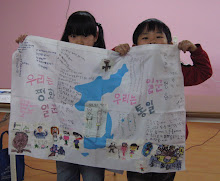
![[URGENT PLEA: In Update] EMERGENCY in GANGJEONG Since AUG. 24, 2011](https://blogger.googleusercontent.com/img/b/R29vZ2xl/AVvXsEiQvpaNf6EePZVucu97_JphYsFS5IgumnSiA4YAmen1PZcim6vMmW7XjZ7J6nLh-Cu36mwBN5n1evrA3ey0vYMpwlAGsgnSFggv6a1w4Qx9BvvqOB0hy0BIcBkL2Exfs3zIxBsBuDGa1kzg/s227/jejusit.jpg)


![[Solidarity from Japan for the Jeju] 253 individuals and 16 groups/organizations](https://blogger.googleusercontent.com/img/b/R29vZ2xl/AVvXsEivji7100kBkr0hzvqYfh4IBBilkZ6XgDIg89jOxS6kTssxsVKC6Wm-fZbKOEsiy3zcO-9gW6GHspD5R_2C9WsGx5S1Z5VPj_OVRF7H6dxdaT0S-2H1eqsDsYvIwOV26VscxTHnKmP5iZmh/s227/jeju_12_10j.jpg)

![[Translation] Korean organizations' statement: Immediately cancel the joint ROK-US drill Nov 26](https://blogger.googleusercontent.com/img/b/R29vZ2xl/AVvXsEgfKDMo-qyEjm5asUtHlREyJY_5Ou-2tyB8SH6aUxiViRbbKR-8W_rirFiGp5DYSoD_KaeNOPMWR0af0ZPUIbJKmR89ImDvADHsGAIqsJVBvJNBEIl5wLd3G_zhPDW3Z2SxsHXadOsXe8st/s227/1.jpg)
![HOT! [Hankyoreh Hani TV] Beneath the Surface: the investigation into the sinking of the Cheonan](https://blogger.googleusercontent.com/img/b/R29vZ2xl/AVvXsEh80rL3Qv9GnfHSqbYMfivdqX5gZN-1O_VQj3A_Gk3yjWdybHwJCsprA3l6cEQB0cYCP2oNeaLo2ohLGIy0Uqqkv_fRkBevGJ2f-qkKD5eP1ZGsKeQ-r-jHUUb79WvucIN7hpEtXza4xXCL/s227/HaniTV+Cheonan.gif)


![[Translation]Statement against illegal inspection and unjust lay-off by the Kunsan USAFK!(Nov_2010)](https://blogger.googleusercontent.com/img/b/R29vZ2xl/AVvXsEg3JlQ-lreusCIJo5Yv2e3ZrRwrSMUE7UQxlrDVjmBehl0Pa24QZIAbZ5vUpgnnExbkKL9PdCwxVYSHWJkr_XK0FM4EhU3CMFhqfborVNu_p4v3bEFpNm3ia-aEHnvMMuEBI27aB7_BETuJ/s227/gunsan+protest.gif)
![[Translation] Korean organizations' statement against dispatching special force to the UAE on Nov.](https://blogger.googleusercontent.com/img/b/R29vZ2xl/AVvXsEiU7TNhTDLLwZkKP0Z78JsCZKp6je-QSFll3_ThmLES_y_nPLXEzeakrsZXoNxhN5blopEhy6xGV2tneJrniPdTR-JvOQMmSLr_HhlucxFvbusxk4oKvvMO2laBOHSIkB9OOeOxrQlqCA0O/s227/antiwarpeace.jpg)
![[Translation] Stop, Joining MD!: South Korean activists' statement and writing on Oct. 25, 2010](https://blogger.googleusercontent.com/img/b/R29vZ2xl/AVvXsEggGIHVei8j7LCJPJB5HIrspd942q436daNTquP-pFd45Cl70Ml_1JFiFDHgKu6FcoqNgFVKIFqjeuSPau2k_BwGHhx0cqFFL2-4ybZSTlmua0_AsERBtKYQa7jZk7uNj41LX6rj2vksHbo/s227/StopMD.jpg)
![[In Update] People First, NO G-20 (Nov. 6 to 12, Korea)](https://blogger.googleusercontent.com/img/b/R29vZ2xl/AVvXsEhZl8VTqeL7o2ndliGIE-sZFCikbTgfB9KCc3AtZvDaYijBBEhdfultMEOpyrCaD5gzpH8mqfWjU20KXMbSUl-5KM7yQeHU6z3BWV8tiOy4UKaCudz9VKWoi5x58xdC_gQpJTjkR5u7O9xf/s227/left21_G20.jpg)
![[International Petition] Stop US helipad plan in Okinawa to save great nature](https://blogger.googleusercontent.com/img/b/R29vZ2xl/AVvXsEihgYmdb0N8ViPvTFC_5i-Psbt4eX_LnAUEOtZkUngv_pGvRyWag1r6W60NicLLyTgWq-sPT1hBxLY5SadEIVv5McfZQ5uIhe-W0VoflQNqojsYZjFW6AH-gB1jsmSDGnGuKIFk2UkvNbFG/s227/yanbaru_w.jpg)
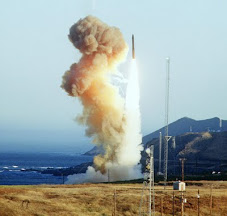
![[Global Network] against the first launch of Quasi-Zenith Satellite, Japan, on Sept. 11, 2010](https://blogger.googleusercontent.com/img/b/R29vZ2xl/AVvXsEj2sYpfodDDMIA7qXwuda0DmKapxXFB479fDnn8RKy7QNZqz0VEvWucNd-DleZ37hWNXC-Z8QtaqtM37VuPwac5SgclJ9_khBBSWOedvm19MRXIP1j1kcWrK6EW5IFjQdEEY2h7E6xuyNvC/s227/Qzss-45-0_09.jpg)
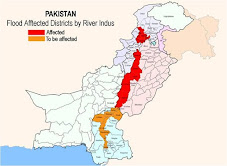
![[In update] Some collections on the Koreans’ protests against the sanction & war on Iran](http://4.bp.blogspot.com/_gnM5QlRx-4c/TJMvke6t8zI/AAAAAAAAFO4/tamQ8LUnOOA/S227/No+Sanction+on+Iran.jpg)
![[Three International Petitions] to End the Korean war and peace treaty(or peace resolution)](https://blogger.googleusercontent.com/img/b/R29vZ2xl/AVvXsEhlohLVYtpCg7iMsZhNYY4hBbhTi2dIheHMHWLDph9X2y78cjgZV1LeSfUJeu80elhJm70Q9E059q72lK-spSPvsRG4bPuCDIytltJB9IH3mWt9OG98HqhnTsPakwhvNeoCFUgF1xoxQ2EZ/s227/border.jpg)


![[Collection of Documents] No Base Learning and Solidarity Program_Korea(June 14 to 20, 2010)](https://blogger.googleusercontent.com/img/b/R29vZ2xl/AVvXsEix_HzjToh3nNGHBc-_5gasq-ykcaZ6GInLixILmZVyRJ5xoeHCxWOyYd9fSM7bmnuFsjSrYOGEPnQOwB1Dcyo-sN4Pw0cFPhUtKig_qlVnGL1Wi82ClvPqbEPWYhJiqdNF0DyzLIBETMB9/s227/No-Base-banner.jpg)
![Site Fwd:[John Hines] A U.S. Debate coach’s research trip on the Issues of Korea](https://blogger.googleusercontent.com/img/b/R29vZ2xl/AVvXsEg8yRra0zNhKHN74Auqhd3Nx9tZ7BWCGflRJHGH4CfzBT_yjhZ8Nl9b3OZuLpYWJ2exsjmR0oVl-Qq_cf832p2VdmOZhUi-lCFzCNeDSyVtweX1lWZPC-RlHmDMLtilHwHjNFTenBiM4Fk4/s227/Jeju-Peace-Tour.jpg)


![[News Update] Struggle Against the Jeju Naval Base since Jan. 18, 2010](https://blogger.googleusercontent.com/img/b/R29vZ2xl/AVvXsEhKfSTRC5QKBBSFIq_m7QIqXdlbL4-gF5GJYn9Q-pN__k7sV7uxGDcLY5L8xmU7QuWuUhBT_GhG-URBPO80RT3AfWfDrWJr06h1hFuZC6ZBVKe4U6PS1Cd7Kr6olO8TYQtk13Drox7IS6ea/s226/scrum1.jpg)


![[Urgent] Please spread the Letter!: There was no Explosion! There was no Torpedo! (May 26, 2010)](https://blogger.googleusercontent.com/img/b/R29vZ2xl/AVvXsEhSd2yWZ3xGwnJQXB73z5FgXCqSosAoB9_33-GLYprOmLqjmvgSAQp1BYI7e4slK1FDxHRi9KK4um-OpDaj8QOkXwAScVAgvvq6-ehbDA-hbkr96wT9oHNNmWnBPv8GU4hoZp9X8F9AZBX4/s227/grounded.jpg)
![Text Fwd: [Stephen Gowans]The sinking of the Cheonan: Another Gulf of Tonkin incident](https://blogger.googleusercontent.com/img/b/R29vZ2xl/AVvXsEi_L6hB3RZ1MovTXHe0A8yn_RfgMALGR0kM6poBuGp809xwvHtB_-PGWtS_WpyPWatyd9lB2pPqL2gOLc4dTCEdJ9sMvxJWEdapl-mMLm7WHAsV-jVpgqarVh8XBtdz_0c-Vohdh3HtJahD/s227/lee-myung-bak.jpg)
![[Japan Focus]Politics in Command: The "International" Investigation into the Sinking of the Cheonan](https://blogger.googleusercontent.com/img/b/R29vZ2xl/AVvXsEiHmTo8v-uCJnabRhMdnBAkC9J3s5bb2JsDKiT5leJHwbK8IDJHxfJmqQ_C0Is_bPC6UGMf05CA0exF2y4r2x9RhFUHT0kjsKviaME_MZXKnq775UyYAdb7w2SAzE75XvBfHp1al2q6i3cf/s227/wen_jiabao_and_lee_myungbak.png)
![[Japan Focus] Who Sank the SK Warship Cheonan? A New Stage in the US-Korean War and US-China](https://blogger.googleusercontent.com/img/b/R29vZ2xl/AVvXsEiKSS5ULT5QBaMGYpXXqBMX9jtwLwMLuK469b6Ku72GTJYKUObzTANaPjZqvvpPzYMJgPF53sjhvhK3DVa88ipYlggsJageykXlkxY6s8TW05xcU-_vfhf-pACUoaWuFbT-fsU1qEhm_yIi/s227/buoy_map.gif)
![[Updated on 12/13/10] [Translation Project] Overseas Proofs on the Damages by the Military Bases](https://blogger.googleusercontent.com/img/b/R29vZ2xl/AVvXsEikADE6JovUNspQyZUWVMTLAQg7yQNqXpVUbqZPk8f4uc_1723_xm1Cco6WAmstQXVPnaJAcb1mZA8Ny_3xONT_f5uh8MNLPnUhtqdGgy3HCtC1Vbbz4Q0ZY1Cssu-4cJEVNdrvznbS5UzO/s227/missile.jpg)
![[International Petition] Close the Bases in Okinawa](https://blogger.googleusercontent.com/img/b/R29vZ2xl/AVvXsEhNpQiHklwFbWVlFK7GDFXnBSOOSFEj3Il-We-N3uTDldKiidL2NGZs7X_LtTnatzTo_r8CexRkFe8NhfxYqmgp1knEEslROTfNjI5_mSb57cdbhPkftvanveYBaevAD9xuKDGoIxiTwoSb/s227/2.jpg)
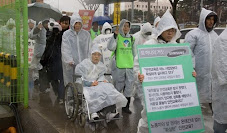
![[In Update]Blog Collection: No Korean Troops in Afghanistan](https://blogger.googleusercontent.com/img/b/R29vZ2xl/AVvXsEjjEmCRXSNAG7_QBxKWbdksmxoWR4nyAovQTTdR1G2AuXh0jxtqNkI9OmYgYWRoLAJShvtBvE840QXuBWSVh3u3zMYqkNAFX6OWy3m5Nur4HM7uNK-pKT1ycyApJp-VLyhIFRRcoisYAh0E/s226/No-Troops-to--Afghanistan.jpg)


