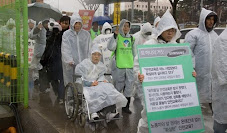
'저는 그들의 땅을 지키기 위하여 싸웠던 인디안들의 이야기를 기억합니다. 백인들이 그들의 신성한 숲에 도로를 만들기 위하여 나무들을 잘랐습니다. 매일밤 인디안들이 나가서 백인들이 만든 그 길을 해체하면 그 다음 날 백인들이 와서 도로를 다시 짓곤 했습니다. 한동안 그 것이 반복되었습니다. 그러던 어느날, 숲에서 가장 큰 나무가 백인들이 일할 동안 그들 머리 위로 떨어져 말과 마차들을 파괴하고 그들 중 몇몇을 죽였습니다. 그러자 백인들은 떠났고 결코 다시 오지 않았습니다….' (브루스 개그논)


For any updates on the struggle against the Jeju naval base, please go to savejejunow.org and facebook no naval base on Jeju. The facebook provides latest updates.
Showing posts with label Russia/China relationship with the Korea. Show all posts

Saturday, March 26, 2011

Text Fwd: Following Cheonan friction, S.Korea at a diplomatic crossroads

The Hankyoreh Peace Institute, People’s Solidarity for Participatory Democracy, and the Three Press Groups‘ Verification Committee of the Results of the Cheonan Investigation host an event on the anniversary of the sinking of the Cheonan entitled, “Cheonan Truth and Democracy, and Peace on the Korean Peninsula,” at the National Assembly, Mar. 24. (Photo by Tak Ki-hyung) 

Hankyoreh
Following Cheonan friction, S.Korea at a diplomatic crossroads
:Seoul must decide whether to adhere to its hardline position or join the international shift towards dialogue
By Yi Yong-in, Staff Writer 
March 25, 2011

The year 2010 began with a timid thaw following the frosty political situation on the Korean Peninsula resulting from North Korea’s 2009 missile launch and nuclear test. In late March of that year, Pyongyang and Washington made secret arrangements for a visit to the U.S. by North Korean First Deputy Foreign Minister Kim Kye-gwan. D-Day was to be mid-April. Just as the two countries were about to finalize the agreement, the Cheonan went down on Mar. 26.
With the sinking, the situation on the peninsula went into zero visibility conditions, where everything was unpredictable. Conflict deepened between Seoul and Beijing, and a clash of power arose between Washington and Beijing. In November, Yeonpyeong Island saw the first artillery attack since the end of the Korean War. The Cheonan sinking sat at the starting point of the heightening of peninsular tensions that led to an artillery exchange between North Korea and South Korea.

The Cheonan sinking brought a reprise of friction between Cold War-era camps to Northeast Asia. To begin with, South Korea, the United States, and Japan on one side and North Korea, China, and Russia on the other offered conflicting determinations as to the cause of the sinking. South Korea’s Joint Investigation Group (JIG) announced that the vessel had gone down due to a North Korean torpedo attack. After an initial silence, Washington began actively involving itself in the investigation in late April and assisted with the South Korean government’s announcement.

North Korea, in contrast, strenuously denied its involvement, and China aligned itself along with this. A government source familiar with the Cheonan investigation process recounted, “The Chinese military determined that it was not a North Korean attack based on its own intelligence, and this determination was passed on to the highest leadership level.” Russia, which dispatched its own investigation team to South Korea, concluded that the so-called “No. 1 torpedo” was “merely torpedo debris, and [the Cheonan’s sinking] is presumed to be due to a mine explosion.”
Also the subject of sharp clashing was the strategic political response to and use of the Cheonan incident. For the Barack Obama administration, which had been facing turbulence with the Yukio Hatoyama administration in Japan over the potential removal of a U.S. armed forces base on Okinawa, the Cheonan situation provided a way through the problem. Visiting Japan on May 22, U.S. Secretary of State Hillary Rodham Clinton recalled the Cheonan, saying that the threat to South Korea was also a threat to Japan. The next day, Hatoyama announced that he was effectively scrapping plans to relocate the USFJ base.

The United States also saw its military influence on South Korea wax further, achieveing a restoration of the “Southern axis” of South Korea, the United States, and Japan as a check against Beijing.

Beijing protested. In particular, it vehemently criticized the U.S.’s introduction of its nuclear-powered aircraft carrier USS George Washington in the West Sea during joint exercises with the South Korean military, and expressed strong suspicions that the U.S. was training to block the Taiwan Strait in the event of an emergency. Distrust and friction built up between Washington and Beijing, and between Seoul and Beijing.

In the process, North Korea and South Korea lost the power to guide the political situation. Seoul announced the “May 24 measures” in response to the Cheonan sinking, which halted all trade and exchange with North Korea except for the Kaesong Industrial Complex. It also engaged in a large-scale naval show of force with the U.S.

One year later, the peninsula finds itself at a crossroads. After carrying on an intense battle of wills for around one year, Washington and Beijing declared a “strategic partnership” at a Jan. 19 summit meeting. The U.S. cautiously began to look for ways to get dialogue going with Pyongyang via the resumption of food aid to North Korea.

With the countries surrounding the peninsula apparently having changed course toward negotiation, the Lee Myung-bak administration is now facing a fork in the road. Will it join in the larger trend, even if it means skirting the Cheonan issue at the risk of protests from domestic North Korea hard-liners, or will it carry on holding out against pressure from the international community to improve its relations with Pyongyang? Analysts say that this choice will determine whether the peninsula proceeds toward peace and stability or conflict and friction.
Please direct questions or comments to [englishhani@hani.co.kr]
____________________________________
See also Add Image
Citizens present flowers at the group memorial for sailors in the week leading up to the one-year anniversary of the sinking of the Cheonan, Mar. 24. (Photo by Rhee Jong-chan)

Hankyoreh
Cheonan 1 year later: enduring doubts and unyielding posture
:As the Lee administration released a white paper, scientists continued to question the evidence presented by the JIG
By Kwon Hyuk-chul, Staff Writer
March 25, 2011

“The investigation findings stating that the Cheonan sank due to a CHT-02D torpedo fired by North Korea are a patently confirmed truth, and it is unfortunate that there are some people who are unable to believe this truth.” This has frequent statement from military authorities has continued recently as the one-year anniversary of the sinking of the Cheonan approaches.

READ MORE

Thursday, March 3, 2011

Text Fwd: Kurils: U.S.-Japan-South Korea Axis Also Aimed At Russia

* Text fwd from Rick Rozoff on March 1, 2011

Global Times
March 2, 2011
Russia gazes East with new defense plans
By Liu Qian

-To some Russian experts, the intensified military operations between the US, Japan and South Korea in the Asia-Pacific region not only aimed at intimidating North Korea and China, but also displayed their military might to Russia.

Russia seems to be tired of its recent verbal war with Japan over the disputed Southern Kuril Islands, or, as the Japanese term them, the Northern Territories. Now it's bringing the conflict to a new level.

On February 9, Russian President Dmitry Medvedev called on Defense Minister Anatoly Serdyukov to strengthen the defense of these islands, bringing a more military aspect to the territorial dispute.

When Medvedev met with Serdyukov and Viktor Basargin, Minister of Regional Development, he said that the Southern Kuril Islands were an inalienable part of and a strategic bulwark for Russia. He indicated that the forces stationed there should be equipped with up-to-date weaponry.

According to reports by the Russian press, the military equipment currently used by forces in the Southern Kuril Islands is seriously outdated. Alexander Khramchikhin, the Deputy Director of the Moscow-based Institute for Politics and Military, described them as "antiques even in the 1950s."

A senior member from the General Staff Department of the Russian Army said that troops on the islands would be equipped with anti-aircraft guns, anti-aircraft missiles and even the newest S-400 air defense system. On Friday, Nikolai Makarov, chief of the General Staff of the Russian Armed Forces, said that one to two ships might also be sent to the Pacific fleet to deal with the security issues there.

After the disintegration of the Soviet Union, Russia's strategic center has been moving toward the West. The Kremlin had to deal with an expanding NATO and had no time to develop its influence in the East.

When the Asia-Pacific region became the focus of world attention, with many countries enhancing their military and economic power there, Russia had to admit that it had fallen behind in the region. However, after Medvedev reached an agreement with US President Barack Obama in the missile defense, Russia had energy to develop in the East.

To some Russian experts, the intensified military operations between the US, Japan and South Korea in the Asia-Pacific region not only aimed at intimidating North Korea and China, but also displayed their military might to Russia.

Khramchikhin claimed that it is entirely possible for Japan to take military action if a radical crisis emerges in East Asia, as they have a territorial dispute with Russia. He added that the military forces currently stationed in the Southern Kuril Islands couldn't contend with Japan.

Russian actions, from Medvedev's visit to the islands to the current plans for rearmanent, show that the nation's strategic purpose is to rebuild its strategic position in the Asia-Pacific.

Other countries in the region are also involved to some degree. Russia has tried to draw other countries to its side on the issue, inviting Chinese and South Korean companies to tap business in the disputed area. The Russian Foreign Ministry called on the US not to intervene in the dispute.

If Russia enhances its naval and air abilities in the Southern Kuril Islands, and expands its Pacific fleet to strengthen the ability to launch marine attacks, the military forces in the islands will be capable of working in concert with military bases in Vladivostok and the Kamchatka Peninsula.

This will certainly affect the security strategy of neighboring countries, and even intensify the potential arms race in Northeast Asia.

The author is a Beijing-based journalist.
________________________
Stop NATO e-mail list home page with archives and search engine
Stop NATO website and articles:

Saturday, January 22, 2011

Text Fwd: The US-China Summit Must Be Used as a Springboard for North-South Korea Dialogue

* Image & caption source: Hankyoreh, Jan. 21, 2011
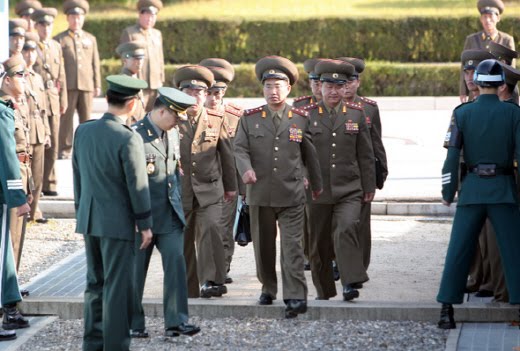
A delegation from North Korea crosses the military demarcation line at Panmunjom for military talks, October 2008. (Photo pool)
* Image source: Hankyoreh, Jan. 21, 2011
'U.S. President Barack Obama, left, and Chinese President Hu Jintao, right, shake hands after concluding a joint press conference at the White House in Washington D.C., Jan. 19. (Reuters Yonhap) '
_____________________________________________

Kyunghyang Shinmun
The US-China Summit Must Be Used as a Springboard for North-South Korea Dialogue
Posted on : 2011-01-21 15:32

Through their summit meeting, US and Chinese presidents Barack Obama and Hu Jintao have once again confirmed that the key to solving the problems of the Korean Peninsula lies with North and South Korea. While expressing agreement on the importance of peace and stability on the Korean Peninsula and the need for dialogue between the two Koreas, the two leaders were careful not to mention specific solutions. However, Obama and Hu have effectively left it up to North and South Korea to make the breakthrough that leads to dialogue.

What Obama and Hu emphasized in their joint statement and joint press conference was mutual respect and cooperation between two Koreas. Through the first state visit of a Chinese leader to America in 14 years, the two countries have confirmed China's rise to the status of a G2 nation and agreed to gradually mend hitherto awkward bilateral relations in a spirit of "seeking similarities and respecting differences."

That is why this US-China summit has been evaluated in terms of symbolism rather than content. Hu Jintao's public acknowledgment of the universality of human rights issues and the need to improve them, while asserting distinct characteristics of his own country's human rights problem, can be interpreted as the product of such a spirit.

The spirit of the summit meeting is apparent in the way it talks about the issues of the Korean Peninsula. In their joint statement, the two presidents expressed their concerns regarding last year's Cheonan and Yeonpyeong Island incidents using the indirect term "recent events." In remarks at their joint press conference, Obama went one step further, saying, "We agreed that North Korea must not commit further provocations." Hu did not object.

The US and China also showed unity regarding the problem of North Korea's uranium enrichment. This was an example of the two states finding points of compromise and speaking in unison on a matter where their viewpoints had previously differed. As with the human rights issue, a subtle change from China can be perceived.

The message from the US and Chinese leaders to North and South Korea is clear. Their joint statement said that the two sides agreed that "Sincere and constructive North-South dialogue is an essential measure." Though genuineness and constructiveness had been stuck on as modifiers, but the weight lay in the notion that the Korean Peninsula must move beyond its current phase of confrontation and into one of dialogue.

In the same vein, the statement emphasized that such dialogue was "a necessary measure that can lead to resumption of the six party talks process as soon as possible." This passage gives notice that the two states will soon begin follow-up efforts to bring about dialogue, though they show differing levels of enthusiasm over specific plans for this.

Given this, North Korea's proposal of high-level military talks immediately after the US-China summit meeting, and the South's decision to agree to them, gives hope for the first time in ages of a development in North-South Korean relations.

Both Koreas must keep the flames of hope alive and lead their peninsula onto a path of peace and prosperity. This is the path demanded of both North and South, not just by the US and China, but by international society. It is the mission that the two Koreas must achieve in the present era.

To this end, it is essential that North and South Korea head into talks sincerely, rather than just attempting to avoid international pressure or the current crisis. It is to be hoped that both North and South Korea move beyond their existing, stagnating stances and prepare for talks from positions of greater flexibility. (Ed. Jan 21, 2011)

_____________________________________
See also

Hankyoreh
S.Korea agrees to inter-Korean military talks
:The administration faces pressure from repeated diplomatic overtures from N.Korea and calls for dialogue from the China-U.S. Summit

Jan. 21, 2011

Hankyoreh
U.S.-China Joint Statement expresses concerns and need for inter-Korean dialogue
:The statement placed more pressure on N.Korea and S.Korea to move towards resolving tensions on the Korean peninsula

Jan. 21, 2011

Organizing Notes
Thursday, January 20, 2011
THE "IN" CROWD - GUEST LIST FOR CHINESE STATE DINNER

Thursday, January 20, 2011

Text Fwd: Obama, Hu call on N. Korea to stop provocations, abide by denuclearization commitment

Yonhap News
Obama, Hu call on N. Korea to stop provocations, abide by denuclearization commitment
By Hwang Doo-hyong

WASHINGTON, Jan. 19 (Yonhap) -- The United States and China Wednesday called on North Korea to stop provocations and abide by its denuclearization pledge.

Speaking at a joint press conference at the White House with Chinese President Hu Jintao, U.S. President Barack Obama said, "I told President Hu that we appreciated China's role in reducing tensions on the Korean Peninsula. And we agreed that North Korea must avoid further provocations. We agreed that the paramount goal must be complete denuclearization of the peninsula."

[..]
The dialogue extensively touched upon North Korea, Iran's nuclear ambitions, the Chinese currency yuan's revaluation, human rights and climate change, the leaders said.

Hu later attended a luncheon at the State Department hosted by Vice President Joe Biden and Secretary Hillary Clinton, and visited a new Chinese embassy complex before attending a state dinner at the White House. On Thursday, Hu will visit congressional leaders on Capitol Hill and give a speech at a luncheon meeting with business leaders before leaving for Chicago later in the day.

"North Korea's nuclear and ballistic missile program is increasingly a direct threat to the security of the United States and our allies," Obama said.

Obama was apparently referring to remarks by U.S. Defense Secretary Robert Gates, who said last week that North Korea's missiles and nuclear weapons will pose a threat to the U.S. within five years and urged the North to impose a moratorium on nuclear and missile testing to help revive the six-party nuclear talks.

READ MORE

Thursday, December 23, 2010

Text Fwd: South Korea To Begin Major War Games Tomorrow

* Texts informed by Rick Rozoff on Dec. 22, 2010

Xinhua News Agency
December 22, 2010
S Korea to stage ground, air firing drill Thursday

SEOUL: South Korea plans to hold a major drill Thursday involving artillery guns and fighter jets following its live-fire drill near a disputed sea border earlier this week, the Army said Wednesday.

The ground and air firing drill, which officials said is part of routine exercises, will take place at a firing range in Pocheon, 40 kilometers northeast of Seoul and 25 kilometers south of the heavily fortified land border between the two Koreas.

It follows a firing drill Monday from the western border island of Yeonpyeong shelled last month by the Democratic People's Republic of Korea (DPRK). The country also started Wednesday four- day sea maneuvers in waters off the east coast of the Korean peninsula.

The series of routine exercises come amid heightened tension in the region as South Korea remains on alert against retaliation from the DPRK, which did not immediately respond to Monday's brief shooting drill it had vehemently protested.

Related:

S Korea begins four-day sea maneuvers in East Sea

SEOUL: South Korea will hold four-day drills in waters off the east coast of the Korean peninsula starting Wednesday, two days after it conducted a live-fire exercise near a tense border, the defense ministry said.

The exercise, reportedly to be held about 100 kilometers south of the eastern sea border with the Democratic People's Republic of Korea (DPRK), will involve navy vessels and Lynx helicopters, according to local reports.
China calls for restraint, dialogue on Korean Peninsula issue

BEIJING: China Tuesday urged all parties involved in the Korean Peninsula situation to remain calm and exercise restraint to avoid future unfortunate incidents.

"The Korean Peninsula situation is still complicated and sensitive," Foreign Ministry spokeswoman Jiang Yu said at a regular news briefing as she called on all parties to have a responsible attitude.Full story

Russian, DPRK diplomats discuss situation on Korean peninsula

MOSCOW: Diplomats of Russia and the Democratic People's Republic of Korea (DPRK) met here Tuesday and discussed possible measures to stabilize the situation on Korean peninsula.

During the meeting with the DPRK ambassador to Moscow Kim Yong Jae, Russian Deputy Foreign Minister Alexei Borodavkin stressed that Russia is seeking "solutions to the issues between Pyongyang and Seoul by political-diplomatic ways," according to a statement of the Russian Foreign Ministry. Full story

________________________________
See also
Defense News
Top Chinese Diplomat: Korean Tensions Came Close To War
Agence France-Presse
December 21, 2010

Ros Business Consulting News Online
Russia Urges Resumption Of Korean Six-Party Talks
December 22, 2010

Monday, December 20, 2010

Text Fwd: Russian, Chinese FMs Call For Restraint On Korean Peninsula

* Texts sent from Rick Rozoff on Dec. 19, 2010

Xinhua News Agency
December 19, 2010
Chinese, Russian FMs call for restraint on Korean Peninsula

-China is willing to keep close communication and coordination with Russia to prevent the situation from deteriorating and getting out of control, and help maintain peace and stability on the peninsula and in Northeast Asia.

ISLAMABAD: Chinese Foreign Minister Yang Jiechi and his Russian counterpart Sergei Lavrov on Saturday night called for restraint from all parties concerned to avoid escalation of tension on the Korean Peninsula.

During a phone conversation with Lavrov, Yang, who is accompanying Chinese Premier Wen Jiabao on a visit to Pakistan, said the situation on the peninsula has become tense recently and may further deteriorate.

China firmly opposes any actions to cause tension and worsen the situation, and demands both sides on the peninsula show calmness and restraint, carry out dialogue and contact, and completely avoid any actions that would fuel the tension, Yang said.

China hopes other concerned parties would do more to help ease the situation on the peninsula, he added.

Yang said China insists that all parties concerned conduct dialogue and consultation, and seek a peaceful settlement of the dispute.

China is willing to keep close communication and coordination with Russia to prevent the situation from deteriorating and getting out of control, and help maintain peace and stability on the peninsula and in Northeast Asia.

Lavrov, for his part, said Russia attaches high importance to the developments on the peninsula, adding his country has expressed great concern to relevant countries and demanded utmost calmness and restraint from all parties concerned.

Russia is willing to work with China to make active efforts to reduce the tension on the peninsula, he said.

South Korea has declared plans for a live-five artillery drill in the tense waters southwest of Yeonpyeong Island on a selected date from Dec. 18-21 depending on weather conditions.

The Democratic People's Republic of Korea (DPRK) on Friday urged Seoul to immediately stop its plans for the shelling exercise, warning it would deliver a second and third "unpredicted self-defense counterattack" that would be bigger and more powerful than the previous one.

South Korea and the DPRK exchanged artillery fire near the Yeonpyeong Island on Nov. 23, which killed four South Koreans.
===========================
Stop NATO
Blog site
_____________________________
See also

Russian Information Agency Novosti

Russian-Initiated Emergency UNSC Meeting On Korea Crisis Today

December 19, 2010


Russian Information Agency Novosti
Korea Crisis: China Calls For Urgent Six-Party Talks

December 18, 2010

Thursday, December 16, 2010

Text Fwd: S. Korean FM calls for greater cooperation with China on N. Korea issues 남한 외교 장관, 북한 이슈들 관한 한 중국과의 더 큰 협조 제안

Yonhap News
2010/12/15 16:31 KST
S. Korean FM calls for greater cooperation with China on N. Korea issues

SEOUL, Dec. 15 (Yonhap) -- South Korea and China should build on progress in their relations and seek greater cooperation in economic and security issues, including tensions over North Korea's nuclear programs and provocations, Seoul's foreign minister said Wednesday.

Minister Kim Sung-hwan made the remark at a ceremony on the opening of a China research center at the ministry-affiliated Institute of Foreign Affairs and National Security think tank. The center's launch is part of South Korea's efforts to enhance its capabilities to deal with the increasingly important neighbor.

"For our country, relations with China have been taking an increasingly important place in security and stability on the Korean Peninsula and our prosperity," he said. "Close cooperation between the two countries is essential on issues related to North Korea and nuclear and other North Korea issues."

South Korea and China established diplomatic relations in 1992. Since then, the two countries have made strides in their economic and trade relations, with China overtaking the United States as South Korea's No. 1 trade partner.

But their political and security relations have not moved forward enough to match the economic ties, with China still seen as trying to protect North Korea even when the regime makes provocations, such as last month's deadly artillery attack on a South Korean island.

Such attitudes deepened frustrations in South Korea about ties with the neighboring nation.

"It is essential that the two countries take an attitude of actively communicating about differences and cooperating while cherishing the achievement made in their relations so far," Kim said. "It is absolutely necessary and indispensable that South Korea and China constantly exchange views and cooperate closely."

Xing Haiming, charge d'affaires at the Chinese Embassy in Seoul, said Beijing "pursues peace and stability on the Korean Peninsula and will make every effort for denuclearization" on the divided peninsula.

"China will make efforts for resolving problems through dialogue and cooperation and will try consistently to achieve the objective while joining hands with South Korea," he said at the ceremony.

The research center will focus on studying Seoul's policies on China while providing China-related education programs and serving as a hub connecting other local research institutes. The foreign ministry also plans to add an office to its bureau handling China affairs to better deal with issues related to the neighboring nation.

Wednesday, December 15, 2010

Text Fwd: Russian Armed Forces on High Alert Over North Korea 러시아 무장 군대, 북한에 대해 높은 경보

*From the Breaking News and Commentary from Citizens for Legitimate Government
670 KBOI
Russian Armed Forces on High Alert Over North Korea
Dec. 14, 2010

Russia announced Tuesday that its armed forces in the east are on high alert. This comes in light of what it calls an "inadequate situation" on the Korean peninsula as tensions have increased in recent weeks between the North and South.


The head of Russia's military said they continue to follow what is happening and have taken measures to raise the forces' combat readiness.


On Monday, Russian Foreign Minister Sergei Lavrov welcomed his North Korean counterpart to Moscow. In the meeting, Lavrov expressed concern with North Korea's ongoing uranium enrichment activities. He also condemned North Korea's attack on the South's Yeonpyeong Island, which has been the source of the recent increased tension.


South Korea's top nuclear official is on his way to Moscow to discuss the disclosure of North Korea's newest uranium enrichment facility and the shelling of Yeonpyeong Island.


Russia joined the U.S. and others in condemning the November attack, which killed four people and brought about the highest tension on the peninsula in years.
Copyright 2010 ABC News Radio

Tuesday, December 14, 2010

Text Fwd: N. Korea agrees on emergency six-way talks: Beijing 북한, 중국과 비상 6자 회담 갖기로 동의

Yonhap News

N. Korea agrees on emergency six-way talks: Beijing
2010/12/14 17:36 KST
By Kim Young-gyo

HONG KONG, Dec. 14 (Yonhap) -- North Korea has agreed to China's proposal to hold emergency discussions among chief envoys to the six-party talks on Pyongyang's nuclear disarmament in a bid to defuse tensions on the Korean Peninsula, China's foreign ministry said Tuesday.

Beijing proposed on Nov. 28 that the lead negotiators from the two Koreas, the U.S., Japan, China and Russia meet at an early date to discuss ways of easing inter-Korean tension sparked by the North's shelling of a South Korean island.

"The agreement was reached when Chinese State Councilor Dai Bingguo met with North Korean leader Kim Jong-il in Pyongyang last week," Jiang Yu, spokesperson for China's foreign ministry, said in a regular press briefing.

"China and North Korea have agreed that the two sides should prevent the tense situation from further escalating and put constructive effort in building peace on the Korean Peninsula, while maintaining calmness and restraint," Jiang said.


The visit came as China, North Korea's closest political ally and largest benefactor, has been under growing international pressure to exercise its influence over Pyongyang to discourage the belligerent regime from further provocations.

Tensions on the Korean Peninsula have come to a head after North Korea fired artillery on a South Korean island near the disputed maritime border on Nov. 23. The North's attack on Yeonpyeong Island, which is home to fishing communities and military bases, killed two South Korean marines and as many civilians, and left 18 others wounded.

Dai, who advises top Chinese officials on foreign policy, made an unannounced trip to Seoul at the end of November and paid a visit to South Korean President Lee Myung-bak to discuss measures for easing tensions on the peninsula.

A high-level U.S. delegation, led by Deputy Secretary of State James Steinberg, is expected to arrive in China later Tuesday in an effort to urge Beijing to play a greater role in reining in Pyongyang.

Sunday, December 12, 2010

Text Fwd: N. Korea appears to have made little concessions to Chinese envoy 북한은 중국 대사에 거의 타협하지 않은 것으로 보임

Yonhap News
N. Korea appears to have made little concessions to Chinese envoy: Seoul official
2010/12/11 22:28 KST

SEOUL, Dec. 11 (Yonhap) -- North Korea appears to have made little concessions when a top Chinese official visited Pyongyang earlier this week on an apparent mission to defuse tensions over the North's recent artillery attack on a South Korean island, a Seoul official said Saturday.

Chinese State Councilor Dai Bingguo met with North Korean leader Kim Jong-il in Pyongyang on Thursday for discussions on matters of mutual concern that outside analysts believe included the Nov. 23 attack. China briefed Seoul on the outcome of the Kim-Dai meeting through diplomatic channels on Friday night, said the official, requesting anonymity.

_________________________________

See also
Korea Times
'No change in Pyongyang's position'
12-12-2010

Friday, December 10, 2010

Text Fwd: China, North Korea reach consensus over crisis: report 중국과 북한, 위기 관련 동의에 도달

* Informed at the Pacific Command

Yahoo News
China, North Korea reach consensus over crisis: report
By Jack Kim and Ben Blanchard Jack Kim And Ben Blanchard
Thu Dec 9, 4:21 am ET

SEOUL/BEIJING (Reuters) – China and North Korea reached consensus on the Korean peninsula crisis after "candid" talks, Chinese state media reported, which analysts said suggested Pyongyang likely agreed not to inflame the situation.

The meeting came as Beijing and Washington continued to trade barbs over how best to deal with the spike in tension on the divided peninsula, with China rejecting U.S. pressure to take its impoverished ally to task over last month's artillery attack on the South.

China's Xinhua news agency said State Councilor Dai Bingguo met the isolated North's ailing leader Kim Jong-il for talks in the Pyongyang and "the two sides reached consensus on bilateral relations and the situation on the Korean peninsula after candid and in-depth talks."

North Korea's KCNA news agency said the talks were "held over the issue of boosting the friendly and cooperative relations between the two countries and a series of issues of mutual concern."

"It's difficult to expect much in the consensus more than a general agreement on the need to resolve the situation ... in a peaceful manner and through dialogue, and that they can't have tensions escalating," said Park Young-ho of the Korea Institute of National Unification.

Neither news agency gave any further details.

REAF MORE

Sunday, December 5, 2010

Text Fwd: EdgeLeft: Diplomatic notes on North Korea and Wikileaks 북한 외교 노트와 위키리크스

* Text thankfully sent by David McReynolds and then forwarded by Frank Cordaro on Dec. 3. Also thankfully forwarded by Edward Evans and then Lotus Fong on Nov. 3 and 4, 2010.

[CRAP-SF]
EdgeLeft: Diplomatic notes on North Korea and Wikileaks
by David McReynolds

(EdgeLeft is an occasional column which can be distributed and/or reprinted without permission)

Wikileaks indicated that China has expressed some reservations about the Democratic People's Republic of North Korea (DPRK), even contemplating its possible unification with South Korea. (It isn't much of a secret that China is worried that, in the event of the collapse of the DPRK, China might be overwhelmed by refugees). It is my assumption that the DPRK had already wanted to broaden its openings to the world, and not be so heavily dependent on China as its only ally.

(In a piece I sent out earlier this week I had noted the visit by two delegates from the DPRK to a conference in Norway of the International Peace Bureau, and the odd visit of three North Korean trade unionists in 1997 looking for contact with the "U.S. Labor Party").

As some of you know, I'm a terrible proof reader, and should let someone check this first, but let me send this out as a bit of history while the time is right - which is now. This is a story which doesn't begin in Asia at all, but with the German Democratic Republic (GDR). So here it is, my first and final draft of some diplomatic memories.

My own role is, at best, merely a guest at history's table, but I have had the chance to see some things before others were aware of them. I had been in East Berlin a couple of times during the height of the Cold War and found it terribly oppressive. The police, whom I remember as dressed in grey, marched through the streets with their rifles. The apartment buildings had none of the wonderful bursts of flowers in window boxes which one saw in even the poorest sections of West Berlin. On one occasion the members of the War Resisters International Council, of which I was a member, were meeting in West Berlin and were invited by the GDR's Peace Committee to dinner at what I think was called the Bertold Brecht House.

We had to chose our delegates with care - one or two would not have been permitted past the Berlin Wall because of involvement with dissidents. Our delegation included a courageous Danish member of our Council who had been active in the underground during the war, and our Chair at the time - the redoubtable Myrtle Solomon.

There was one brief moment of unease when a little "pocket calculater and clock", which I carried in my jacket and which sounded the time once every hour, beeped during the middle of something I was saying. I turned to my jacket pocket and said "Be quiet". I assume the GDR folks were convinced it was a CIA device recording all.

The GDR sent delegations to the US and on one occasion the US Peace Council asked if I would host their delegation. I said yes, and, knowing that most of the time they would have been wined and dined in the spacious apartments of Communists in New York City, I said we would meet at my apartment, a fourth floor walkup on the Lower East Side.

We had a small group of our people, Paul Mayer and Norma Becker were there - I'm not sure who else. The Germans were very late in coming, Norma, who had a habit of smoking pot, had broken out a joint and passed it around, so that when the Germans finally did come "our side" was mildly high. The occasion was rather stiff and formal. They were talking in platitudes about peace and democracy, while we wanted to have a real discussion. At one point, somewhat impatient, I said "This is all very interesting, but we would like to have your views on Solidarity". (The Polish union was just then much in the news). I'm afraid my question brought the meeting to an early conclusion, and their American minders got them safely out.

But from time to time, at the office of War Resisters League, I would have visitors drop by from Pravda, from the Soviet Peace Committee and, somewhat oddly, a young man from the GDR Consulate in Washington, DC.

One afternoon the young man from the GDR came to visit, shortly after Yuri Andropov had assumed command of the Soviet Union. He told me to expect major shifts in Soviet policy. He said "I've been to parts of the Soviet Union that are off limits to tourists - the situation is not good. There will be changes, so great you may not believe them". Andropov, who had headed the KGB, had been a hard-liner in dealing with the crisis in Czechoslovakia in 1968. But he was, as my East German friend had said, a man who sought major reforms in the Soviet Union. (It was during his time in office that Samantha Smith

was invited to the Soviet Union - Samantha was an American child who had written Andropov urging peace). When his health began to fail, he strongly urged that Gorbachev replace him. That however, didn't happen - Cherenenko took his place before, in turn, falling ill and dying. That was when Gorbachev became the head of the Soviet Union. Gorbachev was the KGB candidate.

Because of that visit from the young man from the GDR who had told me what Andropov would do, (but who had died before he could do it), when the first signs of change came from Gorbachev, I knew something major was in the wind. At about that time I was going down to Washington DC to give a talk to a pacifist group. My friend from the GDR suggested he meet me for lunch. When we met, I said "I'm not clear what we are supposed to talk about - the FBI is probably following me and the CIA is certainly following you".

On my last trip to East Berlin I asked a young friend who lived in West Berlin to take me across the wall so that I could meet with East German dissidents. I met first with some student dissidents and then with some East German pastors. As I was leaving the pastors I said "I'm going next to meet with the official committee - should I tell them that I've met with you or would that place you in a difficult position?" They said "By all means tell them you've met with us - it is important for the official committee to know that these discussions are going on - in fact, we'll drive you there", and so they drove me to the headquarters of the GDR's Peace Committee. Clearly things had eased enormously from my first visit to East Berlin.

Looking back on this after the collapse of the GDR I realized that what the GDR was doing in a somewhat clumsy way was to try to "open a door to the West", to see if they might find ways of having relations with the West, rather than going through Moscow. Tragically that movement toward change in East Germany ended with the collapse of the GDR. Very strange, that year. I had a wall calendar in my office which I'd been sent by the GDR - before the year was out, the calendar was still up but the GDR had vanished.

In looking at the DPRK I suspect that at least some of those in high places in Pyongyang would like to have a more open window to the West. China has been a very good friend, having sent its own troops to die in the Korean War, and supplying food and energy to a country that is desperately poor. But if I were in Pyongyang and read the Wikileaks in which China and the US discussed possible futures for Korea, I'd want to look for more options. It is quite certain - there is no doubt of this in my mind - that some key forces in the US want to maintain the state of "no peace / no war" with North Korea as an excuse to keep US bases in South Korea and Japan in an effort to encircle China. But there are other key figures - certainly former President Jimmy Carter - who feel that this hard line military approach is neither safe nor sensible.

Thus the kind of relations between the Christian Churches in North and South Korea are of special importance. And the relief work of the Mennonites, while totally non-political, provides a door through which both sides can get a better sense of the other.

Remember the famous "Ping Pong Diplomacy" in 1971, when a team of American ping pong players, who had been in Japan, were invited to China, the first break in the wall, opening the door, eventually, to the visit by Nixon.

So those of us who are outside the doors of power should not think our actions do not count. The end of the Cold War was, in my view, made possible in part because the truly independent "European Nuclear Disarmament" movement (END) gave the Soviets some assurance that if they took the kind of gamble for peace which Gorbachev did, the Americans could not take advantage of it. (Tragically the West never realized the chance it had to move toward genuine disarmament and the dissolution of NATO - still trapped in its old game of domination it simply moved NATO's borders closer to Russia).

These are brief notes, typed in haste. They are meant to assure those of us who think all things in Korea are locked up solidly, that we must watch for any opening to extend a hand of friendship. Not because we are in love with the policies of the DPRK, but because the dangers of war are so much greater and more harmful to all sides than the risks of peace. Signals of great change often come as softly as a drop of water. An open hand achieves more than a closed fist.

(David McReynolds was a chair of War Resisters International, and served as a co-chair of the Socialist Party. He is retired and lives on the Lower East Side in NYC. He can be reached at:dmcreynolds@nyc.rr.com)

_______________________________________________
See also

The Star Phoeninx
WikiLeaks documents expose diplomatic secrets, infuriate White House
By Sheldon Alberts and Juliet O'Neill, Postmedia News Washington Correspondent November 28, 2010


The Star Phoenix
WikiLeaks exposes diplomatic secrets
Release of classified documents threatens diplomats, agents: U.S.
By Sheldon Alberts, Postmedia News November 29, 2010

Text Fwd: China, Russia Excluded From Clinton's Tripartite Talks On Korea 클린턴, 월요일, 남한, 일본과 북한에 대해 논의할 것임

* Text sent from Rick Rozoff on Dec. 4, 2010
Russian Information Agency Novosti
Clinton to discuss N.Korea Monday with S.Korea, Japan - CNN
December 4, 2010

Moscow: U.S. Secretary of State Hillary Clinton will discuss North Korea in a meeting with the South Korean and Japanese foreign ministers on Monday, CNN reported.

The Russian and Chinese foreign ministers have not been invited to the meeting, despite being members of the six-party talks on North Korea.

A senior State Department official told the channel that the meeting was meant to bring the three "cornerstones of security in the region," adding that "China should not view this as a snub."

Clinton will hold separate bilateral talks with Korean Foreign Minister Kim Sung-hwan and Japanese Foreign Minister Seiji Maehara before opening the three-party talks.

Tensions escalated in the region in mid-November when North Korea launched artillery fire at a South Korean island, injuring four soldiers and provoking a retaliatory attack from the South.

The sides will also the perceived threat from North Korea's nuclear program. The secretive state recently revealed the existence of a new uranium enrichment plant.

North Korea pulled out of talks with Russia, Japan, China, the United States and South Korea over its nuclear program last April after the United Nations condemned the communist state's missile tests.

North Korea wants the talks to resume but the United States has refused, insisting that Pyongyang show it is serious about ending provocations and the development of its nuclear program.

On Wednesday, South Korea and the United States concluded four-day joint naval drills to the west of the Korean peninsula in a show of force to deter the North from launching further attacks across its disputed maritime border with the South.

The United States has also launched large-scale joint military exercises with Japan off Japan's southern island of Okinawa.
===========================
Stop NATO
Blog site

Text Fwd: [Rick Rozoff] N. Korea As Pretext: U.S. Builds Asian Military Alliance Against China, Russia 북한은 구실: 미국, 중국과 러시아에 대항해 아시아 군사 동맹 쌓음

* Image source: same as the link
'USS George Washington Carrier Strike Group'

* Text sent from Rick Rozoff on Dec. 4, 2010

Rick Rozoff blog (also in Stop NATO)
North Korea As Pretext: U.S. Builds Asian Military Alliance Against China And Russia
December 3, 2010
Rick Rozoff

On December 1 the U.S. and its South Korean military ally completed four days of naval maneuvers in the Yellow Sea where China claims a 200-mile exclusive economic zone.

The U.S. dispatched the 97,000-ton USS George Washington nuclear-powered aircraft supercarrier for the exercise, accompanied by a carrier strike group consisting of a guided missile cruiser and three guided missile destroyers. The American deployment included 6,000 sailors and 75 aircraft. South Korea supplied destroyers, corvettes, frigates, support ships, anti-submarine aircraft and an undisclosed amount of military personnel.

The war games, which included live-fire shooting and bombing drills, were the latest in a series of U.S.-led military exercises in South Korea and the seas to its east and west beginning in July of this year:

From July 25-28 the U.S. conducted a joint military exercise with South Korea codenamed Invincible Spirit in the Sea of Japan/East Sea with the involvement of 20 warships including the USS George Washington supercarrier, 200 warplanes including F-22 Raptor stealth fighters and 8,000 troops.

In August the U.S. and South Korea conducted this year’s Ulchi Freedom Guardian military exercise, the world's largest command and control simulation drill, in the latter country with 30,000 U.S. and 56,000 South Korean troops participating.

In early September Washington and Seoul held an anti-submarine warfare exercise in the Yellow Sea with two U.S. guided missile destroyers and a fast attack submarine and two South Korean destroyers.

Only the August exercise was a routine one, the latest in a series of Ulchi Freedom Guardian maneuvers held over several decades.

On the day the most recent military exercise ended, December 1, it was announced that the U.S. and South Korea will hold another military exercise this month. [1] The following day "South Korea...readied plans for more live-fire drills as a warning to North Korea and scheduled talks with the United States and Japan on dealing with [North Korea]...." [2] The armed forces of the Republic of Korea will begin five days of artillery drills on December 6 in 29 locations, including on border islands in the Yellow Sea.

On the same day Secretary of State Hillary Clinton will meet with the foreign ministers of South Korea and Japan in Washington, D.C., in a rebuff to China and Russia, which are partners in the six-party talks - along with the U.S., Japan, South Korea and North Korea - that have been held since 2003 after North Korea withdrew from the Nuclear Non-Proliferation Treaty. This despite China calling for an emergency meeting of representatives to the six-nation negotiations and winning North Korea's agreement to rejoin the long-stalled process. On December 2 Russia announced it was ready to participate in emergency talks with the six-country group.

READ MORE

Sunday, November 14, 2010

Video Fwd: [Hani TV] Beneath the Surface: the investigation into the sinking of the Cheonan 天安艦事件調査の矛盾を暴く ハンギョレ系TV [심층리포트] 천안함 사건 5대 미스터리


* Representing image courtesy: Hani TV 대표 이미지는 한겨레 하니 TV 에서 온 것입니다.

___________________________________________________

Attention

* The below English/ Korean scrip was thankfully provided by Mr. Kim Do-Sung, the PD of the below movie, Hankyoreh, on Nov. 15, 2010. Please respect the courtesy of Hani-TV when you need to use it.


* 아래 영/한 다큐멘터리 원고는 한겨레 하니 TV 김도성 PD 님에 의해 2010년 11월 15일 감사히 제공되었읍니다. 필요해 쓰실 경우 하니 TV 출처를 분명히 해주시면 고맙겠읍니다.


Hani_TV_Cheonan_nar_eng_final.docx

36K View Download


* Thanks to M. S. who translated it in Japanese and manages the Anatakara site in Japan, We have a Japanese translated script with images. HERE(click)!
Thanks to Peace Philosophy Center, you can also see the Japanese script HERE(click)!

* 일본에서 아나타카라 사이트를 담당하는 M. S. 가 이미지와 함께 일본어로 스크립트를 번역했읍니다(클릭)!
평화 철학 센터 덕분에, 여기서 일본 번역본을 또한 보실 수 있읍니다(클릭)!

__________________________________________________

* See also a press interview statement(translated) by the Joint Action for the Truth Examination of the Cheonan ship Incident and Peace in the Korean Peninsula on Nov.11, during the G20 summit meetings. The title is, 'Obama, President of the United States should open all the materials related to the Cheonan Ship incident and should not deny people’s demand of truth examination on that any more!!(click)'
* 한편, G20 기간 정상 회담이 있었던 11월 11일, 발표된 천안함 사건 진실규명과 한반도 평화를 위한 공동행동기자 회견문이 영문 번역되었읍니다. 제목은 '오바마 미국 대통령은 천안함 사건과 관련된 모든 자료를 공개하고, 진실규명 요구를 더 이상 거부하지 말라!!' 입니다.(클릭)
__________________________________________________

* 아래 비디오의 국문 버젼 (2010년 9 월 14일 올려짐)은 여기에서 볼 수 있읍니다.(클릭)

* The original Korean version of the below video can be seen HERE ( posted on Sept. 14, 2010)

* 천안함에 관한 모든 한겨레 비디오는 여기에서 볼 수 있읍니다.(클릭)

* You can see all the Korean language video on Cheonan ship, made by the Hankyoreh, HERE.
__________________________________________________


The video was thankfully shared with many overseas sites: Peace Philosophy Center, Anatakara, DMZ Hawai’i, Reality Zone and Organizing Notes. Apologize if I missed some sites.

이 비디오는 많은 해외 사이트들에 의해 감사히 공유되었읍니다: 평화 철학 센터 (재 캐나다 영어/일어 사이트), 아나타카라 (일본 영어/ 일어 사이트), DMZ 하와이 (하와이), 리얼리티 조운(미국), 그리고 브루스 개그논의 조직 노트 (미국)
. 혹 빠진 사이트가 있다면 사과드립니다.
__________________________________________________


Hankyoreh Notice, Nov. 13, 2010
[Hani TV]Beneath the Surface: the investigation into the sinking of the Cheonan
天安艦事件調査の矛盾を暴く ハンギョレ系TV
[심층리포트] 천안함 사건 5대 미스터리
(Video URL)

-The below video is an English language version.


hanitv | November 11, 2010

'A documentary about unknown story behind the mysterious sinking of the warship. On March 26, 2010, the South Korean Navy's patrol combat corvette Cheonan sank, and with it took the lives of 46 of the 104 sailors aboard. Journalists have worked to uncover the facts behind what happened, and this documentary is a gathering of our investigation findings to date. Our findings uncovered significant flaws in the Civilian-Military Joint Investigation Group's report, and suggest that the next necessary step is a reinvestigation.'
___________________________________________________________

For more info, See the Hankyoreh notice (Nov. 13), HERE

Excerpt

The film also frames the ship’s sinking in a political context, and contends that tensions between the South Korea-U.S. and North Korea-China alliances in addition to the June 2 local elections were both factors in the rush to release the JIG’s findings, after a short two-month investigation.

_________________________________________________
* See also

Tuesday, August 31, 2010
Video Fwd: [Al Zazeera] SHIP SINKING MYSTERY STILL NOT SOLVED IN KOREA 비디오: [알 자지라 방송] 아직도 풀리지 않은 한국 침몰함 미스테리


Letter to Call Upon the Truth Examination of the Cheonan Ship, Stop of the ROK-US War Exercise, And Conclusion of the Peace Agreement
(by theJoint Action for the Truth Examination of the Cheonan ship Incident and Peace in the Korean Peninsula
on July 25, 2010)
천안함 진실규명, 한미 군사훈련 중단, 평화협정 체결 촉구 서한
(천안함 사건 진실규명과 한반도 평화를 위한 공동행동 2010년 7월 25일
발표)

Saturday, October 30, 2010

Text Fwd: [News Briefing] Standoff intensifies over China’s Korean War remarks 중국의 한국 전쟁 발언으로 한미 와 중국 관계 거리감 심화

Hankyoreh
[News Briefing] Standoff intensifies over China’s Korean War remarks
Oct. 29, 2010

The Chinese government on Thursday supported remarks by China’s Vice President Xi Jinping that China‘s entry into the Korean War was “a great and just war for safeguarding peace and resisting aggression” from the U.S.

Chinese Foreign Ministry spokesman Ma Zhaoxu made the Chinese government’s position clear, saying that Xi’s remarks are the decided view of the Chinese government, while South Korea and the U.S. government have denounced them.

Chinese President Hu Jintao and Xi on Monday met with veterans and heroes of the Chinese People’s Volunteers (CPV) to commemorate the 60th anniversary of the volunteer army entering the Democratic People’s Republic of Korea (DPRK) to help in the war to resist U.S. aggression, according to the Xinhua News Agency. Xi said in his speech that China’s entering was “also a great victory gained by the united combat forces of China’s and the DPRK’s civilians and soldiers, and a great victory in the pursuit of world peace and human progress.”

The Chinese people will never forget the friendship established in battle with the DPRK’s people and army, Xi added. 

The Xinhua and the Chinese Communist Party’s organ People’s Daily, however, ran an article on their websites Thursday to acknowledge that the Korean War was started by North Korea’s invasion based on former Soviet Union documents. 

Thursday, October 28, 2010

[Site Fwd] Peace Philiosophy Center: Wada Haruki: "China-Japan, Facing Necessity to Dissolve the Conflicts over Senkaku Islands through Dialogue" 하루키

* Image source: same as the link
Wada Haruki 和田春樹, 와다 하루키
- from Kyunghyang
Shinmoon
________________________________________________

* 캐나다 소재, 사토코 노리마투가 이끄는 평화 철학 센터가 경향 신문 칼럼, 와다 하루키 교수의 '중.일 센카쿠 열도 문제 대화로 풀어야' 기사를 일본, 영어로 소개한 글입니다. 경향 신문 국문은 여기를 가시길.
________________________________________________

Peace Philosophy Center
Tuesday, October 26, 2010
和田春樹「日中は尖閣島問題を対話で解決すべき」
Haruki: "China-Japan, Facing Necessity to Dissolve the Conflicts over Senkaku Islands through Dialogue"

Here is the Japanese version of a column written on the disupte over Diaoyu/Senkaku Islands by Wada Haruki, professor emeritus of Tokyo University, "China-Japan, Facing Necessity to Dissolve the Conflicts over Senkaku Islands through Dialogue." It appeared on the October 4th issue of Kyunghyang Shinmoon, a newspaper in Korea.

See the Korean version HERE. 경향 신문 국문

An English version was published on Japan Focus: Asia-Pacific Journal. Click HERE.

Wednesday, October 27, 2010

Text Fwd: Taking Harder Stance Toward China, Obama Lines Up Allies 오바마, 중국에 대항하여 동맹국들 결집

* Image & caption source: same as the below link

Feng Li/Getty Images
'Hillary Rodham Clinton with Timothy F. Geithner, left, and Vice Premier Wang Qishan of China in Beijing in May.'


New York Times (* also in Defense News letter, Oct. 26, 2010)
October 25, 2010
Taking Harder Stance Toward China, Obama Lines Up Allies
By MARK LANDLER and SEWELL CHAN

WASHINGTON — The Obama administration, facing a confrontational relationship with China on exchange rates, trade and security issues, is stiffening its approach toward Beijing, seeking allies to confront a newly assertive power that officials now say has little intention of working with the United States.

In a shift from its assiduous one-on-one courtship of Beijing, the administration is trying to line up coalitions — among China’s next-door neighbors and far-flung trading partners — to present Chinese leaders with a unified front on thorny issues like the currency and their country’s territorial claims in the South China Sea.

The advantages and limitations of this new approach were on display over the weekend at a meeting of the world’s largest economies in South Korea. The United States won support for a concrete pledge to reduce trade imbalances, which will put more pressure on China to allow its currency to rise in value.

But Germany, Italy and Russia balked at an American proposal to place numerical limits on these imbalances, a step that would have further isolated Beijing. That left the Treasury secretary, Timothy F. Geithner, to make an unscheduled stop in China on his way home from South Korea to discuss the deepening tensions over exchange rates with a top Chinese finance official.

Administration officials speak of an alarming loss of trust and confidence between China and the United States over the past two years, forcing them to scale back hopes of working with the Chinese on major challenges like climate change, nuclear nonproliferation and a new global economic order.

The latest source of tension is over reports that China is withholding shipments of rare-earth minerals, which the United States uses to make advanced equipment like guided missiles. Administration officials, clearly worried, said they did not know whether Beijing’s motivation was strategic or economic.

“This administration came in with one dominant idea: make China a global partner in facing global challenges,” said David Shambaugh, director of the China policy program at George Washington University. “China failed to step up and play that role. Now, they realize they’re dealing with an increasingly narrow-minded, self-interested, truculent, hyper-nationalist and powerful country.”

To counter what some officials view as a surge of Chinese triumphalism, the United States is reinvigorating cold war alliances with Japan and South Korea, and shoring up its presence elsewhere in Asia. This week, Secretary of State Hillary Rodham Clinton will visit Vietnam for the second time in four months, to attend an East Asian summit meeting likely to be dominated by the China questions.

Next month, President Obama plans to tour four major Asian democracies — Japan, Indonesia, India and South Korea — while bypassing China. The itinerary is not meant as a snub: Mr. Obama has already been to Beijing once, and his visit to Indonesia has long been delayed. But the symbolism is not lost on administration officials.

Jeffrey A. Bader, a major China policy adviser in the White House, said China’s muscle-flexing became especially noticeable after the 2008 economic crisis, in part because Beijing’s faster rebound led to a “widespread judgment that the U.S. was a declining power and that China was a rising power.”

But the administration, he said, is determined “to effectively counteract that impression by renewing American leadership.”

Political factors at home have contributed to the administration’s tougher posture. With the economy sputtering and unemployment high, Beijing has become an all-purpose target. In this Congressional election season, candidates in at least 30 races are demonizing China as a threat to American jobs.

At a time of partisan paralysis in Congress, anger over China’s currency has been one of the few areas of bipartisan agreement, culminating in the House’s overwhelming vote in September to threaten China with tariffs on its exports if Beijing did not let its currency, the renminbi, appreciate.

The trouble is that China’s own domestic forces may cause it to dig in its heels. With the Communist Party embarking on a transfer of leadership from President Hu Jintao to his anointed successor, Xi Jinping, the leadership is wary of changes that could hobble China’s growth.

READ MORE

Sunday, September 26, 2010

Text Fwd: U.S. War Games In Asia Target China, Russia, North Korea 아시아에서의 미국 전쟁 게임, 중국, 러시아, 북한 겨냥

* Image source & caption: same as the link

'More than 5,000 air force and army soldiers from five SCO member states, China, Russia, Kazakhstan, Kyrgyzstan and Tajikistan, participated in the 16-day military drill dubbed "Peace Mission 2010."
___________________________________________________________

* Text from Rick Rozoff on Sept. 26, 2010

China Global Times
By Fu Wen

China and other members of the Shanghai Cooperation Organization (SCO) wrapped up their largest ever anti-terrorism military drill Monday in Kazakhstan, the China News Service (CNS) reported.

More than 5,000 air force and army soldiers from five SCO member states, China, Russia, Kazakhstan, Kyrgyzstan and Tajikistan, participated in the 16-day military drill dubbed "Peace Mission 2010."

The most advanced aircraft manufactured in China, the J-10 fighter jets, flew directly to a foreign country to engage in a military mission for the first time and some of China's top military equipment were also included in the exercise.

"The strategy behind the SCO anti-terror military drill is to unite countries in Central Asia and help them crack down on extremists who conduct terrorist activities through international organizations that may pose a threat to the safety of a legitimate government," Rear Admiral Yin Zhuo, a senior researcher at the Chinese Navy's Equipment Research Center, told the Global Times Monday.

The "Peace Mission 2010" was just one of several military drills that China participated in this year.

The East China Sea Fleet of the Chinese People's Liberation Army carried out military exercises with live ammunition in the East China Sea late June and air defense forces in East China's Shandong Province conducted firing practices in early August, reports said.

The US and some of China's neighboring countries are also conducting joint military exercises this year.

Soon after the US and South Korea staged a joint military drill in the Yellow Sea in July, the US and India are expected to hold an exercise this week at a US military base in Okinawa, Japan. The two countries are also discussing a transport aircraft deal worth $3.5 billion, Indian me-dia reports said.

"A series of military drills initiated by the US and China's neighboring countries showed that the US wants to increase its military presence in Asia," said Yin.

"The purpose of these military drills launched by the US is to target multiple countries including China, Russia and North Korea and to build up strategic ties with its allied countries like Japan and South Korea," Yin added.

Song Xiaojun, a Beijing-based military expert, told the Global Times Monday that the US is trying to build a disturbing circle around China's coastal areas through military and diplomatic measures.

"China and the US are gaming over the security environment in Asia Pacific region and it is still unknown if the disturbing circle will be built in the end or China will turn the circle into a cooperative one by developing economic ties with neighboring countries," said Song.

Despite concentrated disputes over territorial sovereignty in the East China Sea and the South China Sea, China is also taking steps to improve bilateral trust with neighboring and western countries.

An Australian escort vessel and a Chinese frigate held a search and rescue exercise Thursday in the Yellow Sea. The drill, which includes the firing of weapons, was described as China's first live exercise with a Western country, Singapore-based Lianhe Zaobao said.

Monday, September 6, 2010

Text Fwd: South Korean government impeded Russian team's Cheonan investigation: Donald Gregg


* Donald P. Gregg, the national security adviser to Vice President George H. W. Bush from 1982 to 1988 and ambassador to Korea from 1989 to 1993, is chairman emeritus of the Korea Society (NYT)
__________________________________________________________

Hankyoreh
South Korean government impeded Russian team's Cheonan investigation:
:Donald Gregg Former U.S. ambassador to South Korea urges full disclosure of long-delayed report on navy warship's sinking
Posted on : Sep.4,2010
By Kwon Tae-ho, Washington correspondent

WASHINGTON — Current Korea Society chairman and former United States Ambassador to South Korea Donald Gregg, who raised doubts about the South Korean government's Cheonan investigation findings in a piece for the International Herald Tribune, claims that the South Korean government impeded an investigation by a Russian team of experts. In a telephone interview with the Hankyoreh on Friday, Gregg said that the South Korean government “must remove all doubts by announcing in detail the findings of the Joint Investigation Group” (JIG). In his International Herald Tribune contribution Wednesday, Gregg wrote that the Russian team "concluded that [the Cheonan's] sinking was more likely due to a mine than to a torpedo."


The following is the text of the interview. Gregg’s responses are taken directly from the interview transcript.


Q: What was the basis for the Russian team reaching that conclusion?

A: Their conclusion was tentative. Because they were not given access to all of the material they wanted to see, and they were not allowed to conduct [simulation] tests.

Q: So doesn't that mean that the Russian team's conclusion was uncertain? How did they reach the determination that it was a mine rather than a torpedo in spite of this?

A: [According to the JIG’s announcement t]he Cheonan sank when it was broken in half all at once by a bubble jet originating from the launching of a torpedo. But, Russia, which is well aware of the situation in North Korea, determined that North Korea didn't access the very high technical weapon to bubble jet, bubble-likely destroy the ship and sink it.

Q: Did the Russian team receive any help from the South Korean government during its investigation?

A: The Russians were frustrated that they couldn't get access to all of the material that they wanted to see, and were not allowed to conduct tests, so they were unable to carry out the investigation. This is also the reason no Chinese investigation team went to South Korea.

Q: Officials with the South Korean government have said off the record that China has not conducted an investigation into the Cheonan because "it doesn't want to know the truth."

A: What I heard from two senior Chinese officials during the past week was that they had been told by Russia that they wouldn't be able to access any information if they went to South Korea, so that there was no need to send an investigation team to Seoul. China took their advice.

Q: Do you also think that the Cheonan's sinking resulted from an accident rather than a North Korean attack?

A: I don't know. But if you look at the situation at the time, North Korea had proposed the third summit, it was preparing U.S.-North Korea talks, and they invited Lee Hee-ho, Kim Dae-jung's widow, to visit Pyongyang. It makes no sense that they would undo all of that by sinking the Cheonan.

Q: Don't you trust the JIG's report?

A: I am not sure. The South Koreans refused to address technical questions raised by the Russian report, and the South Korean [JIG] report has not been made public. They [the Russians] were not allowed to see some material that might have allowed them to criticize the JIG report more strongly. What I fear is that the final defense of the JIG report will be "It's classified information and we cannot tell you about it." So the truth may elude us, as it did after the infamous Tonkin Bay incident of 1964, that was used to drag us into the abyss of the Vietnam War.

Please direct questions or comments to [englishhani@hani.co.kr]
__________________________________________________________
You may see also:

New York Times
Op-Ed : Testing North Korean Waters
By DONALD P. GREGG
Published: August 31, 2010

EXCERPTS:
South Korea has not officially referred to the Russian conclusions. When I asked a well-placed Russian friend why the report has not been made public, he replied, “Because it would do much political damage to President Lee Myung-bak and would embarrass President Obama.”

(* Thanks very much, Mr. Lee Haeng-Woo to inform me the article)
__________________________________________________________
Korea Report
September 1, 2010
"Testing North Korean Waters"

EXCERPTS:

'Unusually, two op-ed articles on Korea appeared in The New York Times on the same day on Aug. 31: neocon Paul Wofowitz's article "In Korea, a Model for Iraq," comparing US troops' role and legacy to that of South Korea appeared in the US edition, and Donald Gregg's piece "Testing North Korean Waters," explaining Cheonan incident and the need for engagement policy was featured in the global edition only.'
__________________________________________________________
Bruce Gagnon blog, Aug. 30, 2010

Video: SHIP SINKING MYSTERY STILL NOT SOLVED IN KOREA
__________________________________________________________
[Stop NATO
] U.S., South Korea Heighten Tensions In Northeast Asia
Voice of Russia
September 4, 2010
Garibov Konstantin

EXCERPT:

Tension is growing in North-East Asia now that Seoul and Washington are about to
get down to practicing the detection and destruction of North Korea’s sea
targets. The manoeuvres, the second in the last three months, are due in the
Yellow Sea on the 5th through the 9th of September [* postponed due to storm] Pyongyang has described the exercise as a grave military provocation. Beijing says the manoeuvres are a
violent challenge to the situation in the region.

[...]
__________________________________________________________