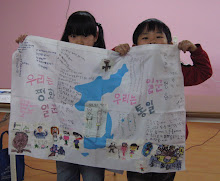
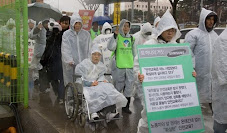
'저는 그들의 땅을 지키기 위하여 싸웠던 인디안들의 이야기를 기억합니다. 백인들이 그들의 신성한 숲에 도로를 만들기 위하여 나무들을 잘랐습니다. 매일밤 인디안들이 나가서 백인들이 만든 그 길을 해체하면 그 다음 날 백인들이 와서 도로를 다시 짓곤 했습니다. 한동안 그 것이 반복되었습니다. 그러던 어느날, 숲에서 가장 큰 나무가 백인들이 일할 동안 그들 머리 위로 떨어져 말과 마차들을 파괴하고 그들 중 몇몇을 죽였습니다. 그러자 백인들은 떠났고 결코 다시 오지 않았습니다….' (브루스 개그논)


For any updates on the struggle against the Jeju naval base, please go to savejejunow.org and facebook no naval base on Jeju. The facebook provides latest updates.
Showing posts with label Joint Vision for the Future ROK-US Alliance. Show all posts

Tuesday, March 22, 2011

Texts Fwd: USFK’s new ‘strategic flexibility,' shown in The US 2nd Infantry's Participation in Philippines Training Exercises


___________________________________________________________
* Image & caption source: Kyunghyang Shinmun
General Walter Sharpe, Commander of US Forces Korea, is answering questions from journalists at the Combined US-Korea Forces Command. Although Korea and the US have an understanding about the operational flexibility of the US forces stationed in Korea theoretically, the US 2nd Infantry's actual participation in the Philippines training exercises causes concerns that Korean soldiers could also be drawn into unwanted battles in the future. File photo Caption by Seol Wontai ___________________________________________________________
The Kyunghyang Shinmun
The US 2nd Infantry's Participation in Philippines Training Exercises is Cause for Concern
2011-03-21

ROK-US Combined Forces Command has announced that troops from the US Army 2nd Infantry Division, stationed in Korea, will take part in joint training exercises between the United States and the Philippines, to be held from April 5 in the Philippines.

This is the first time a part of the United States Forces Korea (USFK) has taken part in an overseas training exercise. As such, it is an important event that tells us that the character and role of the USFK is changing.

According to the mutual defense treaty between the Republic of Korea and the United States, the role of the USFK is to defend the Korean Peninsula. Consequently, deploying the USFK to neighboring regions, or throughout the world strategic flexibility, in other words goes beyond the bounds of this role.

If the character of the USFK changes this way, Korea may be forced to take part in regional and global conflicts in which the US participates. The worst case scenario is that where the USFK intervene in a conflict between mainland China and Taiwan, reducing the status of the Korean Peninsula to that of a US military supply base and eventually bringing conflict to Korea itself.

This may just be a training exercise, but strategic flexibility, when it ceases to be a mere plan and enters the realm of specific implementation, cannot but be a source of serious concern regarding peace and stability on the Korean Peninsula.

How can it be that this exercise is going ahead as if nothing is happening? The Korean government and even the Korean people appear uninterested. In 2006, Korea and the US reached a compromise that stated explicitly that, rather than Korea recognizing the strategic flexibility that the US wants, the United States "respects Korea's stance that Korea will not enter into any conflict in the Northeast Asian region irrespective of the will of the Korean people."

Criticisms have been made, however, that a single such sentence, which merely amounts to a principled expression of opinion, may not be able to remove the risk of strategic flexibility.

Since the Lee Myung-bak administration took office, even this principle has disappeared. On the contrary, this government has consistently made policies that support strategic flexibility, as can be seen in the 2009 "future vision" of the Korea-US alliance.

The US is taking advantage of this atmosphere by effectively running its 2nd Infantry Division on a rotational basis. USFK commander General Walter Sharp emphasized last December "the need for USFK to intervene on a slightly more regional basis and be stationed around the world."

Flexibility takes as a precondition a reduction in the threat from North Korea. But since the Lee Myung-bak administration took office, tension has actually increased, including the breakout of military clashes between North and South, due to hard-line South Korean policies toward the North.

The government, moreover, has even delayed the transfer of wartime operational control from the US to Korea until 2015, on grounds of the increased threat from North Korea. It is a mystery, however, why the government considers flexibility to be acceptable.

The government must not commit the folly of laying the ground for getting caught up in regional conflicts. Let us hope that it wastes no time in providing mechanisms to safeguard against this. (Editorial. The Kyunghyang Daily News, March 21, 2011. p. 31)
______________________________
Hankyoreh
[Editorial] USFK’s new ‘strategic flexibility’
Posted on : Mar.21,2011 13:32 KS

A few days ago, the Eighth U.S. Army Command announced plans for around 500 soldiers from the 2nd Infantry Division reconnaissance battalion stationed in South Korea to take part in joint U.S.-Philippines exercises taking place in the Philippines beginning Apr. 5. Previously, United States Forces Korea (USFK) soldiers have participated in overseas exercises at the small scale of a few dozen troops or so, but this marks the first time an entire unit is being dispatched. This marks a serious development, as the United States has begun moving its forces according to its strategy of “strategic flexibility.”


Based on this strategy, the United States plans to operate its forces for rapid maneuvering rather than leaving them as a fixture in any one region. In the wake of the 9/11 terrorist attack, the United States has pushed for these policy changes in the interest of making effective use of its forces overseas. Its intent is to broaden the scope of the USFK’s placement rather than tying them to the role of deterrent against North Korea according to the Mutual Defense Treaty between the United States and South Korea.

However, the U.S. military’s free coming and going overseas from a base in South Korea, without any controls from the South Korean government, is not a matter that can simply be overlooked. The possibility exists that South Korea may end up unwittingly embroiled in a conflict in another nation or subjected to unnecessary suspicions. Given the delicate interweaving of potential causes for tension on the peninsula and in East Asia, it is reasonable to have serious concerns about this aspect. As an immediate example, Beijing has been expressing keen alarm over the USFK’s role as a curb against it.


In light of these factors, South Korea and the United States agreed on a set of principles regarding the USFK’s strategic flexibility in January 2006. At this time, Seoul agreed to show understanding for Washington’s change in global military strategy and respect the need for strategic flexibility with the USFK. The United States, for its part, agreed to respect Seoul’s desire not to get involved in any regional conflicts in Northeast Asia irrespective of the South Korean people’s will. The problem is that no subsequent procedures were properly instituted to manage the enforcement of these principles.


For instance, last October’s Security Consultative Meeting between South Korea and the United States failed to produce a consensus, with Seoul requesting the institutionalization of prior discussions when applying the strategic flexibility concept, and Washington declaring that it would merely provide notification.


With this latest decision, the U.S. Eighth Army merely provided a brief announcement of the fact that the reconnaissance battalion would be taking part in the exercises. Neither the Combined Forces Command nor the South Korean Ministry of National Defense provided any explanation about the process. It is not normal for South Korea to merely receive unilateral notification without any preliminary discussions when a USFK unit is transferred. We hope the South Korean and U.S. military authorities will engage in sincere discussions and disclose details about the process. (Please direct questions or comments to [englishhani@hani.co.kr] )

_________________________________
NO 731, recent News
Ministry of National Defense

South Korea and the Philippines deepen military ties 
March 15 (upload on March 21, 2011)


South Korea's Defense Minister Kim Kwan-jin, rear left, and his counterpart Voltaire Gazmin of the Philippines at a welcoming ceremony at the ministry in Seoul on Mar. 14. After the welcoming ceremony, two ministers discussed ways to boost bilateral defense exchanges and arms trade, the ministry said. It also said that they exchanged opinions related to regional security matters.


Earlier on Mar. 13, Gazmin landed on South Korea for his four-day visit here. Gazmin visited the Seoul National Cemetry in Dongjak, Seoul, and a 1950-53 Korean War Veterans Memorial for the Philippines in Yeoncheon, Gyeonggi, to pay solemn respect to war deads.


Gazmin have also toured major defense firms. Filipino defense minister, who had served as a commander-in-chief of the Philippines Armed Forces and the ambassador to Cambodia, took ministerial position since June last year.


The Philippines, one of South Korea's traditional allies, had sent some 7,400 troops each year during and after the Korean War between September 1950 and 1955 to fight for freedom of South Korea.


After signing memorandum of understanding related to cooperation on defense and war industry with the Philippines in May 1994, South Korea had either donate F-5A fighters, Patrol Killer Medium and T-41 jets for entry level pilot training for free or sold them.

Monday, December 28, 2009

Text Fwd: ROK-US Alliance Evolves, Challenges Linger

* Image source: same as the link below


Korea Times
12-24-2009 19:30
ROK-US Alliance Evolves, Challenges Linger
By Jung Sung-ki
Staff Reporter

The year 2009 saw South Korea and the United States take a new step forward in their strategic military alliance, as they ironed out thorny issues of mutual concern, defense experts say.

North Korea's continued, provocative military actions on the peninsula also boosted the importance of the alliance, they added.

``Overall, the development of the alliance was fruitful this year, but there are still issues to be further fine-tuned,'' a defense researcher here told The Korea Times on condition of anonymity. He was apparently referring to Seoul's recent decision to redeploy troops to Afghanistan to help U.S. and other coalition forces fight against terrorists there as a case in point.

``As for the deployment to Afghanistan, which is hailed by the U.S. administration, there are still unresolved issues and questions, such as the appropriate number of troops and the timing of the deployment,'' the researcher said. ``The motion hasn't been approved by the National Assembly and we're not sure that the deployment can go ahead as scheduled in the first half of next year, when the U.S. will need troop support the most.''

The administration announced earlier this month that it would send 320 troops and 40 police officers to the Central Asian nation to accompany 100 Korean reconstruction workers to be dispatched to the country.

The decision was made after Washington had repeatedly requested Seoul to contribute troops to Afghanistan. The presidential office said the deployment would help to further strengthen ties with Washington as well as increase the country's global profile to match its economic power.

Some in the military argued a brigade-level unit should be dispatched for full-fledged anti-terror operations. But Cheong Wa Dae was wary of possible public backlash over a large-scale troop deployment.

Opposition lawmakers have opposed the deployment, worrying the country could become a target of terror attacks. The passage of the motion is expected to be delayed until February.

Change in USFK Roles

A key challenge ahead for the alliance is Seoul's smooth acceptance of the U.S. Forces Korea's (USFK) strategic flexibility, the researcher said.

In the early 2000s, the U.S. military initiated the idea of changing the mission of American forces abroad from stationary ones focused on defending host nations to a rapid-deployment strategy in which troops are swiftly dispatched to parts of the world where the U.S. faces conflict.

Seoul and Washington agreed to the altering of the role of U.S. forces in Korea in 2006. The plan has not been fully implemented amid concerns that it could weaken the Korea-U.S. combined defense posture against North Korea.

In recent months, U.S. military leaders repeatedly mentioned the need for the scheme, in line with the planned longer, family-accompanied tours by U.S. forces in Korea.

Speaking at a forum organized by the Center for Strategic and International Studies (CSIS) in Washington, USFK Commander Gen. Walter Sharp said, ``We want the troops to be regionally engaged and globally deployed, but we'll never forget that our No. 1 responsibility in Korea is to defend the Republic of Korea.

``Sometime in the future we could have forces that could, with consultations between both nations, be able to be deployed in different places around the world,'' he said.

The researcher said the strategic flexibility of U.S. troops overseas is an unavoidable ``trend.''

``The strategic flexibility is not a matter of conflict but a matter of consultation or coordination,'' he noted. ``It's time for us to think of what we can get from the U.S. strategic flexibility, not what we can lose from it.

``Given that the agreed 21st strategic alliance partnership calls for boosting bilateral cooperation in global issues, we can't and shouldn't deny the strategic flexibility mechanism,'' said the expert. ``The Lee government should think of how it will get this message across to the public and prevent unnecessary controversy over this issue.''

In June, Presidents Lee Myung-bak and Barack Obama issued the Joint Vision for the ROK-US Alliance at the end of their summit in Washington, D.C. The plan calls for building a broader alliance in the realms of politics, economy, culture and other areas, in addition to the security arena.

Nuclear Deterrence

In the summit, President Obama reaffirmed that Washington will continue to provide an extended nuclear umbrella to South Korea in response to North Korea's increasing nuclear threats.
The pledge was stipulated in a joint communique of the defense ministers from the two nations at the Security Consultative Meeting (SCM) in October in Seoul.

``I think 2009 has been extremely important for the alliance because North Korea has repeatedly demonstrated the importance of the alliance during a period where some key people in both the ROK and the United States seem to be doubting its importance,'' Bruce Bennett, a senior defense analyst at the Rand Corporation, a U.S. non-profit policy think tank, wrote in an e-mail.

North Korean insistence on retaining its nuclear weapons and being designated a nuclear power makes the ROK-US alliance ever more critical for the security of South Korea and the region, he said.

``As a result, I found the ROK-US Joint Vision of the Alliance statement to be a key development. I was especially struck by the US commitment to extended deterrence, including its nuclear umbrella,'' said the analyst.

Bennett said North Korean leader Kim Jong-il's illness early in the year implied that succession could come soon, and the failure of Kim Jong-il to clearly designate a successor suggests that a third-generation Kim family succession could fail.

This view was reinforced by North Korea's provocations — its missile launches and nuclear test — in the first half of the year, which apparently stemmed from Kim Jong-Il's deteriorating health and the need to demonstrate his power, he analyzed.

``If anyone in the ROK was feeling safe from North Korean nuclear weapons, they should have developed a different perspective after May 25 (the nuclear test), and worried about how the ROK government was going to protect them,'' the analyst said.

``While most experts have focused on Kim Jong-Il's efforts to appear peaceful and cooperative in the second half of this year, I think there have been clear signs even in this period of the need for our alliance, given North Korean instability,'' he said.

North Korea's poor crop yield this year likely means that many North Koreans could face famine over the coming year, increasing instability in the communist state, he added, saying the North Korean currency revaluation early this month was a major event that hurt the North Korean elite.

This action is likely to destabilize the North Korean government, increasing the chances of the regime collapsing, he said.

gallantjung@koreatimes.co.kr

Wednesday, December 16, 2009

Text Fwd: S. Korea, US to Draw Up Defense Guidelines

Korea Times
12-16-2009 18:07
S. Korea, US to Draw Up Defense Guidelines
By Jung Sung-ki, Staff Reporter

South Korea and the United States are discussing a plan to draw up "defense guidelines" next year in a bid to upgrade bilateral defense cooperation, according to defense and foreign ministry officials Wednesday.

The guidelines, similar to the U.S.-Japan Defense Guidelines established in 1996, would include key measures to strengthen military cooperation between the militaries, they said.

Among the topics are U.S. reinforcement plans in case of a war on the Korean Peninsula, the U.S. nuclear umbrella for South Korea and the stable presence of U.S. forces in Korea.

"The defense guidelines will be part of follow-up measures to materialize the Korea-U.S. alliance joint vision adopted at the summit between Presidents Lee Myung-bak and Barack Obama," an official at the Ministry of National Defense said. "The guidelines would include a comprehensive package of measures on how the two nations are to cooperate in the event of war on the peninsula."

In the summit meeting in Washington, D.C., Obama said the U.S. government would provide an extended nuclear umbrella to South Korea in response to increasing nuclear threats from the North.

Lee and Obama adopted a "joint vision for the ROK-US alliance" that calls for building a broader, strategic partnership in the realms of politics, economy, culture and other areas beyond the security arena.

In the Security Consultative Meeting (SCM) in Seoul, Oct. 22, U.S. Secretary of Defense Robert Gates confirmed the increased defense cooperation with South Korea. In a joint communique issued at the end of the annual meeting, Gates reaffirmed "the U.S. commitment to provide extended deterrence for the ROK, using the full range of military capabilities, to include the U.S. nuclear umbrella, conventional strike and missile defense capabilities."

It was the first time that detailed plans of increased U.S. deterrence capabilities for South Korea had been revealed and even stipulated in a joint statement since 2006, when the then-defense ministers from both nations first addressed the issue.

Notably, Gates said the United States would use its capabilities not only on the peninsula but also "globally available U.S. forces and capabilities that are strategically flexible to deploy to augment the combined defense in case of crisis."

Previously, the U.S. military had only referred to reinforcement of troops from the U.N. Command's rear bases in Japan in case of an emergency.

Observers said Gates' remarks were construed as a response to a lingering concern here that the 2012 transition of wartime operational control (OPCON) of South Korean troops from the U.S. military to Korean commanders will result in a smaller role of the U.S. military on the peninsula, and that it could tip the military balance between the two Koreas.

Under a 2007 deal on command rearrangements, the U.S. military on the peninsula is to shift to an air- and naval-centric supporting role with the South Korean military taking over main combat operations in the event of conflicts.

The ROK-U.S. Combined Forces Command (CFC) is to be deactivated and two separate theater commands of both militaries will be put in place here.

Speaking at a forum in the United States, CFC Commander Gen. Walter Sharp said the U.S. and Korean militaries have agreed to develop a single joint operational plan even after the OPCON transition. Both sides have already worked out an initial version of the operational plan and will complete the final one soon, he added.

gallantjung@koreatimes.co.kr


* Related Activist Statements

Solidarity for Peace And Reunification of Korea(SPARK)
Letter Sent to the Presidents of the Republic of Korea and the United States on the Occasion of the Korean-US Summit Conference
June 16, 2009

People's Solidarity for Participatory Democracy(PSPD)
“Joint Vision for the Alliance of South Korea and the US” is retrograde absenting a future vision
:The Summit of the South Korea and the US triggers Conflict and Confrontation without Resolving the North Korean Nuclear
2009/06/22


* On SCM, Oct. 22, 2009

The annual Security Consultative Meeting (SCM) between Robert Gates and Kim Tae Young (Minister of the National Defense, ROK) was on Oct. 22. According to the Korean activists here, the SCM document, 2009 (check No. 546, HERE), for the first time, explicitly expressed 1: the strengthened U.S.-S.K. alliance regarding Missile Defense, 2: the expansion of the alliance beyond the Korean peninsula (strategic flexibility).


Sunday, November 22, 2009

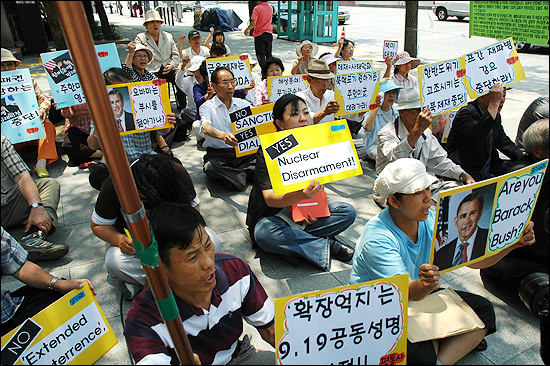
Text Fwd:[SPARK] Statement on the result of the South Korea-United States Summit Meeting


* Below is the unofficial translation of the
statement by the SPARK (Solidarity for Peace And Reunification of Korea) on Nov. 20, 2009, after the President Obama’s visit of South Korea (Nov. 18~19). The SPARK is one of the representative organizations regarding the issues of peaceful reunification in South Korea. It was one of the first organizations that made a statement on the result of Obama visit to South Korea. While it can not be seen as representing the view of the whole South Korean movement, one may glimpse some points that the South Korean activists have to say, including the issue of re-dispatch to Afghanistan. For the issue of Afghanistan, please see No. 1. The translation is by Agatha Haun (dillardhaun@gmail.com) who did a proofreading and suggested the helpful revisions as well on the 1st draft by the No base stories of Korea. Thanks very much, Agatha!


한미정상회담 결과 논평
Statement on the result of
the South Korea-United States Summit meeting


명박 대통령과 오바마 미국 대통령의 정상회담이 19일 열렸다. 이 회담에서는 한미동맹, 북핵, 한미FTA 문제 등이 논의되었다. 이에 대한 우리의 입장을 다음과 같이 밝힌다.

The South Korea-United States summit meeting was held on [Nov.] 19. In the meeting, the issues of the South Korea-United States alliance, the North Korean nuclear program, and the South Korean-US FTA (Free Trade Agreement) were discussed. Our views on these questions are explained below.


1. 대미 종속 심화시키고 한반도 평화협정 정세 거스르는 한미 전략동맹과 ‘2+2’ 회담 폐기하라!

1. Abolish the South Korea-United States Strategic Alliance and ‘2+2’ meeting that increase South Korea's subjugation to the United States and violate the spirit of the movement to reach a peace agreement on the Korean peninsula!

한 미 양국 두 정상은 “지난 6월 정상회담에서 채택한 한미동맹 공동비전을 내실있게 이행하여 한미동맹을 모범적인 21세기 전략동맹으로 발전시켜 나가기로” 했다. 이를 위해 “내년에 한미 양국의 외교`국방 장관이 함께 만나서 미래지향적인 동맹 발전의 구체적인 방안에 대해 논의”하기로 했다.

The two South Korea-United States summits decided: “By substantially following up the South Korea-United States joint vision adopted in the summit meeting last June, to develop the South Korea-United States alliance toward an exemplary strategic alliance in the 21st century.” And for that purpose, “the ministers of the foreign policy and defense departments in both countries, the South Korea and the United States, will meet next year and discuss the concrete ways to develop the alliance in a future-oriented way”.

한 미 전략동맹은 한미동맹을 한미상호방위조약에 근거한 기존의 방어동맹에서 침략동맹으로 바꾸자는 것이다. 이는 본질적으로 미국의 국익에 한국의 국익을 일치시키자는 것으로서 불법적인 것일 뿐만 아니라 한반도와 세계 평화를 위협하고 우리에게 온갖 부담과 희생을 강요하는 일이다.

The South Korea-United States strategic alliance is to transform the South Korea-United States alliance from the existing defense alliance based on the Mutual Security Treaty [in 1954] into an aggressive, offensive alliance. It is in essence illegal, not only in the sense that it aligns South Korea's national interest with that of the United States, but also threatens the peace of the Korean peninsula and the world and forces us to bear all kinds of burden and sacrifice.

양국 외교`국방 장관이 참여하는 이른바 ‘2+2’ 회담을 열기로 한 것은 한미 전략동맹을 본격적인 실행단계로 발전시키겠다는 뜻으로 보인다. 이렇게 되면 한국군 아프간 재파병과 같은 일이 더욱 일상적으로 벌어지게 될 것이다.

The fact that [the two summits agreed] to have the ‘2+2’ meeting, in which the ministers of foreign and defense departments of the both countries reached agreements, seems to indicate that [the two summits] have decided to actively implement the South Korea-United States strategic alliance. If it happens, South Korean troops would be obligated to deploy to Afghanistan and other areas of conflict more frequently, at the demand of the US.

우리나라는 평화적 통일과 세계평화를 국가이익의 중요한 요소로 삼고 있다. 그런데 이를 근본적으로 위협해 온 한미동맹의 범위를 전방위적으로 확장하여 강화하겠다는 것은 우리의 국익에도 반하고 한반도 평화협정 정세에도 역행하는 것이다. 북을 적국으로 삼고 중국과 러시아를 겨냥하는 양자동맹을 강화하는 것과 한반도 및 동북아 평화`안보체제를 구축하는 것은 모순이 되기 때문이다.

Our country holds the position that the peaceful unification of Korea and peace in the world are among the important elements of our national interest. Then, the statement that [the two summits] would expand the scope of the South Korea-United States alliance, which fundamentally threatens unification and peace, into full spectrum and strengthen it, is against our national interest. It complicates the political situation and makes it more difficult to reach a peace agreement on the Korean peninsula because the two sets of goals are completely opposed to each other: to strengthen the bilateral alliance that sees North Korea as the enemy nation and is aimed against China and Russia; and to establish a peace and security system on the Korean peninsula and in the North East Asian region.

한 편, 미국이 한국과 ‘2+2’ 회담을 하기로 한 것은 일본과의 ‘2+2’ 회담에 이어 올 해부터 중국과의 ‘2+2(전략`경제대화)’ 회담이 시작되고, 소외를 우려하여 한국이 반대해왔던 ‘미중일 3자 전략대화’를 열기로 한 것에 대한 보상과 무마 차원인 것으로 보인다. 이는 미국이 동북아에서 자신의 패권을 지키기 위해 한중일 각 나라를 분할 관리 또는 지배하는 방식이라고 할 수 있다.

Otherwise, it seems that a policy of compensation and appeasement toward United States has begun. There was a ‘2+2’ meeting with South Korea following her ‘2+2’ meeting with Japan, her ‘2+2’ meeting with China (dialogue on strategic economy) will begin this year and then there will be the three-party strategic dialogue among the United States, China, and Japan, which South Korea had opposed for fear of isolation. It can be said that it is the way of the United States to divisively manage or rule each country -- South Korea, China, and Japan -- in order to maintain her domination in North East Asia.

이에 우리는 미국의 국익과 패권을 지키기 위해 우리의 국익을 훼손하고 대미 종속의 심화시키며 한반도 평화협정 정세에 역행하는 한미 전략동맹과 이를 위한 ‘2+2’ 회담을 반대한다. 이에 우리는 미국 패권을 위한 대결적이고 퇴행적인 구조를 강화하는 이 같은 흐름을 중단하고 한반도 평화헙정과 동북아 협력안보체제를 구축함으로써 관련국들의 이해관계를 협력적 방식으로 조율해 나아갈 것을 촉구한다.

Seeing that, we oppose the South Korea-United States strategic alliance and ‘2+2’ meeting that are supposed to support the national interest and domination of the United States, to damage our national interest, to deepen the South Korean subjugation into the United States, and to oppose the development of a favorable political climate for a Korean peninsula peace agreement. In view of that, we urge [the two summits] to stop the tendency to strengthen the confrontational and degenerating structure that perpetuates US dominance, and to negotiate in a cooperative way the issues that are of interest to the countries concerned, by establishing the system that will result in reaching a Korean peninsula peace agreement and provide for the [peaceful] mutual security in North East Asia.


2. 이명박 대통령은 비현실적인 ‘그랜드 바겐’ 입장을 철회하고, 오바마 대통령은 북미 정상회담에 조속히 나서 한반도 문제의 근본적 해결을 결단하라!


2. President Lee Myung Bak, withdraw from your position of making an unrealistic ‘Grand Bargain’ and President Obama, immediately begin the North Korea-United States summit meeting and make a determined effort to reach a fundamental settlement of the issue of the Korean peninsula!

북 핵 문제와 관련하여 이명박 대통령은 “두 정상은 그랜드 바겐으로 제시한 일괄 타결이 필요하다는데 전적으로 공감하고 그 구체 내용과 추진 방안에 대해 긴밀히 협의해 나가기로 했다”고 밝혔다. 그러나 오바마 대통령은 기자회견에서 "공동접근 방식(common approach)" "포괄적 해결책(comprehensive resolution)"을 말했을 뿐 ‘그랜드 바겐’이라는 용어는 단 한 차례도 사용하지 않았다. “완전히 의견을 같이한다”거나 “우리도 같은 방식으로 접근한다”고 한 발언은 한미 정상 간에 이견을 드러내지는 않겠다는 뜻으로 이해된다.

Regarding the North Korean nuclear issue, President Lee Myung Bak announced that “The two summits totally agreed with each other that the bundled settlement suggested by the Grand Bargain was needed and that the two would closely negotiate the concrete contents and ways to drive it forward.” However, President Obama only spoke of the “common approach” and “comprehensive resolution”, and did not use even once a term such as ‘Grand Bargain’ in the press interview. His words that [He is] “completely of the same opinion with” [President Lee] or that “We [the United States] approach [this question] in the same way” are understood to mean that he would not yet indicate that there is a difference of opinion between the summits in the South Korea and United States.

‘그 랜드 바겐’의 핵심 내용은 타결과 실행을 일괄적으로 이루는 이른바 ‘원샷 딜(단박 해결)’을 하자는 것이다. 그러나 이런 방식은 6자회담 9`19 공동성명에 명시된 단계적 방식과 행동 대 행동 원칙에 어긋나는 것일 뿐만 아니라 사안의 복잡성에 비추어 현실성도 없는 것이다. 이런 점에서 이명박 대통령이 북한에 대해 6자회담 복귀를 요구하면서도 한편에서는 그랜드 바겐을 주장하는 것은 모순이다. 관련국과 논의도 제대로 거치지 않고 그랜드 바겐을 ‘선언’한 것도 문제다. 바로 이런 점들 때문에 한국의 협력을 필요로 하는 미국조차 이 안에 동의하기 어려운 것이다.

The core content of the ‘Grand Bargain’ is to bundle together the settlement and the follow-up, in a so-called ‘one shot deal’. However, such a method not only violates the step-by-step approach and action-for-action principle elucidated at the 9.19 joint statement in the six party talks, but also, in view of the complexity of the issues, it has no realistic chance of being realized. In that sense, it is contradictory that President Lee Myung Bak demands that North Korea return to the six party meetings while he promotes the Grand Bargain. The essential problem is that he ‘declared’ the Grand bargain without the proper discussion with the countries that are affected by it. For that very reason, it is difficult even for the United States, which needs South Korea's cooperation, to agree with [the Grand Bargain].

이명박 정부가 이처럼 내용이나 절차, 현실성에서 모두 치명적 문제가 있는 그랜드 바겐에 집착하는 이유는 북미관계 진전을 발목 잡고 반북수구세력의 기득권을 지키려는 저의 때문이라고 볼 수밖에 없다.

The reason that the Lee Myung Bak government so strongly supports the Grand Bargain is that the critical problem in all the matters of content, procedure and reality can be explained only by his hidden intention to hinder the progress of improved North Korean-US relations and to maintain the vested rights of the power-holding class, which is anti-North Korea and adheres to its traditional conservative ways.

이에 우리는 이명박 대통령이 실체도 없고 현실성도 없는 그랜드 바겐에 대한 집착을 버리고 북미관계 정상화에 적극 협조하고 이에 발맞추어 남북관계도 정상화할 것을 강력히 촉구한다.

Seeing that, we strongly urge President Lee Myung Bak to abandon his attachment to the Grand Bargain, which has no real substance and no realistic possibility of being implemented, and to actively cooperate for the normalization of the relationship between North Korea and the United States, and simultaneously, to facilitate the normalization relations between North and South Korea.

한 편, 오바마 대통령은 “보즈워스 대북정책 특별대표를 12월 8일 북한에 보내 양자대화를 시작할 것”이라고 밝혔다. 북미 양자대화를 지속적으로 요구해온 우리는 이 발표를 환영한다. 하지만 오바마 대통령은 북한의 “도발적 행동”을 문제 삼으면서 북핵문제의 원인을 북한으로 돌리고 있다. 이는 한국전쟁 이래 핵위협을 지속하여 북한으로 하여금 핵무기개발을 하도록 내몬 미국의 책임을 외면하는 것이다.

Furthermore, President Obama announced that [he would] “start the bilateral talks [with North Korea] by sending Bosworth, the U.S. Special Envoy for North Korea, to visit North Korea on Dec. 8”. We who have constantly demanded the bilateral talks between North Korea and the United States welcome that announcement. However, President Obama places responsibility for the North Korean nuclear problem on North Korea alone, making the problem a matter of North Korea's “provocative action”. This ignores the US's responsibility for pushing North Korea into developing nuclear weapons, by continuing her nuclear threat since the Korean War.

오 바마 대통령이 한반도 핵문제의 원인을 북한의 책임으로 돌리는 태도로는 문제의 해결을 기대하기 어렵다. 이에 우리는 오바마 대통령이 자신이 대통령 선거 과정에서 밝힌 대로 김정일 국방위원장을 직접 만나 허심탄회한 대화를 통해 한반도 비핵화와 평화협정, 북미수교에 대한 결단을 내릴 것을 촉구한다.

It is difficult to expect that the issue will be settled, in view of President Obama's attitude, attributing the emergence of the nuclear issue on the Korean peninsula to North Korea. To reach a settlement, we urge President Obama, as he himself announced in the process of the presidential election, to make a decision in favor of the non-nuclearization of the Korean peninsula, a peace agreement, and the establishment of friendly relationship between North Korea and United States, by meeting in person and having open talks with Kim Jong-Il, the Chairman of the Defense Council, [in North Korea].


3. 미국의 부당한 자동차 시장 압력 거부하고 한미FTA 전면 재협상에 나서라!


3. Reject the US's unjust pressure on the automobile market and begin a complete renegotiation of the South Korea-United States FTA (Free Trade Agreement)!

이명박 대통령이 “미국에 자동차 문제가 있다면 우리는 다시 이야기할 자세가 돼 있다”고 밝혔다. 이는 한미FTA 재협상 의지를 밝힌 것이다.

President Lee Myung Bak announced that we, [South Korea] are “prepared to have talks again with the United States if there is any problem on the part of the United States concerning the issue of the automobile industry.” He thus showed that he is open to renegotiating the FTA between South Korea and United States.

한 미FTA는 농업, 서비스 등 대표적인 불평등 분야뿐만 아니라 자동차 분야에서도 굴욕적 내용이 가득하다. 관세철폐, 자동차세제, 안전 및 환경기준이 미국에 일방적으로 유리하게 되어 있을 뿐만 아니라 한국 정부가 이런 약속을 어길 경우 미국이 한국에 약속한 관세 혜택을 박탈할 수 있도록 한 ‘스냅 백’과 신속 분쟁처리 절차(신속 절차)는 그동안 세계 어떤 통상협정에도 없었던 ‘독소 조항’들이다.

The FTA is quite humiliating to South Korea, not only in unequal treatment of South Korea and the US in fields such as agriculture and services, but also automobile manufacturing. The issues of the abolition of tariffs, taxes on automobiles, and safety and environmental protection measures are not only unilaterally advantageous to the United States. Furthermore, the ‘snap back’ and the 'prompt procedure' for dealing with disputes, which gave the US the right to eliminate South Korea's tariff benefit, when the South Korean government does not demand equal treatment on these issues, are also the sort of ‘poisonous clauses’ that can not be seen in any trade negotiations in the world.

미 국이 내세우는 자동차 수출 규모의 현저한 차이는 무역제도의 문제가 아니라 대형차 위주의 미국 자동차 산업이 경쟁력을 잃어 한국민에게 매력이 없기 때문이다. 그럼에도 불구하고 미국이 재협상을 요구하는 것은 억지로라도 미국 자동차의 한국시장 점유율을 올리겠다는 것이다. 이는 자유무역협정의 기본 전제를 무너뜨리는 것이다.

The US raises the issue of the remarkable gap in the sizes of automobiles for export. This is not because of the problem of the trade system but because of the fact that the US automobile industry prioritized the production of large cars and lost its ability to compete in foreign markets, for example, when its cars did not appeal to South Koreans. Despite that, the United States demands re-negotiation because she intends to even forcibly raise the number of United States automobiles in the South Korean market. It is to destroy the basic premise of the free trade agreement itself.

광 우병 위험 미국산 쇠고기 수입에 반대하는 국민의 목소리를 철저히 외면하고 짓밟던 이명박 대통령이 미국의 재협상 요구를 수용하려는 것은 경악할만한 일이다. 이로써 이명박 대통령은 스스로 국민은 탄압하고 미국과 독점자본 이익은 충실히 대변하는 대통령임을 폭로한 것이다.

It is terrible that President Lee Myung Bak attempted to accept the US's demand for renegotiation, completely ignoring and silencing the people’s voice opposing the import of the United States beef due to the risk of mad cow disease. In so doing, President Lee Myung Bak exposed himself as the president who faithfully represents the interest of the United States and monopoly capital, while oppressing his people.

우리는 자동차 분야에서 추가적인 양보를 강요하는 미국과 이를 수용하려는 이명박 정부를 강력히 규탄한다. 우리는 미국의 부당한 압력을 거부하고 이번 기회에 불평등한 한미FTA에 대한 전면 재협상에 나설 것을 강력히 촉구한다.

We strongly denounce the United States for forcing the additional concession in the automobile field and the Lee Myung Bak government for attempting to accept it. We firmly oppose the unjust oppression by the United States and demand a complete renegotiation of the unequal South Korea-United States Free Trade Agreement.


2009. 11. 20.

Nov. 20, 2009

평화와 통일을 여는 사람들
(상임대표 : 문규현, 배종열, 홍근수)

Solidarity for Peace And Reunification of Korea (SPARK)
(Co-Executive Chairpersons: Fr. Moon Kyu-Hyun, Bae Jong-Ryol and Rev. Hong Keun-Soo)

Sunday, June 28, 2009

Text fwd: N. Korea denounces S. Korea-U.S. summit and six party talks as a “shattered bowl”

* Image source/ description* same as below:
"North Koreans participate in a rally held to commemorate the June 25 anti-U.S. Day in front of the Pueblo, a U.S. spy ship that North Korea seized 41 years ago, in Pyongyang in this June 23, 2009 picture. (REUTERS/KCNA)"

The Hankyoreh Media Company
N. Korea denounces S. Korea-U.S. summit and six party talks as a “shattered bowl” N. Korea criticizes timing as indicating Lee’s repudiation of the June 15 Joint Declaration, and demonstrates further resolve for nuclear armament Posted on : Jun.26,2009 12:19 KST

North Korea has presented its first response nine days after the South Korea-U.S. summit held in Washington on June 16. A commentator’s piece entitled “Disgusting kiss shared between a master and its dog in the White House Rose Garden” was published in the Rodong Sinmun, the official newspaper of North Korea’s Workers’ Party, and included an itemized critique of the agreements and statements on North Korea made by the two leaders. Commentator’s pieces in the Rodong Sinmun are pieces that contain policies organized at the party level, and are in effect a formal response by North Korea. However, aside from conveying criticism, the piece made no direct or specific mention of any response measures.

In reference to the summit’s agreement that the U.S. would provide extended deterrence, the Rodong Sinmun said this “ultimately merely adds greater justification for us possessing a nuclear deterrent, and it is asking for the calamitous situation of having a fire shower of our nuclear retaliation fall over South Chosun(Korea) ‘should an incident occur.’” Previously, North Korean media had claimed that its nuclear weapons were for defense against the U.S. and were not a threat to South Korea, but recently they have been implicitly suggesting that these weapons could be used towards South Korea. On Tuesday, the North Korean website Uriminzokkiri included statements saying, “Our mighty military strength, including our nuclear deterrent, is not at all simply for show,” and “The revolutionary armed forces know not a shed of mercy for those who mess with its autonomy, and the Lee Myung-bak administration cannot be an exception.”

In reference to the discussion of sanctions against North Korea, the newspaper said “The U.S. and others are going on about financial sanctions and making a lot of noise as though we cannot develop satellites or nuclear capabilities if our line of money is cut off.” The newspaper added, “However, we have in place everything we need to strengthen the nuclear deterrent, and in terms of uranium ore alone, we have the world’s largest deposits.”

In reference to the potential of five-party talks that leaves North Korea, the newspaper declared, “The six-party talks are already a shattered bowl, and ‘abandoning nuclear capabilities’ has long since been a thing of the past.”

Referring to the stipulation of “unification based on principles of liberal democracy and the market economy” in the South Korea-U.S. joint vision, the newspaper said, “President Lee Myung-bak is showing that not only has he not changed a whit in his anti-republic confrontational policy, he pursues it even more villainously with each passing day.”

The newspaper also called President Lee’s references to the Kaesong (Gaeseong) Industrial Complex a “repudiation of working-level meetings” and a declaration that he would “ultimately trample the June 15 Joint Declaration and thrust North-South relations into a confrontation.”

The newspaper also criticized President Lee’s choice of a date for his U.S. visit, saying, “The traitor Lee Myung-bak went through all possible dates and chose to go see his master on June 15, the anniversary of the announcement of the North-South Joint Declaration.”

The newspaper also indicated dissatisfaction with U.S. President Barack Obama by saying, “Seeing the new master, who makes a lot of noise about change and espouses a distinction from the Bush administration, putting his own stamp down (on President Lee) recalls a Chosun saying that ‘Green is the same color.’”

Please direct questions or comments to [englishhani@hani.co.kr]


© 2006 The Hankyoreh Media Company.

Tuesday, June 23, 2009

Letter Fwd: Letter Sent to the Presidents of the Republic of Korea and the United States on the Occasion of the Korean-US Summit Conference (2009.6.16

Solidarity for Peace And Reunification of Korea
June 16, 2009

The Korean-US summit conference will be opened in Washington DC on June 16. The agenda will include adopting an announcement about the "joint vision for the future ROK-US alliance", the North Korean nuclear problem, the question of a renewed dispatch of ROK troops to Afghanistan, etc.

This summit conference, by means of reinforcing the aggressive ROK-US alliance, will increase the ROK's subordination to the US even more and make our nation's sacrifice and burden even heavier.

Accordingly, below we clarify our position in opposition to this kind of ROK-US summit conference.

Cancel the adoption of the "announcement of the joint vision for the future ROK-US alliance" which seeks to make permanent the aggressive ROK-US alliance!

It has been arranged that at this summit conference between the two countries, they will adopt the announcement of the "joint vision for the future ROK-US alliance". This goes beyond the security of the ROK-US alliance; it extends into all spheres of life - politics, the economy, society, culture, everywhere; the essence of it is that it will be developed into a global alliance that is supposed to contribute to stability and peace, not only on the Korean peninsula and in Northeast Asia, but throughout the entire world.

The ROK and the US, as a way of justifying efficient cooperation in addressing global issues such as international terror, proliferation of weapons of mass destruction, etc., are intensifying their mutual assistance in operations such as the Iraq and Afghanistan invasions or the Proliferation Security Initiative, and hastening the implementation of the ROK-US Free Trade Agreement.

This is related to the forward expansion of the ROK-US alliance. The ROK and the US are enlarging the sphere of their alliance in all aspects. This expansion of the geographical scope to include the entire world is a violation of the ROK-US Mutual Defense Treaty, which limits US troops' sphere of operations to defense against aggression from North Korea. The enlargement of the ROK-US alliance into a global alliance means that the ROK government is perpetuating its subordinate position, blindly obeying the US's demand that the alliance's resources be mobilized and that the US's declining hegemony be maintained.

As a result of this, our nation's people must offer land and bear the costs of providing the US with military bases and training areas, buy weapons made in the US, assist in wars of aggression, and bear the burden of all kinds of sacrifices and expenses because of that.

The ROK and the US intend to convert the ROK-US alliance into a global and permanent alliance. Burwell Bell, while acting as the USFK commander, said that he hoped that the US troops would be stationed in Korea even after a Korean peninsula peace agreement is concluded, and last July, Timothy Keating, the US Pacific commander, explained that while the USFK are stationed here permanently, the US troops would participate in humanitarian aid or disaster relief operations and the like.

This shows clearly that the US intends to continue the stationing of the USFK and the ROK-US alliance permanently. The "joint vision for the future ROK-US alliance", which aims to perpetuate the aggressive ROK-US alliance, goes against the trend of our time, which is to establish a structure of peace and security for the Korean peninsula and Northeast Asia by means of the withdrawal of foreign military forces, the abolition of the military alliance, and achieving peace and disarmament. In particular, stipulating "extended deterrence" in the "joint vision for the future ROK-US alliance", runs counter to the 9.19 joint statement which declares the goal of denuclearization of the Korean peninsula.

Accordingly, we are resolutely opposed to the adoption of the "announcement of the joint vision for the future ROK-US alliance", which endangers peace on the Korean peninsula and world peace, and imposes on us all kinds of sacrifices and burdens. This new alliance will certainly place obstacles in the way of the current trend toward stable peace. We demand categorically that it be abandoned.

Stop the sanctions and pressure against North Korea and enter into dialogue with North Korea immediately!

Although North Korea asserted its right as a sovereign nation to launch a satellite, the US led the UN Security Council to pass resolution no. 1874, which imposes an embargo on the import or export of weapons, authorizes the inspection of cargo, imposes economic sanctions, etc. The day immediately following this, the 13th, North Korea issued an official statement declaring that it would proceed with the weaponization of plutonium and enrichment of uranium, and would regard any blockade of the North as equivalent to an act of war.

The Korean peninsula nuclear problem cannot be resolved by sanctions and confrontation. Not even the omnidirectional blockade policy followed by the US Bush administration, which pushed military unilateralism to an extreme, could make North Korea submit. More stringent sanctions imposed by the US would certainly provoke North Korea into taking stronger counter-measures.

Such sanctions and pressure will not solve the problem. On the contrary, they will only make the situation worse. If the US sincerely desires to denuclearize the Korean peninsula, we demand that it abandon its hostile policy toward North Korea, which is the original cause of the North Korean nuclear problem. In addition, we urge the US to enter into negotiations with the North, to conclude a peace agreement that will simultaneously resolve the questions of the denuclearization of the Korean peninsula and the US's hostile policy toward the North, and to establish amicable relations between North Korea and the US.

We also urge the Lee Myeong Bak government, that took the lead in imposing sanctions against the North, to give up its confrontational attitude and start to create the conditions for the purpose of direct North Korean-US dialogue.

Stop the redeployment of ROK troops that increases support for the occupation of Afghanistan and for aggressive war!

Walter Sharp, the USFK commander, declared in connection with the ROK's support for the Afghanistan war that “the Republic of Korea is ... working very closely with our forces in Afghanistan, with NATO forces that are there in order to be able to determine what is the best contribution, whether its money, forces, or materials."

This shows that with reference to Afghanistan, they are considering not only noncombatant support, such as expanding the scope of the Provincial Reconstruction Teams (PRT), but even the dispatch of ROK military forces. The ROK government's decision to send more troops to Afghanistan endangers the lives and the national sovereignty of the Afghan people. Furthermore, it violates the ROK Constitution, which disavows aggressive war (article 5, paragraph 1) and violates the ROK-US Mutual Defense Treaty (articles 2, 3), which authorizes operations only on the Korean peninsula, and is applicable only on occasion of the armed aggression from outside.

Not only does this violate the ROK Constitution and the Mutual Defense Treaty; but it also breaks the ROK government's promise to the nation. After the tragic suicides of Sgt. Yoon Jang Ho and a member of the Saemmul Community Church, the ROK government promised that the ROK troops would be immediately evacuated from Afghanistan.

We hereby strongly urge the Obama administration to cancel its demand for the redeployment of ROK military forces to Afghanistan, which constitutes a typical instance of the aggressive ROK-US alliance. We also urge the Lee Myeong Bak government not to give any further support to this war of aggression.

2009. 6. 16.

Village People's Committee Against the Expansion of the Mugeonri Military Training Field; Support Committee for Prisoners of Conscience; Central Council for National Sovereignty and Reunification; Minkahyup Human Rights Group; Korean Council for Democratic Martyr; Korean Confederation of Trade Unions; Southern Headquarters of the Pan-Korean People's Alliance for Reunification; Korean Catholic Federation for Justice; Solidarity for Peace and Reunification of Korea

Participants of the 117th Joint Monthly Anti-US Rally

→ Click : [more] SPARK PHOTO

→ Click : [activities] South Korea US Proest - 2009.6.16