'저는 그들의 땅을 지키기 위하여 싸웠던 인디안들의 이야기를 기억합니다. 백인들이 그들의 신성한 숲에 도로를 만들기 위하여 나무들을 잘랐습니다. 매일밤 인디안들이 나가서 백인들이 만든 그 길을 해체하면 그 다음 날 백인들이 와서 도로를 다시 짓곤 했습니다. 한동안 그 것이 반복되었습니다. 그러던 어느날, 숲에서 가장 큰 나무가 백인들이 일할 동안 그들 머리 위로 떨어져 말과 마차들을 파괴하고 그들 중 몇몇을 죽였습니다. 그러자 백인들은 떠났고 결코 다시 오지 않았습니다….' (브루스 개그논)


For any updates on the struggle against the Jeju naval base, please go to savejejunow.org and facebook no naval base on Jeju. The facebook provides latest updates.
Showing posts with label Operational Control(OPCON). Show all posts

Tuesday, October 12, 2010

Site Fwd: [SPARK] Activities against the 42th SCM 42차 한미연례안보협의회(SCM) 대응 활동 (종합)

______________________________________________________
* See also Pan-Korean Alliance for Reunification of Korea on Oct. 10, 2010
범민련 남측본부, 2010년 10월 10일(클릭)
______________________________________________________
* Solidarity for Peace And Reunification of Korea on Oct. 10, 2010
평화와 통일을 여는 사람들, 2010년 10월 10일(클릭)


42차 한미연례안호협의회의(SCM) 대응 활동 정리(종합)


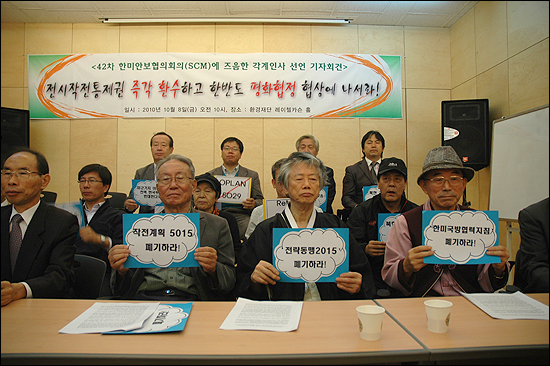
■ 42차 한미안보협의회의(SCM)에 즈음한 각계인사 선언 기자회견 ■

* 주제 : 전시 작전통제권 즉각 환수하고 한반도 평화협정 협상에 나서라! * 일시 : 2010년 10월 8일(금) 오전 10시 * 장소 : 환경재단 레이첼카슨 룸 * 선언에는 각계인사 노동39명, 농민14명, 빈민3명, 재야9명, 평화 14명, 통일12명, 종교10명, 인권 8명, 학계22명, 법조계 2명, 청년학생3명 지역 1명등 총 151명이 동참해 주셨습니다.

원유철 의원 망발과 한미 SCM 규탄 경기남부, 평택지역 기자회견

* 아먹는 원유철 의원 막말 규탄, 제 42차 SCM 규탄 기자회견 * 일시 : 2010년 10월 8일(금) 오전 11시 * 장소 : 원유철 한나라당 의원 사무실 * 기자회견 후 “평택을 한미동맹 상징도시로 만들겠다”는 원유철 의원 발언에 대한 질의서 전달 함


군사주권 포기, 대북 무력흡수통일 가속화, SCM 규탄 광주전남지역 기자회견

* 일시 : 2010년 10월 8일(금) 오전 11시
* 장소 : 광주역 앞

■ 한미동맹 폐기, 평하협정 실현, SCM에 즈음한 대구지역 기자회견 ■

* 일시 : 2010년 10월 8일(금) 오전 10시 30분
* 장소 : 켐프 헨리 후문
* 기자회견 후 항의서한 전달함


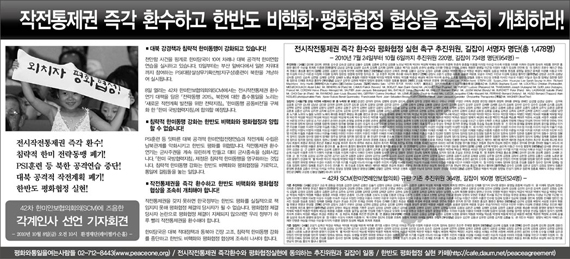
평화협정 실현운동 추진위원 신문 광고

* 주제 : 작전통제권 즉각 환수하고 한반도 비핵화/평화협정 협상을 조속히 개최하라
* 일시 : 2010년 10월 8일자 한겨레신문 2면
* 참가자 : 전시 작전통제권 즉각 환수와 평화협정 실현 촉구 추진위원, 길잡이 총 1,478명


■ 미니 영상 및 온-오프라인 홍보활동과 국민제안 ■

* 영상(작전통제권 즉각환수!)제작 및 국민홍보 (8일 현재 조회수 1,300회)


* 영상(군 복무기간 연장 꼼수는 북한 안정화 작전 위한 것!)제작 및 국민홍보


* 한겨레 <왜나면>, 오마이뉴스, 통일뉴스 기고 : 주권과 평화, 국익 해치는 한미안보협의회 (클릭)

* 경향신문 <독자마당>, 오마이뉴스 기고 : 북한 안정화 작전위해 사병 복무기간 늘리나?(클릭)

* 국방부 홈피 국민제안방 : 작전통제권 즉각 환수 및 기지이전비용 부담 반대 제안 (클릭)

* 다음 아고라에 작전통제권 환수 연기의 진짜 속셈은? (클릭)

* 그 외

올린이:홍보팀

Friday, July 23, 2010

Photos Fwd: Koreans Protest against the ROK-US '2+2 Meeting' and War Exercise

End the Invasive ROK-US Alliance!
Stop the ROK-US War Exercise!
No Sanction against North Korea!
Peace Treaty Now!

Recover the OPCON Now!

________________________________________________________
* Related:
Click Here: [Three International Petitions]
to End the Korean War and Peace Treaty! (or resolution)
_________________________________________________________

* Image source: Hankyoreh, July 22, 2010

'Members of civic organizations hold a signboard that reads, “‘Invincible Spirit’ for the destruction of peace on the Korean Peninsula?” during demonstration against the South Korea-U.S. ‘2 plus 2 talks’ in front of the government complex buildings at Sejongro, July 21, 2010.'
____________________________________________________________

* All the image sources of the below: Solidarity for Peace And Reunification of Korea, July 21, 2010. The contents are translated summary from the original and other source sites.

1. In front of the War Memorial Hall, Seoul, 1pm on July 21, 2010


____________________________________________________________

2. In front of the government complex bldg., Seoul, 1: 30pm on July 21, 2010

About Eight organizations including the Solidarity for Peace And Reunification of Korea, Veterans for Peace (ROK), Korean Alliance of Progressive Movement, Korean Confederation of Trade Unions, Pan-Korean Alliance for Reunification (PKAR), South Korean branch, Association of the Bereaved Families of the Massacred Civilians Around the Korean War (tentative translation), Association of the Families for the Democracy Practice - Sponsoring Group for the Political Prisoners (tentative translation), and Solidarity for the Practice of June 15 Joint Statement (? tentative translation) joined the press interview in front of the government complex bldg. on July 21, 2010. The bereaved family members of the Civic Committee for the Return of the Wolmi-Island Native people to Home (tentative translation), who have lost their families and homes by the U.S. air raids during the Incheon landing Operation in September, 1950 and have held a ‘sit-in strike for 2,025 days since Oct. 7, 2004, demanding the U.S. apology and responsibility from the City of Incheon, could not attend the press interview because of the intentional interruption by the Incheon police agency who had not wanted their struggle known to the world. But the bereaved families could join the press interview that was held in front of the bldg. of the Ministry of the Foreign Affairs and Trade at 4:30pm, same day. See the NO. 3.

The banner says:
'Joint Press Interview to Denounce the '
ROK-US Foreign and Defense Ministers’ Meeting'
We denounce the ROK-US '2+2 meeting' that makes the invasive ROK-US alliance perpetual!
Date: 1:30pm, July 21, 2010 (Wed.)/ Place: Front gate of the government complex bldg.'


“‘Invincible Spirit’ for the destruction of peace on the Korean Peninsula?” (Korean Alliance of the Progressive Movement:KAPM)

'Recover Operational Control [Right] Now!' (Solidarity for Peace And Reunification of Korea: SPARK)

'Recover Operational Control [Right] Now!' ( SPARK)

'Stop the ROK-US maritime drill that threatens the peace in the Korean peninsula!' (SPARK)
'ROK-US joint war exercise - as the follow-up measure of the Cheonan ship incident?

Examine the truth first!' (KAPM)


'Stop the ROK-US war drill and resume the six party talks!'(SPARK)

'United States, take responsibility for the massacre of the civilians in the Wolmi-Island!!' (SPARK)

‘2+2 meeting that deepens the subordination into the U.S.’(SPARK)

____________________________________________________________

3. In front of the bldg. of the Ministry of Foreign Affairs and Trade, Seoul, 4: 30pm
on July 21, 2010
(photos are not available yet)

While the two U. S. Secretaries passed through inside the building, the civil organizations, seeing through them through the building glass, shouted, 'No Sanction [against North Korea],' and 'Peace Treaty Now' in English. The police were heavily blocking the protesters from the sight of the passengers and cars. Some bereaved family members of the massacred Wolmi-Island civilians who were killed by the US air raids during the Incheon landing operation during the Korean War could join the press interview this time and appealed the investigation of the truth, apology and compensation from the United States.


* Image source: Hankyoreh, July 16, 2010
The 'Bereaved family members of [Wolmi Island] civilians killed during the U.S. air raids during the Korean War hold signboards requesting compensation from South Korean and U.S. governments, July 15. ' According to the article, the Bereaved families have continued more than 2000 day sit-in on Wolmi Island and have 'remained uncompensated for eviction during the war while a $23M park project is underway.' According to the SPARK site, the families want the investigation of truth more than compensation.


Related blog: Text Fwd: TRCK relaxes U.S. bombing investigation criterion under new president

Wednesday, July 14, 2010

Photos Fwd: ‘Immediately and Fully Transfer the OPCON!’ and ‘We Oppose the ROK-US 2+2 Meeting’

*All the image sources: Solidarity for Peace And Reunification of Korea


*In the performance during the rally, Obama is holding a puppet with the two strings attached to his two hands. The two labels in the strings say, 'wartime operational control right,' and 'ROK-US alliance.'

* Delivering the letter to the United States embassy in Seoul.

130th monthly Self-Reliance Unification Peace Action
In front of the United States embassy, Seoul, July 13, 2010

Immediately and Fully Transfer the OPCON!
and ‘We Oppose the ROK-US 2+2 meeting

_______________________________________________________________

Sunday, June 27, 2010

Text Fwd: Closed-door negotiations may push OPCON transfer to 2015


Hankyoreh
Closed-door negotiations may push OPCON transfer to 2015
: Diplomatic sources say S.Korea and the U.S. discussed an OPCON transfer delay, but will not go public with the plans until Saturday’s summit
Posted on : Jun.26, 2010 Modified on : Jun.26,2010

President Lee Myung-bak and U.S. President Barack Obama will discuss delaying the transfer of wartime operational control (OPCON) when the two meet in Toronto on Saturday (local time). Neither leader, however, has officially stated the way in which discussions over the issue have unfolded thus far. An examination of statements given by government officials and diplomatic sources indicates that a decision in principle has already seemingly been reached.


Multiple diplomatic sources involved with South Korea-U.S. relations said Friday that they understand that through closed-door contacts over time, the South Korean and U.S. governments have virtually reached an agreement to postpone the transfer of wartime operational control, which was initially scheduled for April 17, 2012, three years to 2015.

U.S. forces in Japan, which are linked to U.S. forces in South Korea, are scheduled to complete their redeployment by October 2015, and from a purely military technology perspective, even if the transfer of operational control is delayed to October 2015, the United States would not have to make any changes to its global military strategy,” said a government official. “It seems predictions that the move of U.S. bases to Pyeongtaek will be complete by around 2015 have been factored in as well.

There are many, however, who predict that during the Toronto summit, no concrete mention of the timing of the delay will be made; rather, after the two leaders have expressed a direction in principle, the details will be worked out through follow-up negotiations between South Korean and U.S. military officials.


The South Korean and U.S. governments have until recently repeatedly said that the transfer would proceed as scheduled, but in fact, there have reportedly been under-the-table negotiations on the issue of delaying the transfer since last year. Foreign Minister Yu Myung-hwan told local and foreign journalists Thursday that the government began to recognize changes in the situation when North Korea conducted its second nuclear test (on May 25, 2009). The under-the-table negotiations reportedly began in earnest last December, when a key figure in Cheong Wa Dae’s office of the senior secretary for foreign affairs secretly visited the United States, informing not even the South Korean ambassador in Washington, to meet with White House and State Department officials. The United States was reportedly negative at first regarding South Korea’s request to delay the transfer, but it began to adopt a more positive attitude towards the matter in March-April.


The problem is that the fine-tuning on a key point of contention of the alliance was conducted via high-level, secret negotiations focused on Cheong Wa Dae and the White House while virtually excluding the ministries and departments in charge of the issue in both countries. In response, Defense Ministry spokesman Won Tae-jae said during an open briefing Friday that the Defense Ministry has not conducted any negotiations with the Untied States over delaying the transfer. Foreign Ministry officials have responded by saying they know nothing, and official of the South Korean embassy in Washington say they have not been ordered by Seoul to do anything regarding the issue. The U.S. Pentagon is reportedly opposed to delaying the transfer as it stands. In fact, U.S. Defense Secretary Robert Gates said at a press conference after the 41st Security Consultative Meeting (SCM) in October that he was “absolutely certain” operational command would be transferred on April 17, 2012.

Please direct questions or comments to [englishhani@hani.co.kr]

______________________________________________________________

* Related article (* Informed by Rick Rozoff on June 28, 2010)

Obama: U.S. Extends South Korea Wartime Control To 2015
: Defense News
Agence France-Presse
U.S., S. Korea Defer Command Transfer To 2015
June 27, 2010


Thursday, February 25, 2010

Text fwd: 'ROK-US Combined Defense More Effective to Counter NK'

'Kim Tae-young
Defense Minister'


Korea Times
02-24-2010 19:32
'ROK-US Combined Defense More Effective to Counter NK'
By Jung Sung-ki
Staff Reporter

Defense Minister Kim Tae-young expressed hope Wednesday that the U.S.-led defense system would stay intact in coming years amid the lingering North Korean military threat.

Referring to the planned transition of operational control (OPCON) of South Korean troops during wartime from the U.S. to Korean commanders in 2012, Kim said the military was putting forth the best efforts to take over OPCON in 2012.

He said the ROK-U.S. combined defense posture would be more effective in defending South Korea for the time being, given the lingering threat posed by North Korean missile and nuclear programs.

"I also hope that the U.S.-led defense scheme will remain further, given the North Korean nuclear and missile threat," Kim said at a lecture hosted by a naval defense research institute in Seoul.

"But the OPCON transfer is a promise between the governments, so if we ask to scrap the agreement, we must give away many things. If not, it's impossible," he said.

The minister anticipated that the year 2012 would be a "complicated" year, referring to North Korea's goal to become a "strong and powerful nation" by that time to mark the 100th birthday of the late North Korean founder, Kim Il-sung, and the planned presidential elections in South Korea and the United States.

Kim said President Lee Myung-bak and other diplomatic and defense officials were trying to deal with the controversy over the OPCON transition, hinting at a possibility of renegotiations with the U.S. government over the issue.

Seoul and Washington agreed in 2007 that Korean commanders would execute independent operational control of their troops during wartime beginning on April 17, 2012, with the U.S. military shifting to an air- and naval-centric supporting role.

The two governments plan to set up their own theater commands after disbanding the ROK-U.S. Combined Forces Command (CFC).

South Korea voluntarily handed over both peacetime and wartime operational controls to the U.S.-led United Nations Command at the outbreak of the 1950-53 Korean War. The command authority was later transferred to the CFC. Korea took over peacetime control in 1994.

Conservative forces regard the command changes as a U.S. move to reduce its security commitment to South Korea. They argue the smaller role of the U.S. military amid lingering threats posed by North Korea could tip the military balance on the Korean Peninsula.

Many defense experts say the South Korean military will not be able to establish an independent defense posture due to its lack of intelligence, surveillance and reconnaissance (ISR) assets until 2012.

gallantjung@koreatimes.co.kr

Monday, January 11, 2010

Text fwd: 3-Star General May Head USFK

Korea Times
3-Star General May Head USFK
By Jung Sung-ki
Staff Reporter

A three-star general is likely to assume command of the U.S. Force Korea (USFK) after the planned command rearrangements designed to shift the roles of American forces here to naval- and air-centric supporting ones are completed, sources said Monday.

Currently, a four-star Army general is in charge of the 28,500-slot USFK. The USFK commander also serves as chief of the ROK-U.S. Combined Forces Command (CFC) and the U.N. Command (UNC).

But the four-star general will move to the U.S. Army Pacific (USARPAC) in Hawaii by 2012 when South Korea takes back wartime operational control (OPCON) of its forces from the USFK, as part of a realignment of U.S. forces in Asia and the Pacific, they said. The general then would likely take charge of all U.S. Army forces in the Asia-Pacific region.

“South Korea wants a four-star general to take command of the USFK even after the OPCON transition in 2012 as it is not only of U.S. strategic importance on the peninsula but also deals with a stronger ROK-U.S. alliance,” an American military source here told The Korea Times.

“The U.S. is positive about it but still is considering various options, including moving the four-star general from Seoul to Honolulu, in consideration of the post OPCON-transition command structure.”

An official for Seoul’s Joint Chiefs of Staff said the USFK has not given its official position on whether or not a new U.S. military command, or Korea Command (KORCOM), to be established by 2012 will keep a four-star general intact, declining to elaborate.

USFK officials here denied the move.

KORCOM will have a four-star commander even after the 2012 transition,” a USFK official said on condition of anonymity.

He said a recent decision to keep the three-star-level 8th U.S. Army in South Korea also proves the higher USFK commander will retain his four-star position.

The South Korean and U.S. militaries have been on track to make the change from the decades-old U.S.-led combined forces mechanism to a South Korean-led joint command system following a 2007 deal. Under the envisaged system, both sides will launch separate theater commands in 2012 after deactivating the CFC.

South Korean forces will take the lead of key combat missions while the U.S. military will focus on a naval- and air-centric supporting role. Instead, the U.S. forces in Korea will be transformed into rapid deployment troops that can be dispatched to other parts of the world where the U.S. faces hostilities.

Earlier, a Hawaii-based daily newspaper, The Honolulu Advertiser, reported the change in the USFK’s commander status.

“Sometime in 2012, or shortly thereafter, an American sergeant major in Seoul will haul down the flag of the four-star general who commands U.S. forces in South Korea,” the newspaper said Jan. 10.

Shifting a top general from South Korea will be among the final actions in a long, slow decline of the American engagement in Korea, it said, quoting senior U.S. military officers.

The newspaper revealed the USFK troop strength has recently downed to 24,700.

“Senior U.S. officers have told the South Koreans they must be responsible for their own defense against communist North Korea, and the departure of the top U.S. general reflects that,” it said.

The four-star general in charge of the USARPAC will work with the four-star officers commanding Navy and Air Force components of the Pacific Command, the report said.

In addition, Pacific Command will have a top Army officer to deal with other armies in Asia and the Pacific.

gallantjung@koreatimes.co.kr

Wednesday, December 16, 2009

Text Fwd: S. Korea, US to Draw Up Defense Guidelines

Korea Times
12-16-2009 18:07
S. Korea, US to Draw Up Defense Guidelines
By Jung Sung-ki, Staff Reporter

South Korea and the United States are discussing a plan to draw up "defense guidelines" next year in a bid to upgrade bilateral defense cooperation, according to defense and foreign ministry officials Wednesday.

The guidelines, similar to the U.S.-Japan Defense Guidelines established in 1996, would include key measures to strengthen military cooperation between the militaries, they said.

Among the topics are U.S. reinforcement plans in case of a war on the Korean Peninsula, the U.S. nuclear umbrella for South Korea and the stable presence of U.S. forces in Korea.

"The defense guidelines will be part of follow-up measures to materialize the Korea-U.S. alliance joint vision adopted at the summit between Presidents Lee Myung-bak and Barack Obama," an official at the Ministry of National Defense said. "The guidelines would include a comprehensive package of measures on how the two nations are to cooperate in the event of war on the peninsula."

In the summit meeting in Washington, D.C., Obama said the U.S. government would provide an extended nuclear umbrella to South Korea in response to increasing nuclear threats from the North.

Lee and Obama adopted a "joint vision for the ROK-US alliance" that calls for building a broader, strategic partnership in the realms of politics, economy, culture and other areas beyond the security arena.

In the Security Consultative Meeting (SCM) in Seoul, Oct. 22, U.S. Secretary of Defense Robert Gates confirmed the increased defense cooperation with South Korea. In a joint communique issued at the end of the annual meeting, Gates reaffirmed "the U.S. commitment to provide extended deterrence for the ROK, using the full range of military capabilities, to include the U.S. nuclear umbrella, conventional strike and missile defense capabilities."

It was the first time that detailed plans of increased U.S. deterrence capabilities for South Korea had been revealed and even stipulated in a joint statement since 2006, when the then-defense ministers from both nations first addressed the issue.

Notably, Gates said the United States would use its capabilities not only on the peninsula but also "globally available U.S. forces and capabilities that are strategically flexible to deploy to augment the combined defense in case of crisis."

Previously, the U.S. military had only referred to reinforcement of troops from the U.N. Command's rear bases in Japan in case of an emergency.

Observers said Gates' remarks were construed as a response to a lingering concern here that the 2012 transition of wartime operational control (OPCON) of South Korean troops from the U.S. military to Korean commanders will result in a smaller role of the U.S. military on the peninsula, and that it could tip the military balance between the two Koreas.

Under a 2007 deal on command rearrangements, the U.S. military on the peninsula is to shift to an air- and naval-centric supporting role with the South Korean military taking over main combat operations in the event of conflicts.

The ROK-U.S. Combined Forces Command (CFC) is to be deactivated and two separate theater commands of both militaries will be put in place here.

Speaking at a forum in the United States, CFC Commander Gen. Walter Sharp said the U.S. and Korean militaries have agreed to develop a single joint operational plan even after the OPCON transition. Both sides have already worked out an initial version of the operational plan and will complete the final one soon, he added.

gallantjung@koreatimes.co.kr


* Related Activist Statements

Solidarity for Peace And Reunification of Korea(SPARK)
Letter Sent to the Presidents of the Republic of Korea and the United States on the Occasion of the Korean-US Summit Conference
June 16, 2009

People's Solidarity for Participatory Democracy(PSPD)
“Joint Vision for the Alliance of South Korea and the US” is retrograde absenting a future vision
:The Summit of the South Korea and the US triggers Conflict and Confrontation without Resolving the North Korean Nuclear
2009/06/22


* On SCM, Oct. 22, 2009

The annual Security Consultative Meeting (SCM) between Robert Gates and Kim Tae Young (Minister of the National Defense, ROK) was on Oct. 22. According to the Korean activists here, the SCM document, 2009 (check No. 546, HERE), for the first time, explicitly expressed 1: the strengthened U.S.-S.K. alliance regarding Missile Defense, 2: the expansion of the alliance beyond the Korean peninsula (strategic flexibility).


Wednesday, October 7, 2009

Text Fwd: Seoul Suspects 100 Sites Over NK Nuke Program

Korea Times
10-05-2009 15:45
Seoul Suspects 100 Sites Over NK Nuke Program

South Korea has identified about 100 North Korean sites linked to the communist state's nuclear program and has the capacity to strike them if necessary, South Korean Defense Minister Kim Tae-young said Monday.

"There are about 100 sites related to the nuclear" program in North Korea, Minister Kim was quoted as telling lawmakers during a parliamentary audit.

"We have a complete list of them," he said, expressing confidence his forces could strike any of them "if it is absolutely clear a North Korean offensive is imminent."

The comment came after Kim said at a parliamentary hearing last month that he knew of sites where the North could be hiding its stockpile of nuclear arms if the communist state had one.

"We have sufficient information as to the locations where items related to the nuclear program are stored and the delivery means are placed," the former chairman of the Joint Chiefs of Staff said Monday.

North Korea has conducted two known atomic tests in the past three years _ one in October 2006 and the other in May this year.


* Related Korean article

Tongil News
[The South Korea Army] says, "We Made the 2nd Version of the 1st Draft of the New Operational Plan."
Chief of the Ministry of the Defense Department, "Version-Up from the Part of the UFG Training Application."
Oct. 6, 2009, Tues. by Jung, Myung-Jin, mjjung@tongilnews.com

Monday, September 28, 2009

Text Fwd: [Exclusive]Korea, US Devise Broader Air Operations Command

Image Source: Wikipedia

Image Source: same as above

Korea Times
9-27-2009 17:13
[Exclusive] Korea, US Devise Broader Air Operations Command
By Jung Sung-ki
Staff Reporter

A broader joint air operations command of South Korean and U.S. Air Forces is being set up here in tandem with the planned transition of wartime operational control (OPCON) in 2012, a military source said Sunday.

The Hardened Theater of Air Control Center (HTACC), the Korea-U.S. combined air operations command led by a three-star American general at Osan Air Base, has been working to expand its roles and missions after being renamed the Korea Air and Space Operations Center (KAOC), the source said on condition of anonymity.

The Master Control and Reporting Center (MCRC), a computer system to monitor and track aircraft on a real-time basis, at the KAOC is also receiving upgrades, he said.

"KAOC will be developed further to serve as an integrated joint air force command of the two allies on the peninsula by 2012, effectively orchestrating all operations of the two air forces in the case of an emergency," the source said.

The U.S.-led Combined Forces Command (CFC) is to hand over almost all operations authority on the peninsula to South Korea's Joint Chiefs of Staff (JCS) in 2012 before being deactivated.

But the U.S. military will still lead air operations after the transformation to take advantage of its dominant aerial assets against North Korea in time of war.

Both air forces successfully tested KAOC during the Ulchi Freedom Guardian exercise in August, according to the source.

The command will manage and direct operations conducted both by South Korean forward and rear area air operations headquarters, he said.

Under the Defense Reform 2020 plan, the Air Force, which currently operates a rear area air combat command in Daegu, about 300 kilometers southeast of Seoul, plans to launch a forward area air combat command in Osan next year.

"Work to build facilities of the new forward area command is underway in Osan," an Air Force official said. "In a bid to help boost interoperability, a liaison office from the rear area command may also be opened at the Osan base."

A U.S. military source expressed confidence in joint air operations by both commands, saying, "Each U.S. officer in KAOC has a Korean counterpart and all communications and briefings are delivered in both English and Korean. This close partnership is vital to the security of Korea."

How to map out a new command structure of the South Korean and U.S. Air Forces on the peninsula has been a key topic of the 2012 command rearrangement procedures, as the U.S. military pledged to shift its roles and missions to air- and naval-centric ones while reducing the number of ground troops.

In February, U.S. Forces Korea Commander Gen. Walter Sharp, who also serves as chief of the CFC, unveiled a plan to launch a U.S.-led combined theater air operations command in Osan by 2012.

As for criticism that a U.S. commander will still be in charge of joint air operations even after the 2012 transition, Gen. Lee Sang-eui, nomine for JCS chairman, said the authority to command and control joint air operations will, in fact, be in the hands of South Korea, given the JCS chief will eventually have the highest decision-making power for all wartime operations.

gallantjung@koreatimes.co.kr


* Related blogs

http://nobasestorieskorea.blogspot.com/2009/09/text-fwd-n-korean-nuclear-bases-pose.html
Thursday, September 24, 2009
Text fwd: N. Korean nuclear bases pose greatest threat: S. Korean commander
Yonhap News
2009/09/24 14:00 KST
By Sam Kim

http://nobasestorieskorea.blogspot.com/2009/09/text-fwd-us-braces-for-possible-nuke.html
Korea Times
09-09-2009 18:20
'US Braces for Possible Nuke War With NK'
By Jung Sung-ki
Staff Reporter

http://nobasestorieskorea.blogspot.com/2009/05/text-fwd-10000-to-practice-s-korea.html
Thursday, May 14, 2009
Text Fwd: 10,000 to practice S. Korea evacuation
By Ashley Rowland, Stars and Stripes Pacific edition,


Thursday, September 17, 2009

Text Fwd: Outgoing Commander Bolsters Korea-US Alliance


* Image source/ description: same as below
'Gen. Lee Sung-chool'

* Korea Times
09-16-2009 19:12
Outgoing Commander Bolsters Korea-US Alliance
By Jung Sung-ki, Staff Reporter

A successful transition of operational control (OPCON) of South Korean troops during wartime from the U.S. military to Korean commanders will serve as a barometer for the future strategic alliance between Seoul and Washington, the outgoing deputy commander of the ROK-U.S. Combined Forces Command (CFC) said.

Gen. Lee Sung-chool, 60, who also serves as head of the CFC's Ground Component Command, said any failure of the OPCON transfer would give the wrong signal to North Korea and destabilize the security of the Korean Peninsula.

Lee will retire next Monday, ending his 40-year-long service with the nation's military. Since assuming the post of chief director of strategic planning for the Joint Chiefs of Staff in December 2007, Lee has led works on overhauling the three-decade-old U.S.-led combined forces mechanism to a South Korean-led "joint defense system."

Both countries agreed to launch the new system on April 17, 2012, from when the two militaries are to run separate theater commands, with the U.S. military shifting to a naval- and air-centric support role.

"There are two possible kinds of failures regarding the OPCON transition," Lee said in an exclusive interview with The Korea Times, Tuesday. "One is that we shall take over OPCON when we're not fully prepared. The other is that we shall be prepared but the U.S. would not properly transfer the command authority."

Both cases could give a chance for North Korea to make a wrong decision to take provocative steps on the peninsula, the general stressed.

"The bottom line is that we should take over OPCON from the U.S. when we'll be fully prepared in a stable manner, not just being bound by the timetable," he said, advising the Seoul government managing the OPCON issue in a more careful and measured way in the coming years.

"South Korea is destined to achieve the tasks of 'survival' and 'prosperity,''' Lee noted. "In that context, the OPCON transfer is a matter of survival, while the free trade agreement with the United States, for example, is that of prosperity."

We should keep in mind that prosperity is possible only after survival, he said.

Public Diplomacy

Following his assumption of command as Deputy CFC Commander, Lee has been recognized for spearheading a public diplomacy effort to secure extended public and parliamentary support for the alliance.

He actively supported the Good Neighbor community outreach program organized by the U.S. Forces Korea (USFK) and often hosted roundtable meetings between USFK officials and South Korean lawmakers or policymakers.

"Gen. Walter Sharp came here with a mission to transform the six-decade-old alliance mechanism into a new one, so he needed much help from the Korean side," Lee said. "I tried my best to understand their way of thinking and supported them, serving as a de facto mentor regarding Korean affairs. Simply, I asked Sharp to meet with as many Koreans as possible, listen to their opinions and persuade them if required."

Gen. Lee was proud of having worked for the military and deeply thanked his nation for giving him a chance to serve as a four-star general despite his "humble" background.

Born to a farmer in Bi-geum Island, Sinan County, South Jeolla Province, Lee was unable to enter advanced education due to financial constraints. But he learned himself and later passed the qualification exam for secondary education by working during the day and studying at night.

Before entering the Korea Military Academy in 1970, Lee worked as an official at a local prosecutor's office.

After being commissioned in 1974, Lee served in key assignments in both field units and policy-related offices.

Key positions include commander of the 22nd Army Division (2002-2004) and commander of the 5th Army Corp (2005-2007).

Lee was awarded many medals and citations, including the Order of National Security Merit, Samil and Chonsu Medals, a U.S. Secretary of the Army Commendation and a ROK Presidential Commendation.

gallantjung@koreatimes.co.kr

Wednesday, February 18, 2009

Hillary Clinton, Start Dialogue With the North Korea Now!


* image caption*

The letters of the first photo say:

No! Missile Defense participation!, No! Proliferation Security Initiative!, No! US-SK joint military exercise! No! dispatch to Afghanistan!

Yes! Normalization of the US-NK relationship! Yes! Sign the Peace Agreement!


On February 17, 2009, The Solidarity for Peace And Reunification of Korea(SPARK) had a 113th monthly Anti-US imperialism rally, in front of the US Embassy, Seoul, Korea.

The summary of its claims in the rally (tentative translation)

1. Hillary Clinton, the Secretary of State visits Korea on Feb. 19-20, 2009. She said that “ If the North Korea is seriously ready to abolish the nuclear weapons completely, verifiably, the Obama government will be willing to normalize the relationship between the two countries, to replace the long time cease fire into the peace agreement, and to provide the North Korean people with the economic help of energy and others"…When the Lee Myung Park government’s harsh policy against the North Korea has led the SK-NK relationship into the closed alley, the change of the political current of the Korean peninsula through the improvement of the US-NK is desperately needed. Therefore we urge the president Obama and her to promote the dialogue with the North Korea, counter-mirroring the lessons of the policy of the Bush administration and to make a breakthrough for the normalization of the relationship between the NK-US relationship.

2. Otherwise, Walter Sharp, the commander of the United States of Forces of Korea(USFK) announced the foundation of the CAC(Combined Air Command) and the policy of the remaining of the USFK 8th Brigade. The both military departments of the both governments are promoting the highly integrated commanding system surpassing the current level of the US-SK joint command system through all areas and abilities, It means the USFK ‘s continuing domination of and meddling into the South Korean military, making meaningless of the decision of the transferring the wartime operational control (OPCON).

3. On January 15, the 8th Special Measure Agreement was submitted to the National Assembly through the official signing. If the assembly, like the government, permits the illegal and shameful increasement of the defense share budget for the relocation of the USFK 2nd brigade, the South Korean people would be the victim by the United States government. We want to expand the consciousness on this issue and to pressure the assembly so that it could actively question the whole issues.

4. It has recently first revealed that the U.S. Department of State has supported the huge amount of the fund to the so called “Human Rights organizations against the North Korea”. We strongly denounce the government of the United States of America who has added oppression against the North Korea with the issue of ‘human rights’ as weapon and who has laid the obstacle in the process for the peaceful normalization of the US-NK relationship.


* Related : A Joint Letter of the representatives of the civil society organizations in South Korea to the U.S. Secretary of State Mrs Hillary Rodham Clinton, February 18, 2009

“We, the representatives of the civil society in South Korea,
congratulate Mrs Hillary Rodham Clinton on assuming the post of Secretary of State, welcome her first official visit to Korea and take this opportunity to present our policy concerns and suggestions on the matters of U.S. policy orientation towards North Korea, the development of the Korea-U.S. alliance, and aspirations for peace in the Korean Peninsula.”


Related Korean article:

http://spark946.org/bugsboard/index.php?BBS=s_news&action=viewForm&uid=2113&page=1
113차 반미연대집회 " 힐러리 미 국무장관은 조속히 북미대화에 나서라"
- 2009년 2월 17일(화) 낮 12시, 광화문 미대사관 인근 KT 빌딩 앞 –


http://www.tongilnews.com/news/articleView.html?idxno=82884


* Related englisg article:
http://www.spark946.org/bugsboard/index.php?BBS=eng_3&action=viewForm&uid=25&page=1
Defense Ministry decides not to classify N. Korea as its ‘main enemy’
Designation as a ‘direct and serious threat’ is separate from a readiness posture or the recognition of a realistic threat


* Related blog: Space4Peace(Organizing Notes) READING THE TEA LEAVES
http://space4peace.blogspot.com/2009/02/reading-tea-leaves.html


* related article from the Ministry of the Defense Department, South Korea*
http://mnd.go.kr/mndEng/WhatsNew/RecentNews/


Status of OPCON transfer
Date 2009-02-16 16:16

Entire military working toward transfer under Joint Chiefs of Staff

The Republic of Korea (ROK) and the United States are working toward transferring the wartime operational control (OPCON) of ROK military to the chairman of the ROK Joint Chiefs of Staff (JCS) as the two sides have agreed to transfer the OPCON on 17 April 2012. The OPCON of ROK forces is currently under control of the commander of ROK-U.S. Combined Forces Command (CFC).

The agreement on the transfer of OPCON came at a ROK-U.S. summit in 2006 after the two countries agreed to speed up the process in a Security Consultative Meeting (SCM) held in 2005. The sides have since agreed on the timing of the OPCON transfer and other details of the process through SCMs, ROK-U.S. defense ministerial talks and standing military committee meetings.

After the OPCON transfer, the CFC commander will be tasked to draw up a new single command system that will control both ROK and U.S. militaries, transforming the ROK-U.S. alliance.

Under the new single command system, there will be two separate combat theater command headquarters – the ROK Joint Chiefs of Staff and the U.S. Korea Command – that will remain independent from each other, but will work together to form a joint defense system. A military consultation body will also be formed to ensure continuous military cooperation between the two sides.

Therefore, the disbandment of the ROK-U.S. CFC following the transfer of OPCON will not lead to the dismantlement of the ROK-U.S. joint defense system or any changes in the ROK-U.S. military alliance, according to Brig. Gen. Jeon In Beom, chief of the OPCON transfer office at the ROK JCS.

Toward this end, the countries are annually holding two meetings of the military committee attended by the chairman of the JCS and the U.S. commander of the ROK-U.S. CFC, as well as monthly meetings of high-level representatives that involve the JCS chief of strategies and the deputy commander of the CFC, while some 20 related offices from each sides are working closely together.

While pursuing all-out efforts to prepare for the transfer, the Joint Chiefs of Staff is holding quarterly reviews on 114 tasks in six fields. The six task fields are the establishment of theater combat command system, a ROK-U.S. military cooperation system, operational plans, command execution systems, joint exercises and basis for the transfer of OPCON.

For the establishment of a new theater combat command system, the JCS is working to restructure its organization. While creating new offices of general staff (J-1…J-7) to enable theater combat command by the JCS, the JCS is working to build a new command headquarters by 2011, as well as the headquarters for a ROK military consultation group in the Pyeongtaek Garrison, where the new U.S. Korea Command will be located.

For the establishment of a military cooperation system, the two countries have agreed to set up an Allied Military Command Center (AMCC), Combined Air Command (CAC), and various other command centers, such as CWIOC, COCG and IPS.

Also, many of the consultative bodies will be run even in peacetime while the sides will each dispatch a number of liaison officers to maintain close cooperation. The sides are also working to write up standard operating procedures for consultative bodies while also trying to set up detailed plans for their location, organization and operation. The structure and operation of intelligence and air consultation bodies will remain intact as they are under the current joint defense system.

For the establishment of a theater combat command execution system, the sides have agreed to establish a joint crisis management system, as well as combined operation plans, and to check the systems regularly through their annual Taegeuk exercise and Ulchi Freedom Guardian exercise.

In addition, the sides are trying to develop an operating system for the joint combat command headquarters as well as a C4I system for the joint command. To this end, the ROK military is working to develop an Allied Korea Joint Command and Control System (AKJCCS) by 2011, which will then be linked to the U.S. military’s C4I system.

“The ROK JCS and the U.S. Forces Korea command are working together under close cooperation for the transfer of OPCON,” Brig. Gen. Jeon said. “We will work to focus all our efforts for the successful transfer of the OPCON, which will mark the second formation of our military.”