* Text fwd from Martha Duenas and Jean Downey on April 27, 2011
The State Column
http://www.thestatecolumn.com/state_politics/virginia/sen-jim-webb-to-visit-korea-vietnam-japan-and-guam/
Sen. Jim Webb to Visit Korea, Vietnam, Japan and GuamThe State Column | Staff | Sunday, April 17, 2011
U.S. Senator Jim Webb, chair of the Senate Committee on Foreign Relations East Asian and Pacific Affairs Subcommittee and member of the Senate Committee on Armed Services, will visit the Republic of Korea, Vietnam, Japan, and Guam April 16-29. Senator Webb is scheduled to hold meetings with government officials, U.S. diplomats and military commanders, and business leaders.
In Korea, Senator Webb will review the security situation on the Korean peninsula and reaffirm his support for passage of the U.S.-Korea Free Trade Agreement.
(ONLY GOOD NEWS) In Vietnam, Senator Webb will address water security issues in Southeast Asia and continue advocating a multilateral approach to avert the devastating consequences of proposed mainstream dams along the Mekong River. If completed, these dams could fundamentally change the world’s 12th longest river and place at risk the Mekong Delta, Vietnam’s “rice bowl” and the world’s richest inland fishery.
Senator Webb is returning to Japan for the second time this year after keynoting the New Shimoda Conference in February. On this trip, he is traveling to Tokyo with Senator Carl Levin, chairman of the Senate Committee on Armed Services, to reaffirm the critical importance of the U.S.-Japan alliance and express condolences to the Japanese people and government following last month’s earthquake and tsunami.
Senator Webb will also visit Okinawa, Guam and Tinian, as a follow-on to visits he made last year, in order to meet with local officials and American military leaders responsible for the proposed realignment of U.S. military bases in the Pacific region.
Senator Webb has enjoyed a continuous personal involvement in Asian and Pacific affairs that long predates his time in the Senate. In addition to his more recent visits as a member of the Senate Foreign Relations Committee, he has worked and traveled throughout this vast region for more than four decades—as a Marine Corps officer, a defense planner, a journalist, a novelist, a senior official in the Department of Defense, and as a business consultant.
The Chamorro activists and Koohan Paik (who worked at Pacific News Center as a reporter) said not to believe its reports, which slanted to pro-build-up.
__________________________________
See also
Marianas Variety
http://www.mvguam.com/index.php?option=com_content&view=article&id=17773:us-senators-buildup-not-set-in-stone&catid=59:frontpagenews
US Senators: 'Buildup Not Set in Stone'
Therese Hart
Tuesday, April 25, 2011
KUAM News
http://www.kuam.com/story/14512570/2011/04/26/us-senators-discuss-buildup
US Senators Discuss BuildupNick Delgado
Apr 26, 2011 1:41 AM PDT
Showing posts with label USMC Guam relocation. Show all posts
Showing posts with label USMC Guam relocation. Show all posts
Thursday, April 28, 2011

Saturday, January 22, 2011
Text Fwd: "We Are Guåhan": DoD Plans to Acquire More Land, Pagat Plans Unchanged
 * Image source& caption: Pacific News Center
* Texts fwd from Martha Duenas on Jan. 22, 2011
Pacific News Center
"We Are Guahan": DoD Plans to Acquire More Land, Pagat Plans Unchanged
"We Are Guahan": DoD Plans to Acquire More Land, Pagat Plans Unchanged
News Release
Friday, 21 January 2011 10:45
Guam - In contrast to a statement released yesterday [Thursday] by the Governor and the visiting federal delegation, "We Are Guåhan" today released a statement of its own arguing that the Department of Defense actually plans on acquiring more land and claiming that DoD's plans for Pagat remain unchanged.
The statement is printed below:
Officials from the Department of Defense were on Guam for one day to pitch their plans to build a firing range complex at Pågat Village and the surrounding areas to island leaders. During their meetings, DoD officials confirmed that Pågat Village and the surrounding area remain its “preferred alternative” for the site of its 5 firing ranges.
Although DoD plans to “acquire” Pågat Village and the surrounding area – including the Guam International Raceway Park – DoD officials verbally promised “un-impeded access” to Pågat Village. This suggestion is similar to the one made by Undersecretary Jackalyn Pfannenstiel soon after DoD was sued by the Guam Preservation Trust, We Are Guåhan and the National Trust for Historic Preservation for not following the law.
For over a year, the people of Guam have opposed DoD’s plans to acquire any additional land or to build a firing range complex at Pågat Village. DoD’s continued plans of “acquiring” over 1,000 more acres of land and firing around and above Pågat Village do not address these concerns. “Un-impeded access” to Pågat Village was never the issue.
“The messengers may change, but the message remains the same: DoD plans on taking Pågat,” says We Are Guåhan member Cara Flores-Mays. “Pågat, and what it represents, is worth more to our island than vague promises of returning land that was taken from our people decades ago.”
Responding to DoD’s proposal is Governor Calvo’s first opportunity to fulfill his promise to the people of Guam that he will not abandon Pågat, and that the Calvo Tenorio administration will not agree to DoD expanding beyond its current footprint.
Governor Calvo ran on the promise that Pågat is not for sale. This means that he would never allow DoD to fire bullets over or around the graves of our ancestors. This means that Pågat will not be traded to DoD in exchange for the return of thousands of acres of land DoD currently owns but does not use, or a promise to ask Congress for money to pay for a museum and cultural center.
“Machine guns being fired overhead, and grenades blowing up in the distance, are unacceptable impacts on Pågat Village and the people living in the surrounding area,” says Flores-Mays. “We Are Guåhan will not give up on Pågat.”
Friday, 21 January 2011 10:45
Guam - In contrast to a statement released yesterday [Thursday] by the Governor and the visiting federal delegation, "We Are Guåhan" today released a statement of its own arguing that the Department of Defense actually plans on acquiring more land and claiming that DoD's plans for Pagat remain unchanged.
The statement is printed below:
Officials from the Department of Defense were on Guam for one day to pitch their plans to build a firing range complex at Pågat Village and the surrounding areas to island leaders. During their meetings, DoD officials confirmed that Pågat Village and the surrounding area remain its “preferred alternative” for the site of its 5 firing ranges.
Although DoD plans to “acquire” Pågat Village and the surrounding area – including the Guam International Raceway Park – DoD officials verbally promised “un-impeded access” to Pågat Village. This suggestion is similar to the one made by Undersecretary Jackalyn Pfannenstiel soon after DoD was sued by the Guam Preservation Trust, We Are Guåhan and the National Trust for Historic Preservation for not following the law.
For over a year, the people of Guam have opposed DoD’s plans to acquire any additional land or to build a firing range complex at Pågat Village. DoD’s continued plans of “acquiring” over 1,000 more acres of land and firing around and above Pågat Village do not address these concerns. “Un-impeded access” to Pågat Village was never the issue.
“The messengers may change, but the message remains the same: DoD plans on taking Pågat,” says We Are Guåhan member Cara Flores-Mays. “Pågat, and what it represents, is worth more to our island than vague promises of returning land that was taken from our people decades ago.”
Responding to DoD’s proposal is Governor Calvo’s first opportunity to fulfill his promise to the people of Guam that he will not abandon Pågat, and that the Calvo Tenorio administration will not agree to DoD expanding beyond its current footprint.
Governor Calvo ran on the promise that Pågat is not for sale. This means that he would never allow DoD to fire bullets over or around the graves of our ancestors. This means that Pågat will not be traded to DoD in exchange for the return of thousands of acres of land DoD currently owns but does not use, or a promise to ask Congress for money to pay for a museum and cultural center.
“Machine guns being fired overhead, and grenades blowing up in the distance, are unacceptable impacts on Pågat Village and the people living in the surrounding area,” says Flores-Mays. “We Are Guåhan will not give up on Pågat.”
_________________________________
See also
Pacific News Center
Navy Under-Secretary Work: DoD Determined to "Continue to Listen to the Government & People of Guam"
News Release
Friday, 21 January 2011 10:30
Pacific News Center
BREAKING NEWS: 10:40 a.m. - Navy releases more details on Work's "four pillars" of buildup
Jan. 21, 2011
Sunday, September 26, 2010
Text Fwd: [famoksaiyanfriends] Military Says Guam Buildup on Schedule Despite New Problems 군대는 말하길, 새로운 문제들에도 불구, 괌 증강, 예정대로

 * Images from Minagahet Chamorro blog on Sept. 26, 2010
_________________________________________________________
* Text sent from Martha Duenas on Sept. 26, 2010
Stars & Stripes
Military Says Guam Buildup on Schedule Despite New Problems
By Travis J. Tritten
Published: September 24, 2010
SASEBO NAVAL BASE, Japan — The plan for a U.S. military buildup on Guam hit two more snags this week that will delay key projects.
The Department of Defense and Guam are at an impasse over the use of ancestral land for a Marine Corps firing range, which could put the future of the project in question, the Guam State Historic Preservation Office said.
Meanwhile, building a berth for aircraft carriers must be delayed for another year while the Navy researches the environmental impact on coral, the Naval Facilities Engineering Command in Hawaii confirmed Friday.
Both projects are part of a historic shift of military forces in the Pacific that includes an agreement with Japan to move 8,600 Marines from Okinawa to Guam by 2014.
Difficulties in the process have fueled public speculation and media reports that the transfer of Marines will be delayed to 2016 or later, but the military has remained committed to the deadline.
Landmark Guam buildup plans the Navy released Tuesday are based on the 2014 deadline and the transfer of Marines will continue on that schedule, Maj. Neil Ruggiero, spokesman for the Joint Guam Program Office, told Stars and Stripes on Friday.
The construction of some Marine facilities is expected to begin early next year on Guam using $498 million in funding from Japan.
But the future of planned training ranges on the island is far less certain.
The military has been unable to get support it needs from the Guam government to place Marine live-fire ranges on ancient Chamorro land at Pagat Village, a federally registered archaeological site that holds deep meaning for many on the island.
“The Department of Defense is still recognizing Pagat as the site for the firing range, whereas we don’t even want it mentioned in the programmatic agreement,” said Lynda Aguon, State Historic Preservation officer. “We just don’t want Pagat to be mentioned at all.”
The DOD is seeking an agreement with the preservation office that will set ground rules to deal with damage to historic sites during construction and to clear the way for the ranges. Such agreements are required by federal law when the government builds on historic land.
But Aguon said her office will not support a DOD plan that targets Pagat — a position that has thrown the possibility of any agreement into question.
“We just want that [land] kept pristine,” she said. “If you fence off the area, we can’t visit where our ancestors were and pay our respects.”
Retired Marine Maj. Gen. David Bice, executive director of the Joint Guam Program Office, said Tuesday that Pagat is the only site on the island that meets all requirements for Marine training and it remains the military’s top choice for the ranges.
“We could not find any parcels on DOD property that would accommodate the ranges,” he said. “Through the process of talking to Guam leaders and agency heads, we started looking around and were guided to the preferred alternative [of Pagat Village] at Route 15.”
Bice said any final decision on using the site will be delayed as talks continue.
The two groups have failed to reach an understanding after months of meetings and multiple agreement drafts, according to Aguon.
If an understanding is not reached, Aguon said the DOD could take the land without Guam government support through condemnation.
Meanwhile, the Navy must conduct another study of coral before it can dredge Apra Harbor to make access for aircraft carriers.
The new research will focus on coral, fish, sponges and protected sea turtles at 72 sites in the harbor. It was requested by federal agencies including the Environmental Protection Agency, the U.S. Fish and Wildlife Service and the National Marine Fisheries Service.
Previous Navy studies show little high-quality coral is likely to be removed and three harbor reefs will not be dredged. About 71 acres would be dredged under the Navy’s preferred plan, including about 25 acres containing sparse patches of coral, according to studies compiled by the Navy in July.
The Navy will delay a decision on where to locate the carrier berth until after the new research is complete in November 2011, according to contract information supplied by NAVFAC.
A $2.3 million contract for the study was awarded on Sept. 17 to HDR-e2M, a Denver-based environmental and engineering company, and work will begin in October, NAVFAC said.
The fate of harbor coral has stoked public concerns on Guam similar to the Pagat ranges.
“We will never get those corals back. It is a terrible loss for our island,” said Guam Sen. Judith Guthertz, chairwoman of the legislature’s Committee on the Guam Military Buildup and Homeland Security.
Guthertz said the U.S. military will “hurt their cause and alienate people” by dredging coral and using Pagat for training ranges despite the persistent public concerns.
Still, she said the projects are probably inevitable despite the delays this month.
“Even if they delayed [plans] for awhile, it will happen,” she said.
trittent@pstripes.osd.mil
Wednesday, September 22, 2010
Text Fwd: Navy Finalizes Plans For U.S. Military Buildup On Guam 미 해군, 괌에서의 미 군대 증강 계획 최종
* Stop NATO
Stars and Stripes
September 20, 2010
Navy finalizes plans for U.S. military buildup on Guam
By Travis J. Tritten
SASEBO NAVAL BASE, Japan: The U.S. Navy firmed up plans Tuesday for a military
buildup on Guam that could lead to a historic shift in military forces in the
Pacific.
The Navy’s record of decision finalizes where facilities will be built for
8,600 Marines scheduled to move from Okinawa by 2014 and identifies the planned
pace of the massive construction effort, according to a brief released by the
Department of Defense Joint Guam Program Office.
But the Navy delayed decisions on controversial plans to build military training
ranges on Guam’s ancestral land and to dredge coral in Guam’s main harbor
for an aircraft carrier berth, according to the brief.
The full report on the buildup was not available immediately after it was signed
by Assistant Secretary of the Navy Jackie Pfannenstiel early Tuesday. The joint
program office said it would post the full document online by Wednesday.
....
Utilities funding from the Japanese government is critical, he said.
The United States is in talks with Japan and the Japanese Bank of International
Cooperation over the country’s $740 million contribution for wastewater, power
and water upgrades on Guam.
Japan agreed in 2006 to fund the upgrades as part of the shift of Marines from
Okinawa.
....
===========================
Stop NATO
Blog site
_____________________________________________________
* See a text sent from Martha Duenas on Sept. 22, 2010, also.
Guam Build EIS
Associated Press
US Military Postpones 2 Guam Buildup Decisions
By AUDREY McAVOY (AP) – 2:09 PM Guam / ChST
HONOLULU — The U.S. military has postponed two key decisions related to its buildup of forces on the Guam to ensure it's complying with environmental and historic preservation laws.
But it gave final approval to the single biggest part of the buildup: a proposal to move 8,000 Marines and their dependents from Okinawa, Japan to the U.S. territory in the Pacific. The decision was posted online Tuesday.
The Navy put off deciding where to build a live fire range for the Marines while it consults with preservation authorities on how the training area would affect the ancient village of Pagat. Stone bowls, fishing gear, spear points and other artifacts dating back more than a millennium have been found at the village, which is listed on the National Register of Historic Places.
The military acknowledged in a document called a "Record of Decision" that a significant new influx of population would affect the island's indigenous Chamorro population, and vowed to be sensitive to this issue.
At its peak, the buildup is expected to boost Guam's population by 79,000 people, or 45 percent, over its current 180,000 residents.
The Department of Defense "is cognizant of the concerns regarding the degradation of Chamorro culture and respects Chamorro social and cultural traditions and will continue to strive to be good neighbors," the document said.
The Navy also delayed deciding where in Apra Harbor it will place a new aircraft carrier berth so it can study how construction of the dock would affect the harbor's coral reef.
The Environmental Protection Agency in February said the military, in a draft environmental impact statement, had underestimated the effect the berth would have on corals that provide essential habitats for fish and endangered sea turtles.
The EPA told the Navy this month it would need to study the coral matter further before it selected a site within Apra for the carrier.
The Navy wants the new berth to accommodate the military's strategy of having its aircraft carriers spend more time in the western Pacific.
Guam is about 3,700 miles southwest of Hawaii and 1,500 miles south of Tokyo.
Stars and Stripes
September 20, 2010
Navy finalizes plans for U.S. military buildup on Guam
By Travis J. Tritten
SASEBO NAVAL BASE, Japan: The U.S. Navy firmed up plans Tuesday for a military
buildup on Guam that could lead to a historic shift in military forces in the
Pacific.
The Navy’s record of decision finalizes where facilities will be built for
8,600 Marines scheduled to move from Okinawa by 2014 and identifies the planned
pace of the massive construction effort, according to a brief released by the
Department of Defense Joint Guam Program Office.
But the Navy delayed decisions on controversial plans to build military training
ranges on Guam’s ancestral land and to dredge coral in Guam’s main harbor
for an aircraft carrier berth, according to the brief.
The full report on the buildup was not available immediately after it was signed
by Assistant Secretary of the Navy Jackie Pfannenstiel early Tuesday. The joint
program office said it would post the full document online by Wednesday.
....
Utilities funding from the Japanese government is critical, he said.
The United States is in talks with Japan and the Japanese Bank of International
Cooperation over the country’s $740 million contribution for wastewater, power
and water upgrades on Guam.
Japan agreed in 2006 to fund the upgrades as part of the shift of Marines from
Okinawa.
....
===========================
Stop NATO
Blog site
_____________________________________________________
* See a text sent from Martha Duenas on Sept. 22, 2010, also.
Guam Build EIS
Associated Press
US Military Postpones 2 Guam Buildup Decisions
By AUDREY McAVOY (AP) – 2:09 PM Guam / ChST
HONOLULU — The U.S. military has postponed two key decisions related to its buildup of forces on the Guam to ensure it's complying with environmental and historic preservation laws.
But it gave final approval to the single biggest part of the buildup: a proposal to move 8,000 Marines and their dependents from Okinawa, Japan to the U.S. territory in the Pacific. The decision was posted online Tuesday.
The Navy put off deciding where to build a live fire range for the Marines while it consults with preservation authorities on how the training area would affect the ancient village of Pagat. Stone bowls, fishing gear, spear points and other artifacts dating back more than a millennium have been found at the village, which is listed on the National Register of Historic Places.
The military acknowledged in a document called a "Record of Decision" that a significant new influx of population would affect the island's indigenous Chamorro population, and vowed to be sensitive to this issue.
At its peak, the buildup is expected to boost Guam's population by 79,000 people, or 45 percent, over its current 180,000 residents.
The Department of Defense "is cognizant of the concerns regarding the degradation of Chamorro culture and respects Chamorro social and cultural traditions and will continue to strive to be good neighbors," the document said.
The Navy also delayed deciding where in Apra Harbor it will place a new aircraft carrier berth so it can study how construction of the dock would affect the harbor's coral reef.
The Environmental Protection Agency in February said the military, in a draft environmental impact statement, had underestimated the effect the berth would have on corals that provide essential habitats for fish and endangered sea turtles.
The EPA told the Navy this month it would need to study the coral matter further before it selected a site within Apra for the carrier.
The Navy wants the new berth to accommodate the military's strategy of having its aircraft carriers spend more time in the western Pacific.
Guam is about 3,700 miles southwest of Hawaii and 1,500 miles south of Tokyo.
Wednesday, September 15, 2010
Text Fwd:[famoksaiyanfriends] US Embassy Tokyo: U.S. and Japan Moving Forward on U.S. Force Realignment 도쿄 미 대사관: 미국과 일본 미국 군대 재배치를 향해 전진
 *Image source: Teri Weaver/Stars and Stripes
'A man walks along Guam's eastern shore in an area near Pagat, the site of an ancient Chamorro village.'
__________________________________________________________
* Texts fwd from Martha Duenas on Sept. 15, 2010
Embassy of the United States - Japan
PRESS RELEASE:
U.S. and Japan Moving Forward on U.S. Force Realignment
Sept. 14, 2010
On Sept. 14, 2010 in Tokyo, Ambassador Extraordinary and Plenipotentiary of the United States of America John V. Roos and Japanese Foreign Minister Katsuya Okada exchanged Notes pertaining to the transfer of funds provided by the Government of Japan to the United States Government in accordance with the Agreement on the Relocation of United States Marine Corps from Okinawa to Guam, signed between Secretary of State Clinton and Foreign Minster Nakasone on Feb. 17, 2009.
Based on the exchanged Notes, the Government of Japan will provide $497.8 million to the United States Government during FY2010 to be used for projects to develop facilities and infrastructure on Guam for the relocation of 8,000 U.S. Marines and their dependents from Okinawa to Guam. This significant step is in accordance with the May 1, 2006, SCC Document, "United States-Japan Roadmap for Realignment Implementation," which both Governments reaffirmed in the May 28, 2010, SCC Joint Statement.
Projects to be funded by the Government of Japan during FY2010 for the relocation of U.S. Marines from Okinawa to Guam:
On-base infrastructure project in Finegayan area (Phase 2): 309 million U.S. dollars
Construction project of fire station in Finegayan area: 25.1 million U.S. dollars
Construction project of port operation unit headquarters building in Apra area: 24.8 million U.S. dollars
Construction project of medical clinic in Apra area: 96 million U.S. dollars
Design project (base administrative building, Marine Logistic Group headquarters building, police station, physical training complex, enlisted dining facility and bachelor enlisted quarters in Finegayan area): 42.9 million U.S. dollars
TOTAL: 497.8 million U.S. dollars
_____________________________________________________
* Related articles
Stars and Stripes
Japan Agrees to Pay $498 Million Toward Guam Buildup
By Travis J. Tritten
September 14, 2010 1:58 PM Guam/ChST
Saturday, September 4, 2010
Text Fwd: [famoksaiyanfriends] from Minagahet Chamorro blog: :Minagahet Zine: Critical Comments
 * Image source: same as in the link
* Texts fwd from Martha Duenas on Sept. 3, 2010
No Rest for the Awake: Minagahet Chamorro blog
by Michael Lujan Bevacqua
Sept. 2, 2010
EXCERPTS
'The DEIS (Draft Environmental Impact Statement) comment period was an incredible three months. The public engagement and critique was far beyond anyone could have expected. 9,000 – 10,000 comments were submitted to the Joint Guam Program Office, thousands and thousands more than they most likely anticipated. The public comment meetings were dominated by people who were either against the buildup or at least suspicious about how this sort of massive movement of people and rapid haphazard period of development could be beneficial for Guam long-term. Throughout the DEIS comment period, I was trying my best to keep up with what was going on, and wrote a series of blog posts about how we could see the buildup as a process “breaking down.” The idea of it “breaking down” wasn’t meant to convey that it wasn’t going to happen or that it had been valiantly stopped, but more to discuss how opinions of it, representations of it, and even political decisions about it were changing and moving. The buildup was always a massive, complicated, kaduku and impossible thing, but this aspect was something most people on Guam did not take seriously. Deeply embedded colonizing thoughts that whatever is good for the US is good for Guam, or that Uncle Sam is always looking out for Guam created a gigantic bubble, which made this ridiculously large project seem more like a dream than reality. The buildup was for years a golden ticket, something which would make dreams come true. Another way in which Guam reinvents its dependency upon the United States, through emotional nationalism and deluding optimism. People didn’t know a lot of details, but didn’t really have to, since those details would be taken care of by others who we can be certain are much better at their jobs than anyone on Guam and only have Guam’s interests at heart.
The DEIS comment period (thankfully) did a lot to change this. The DEIS document and those people who did the difficult work of translating it and interpreting it for the public, laid bare the scope and the damage the buildup entails. The news media, started to reach beyond the official DOD line that comes from JGPO and look at what the murmurs were in Japan and Washington D.C. and suddenly things seemed less certain, less inevitable. Not only was there a very real possibility that this buildup would not make Guam’s dreams come true, but in fact it could do far more damage than anyone had imagined, to the environment, society and the economy. Even the promises which were made that Guam would swim in more money than it could ever hope to spend, were clearly not enough to cover the costs of increasing Guam’s social capacity enough to handle the population increases or the damage that would be caused at Apra Harbor. Today, the perceptions of the buildup are far closer to where they should be than ever before. People see the buildup as both positive and negative, and by this I don’t mean they see it has something bubula’ ni positives, with unu pat dos na negatives. They see it as something which could improve some things, but could also damage others. And the positives in no clear way outweigh the negatives. This is the point which Guam should have been at 4 years ago, in the first days of this buildup, because then it could have adequately prepared for either handling or challenging this buildup.
FOR MORE READING, SEE'
Saturday, August 28, 2010
Text Fwd: [famoksaiyanfriends] Kyodo : U.S. says it can't repay Japan loan to build infrastructures in Guam
* Texts informed from Martha Duenas on Aug. 27, 2010
Kyodo News
US Says It Can't Repay Japan Loan to Build Infrastructures in Guam
The United States has told Japan that it cannot work out a repayment schedule for more than half of a $740 million loan to be extended by the Japan Bank for International Cooperation, the sources said.
Kyodo News
US Says It Can't Repay Japan Loan to Build Infrastructures in Guam
Aug 27 06:33 AM US/Eastern / Aug 27 20:33 PM Guam/CST
WASHINGTON, Aug. 27 (AP) - (Kyodo) — The planned transfer of some U.S. Marines from Okinawa to Guam faces a financial hurdle as the U.S. government considers it will be impossible to repay a Japanese loan to finance infrastructure projects needed for the transfer of the Marines to the U.S. Pacific territory, bilateral diplomatic sources said Friday.
The United States has told Japan that it cannot work out a repayment schedule for more than half of a $740 million loan to be extended by the Japan Bank for International Cooperation, the sources said.
The Japanese government has begun to consider a delay in extending the loan, despite U.S. demands for its early provision.
Japan and the United States agreed to move some 8,000 U.S. Marines from Okinawa to Guam as a pillar of their agreement in 2006 on the realignment of U.S. forces in Japan.
The agreement included the JBIC loan to build water supply and sewage systems as well as power supply facilities for the Marines and their families.
While up to $435 million, or 58 percent of the loan, would be used to construct sewage facilities, the U.S. government planned to repay that portion with water charges to be collected by the Guam government.
But the Guam government refused to be liable for the repayment, making it impossible for Washington to prepare a repayment schedule for the portion, the sources said, adding that the repayment of the remaining portion would be also difficult in light of financial conditions in Guam.
The U.S. government is expected to avoid including details in a funding plan it will map out in September for the infrastructure building projects.
The Pentagon has said the transfer of the Marines could be delayed until 2017 from the current target of 2014.
As a long delay in the transfer could adversely affect the bilateral alliance, the Japanese government has not ruled out the possibility of shouldering the infrastructure-building costs, the sources said.
The planned JBIC loan is structured to have the Japanese government cover it if it goes sour.
_______________________________________________________________
See also
Ginowan Mayor Renews Opposition to Futenma Base Relocation to Henoko
Aug 27 01:57 AM US/Eastern
Wednesday, April 28, 2010
Text Fw: [famoksaiyanfriends] The Buildup Proponents Strike Back
* Text informed by Koohan Paik through [famoksaiyanfriends] on April 28, 2010
PACIFIC ISLANDS REPORT
Pacific Islands Development Program/East-West Center
With Support From Center for Pacific Islands Studies/University of Hawai‘i
--------------------------------------------------------------------------------
Commentary
BRINGING BALANCE TO GUAM BUILDUP DISCUSSION
By Jay R. Merrill
HAGÅTÑA, Guam (Marianas Business Journal, April 26, 2010) – Reading much of the national press, one gets the impression that most people on Guam are against the military buildup for one reason or another. The Draft Environmental Impact Study hearings seemed to uncover staunch public opposition to what is planned. The participants who voiced their concerns were passionate, young and for the most part articulate. It is not surprising that the Washington Post, Nation magazine and others have portrayed Guam as a community that believes it is being imposed upon and taken for granted. Such was most of what was heard at the hearings. The hearings were contentious and marked the emergence of a new social brand called "We are Guahan." The group has continued beyond the hearings, advocating vigorously for sustaining Guam’s environment, its culture and "way of life." They express sincere and passionate fears about the change the military buildup will bring. While it is hard to argue against sustaining the environment and the island’s culture, the national media gets it wrong when they portray Guamanians as opposed to the change the military buildup will bring. The fact is, if a survey were held today, a majority of Guamanians remains in favor of the military buildup. Most people are not afraid of the change that will come; they fear more what Guam will become without it.
That is why the evolution of a new social brand is refreshing and needed. The group is called Hita I Marianas, which, I am told, translates to "We are the Marianas." The group is trying to create greater balance in the public discussion about the buildup. It believes that as much must be discussed about how the community can benefit from the economic growth that is coming as is discussed about the challenges it may present. The benefits the military buildup will create will be opportunities, not dollars falling from the sky. Unless the community understands those benefits, prepares for them, and starts working now to insure their fruition, they just might pass us by. If so, what then? What alternative exists to the buildup that could create as many jobs, as much income, and help Guam and the Northern Mariana Islands finance the public infrastructural improvements required by both communities? At the moment, no one has an answer.
The face of Hita I Marianas is retired Army Command Master Sgt. Ben Palacios, from Saipan wanting to start a business, concerned about the future of the region’s economy. It is also Adam Tydingco, soon to graduate from university in California wanting to come home to a career in Guam. The group believes more has to be focused on making those kinds of dreams a reality. The discussion should be about both Guam and the NMI, as the buildup will affect the entire region. There should be more discussion about connecting local businesses and off-island concerns to work together to create jobs. Hita I Marianas wants the public to learn more about how the military and the community can work together to forge a coexistence that can make the region a better place to live and work.
The group is forming; it is soliciting others to join in. It is holding a conference in San Diego to inform businesses on the mainland that the people of the region are looking for investors interested in the long term. The conference is about informing those thinking of coming to the region about long-term opportunities that exist and are emerging. It also provides a chance for U.S. firms to learn how to partner with local firms and with the community in ways that will be more efficient and will improve the region. The group’s website can be found at www.marianasbuildup.com. It is worth checking out.
Marianas Business Journal
Copyright © 2009 Glimpses of Guam Inc., All Rights Reserved
Jay R. Merrill is chairman of Market Research & Development Inc.
PACIFIC ISLANDS REPORT
Pacific Islands Development Program/East-West Center
With Support From Center for Pacific Islands Studies/University of Hawai‘i
--------------------------------------------------------------------------------
Commentary
BRINGING BALANCE TO GUAM BUILDUP DISCUSSION
By Jay R. Merrill
HAGÅTÑA, Guam (Marianas Business Journal, April 26, 2010) – Reading much of the national press, one gets the impression that most people on Guam are against the military buildup for one reason or another. The Draft Environmental Impact Study hearings seemed to uncover staunch public opposition to what is planned. The participants who voiced their concerns were passionate, young and for the most part articulate. It is not surprising that the Washington Post, Nation magazine and others have portrayed Guam as a community that believes it is being imposed upon and taken for granted. Such was most of what was heard at the hearings. The hearings were contentious and marked the emergence of a new social brand called "We are Guahan." The group has continued beyond the hearings, advocating vigorously for sustaining Guam’s environment, its culture and "way of life." They express sincere and passionate fears about the change the military buildup will bring. While it is hard to argue against sustaining the environment and the island’s culture, the national media gets it wrong when they portray Guamanians as opposed to the change the military buildup will bring. The fact is, if a survey were held today, a majority of Guamanians remains in favor of the military buildup. Most people are not afraid of the change that will come; they fear more what Guam will become without it.
That is why the evolution of a new social brand is refreshing and needed. The group is called Hita I Marianas, which, I am told, translates to "We are the Marianas." The group is trying to create greater balance in the public discussion about the buildup. It believes that as much must be discussed about how the community can benefit from the economic growth that is coming as is discussed about the challenges it may present. The benefits the military buildup will create will be opportunities, not dollars falling from the sky. Unless the community understands those benefits, prepares for them, and starts working now to insure their fruition, they just might pass us by. If so, what then? What alternative exists to the buildup that could create as many jobs, as much income, and help Guam and the Northern Mariana Islands finance the public infrastructural improvements required by both communities? At the moment, no one has an answer.
The face of Hita I Marianas is retired Army Command Master Sgt. Ben Palacios, from Saipan wanting to start a business, concerned about the future of the region’s economy. It is also Adam Tydingco, soon to graduate from university in California wanting to come home to a career in Guam. The group believes more has to be focused on making those kinds of dreams a reality. The discussion should be about both Guam and the NMI, as the buildup will affect the entire region. There should be more discussion about connecting local businesses and off-island concerns to work together to create jobs. Hita I Marianas wants the public to learn more about how the military and the community can work together to forge a coexistence that can make the region a better place to live and work.
The group is forming; it is soliciting others to join in. It is holding a conference in San Diego to inform businesses on the mainland that the people of the region are looking for investors interested in the long term. The conference is about informing those thinking of coming to the region about long-term opportunities that exist and are emerging. It also provides a chance for U.S. firms to learn how to partner with local firms and with the community in ways that will be more efficient and will improve the region. The group’s website can be found at www.marianasbuildup.com. It is worth checking out.
Marianas Business Journal
Copyright © 2009 Glimpses of Guam Inc., All Rights Reserved
Jay R. Merrill is chairman of Market Research & Development Inc.
Friday, February 12, 2010
Text Fwd: No more troops Japanese officials given copy of ‘sentiment’ resolution
*Text Fwd from Corazon Valdez Fabros on Feb. 12, 2010, through [ap-nobases]
No more troops:
Japanese officials given copy of ‘sentiment’ resolution
Friday, 12 February 2010 03:52
by Therese Hart | Variety News Staff
[Speaker Judi Guthertz discusses Guam’s sentiments with Japanese House Rep. Mikio Shimoji, while vice speaker BJ Cruz and Sen. Tina Muna Barnes listen during the Japanese delegation’s visit to the legislature on Thursday. Matt Weis]
LAWMAKERS yesterday unanimously passed a resolution that reiterates the island residents’ sentiments on the military’s draft environmental impact statement, which they consider “grossly flawed.”
Visiting members of Japan’s House of Representatives assured senators that there will be no additional troops that will be deployed to Guam beyond the number originally agreed upon between The United States and Japan.
Senator Rory Respicio, author of Resolution 275, described the legislature’s action as a tremendous victory for the people of Guam. He said the resolution reflects months of input based on the review of the draft impact report.
“The legislature’s approach to this military buildup is that we have to represent the people’s feelings on this matter,” said the lawmaker.
Respicio said Congresswoman Madeleine Z. Bordallo has made a commitment to represent the legislature’s position, which reflects the sentiments of the people.
Respicio hopes for Gov. Felix Camacho’s support for the resolution and to give his commitment as well.
Two members of Japan’s Diet, Mikio Shimoji of the People’s New Party and Tomoko Abe of the Social Democrat Party, made a brief stop at the legislature during yesterday’s session. The resolution was presented to the two Japanese lawmakers.
“What we saw today, we don’t think that there’s enough capacity for more forces because of the infrastructure situation in Guam,” Shimoji said through an interpreter. “And considering the sentiments and motivations of the people of Guam, at this point, there cannot be additional forces from Japan.”
Shimoji also said that the United States and Japan must both share equal responsibility for the buildup. He said when he returns to Japan, he and other members of the delegation will share with their colleagues the sentiments of Guam residents about the buildup.
Committeewoman on the Guam Military Buildup, Sen. Judi Guthertz said that
“The people of Guam should be proud of the legislature for standing up for them and for trying to make certain that this buildup will not be one sided but that it will benefit everyone who calls Guam home now and in the future,” said Sen. Judi Guthertz, chairman of the military buildup committee.
Guthertz said that was the goal of lawmakers when they drafted the resolution. “I encourage the people of Guam to read the resolution so that they can see what the legislature said and what we’re trying to accomplish,” said the lawmaker.
Speaker Judi Won Pat said the resolution is a very significant piece of document that would change Japan’s impression of Guam’s position on the military buildup.
Japanese Diet members told Won Pat that they were always under the impression, three to four years ago, that 80 to 90 percent of Guam residents were in favor of the buildup. “That was the story they were given,” Won Pat said.
They were very curious to find what the true sentiments were and this is why they made the effort to visit the Guam Legislature when they learned that Resolution 275 was being heard regarding the buildup.
“We told them that it will contain the sentiments of the people, and that to them was far more important—that they know what the military side of the story is, and they wanted to know the people of Guam’s story, too,” said the speaker.
Won Pat said members of the Japanese Diet were very humble when they acknowledged that Japan has an equal responsibility as the United States in terms of the Marines’ relocation as stated in the U.S. and Japan agreement.
“To us, this speaks volumes because this is the first time any government has ever said that—admitting that share in the responsibility,” said Won Pat.
The delegation left Guam yesterday afternoon.
--
si Debbie Quinata
I Nasion Chamoru
P.O. Box 6132
Merizo, Guam 96916
(671) 828-2957
No more troops:
Japanese officials given copy of ‘sentiment’ resolution
Friday, 12 February 2010 03:52
by Therese Hart | Variety News Staff
[Speaker Judi Guthertz discusses Guam’s sentiments with Japanese House Rep. Mikio Shimoji, while vice speaker BJ Cruz and Sen. Tina Muna Barnes listen during the Japanese delegation’s visit to the legislature on Thursday. Matt Weis]
LAWMAKERS yesterday unanimously passed a resolution that reiterates the island residents’ sentiments on the military’s draft environmental impact statement, which they consider “grossly flawed.”
Visiting members of Japan’s House of Representatives assured senators that there will be no additional troops that will be deployed to Guam beyond the number originally agreed upon between The United States and Japan.
Senator Rory Respicio, author of Resolution 275, described the legislature’s action as a tremendous victory for the people of Guam. He said the resolution reflects months of input based on the review of the draft impact report.
“The legislature’s approach to this military buildup is that we have to represent the people’s feelings on this matter,” said the lawmaker.
Respicio said Congresswoman Madeleine Z. Bordallo has made a commitment to represent the legislature’s position, which reflects the sentiments of the people.
Respicio hopes for Gov. Felix Camacho’s support for the resolution and to give his commitment as well.
Two members of Japan’s Diet, Mikio Shimoji of the People’s New Party and Tomoko Abe of the Social Democrat Party, made a brief stop at the legislature during yesterday’s session. The resolution was presented to the two Japanese lawmakers.
“What we saw today, we don’t think that there’s enough capacity for more forces because of the infrastructure situation in Guam,” Shimoji said through an interpreter. “And considering the sentiments and motivations of the people of Guam, at this point, there cannot be additional forces from Japan.”
Shimoji also said that the United States and Japan must both share equal responsibility for the buildup. He said when he returns to Japan, he and other members of the delegation will share with their colleagues the sentiments of Guam residents about the buildup.
Committeewoman on the Guam Military Buildup, Sen. Judi Guthertz said that
“The people of Guam should be proud of the legislature for standing up for them and for trying to make certain that this buildup will not be one sided but that it will benefit everyone who calls Guam home now and in the future,” said Sen. Judi Guthertz, chairman of the military buildup committee.
Guthertz said that was the goal of lawmakers when they drafted the resolution. “I encourage the people of Guam to read the resolution so that they can see what the legislature said and what we’re trying to accomplish,” said the lawmaker.
Speaker Judi Won Pat said the resolution is a very significant piece of document that would change Japan’s impression of Guam’s position on the military buildup.
Japanese Diet members told Won Pat that they were always under the impression, three to four years ago, that 80 to 90 percent of Guam residents were in favor of the buildup. “That was the story they were given,” Won Pat said.
They were very curious to find what the true sentiments were and this is why they made the effort to visit the Guam Legislature when they learned that Resolution 275 was being heard regarding the buildup.
“We told them that it will contain the sentiments of the people, and that to them was far more important—that they know what the military side of the story is, and they wanted to know the people of Guam’s story, too,” said the speaker.
Won Pat said members of the Japanese Diet were very humble when they acknowledged that Japan has an equal responsibility as the United States in terms of the Marines’ relocation as stated in the U.S. and Japan agreement.
“To us, this speaks volumes because this is the first time any government has ever said that—admitting that share in the responsibility,” said Won Pat.
The delegation left Guam yesterday afternoon.
--
si Debbie Quinata
I Nasion Chamoru
P.O. Box 6132
Merizo, Guam 96916
(671) 828-2957
Site Fwd: Jeju Island, Korea • Okinawa • Guam: Why does the US want more & bigger military bases in the Asia-Pacific?
* Ten Thousand Things, Feb. 9, 2010

(From "US Bases and Empire: Global Perspectives on the Asia Pacific" by Catherine Lutz, posted at Japan Focus. For a larger view, click here.)
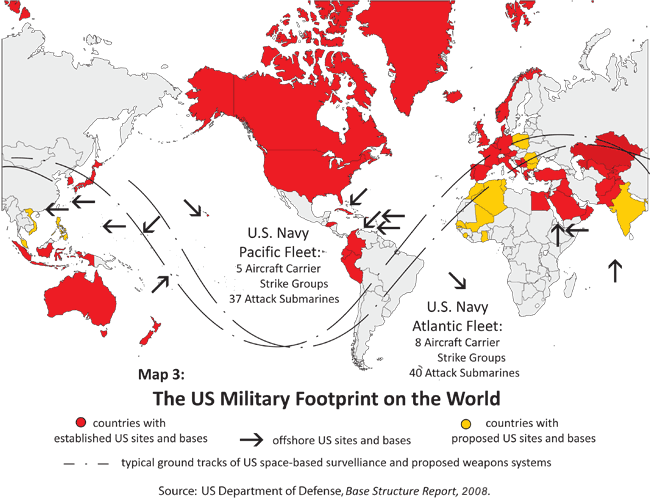
Why does the U.S. government--which already has a global military empire of over 1,000 bases--have an out-of-control appetite for more and bigger military bases, many of them located in places where locals do not want them?
Does the US wage wars simply to acquire territory and create justification to build yet more military bases in these places--Iraq, Afghanistan, Pakistan, Yemen?
And how is it that most Americans remain unaware of this vast network of military bases and what it entails: confiscation of land from unwilling landowners; unceasing demands for base closures by locals (in the case of Okinawa, for more than sixty years); military-caused crime & violence (including rapes and deaths); environmental pollution and health issues created by the bases and weapons testing; and other "collateral damage"?
And why is the US engaging in military expansion throughout the Asia-Pacific--a region of relative and stable peace since the 1970s when U.S. forces withdrew from Vietnam?
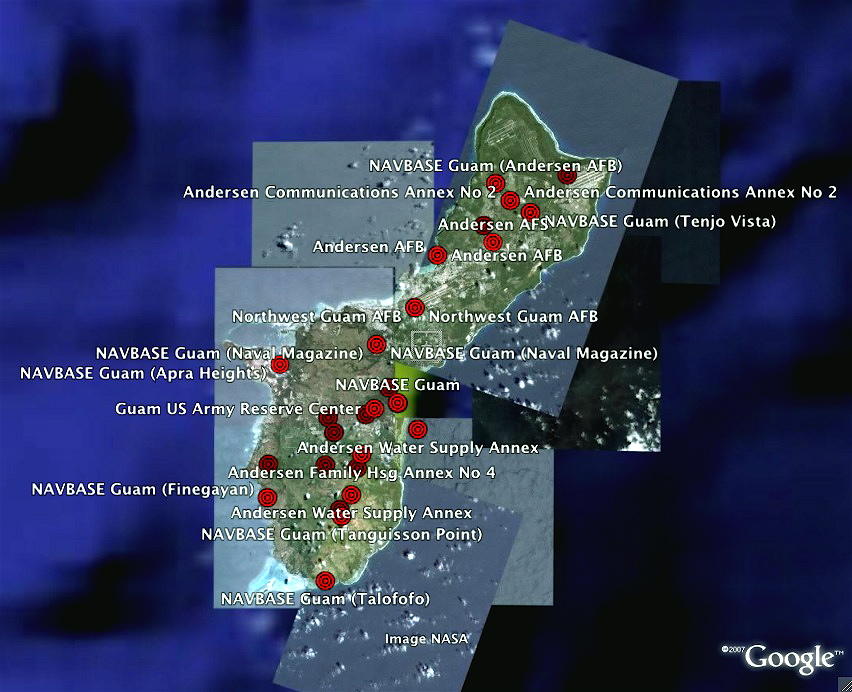
The US already has around 100 military installations in Japan and Okinawa. This includes Kadena Air Base, the largest US military base in Asia. Why does it need new helipads in a pristine Okinawan forest? The US already has at least 40 military installations in Korea. Why does it want the South Korean government to destroy a coral reef in Jeju Island--a World Heritage site because of its rich and untouched biodiversity--to build another naval base? And the US already has military bases covering 1/3 of the island of Guam.
It's a huge stretch to consider China a military threat to the US when it is America's largest foreign creditor and given the immensity of economic integration between the two nations. In the early 1990's, political sensationalists unaware of the level of economic integration between the US and Japan predicted a US-Japan war "within twenty years." In hindsight, this appears silly. Now similar pundits are saying the same about the US and China.
Similarly, China is Japan's top trading partner. Moreover, the Hatoyama administration has already eased tensions that the former Koizumi-led government created with its theatrical visits to the Yasukuni war shrine and differences with China over memories of Japan’s fifteen year invasion (1931-45).
And North Korea may have an atomic bomb and a missile that can reach South Korea or waters near Japan. But if it ever engaged in such a suicidal attack--the US, Japan, and S. Korea would respond with nuclear and conventional power more than sufficient to destroy N. Korea. More bases, weapons and war games are overkill. The only solution is diplomatic engagement.
Why put beautiful and environmentally sensitive Jeju Island, Korea; Takae (Yanbaru Forest) and Henoko, northern Okinawa; and Guam under threat of new, larger and more technologically advanced US military presence--where residents are adamantly opposed--when these bases are not needed?
What is the purpose of these new US military bases planned for Okinawa, Guam (and the South Korean naval base intended to port U.S. and South Korean Aegis destroyers outfitted with missile defense systems at Jeju Island)?
Do they make sense to anyone besides those still infected with Cold War Era hangover fears?
For almost a century, ever since the US seized control of the Philippines in 1898, the US had a military presence there. Its two major bases of the post- World War II era were Clark Air Force Base and Subic Naval Station--once the US' largest military installations in Asia. But after the 1986 fall of Philippine dictator and loyal US ally Ferdinand Marcos, Filipinos voted in 1991 to kick out the US military and the US was forced to relinquish both bases.
After the fall of Saigon, in May 1975, the Royal Thai Government asked the US to close its military bases and remove all of its combat forces (27,000 troops, 300 aircraft) by 1976. In the late 1990s, Thailand also rejected new US requests to establish permanent military bases there.
The US has nevertheless continued its military expansion in the territories of more docile Asian governments and colonies--frequently overriding the political will of the citizens and residents of those places.
In the case of Guam, residents have generally been supportive of US military bases according to filmmaker Vanessa Warheit--(whose new film The Insular Empire: America in the Marianas explores Guam's history of colonization by the US):
So now, we're witnessing local residents struggling to protect land rights; sensitive, biodiverse natural environments; and democratic processes--versus unnecessary military expansion fueled by international pork barrel politics--in Jeju island, Okinawa, and Guam.
--Jean Downey
Howard Zinn on the history of US colonialism in N. America, Asia, and the rest of the world. 
___________________________________________________________________
* Ten Thousand Things, Feb. 9, 2010
 (From "US Bases and Empire: Global Perspectives on the Asia Pacific" by Catherine Lutz, posted at Japan Focus. For a larger view, click here.)
Some background on the military construction contractor feeding frenzy over Guam:
"Does the US want to turn Guam into the next Diego Garcia--an island turned into a massive military base by the US and UK in 1971?"
"Chamoru & Guam Residents Organize Against US $15B Military Buildup in Guam • Hawaii congressman fights to bag contracts for campaign contributor"
Over 1,500 companies have signed up for contractual bidding processes already conducted in Washington, Honolulu and Guam.
More companies will be submitting bids for contracts in Guam at the Annual Pacific Island Local Government (APILG) conference that will be held in Olangapo City, Philippiines on Feb. 18-21.
"Filipinos to bid in $15-B Guam US naval project:"
Jeju Island, Korea • Okinawa • Guam: Why does the US want more & bigger military bases in the Asia-Pacific?

(From "US Bases and Empire: Global Perspectives on the Asia Pacific" by Catherine Lutz, posted at Japan Focus. For a larger view, click here.)
Why does the U.S. government--which already has a global military empire of over 1,000 bases--have an out-of-control appetite for more and bigger military bases, many of them located in places where locals do not want them?
Does the US wage wars simply to acquire territory and create justification to build yet more military bases in these places--Iraq, Afghanistan, Pakistan, Yemen?
And how is it that most Americans remain unaware of this vast network of military bases and what it entails: confiscation of land from unwilling landowners; unceasing demands for base closures by locals (in the case of Okinawa, for more than sixty years); military-caused crime & violence (including rapes and deaths); environmental pollution and health issues created by the bases and weapons testing; and other "collateral damage"?
And why is the US engaging in military expansion throughout the Asia-Pacific--a region of relative and stable peace since the 1970s when U.S. forces withdrew from Vietnam?
The US already has around 100 military installations in Japan and Okinawa. This includes Kadena Air Base, the largest US military base in Asia. Why does it need new helipads in a pristine Okinawan forest? The US already has at least 40 military installations in Korea. Why does it want the South Korean government to destroy a coral reef in Jeju Island--a World Heritage site because of its rich and untouched biodiversity--to build another naval base? And the US already has military bases covering 1/3 of the island of Guam.
It's a huge stretch to consider China a military threat to the US when it is America's largest foreign creditor and given the immensity of economic integration between the two nations. In the early 1990's, political sensationalists unaware of the level of economic integration between the US and Japan predicted a US-Japan war "within twenty years." In hindsight, this appears silly. Now similar pundits are saying the same about the US and China.
Similarly, China is Japan's top trading partner. Moreover, the Hatoyama administration has already eased tensions that the former Koizumi-led government created with its theatrical visits to the Yasukuni war shrine and differences with China over memories of Japan’s fifteen year invasion (1931-45).
And North Korea may have an atomic bomb and a missile that can reach South Korea or waters near Japan. But if it ever engaged in such a suicidal attack--the US, Japan, and S. Korea would respond with nuclear and conventional power more than sufficient to destroy N. Korea. More bases, weapons and war games are overkill. The only solution is diplomatic engagement.
Why put beautiful and environmentally sensitive Jeju Island, Korea; Takae (Yanbaru Forest) and Henoko, northern Okinawa; and Guam under threat of new, larger and more technologically advanced US military presence--where residents are adamantly opposed--when these bases are not needed?
What is the purpose of these new US military bases planned for Okinawa, Guam (and the South Korean naval base intended to port U.S. and South Korean Aegis destroyers outfitted with missile defense systems at Jeju Island)?
Do they make sense to anyone besides those still infected with Cold War Era hangover fears?
For almost a century, ever since the US seized control of the Philippines in 1898, the US had a military presence there. Its two major bases of the post- World War II era were Clark Air Force Base and Subic Naval Station--once the US' largest military installations in Asia. But after the 1986 fall of Philippine dictator and loyal US ally Ferdinand Marcos, Filipinos voted in 1991 to kick out the US military and the US was forced to relinquish both bases.
After the fall of Saigon, in May 1975, the Royal Thai Government asked the US to close its military bases and remove all of its combat forces (27,000 troops, 300 aircraft) by 1976. In the late 1990s, Thailand also rejected new US requests to establish permanent military bases there.
The US has nevertheless continued its military expansion in the territories of more docile Asian governments and colonies--frequently overriding the political will of the citizens and residents of those places.
In the case of Guam, residents have generally been supportive of US military bases according to filmmaker Vanessa Warheit--(whose new film The Insular Empire: America in the Marianas explores Guam's history of colonization by the US):
Most families in the Marianas have family members serving in the US Armed Forces. The younger generation that has had the benefit of a college education is starting to push people to recognize the larger context -- but their culture is one that is based on a huge amount of respect for the elders (manam'ko), and the generation from the Pacific War - on Guam, anyway - still feels an enormous sense of gratitude to the US Marines for saving them from the Japanese Imperial Military.But because of the US' latest move to expand the bases to over 40% of the island, many Guamanians--especially the indigenous Chamoru and younger people who are concerned abou future water issues as well as a negative impact on Guam's beautiful natural environment and tourist industry--are resisting. Their opponents include a huge transnational military construction industry packed with contractors already bidding for projects.
So now, we're witnessing local residents struggling to protect land rights; sensitive, biodiverse natural environments; and democratic processes--versus unnecessary military expansion fueled by international pork barrel politics--in Jeju island, Okinawa, and Guam.
--Jean Downey
Howard Zinn on the history of US colonialism in N. America, Asia, and the rest of the world.
___________________________________________________________________
* Ten Thousand Things, Feb. 9, 2010
 (From "US Bases and Empire: Global Perspectives on the Asia Pacific" by Catherine Lutz, posted at Japan Focus. For a larger view, click here.)
Some background on the military construction contractor feeding frenzy over Guam:
"Does the US want to turn Guam into the next Diego Garcia--an island turned into a massive military base by the US and UK in 1971?"
"Chamoru & Guam Residents Organize Against US $15B Military Buildup in Guam • Hawaii congressman fights to bag contracts for campaign contributor"
Over 1,500 companies have signed up for contractual bidding processes already conducted in Washington, Honolulu and Guam.
More companies will be submitting bids for contracts in Guam at the Annual Pacific Island Local Government (APILG) conference that will be held in Olangapo City, Philippiines on Feb. 18-21.
"Filipinos to bid in $15-B Guam US naval project:"
It’s sad and ironic that Filipinos, who fought so hard to get the U.S. bases out of their country because of the terrible social and environmental costs, would now be bidding on contracts for the military expansion on Guam, turning their past oppression into “experience” capital
Tuesday, March 17, 2009
Text Fwd: Guam Residents Unhappy About Relocation of US Marines from
Fwd by Debbie Quinata, Agatha Haun
Video fwd: Guam Take me back
Guam Residents Unhappy About Relocation of US Marines from
Okinawa
Original source by Akahata (Japan)
3-14-09, 10:21 am
Residents of Guam are so reluctant to accept the US Marines to be stationed
on the island of US territory in the Pacific, that the Guam governor would
sign the ordinance passed by the Guam Legislature to hold a referendum over
the planned reinforcement of US forces in Guam, said the speaker of the Guam
Territorial Legislature.
Japanese Communist Party member of the House of Councilors Inoue Satoshi
heard this while he was visiting Guam on March 8-9 while leading a JCP
investigation team in preparation for the upcoming parliamentary discussion
on the so-called Guam Agreement recently signed by Japanese Foreign Minister
Nakasone Hirofumi and US Secretary of State Hillary Clinton. The agreement,
if it comes into force after being approved by both countries, will force
Japan to pay the costs for constructing US military facilities on Guam.
Speaker of Guam's Territorial Legislature Judith Won Pat and representatives
of residents' organizations in meetings with the JCP team proved that the
Japanese government's argument that Guam is welcoming the US Marine Corps
(USMC) to be relocated to Guam is false.
In May 2006, the Japanese and US governments reached the final agreement on
the realignment of U.S. forces in Japan, which included the relocation of
8,000 US Marines and 9,000 families from Okinawa to Guam as well as Japan's
payment of about 6.1 billion dollars as part of the cost for the USMC
relocation project totaling about 10.3 billion dollars.
On February 17, the two governments agreed to remake the roadmap, including
the payment of the 6.1 billion dollars, into an official treaty entitled:
AGREEMENT BETWEEN THE GOVERNMENT OF JAPAN AND THE GOVERNMENT OF THE UNITED STATES OF AMERICA CONCERNING THE IMPLEMENTATION OF THE RELOCATION OF III MARINE EXPEDITIONARY FORCE PERSONNEL AND THEIR DEPENDENTS FROM OKINAWA TO GUAM.
After visiting the site for the construction of the new USMC facilities, the
JCP investigation team met with landowners and residents.
On March 9, after a briefing from Japan's consul general in Guam, they met
and held about two hours of talks with Speaker of Guam's Territorial
Legislature Won Pat.
The Speaker stated that the US Department of Defense has provided Guam with
little information concerning the relocation plan and that no public opinion
survey has been held on this issue. She expressed anxieties over further
contamination from sewage water from the new military facilities as well as
possible sexual assaults by the increased presence of Marines.
She referred to Guam's Governor Felix P. Camacho, who is expected to sign
the bill to hold a referendum on the relocation issue.
Specifically on the Japan-US agreement on the USMC Guam relocation, which is
expected to be discussed in Japan's Diet, she stressed that the Diet is
called upon to listen to Guam and that she is ready to provide information
concerned to any Japanese political parties.
On the USFJ realignment issue, she indicated the possibility that additional
units will come to a new US base to be constructed in the Henoko district of
Nago City, even after a part of the US Marines are moved to Guam.
The JCP team toured the island guided by a representative of the Chamorro
Nations, an organization of aboriginals in Guam.
Upon watching CNN news reports on mass layoffs sweeping Japan, they said
that they don't understand why Japan has agreed to pay so much money for a
foreign government instead of stimulating the Japanese economy.
Guam's landowners association chief Antonio told Inoue that he has not been
paid a penny by the military every since his land was taken for use by the
U.S. Andersen Air Base. He expressed worries over an additional
expropriation of land as a result of the USMC Guam relocation.
JCP Inoue stated, "It is extraordinary for Japan to use tax money for the
construction of a military base on foreign territory. I want to convey Guam
people's voices to the Japanese Diet so that the new Guam Agreement will be
rejected."
Posted by Added Entry at 11:21
si Debbie Quinata <dquinata@gmail.com>
I Nasion Chamoru
P.O. Box 6132
Merizo, Guam 96916
(671) 828-2957
Video fwd: Guam Take me back
Guam Residents Unhappy About Relocation of US Marines from
Okinawa
Original source by Akahata (Japan)
3-14-09, 10:21 am
Residents of Guam are so reluctant to accept the US Marines to be stationed
on the island of US territory in the Pacific, that the Guam governor would
sign the ordinance passed by the Guam Legislature to hold a referendum over
the planned reinforcement of US forces in Guam, said the speaker of the Guam
Territorial Legislature.
Japanese Communist Party member of the House of Councilors Inoue Satoshi
heard this while he was visiting Guam on March 8-9 while leading a JCP
investigation team in preparation for the upcoming parliamentary discussion
on the so-called Guam Agreement recently signed by Japanese Foreign Minister
Nakasone Hirofumi and US Secretary of State Hillary Clinton. The agreement,
if it comes into force after being approved by both countries, will force
Japan to pay the costs for constructing US military facilities on Guam.
Speaker of Guam's Territorial Legislature Judith Won Pat and representatives
of residents' organizations in meetings with the JCP team proved that the
Japanese government's argument that Guam is welcoming the US Marine Corps
(USMC) to be relocated to Guam is false.
In May 2006, the Japanese and US governments reached the final agreement on
the realignment of U.S. forces in Japan, which included the relocation of
8,000 US Marines and 9,000 families from Okinawa to Guam as well as Japan's
payment of about 6.1 billion dollars as part of the cost for the USMC
relocation project totaling about 10.3 billion dollars.
On February 17, the two governments agreed to remake the roadmap, including
the payment of the 6.1 billion dollars, into an official treaty entitled:
AGREEMENT BETWEEN THE GOVERNMENT OF JAPAN AND THE GOVERNMENT OF THE UNITED STATES OF AMERICA CONCERNING THE IMPLEMENTATION OF THE RELOCATION OF III MARINE EXPEDITIONARY FORCE PERSONNEL AND THEIR DEPENDENTS FROM OKINAWA TO GUAM.
After visiting the site for the construction of the new USMC facilities, the
JCP investigation team met with landowners and residents.
On March 9, after a briefing from Japan's consul general in Guam, they met
and held about two hours of talks with Speaker of Guam's Territorial
Legislature Won Pat.
The Speaker stated that the US Department of Defense has provided Guam with
little information concerning the relocation plan and that no public opinion
survey has been held on this issue. She expressed anxieties over further
contamination from sewage water from the new military facilities as well as
possible sexual assaults by the increased presence of Marines.
She referred to Guam's Governor Felix P. Camacho, who is expected to sign
the bill to hold a referendum on the relocation issue.
Specifically on the Japan-US agreement on the USMC Guam relocation, which is
expected to be discussed in Japan's Diet, she stressed that the Diet is
called upon to listen to Guam and that she is ready to provide information
concerned to any Japanese political parties.
On the USFJ realignment issue, she indicated the possibility that additional
units will come to a new US base to be constructed in the Henoko district of
Nago City, even after a part of the US Marines are moved to Guam.
The JCP team toured the island guided by a representative of the Chamorro
Nations, an organization of aboriginals in Guam.
Upon watching CNN news reports on mass layoffs sweeping Japan, they said
that they don't understand why Japan has agreed to pay so much money for a
foreign government instead of stimulating the Japanese economy.
Guam's landowners association chief Antonio told Inoue that he has not been
paid a penny by the military every since his land was taken for use by the
U.S. Andersen Air Base. He expressed worries over an additional
expropriation of land as a result of the USMC Guam relocation.
JCP Inoue stated, "It is extraordinary for Japan to use tax money for the
construction of a military base on foreign territory. I want to convey Guam
people's voices to the Japanese Diet so that the new Guam Agreement will be
rejected."
Posted by Added Entry at 11:21
si Debbie Quinata <dquinata@gmail.com>
I Nasion Chamoru
P.O. Box 6132
Merizo, Guam 96916
(671) 828-2957
Subscribe to:
Posts (Atom)

![[URGENT PLEA: In Update] EMERGENCY in GANGJEONG Since AUG. 24, 2011](https://blogger.googleusercontent.com/img/b/R29vZ2xl/AVvXsEiQvpaNf6EePZVucu97_JphYsFS5IgumnSiA4YAmen1PZcim6vMmW7XjZ7J6nLh-Cu36mwBN5n1evrA3ey0vYMpwlAGsgnSFggv6a1w4Qx9BvvqOB0hy0BIcBkL2Exfs3zIxBsBuDGa1kzg/s227/jejusit.jpg)


![[Solidarity from Japan for the Jeju] 253 individuals and 16 groups/organizations](https://blogger.googleusercontent.com/img/b/R29vZ2xl/AVvXsEivji7100kBkr0hzvqYfh4IBBilkZ6XgDIg89jOxS6kTssxsVKC6Wm-fZbKOEsiy3zcO-9gW6GHspD5R_2C9WsGx5S1Z5VPj_OVRF7H6dxdaT0S-2H1eqsDsYvIwOV26VscxTHnKmP5iZmh/s227/jeju_12_10j.jpg)

![[Translation] Korean organizations' statement: Immediately cancel the joint ROK-US drill Nov 26](https://blogger.googleusercontent.com/img/b/R29vZ2xl/AVvXsEgfKDMo-qyEjm5asUtHlREyJY_5Ou-2tyB8SH6aUxiViRbbKR-8W_rirFiGp5DYSoD_KaeNOPMWR0af0ZPUIbJKmR89ImDvADHsGAIqsJVBvJNBEIl5wLd3G_zhPDW3Z2SxsHXadOsXe8st/s227/1.jpg)
![HOT! [Hankyoreh Hani TV] Beneath the Surface: the investigation into the sinking of the Cheonan](https://blogger.googleusercontent.com/img/b/R29vZ2xl/AVvXsEh80rL3Qv9GnfHSqbYMfivdqX5gZN-1O_VQj3A_Gk3yjWdybHwJCsprA3l6cEQB0cYCP2oNeaLo2ohLGIy0Uqqkv_fRkBevGJ2f-qkKD5eP1ZGsKeQ-r-jHUUb79WvucIN7hpEtXza4xXCL/s227/HaniTV+Cheonan.gif)


![[Translation]Statement against illegal inspection and unjust lay-off by the Kunsan USAFK!(Nov_2010)](https://blogger.googleusercontent.com/img/b/R29vZ2xl/AVvXsEg3JlQ-lreusCIJo5Yv2e3ZrRwrSMUE7UQxlrDVjmBehl0Pa24QZIAbZ5vUpgnnExbkKL9PdCwxVYSHWJkr_XK0FM4EhU3CMFhqfborVNu_p4v3bEFpNm3ia-aEHnvMMuEBI27aB7_BETuJ/s227/gunsan+protest.gif)
![[Translation] Korean organizations' statement against dispatching special force to the UAE on Nov.](https://blogger.googleusercontent.com/img/b/R29vZ2xl/AVvXsEiU7TNhTDLLwZkKP0Z78JsCZKp6je-QSFll3_ThmLES_y_nPLXEzeakrsZXoNxhN5blopEhy6xGV2tneJrniPdTR-JvOQMmSLr_HhlucxFvbusxk4oKvvMO2laBOHSIkB9OOeOxrQlqCA0O/s227/antiwarpeace.jpg)
![[Translation] Stop, Joining MD!: South Korean activists' statement and writing on Oct. 25, 2010](https://blogger.googleusercontent.com/img/b/R29vZ2xl/AVvXsEggGIHVei8j7LCJPJB5HIrspd942q436daNTquP-pFd45Cl70Ml_1JFiFDHgKu6FcoqNgFVKIFqjeuSPau2k_BwGHhx0cqFFL2-4ybZSTlmua0_AsERBtKYQa7jZk7uNj41LX6rj2vksHbo/s227/StopMD.jpg)
![[In Update] People First, NO G-20 (Nov. 6 to 12, Korea)](https://blogger.googleusercontent.com/img/b/R29vZ2xl/AVvXsEhZl8VTqeL7o2ndliGIE-sZFCikbTgfB9KCc3AtZvDaYijBBEhdfultMEOpyrCaD5gzpH8mqfWjU20KXMbSUl-5KM7yQeHU6z3BWV8tiOy4UKaCudz9VKWoi5x58xdC_gQpJTjkR5u7O9xf/s227/left21_G20.jpg)
![[International Petition] Stop US helipad plan in Okinawa to save great nature](https://blogger.googleusercontent.com/img/b/R29vZ2xl/AVvXsEihgYmdb0N8ViPvTFC_5i-Psbt4eX_LnAUEOtZkUngv_pGvRyWag1r6W60NicLLyTgWq-sPT1hBxLY5SadEIVv5McfZQ5uIhe-W0VoflQNqojsYZjFW6AH-gB1jsmSDGnGuKIFk2UkvNbFG/s227/yanbaru_w.jpg)

![[Global Network] against the first launch of Quasi-Zenith Satellite, Japan, on Sept. 11, 2010](https://blogger.googleusercontent.com/img/b/R29vZ2xl/AVvXsEj2sYpfodDDMIA7qXwuda0DmKapxXFB479fDnn8RKy7QNZqz0VEvWucNd-DleZ37hWNXC-Z8QtaqtM37VuPwac5SgclJ9_khBBSWOedvm19MRXIP1j1kcWrK6EW5IFjQdEEY2h7E6xuyNvC/s227/Qzss-45-0_09.jpg)

![[In update] Some collections on the Koreans’ protests against the sanction & war on Iran](http://4.bp.blogspot.com/_gnM5QlRx-4c/TJMvke6t8zI/AAAAAAAAFO4/tamQ8LUnOOA/S227/No+Sanction+on+Iran.jpg)
![[Three International Petitions] to End the Korean war and peace treaty(or peace resolution)](https://blogger.googleusercontent.com/img/b/R29vZ2xl/AVvXsEhlohLVYtpCg7iMsZhNYY4hBbhTi2dIheHMHWLDph9X2y78cjgZV1LeSfUJeu80elhJm70Q9E059q72lK-spSPvsRG4bPuCDIytltJB9IH3mWt9OG98HqhnTsPakwhvNeoCFUgF1xoxQ2EZ/s227/border.jpg)


![[Collection of Documents] No Base Learning and Solidarity Program_Korea(June 14 to 20, 2010)](https://blogger.googleusercontent.com/img/b/R29vZ2xl/AVvXsEix_HzjToh3nNGHBc-_5gasq-ykcaZ6GInLixILmZVyRJ5xoeHCxWOyYd9fSM7bmnuFsjSrYOGEPnQOwB1Dcyo-sN4Pw0cFPhUtKig_qlVnGL1Wi82ClvPqbEPWYhJiqdNF0DyzLIBETMB9/s227/No-Base-banner.jpg)
![Site Fwd:[John Hines] A U.S. Debate coach’s research trip on the Issues of Korea](https://blogger.googleusercontent.com/img/b/R29vZ2xl/AVvXsEg8yRra0zNhKHN74Auqhd3Nx9tZ7BWCGflRJHGH4CfzBT_yjhZ8Nl9b3OZuLpYWJ2exsjmR0oVl-Qq_cf832p2VdmOZhUi-lCFzCNeDSyVtweX1lWZPC-RlHmDMLtilHwHjNFTenBiM4Fk4/s227/Jeju-Peace-Tour.jpg)


![[News Update] Struggle Against the Jeju Naval Base since Jan. 18, 2010](https://blogger.googleusercontent.com/img/b/R29vZ2xl/AVvXsEhKfSTRC5QKBBSFIq_m7QIqXdlbL4-gF5GJYn9Q-pN__k7sV7uxGDcLY5L8xmU7QuWuUhBT_GhG-URBPO80RT3AfWfDrWJr06h1hFuZC6ZBVKe4U6PS1Cd7Kr6olO8TYQtk13Drox7IS6ea/s226/scrum1.jpg)


![[Urgent] Please spread the Letter!: There was no Explosion! There was no Torpedo! (May 26, 2010)](https://blogger.googleusercontent.com/img/b/R29vZ2xl/AVvXsEhSd2yWZ3xGwnJQXB73z5FgXCqSosAoB9_33-GLYprOmLqjmvgSAQp1BYI7e4slK1FDxHRi9KK4um-OpDaj8QOkXwAScVAgvvq6-ehbDA-hbkr96wT9oHNNmWnBPv8GU4hoZp9X8F9AZBX4/s227/grounded.jpg)
![Text Fwd: [Stephen Gowans]The sinking of the Cheonan: Another Gulf of Tonkin incident](https://blogger.googleusercontent.com/img/b/R29vZ2xl/AVvXsEi_L6hB3RZ1MovTXHe0A8yn_RfgMALGR0kM6poBuGp809xwvHtB_-PGWtS_WpyPWatyd9lB2pPqL2gOLc4dTCEdJ9sMvxJWEdapl-mMLm7WHAsV-jVpgqarVh8XBtdz_0c-Vohdh3HtJahD/s227/lee-myung-bak.jpg)
![[Japan Focus]Politics in Command: The "International" Investigation into the Sinking of the Cheonan](https://blogger.googleusercontent.com/img/b/R29vZ2xl/AVvXsEiHmTo8v-uCJnabRhMdnBAkC9J3s5bb2JsDKiT5leJHwbK8IDJHxfJmqQ_C0Is_bPC6UGMf05CA0exF2y4r2x9RhFUHT0kjsKviaME_MZXKnq775UyYAdb7w2SAzE75XvBfHp1al2q6i3cf/s227/wen_jiabao_and_lee_myungbak.png)
![[Japan Focus] Who Sank the SK Warship Cheonan? A New Stage in the US-Korean War and US-China](https://blogger.googleusercontent.com/img/b/R29vZ2xl/AVvXsEiKSS5ULT5QBaMGYpXXqBMX9jtwLwMLuK469b6Ku72GTJYKUObzTANaPjZqvvpPzYMJgPF53sjhvhK3DVa88ipYlggsJageykXlkxY6s8TW05xcU-_vfhf-pACUoaWuFbT-fsU1qEhm_yIi/s227/buoy_map.gif)
![[Updated on 12/13/10] [Translation Project] Overseas Proofs on the Damages by the Military Bases](https://blogger.googleusercontent.com/img/b/R29vZ2xl/AVvXsEikADE6JovUNspQyZUWVMTLAQg7yQNqXpVUbqZPk8f4uc_1723_xm1Cco6WAmstQXVPnaJAcb1mZA8Ny_3xONT_f5uh8MNLPnUhtqdGgy3HCtC1Vbbz4Q0ZY1Cssu-4cJEVNdrvznbS5UzO/s227/missile.jpg)
![[International Petition] Close the Bases in Okinawa](https://blogger.googleusercontent.com/img/b/R29vZ2xl/AVvXsEhNpQiHklwFbWVlFK7GDFXnBSOOSFEj3Il-We-N3uTDldKiidL2NGZs7X_LtTnatzTo_r8CexRkFe8NhfxYqmgp1knEEslROTfNjI5_mSb57cdbhPkftvanveYBaevAD9xuKDGoIxiTwoSb/s227/2.jpg)

![[In Update]Blog Collection: No Korean Troops in Afghanistan](https://blogger.googleusercontent.com/img/b/R29vZ2xl/AVvXsEjjEmCRXSNAG7_QBxKWbdksmxoWR4nyAovQTTdR1G2AuXh0jxtqNkI9OmYgYWRoLAJShvtBvE840QXuBWSVh3u3zMYqkNAFX6OWy3m5Nur4HM7uNK-pKT1ycyApJp-VLyhIFRRcoisYAh0E/s226/No-Troops-to--Afghanistan.jpg)