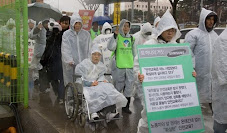
'저는 그들의 땅을 지키기 위하여 싸웠던 인디안들의 이야기를 기억합니다. 백인들이 그들의 신성한 숲에 도로를 만들기 위하여 나무들을 잘랐습니다. 매일밤 인디안들이 나가서 백인들이 만든 그 길을 해체하면 그 다음 날 백인들이 와서 도로를 다시 짓곤 했습니다. 한동안 그 것이 반복되었습니다. 그러던 어느날, 숲에서 가장 큰 나무가 백인들이 일할 동안 그들 머리 위로 떨어져 말과 마차들을 파괴하고 그들 중 몇몇을 죽였습니다. 그러자 백인들은 떠났고 결코 다시 오지 않았습니다….' (브루스 개그논)


For any updates on the struggle against the Jeju naval base, please go to savejejunow.org and facebook no naval base on Jeju. The facebook provides latest updates.
Showing posts with label Decolonization. Show all posts

Thursday, March 17, 2011

[Translation] Send the human force and resource mobilized in the Foal Eagle exercise to rescue the Japan from the disaster!

No war exercise against North Korea!
Stop the war exercise and support for the rescue of Japan from the big earthquakes!


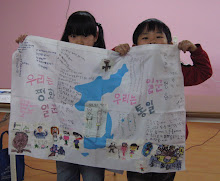
* All the image source: Solidarity for Peace And Reunification of Korea,
In front of the United States embassy, Seoul, March 15, 2011
_____________________________________________

Upon the horrible three disasters of tsunami, earthquake and nuclear plant explosion in Japan, Yoo Yong-Jae, director of the U.S. military matters, of Solidarity for Peace And Reunification of Korea wrote a column titled, “Send the human force and resource mobilized in the Foal Eagle exercise to rescue the Japan from the disaster." Praising the Japanese citizens’ mature consciousness despite terrible disaster and expressing he and fellow Koreans’ sincerest condolence to the Japanese citizens’ he demanded that the South Korean and United States forces should immediately stop the current Foal Eagle war exercise and should send the human force and resources mobilized in war drill to rescue Japan instead. The below is the hurried partial translation of his article. You can see his original Korean writing here.
______________________________________

From March 16, the nuclear aircraft carrier, Ronald Reagan has been put in the support operation for the disaster of Japan. It was also known that there is the high possibility that part of the US marine force stationing in Okinawa would be mobilized into the rescue operation for the Japan earthquakes so the size of the US military force joining in the Foal Eagle exercise would be more decreased.

However the personnel of the Combined Forces Command explained that “the matter of Ronald Reagan’s participation in the drill is still opaque and other drills will be proceeded as the original schedule.”

At the time when the terrible state of emergency is happening in Japan who is the biggest Asian ally nation of the United States and ‘partner’ of South Korea, with the centurial disaster, it is the urgent situation that needs various supports and rescuing hands. However it looks to be unreasonable that the United States says that she would continue the drill to the end since it has been planned long time ago, like making an executioner’s dance beside the house in mourning.

Further the war exercises that the authorities of South Korea and United States are staging this year have been intensified of their invasive nature against North Korea. The military authorities of South Korea and United States, following their earth-scorching exercise against the initial points of attacks in North Korea, such as with the F-15K or MLRS, in case of North’s attack in the northwestern Island areas, are staging the synchronizing exercises in which they aim to paralyze the North Korean’s war performance ability and her will by precisely attacking 700 target points within 72 hours upon the symptom of North Korean invasion near the cease fire line and to put in the ROK-US combined forces into North Korea upon the timings of the posthumous of Kim Jong-Il, of residents’ uprisings and of outflows of nuclear and weapons of mass destructions.

Even though the ROK and United States quibble that it was for the ‘yearly defense exercise’ while doing such aggressive war drill, that is only a lie for hiding the invasive and illegal natures of the war exercise this time. Because of such war exercise by the ROK and US authority, the militaristic tension in the Korean peninsula is heightened and the dialogue phase that has barely opened after the biggest war crisis is becoming risky as well.

The ROK and US authorities should immediately stop such confrontational and wasteful ROK-US Foal Eagle war exercise in the situation when their ally and partner nation is experiencing the disaster unheard-of before. And under the agreement and negotiation with the Japanese government, they should cooperate to help to build the Japanese people’ will for life, by promptly supporting the resources such as human forces, equipments, foods, medicines and fuel that have been put in into the ROK-US joint drill.

______________________________________________________________

Upon the horrible current disaster in Japan, the victims of the sex slavery by the Japanese force during the Japanese imperialism in Korea from 1910 to 1945 processed their regular Wednesday protest with silence on March 15, praying with consolation and condolence to the Japanese citizens and Korean residents in Japan. The idea had been first initiated by the old women, victims themselves. (Image source: Cho Sung-Bong, Tongil News, March 16, 2011)


Sunday, March 13, 2011

Text Fwd: "Operation Libya" and the Battle for Oil: Redrawing the Map of Africa


Global Research
"Operation Libya" and the Battle for Oil: Redrawing the Map of Africa
By Prof Michel Chossudovsky
March 9, 2011

Part II

See Part I Insurrection and Military Intervention: The US NATO Attempted Coup d'Etat in Libya?
The geopolitical and economic implications of a US-NATO led military intervention directed against Libya are far-reaching.

Libya is among the World's largest oil economies with approximately 3.5% of global oil reserves, more than twice those of the US.

"Operation Libya" is part of the broader military agenda in the Middle East and Central Asia which consists in gaining control and corporate ownership over more than sixty percent of the world's reserves of oil and natural gas, including oil and gas pipeline routes.

"Muslim countries including Saudi Arabia, Iraq, Iran, Kuwait, the United Arab Emirates, Qatar, Yemen, Libya, Egypt, Nigeria, Algeria, Kazakhstan, Azerbaijan, Malaysia, Indonesia, Brunei, possess between 66.2 and 75.9 percent of total oil reserves, depending on the source and methodology of the estimate." (See Michel Chossudovsky, The "Demonization" of Muslims and the Battle for Oil, Global Research, January 4, 2007) .

With 46.5 billion barrels of proven reserves, (10 times those of Egypt), Libya is the largest oil economy in the African continent followed by Nigeria and Algeria (Oil and Gas Journal). In contrast, US proven oil reserves are of the order of 20.6 billion barrels (December 2008) according to the Energy Information Administration. U.S. Crude Oil, Natural Gas, and Natural Gas Liquids Reserves)

Tuesday, March 1, 2011

Text Fwd: 2011 Special Committee on Decolonization - UN Secretary General::"Colonial Situations Are Completely Outdated"

* Text fwd from Martha Duenas on Feb. 27, 2011

Overseas Territories Review
27 February 2011
"Colonial Situations Are Completely Outdated" - U.N. Secretary General Ban Ki-Moon
Secretary-General
SG/SM/13412
GA/COL/3216

"Completing decolonization will require concerted efforts on the part of of all concerned."
Following are UN Secretary-General Ban Ki-moon’s remarks at the opening of the 2011 session of the Special Committee on Decolonization, in New York, 24 February:

I am pleased to join the Special Committee as it begins its work for 2011.

This year marks the beginning of the Third International Decade for the Eradication of Colonialism. Let us focus our attention on accomplishing concrete results with the involvement of all concerned: the Special Committee, the administering Powers and the Non-Self-Governing Territories.

Last December, we commemorated the fiftieth anniversary of the Declaration on the Granting of Independence to Colonial Countries and Peoples, adopted by the General Assembly. On that occasion, I appealed to the international community to realize the full spirit of the Declaration, which called for “the immediate and complete elimination of the colonial system in all its forms and manifestations”, in keeping with the principles of the United Nations Charter. The Special Committee has a crucial role to play as the intergovernmental body exclusively devoted to advancing the United Nations decolonization agenda.

Today, 16 Non-Self-Governing Territories remain on the list, awaiting constructive, results-oriented initiatives. On a case-by-case basis, those Territories have to be given the opportunity to exercise their right to self-determination in order to take the interests of their peoples fully into account. Colonial situations are completely outdated and must be addressed with renewed vigour and creativity.

Last year, in my report to the General Assembly on the “Second International Decade for the Eradication of Colonialism”, I recalled that the Assembly had requested the Special Committee to continue to seek suitable means for the immediate and full implementation of the Decolonization Declaration. In practice, this would mean that the Committee could assess its past work and achievements in order to chart a way forward, together with the administering Powers, for the ultimate benefit of the peoples of the Non-Self-Governing Territories.

Your current work on devising a plan of action for the Third International Decade, and the forthcoming 2011 Caribbean Seminar on Decolonization, might prove instrumental in that regard. It is my hope that difficulties encountered in the recent past will gradually be overcome, thereby strengthening the Committee’s determination to develop effective formal and informal modalities that would help it accomplish its mandate.

The completion of the process of decolonization will require the concerted efforts of all concerned: first and foremost, the Special Committee, the administering Powers, and the peoples in the Non-Self-Governing Territories. Dialogue aimed at improving cooperation between the Special Committee and the administering Powers continues to be of utmost importance.

The Secretariat will spare no effort to assist the Committee in its work. But this can be no substitute for the choices, decisions and actions expected of the Special Committee.

I wish you every success in your important endeavour.
____________________________________________________________________________
Electing New Chair in Unprecedented Secret Ballot, U.N. Decolonisation Committee Members also Approve Timetable, Organization of Work

Addressing the first meeting of the 2011 substantive session of the Special Committee on Decolonization, United Nations Secretary-General Ban Ki-moon called today for “concrete results” in the quest for self-determination by the world’s 16 remaining Non-Self-Governing Territories.

Those results could only be achieved through the concerted efforts of all stakeholders, including the Special Committee, the administering Powers and the peoples of the Territories, he said. “On a case-by-case basis, those Territories have to be given the opportunity to exercise their right to self-determination,” Mr. Ban added, emphasizing that dialogue aimed at improving cooperation between the Special Committee and the administering Powers continued to be “of utmost importance”.

In an unprecedented action this morning, the Special Committee (on Decolonisation) held a secret ballot to elect a new Chair. Out of 25 recorded votes, Francisco Carrion-Mena ( Ecuador) received 15 to become the new Chair, replacing Donatus Keith St. Aimee ( Saint Lucia), who won 10 votes.

The Special Committee also elected, by acclamation, the following Bureau members: Pedro Núñez Mosquera (Cuba) and Rupert Davies (Sierra Leone), Vice-Chairs; and Bashar Ja’afari (Syria), Rapporteur.

Speaking after the elections, Mr. Carrion-Mena called for “reinvigorated multilateralism” in global decolonization efforts. “Decolonization is a tough challenge, but not one that should be impossible,” he said, noting that the United Nations membership had swelled by 93 Member States in the last 50 years. Pledging to push for the decolonization of the remaining Non-Self-Governing Territories, he described his election as a positive testament to the “liveliness” of the Special Committee and its search for a higher profile.

Delegations then took the floor in support of the Special Committee’s work, with Cuba’s representative emphasizing that Puerto Rico, which was not on the list of Non-Self-Governing Territories, also needed the Special Committee’s support.

Papua New Guinea’s representative said it was through the Special Committee that many nations had been born, something of which all its members could be proud. However, the administering Powers could and should be more proactive in helping the Territories under their jurisdiction realize their rights, he added.

Syria’s representative, speaking in his national capacity, congratulated the new Chair, saying his election “breathed new life” into the Special Committee’s efforts. Despite its good work in recent years, however, it was shameful that there was still a need to liberate non-self-governing peoples, he said, appealing for an end to that chapter of history.

The Special Committee also heard brief statements by representatives of India, Indonesia, Congo and Saint Lucia.

In other business, the Special Committee approved, by consensus as orally amended, resolutions and decisions relevant to its work, as contained in a note by the Secretary-General (document A/AC.109/2011/L.1); and the organization of its work, programme of work and timetable (document A/AC.109/2011/L.2).

It also invited the delegations of Argentina, Spain and Tajikistan to participate in its deliberations as observers.

The Special Committee, also known informally as the Committee of 24, is the focal point for the implementation of the Decolonization Declaration. Its current 29 members are: Antigua and Barbuda; Bolivia; Chile; China; Congo; Côte d’Ivoire; Cuba; Dominica; Ecuador; Ethiopia; Fiji; Grenada; India; Indonesia; Iran; Iraq; Mali; Nicaragua; Papua New Guinea; Russian Federation; Saint Kitts and Nevis; Saint Lucia; Saint Vincent and the Grenadines; Sierra Leone; Syria; Timor-Leste; Tunisia; United Republic of Tanzania; and Venezuela.

Remaining on the list of Non-Self-Governing Territories are Western Sahara, Anguilla, Bermuda, British Virgin Islands, Cayman Islands, Falkland Islands (Malvinas), Montserrat, St. Helena, Turks and Caicos, United States Virgin Islands, Gibraltar, American Samoa, Guam, New Caledonia, Pitcairn and Tokelau.

The Special Committee will reconvene at a date and time to be announced.

Sunday, February 27, 2011

[Jeju Update] Language, Island, colonial culture and the Jeju naval base 언어, 섬, 식민지 문화 그리고 제주 해군 기지

* Image source: Headline Jeju, Feb. 25, 2011헤드라인 제주, 2011년 2월 25일(클릭)
The sign reads: 'Allow and actively promote the use of the Jeju dialect in schools!
'Critically endangered Jeju dialect' of the UNESCO-registered-and-promoted

It is the responsibility of the Jeju Provincial Office of Education that has not allowed the use of the Jeju dialect for 40 years, who has alledged that it is a ‘rustic and impertinent’ dialect. '
____________________________________________________________
Thanks to the activists who are making efforts to decolonize the cultures of their Islands, for example, Michael Lujan Bevacqua who runs the blog called ‘No Rest for the Awake: Minagahet Chamorro,’ it has become clearer to more people that no base movement cannot be separate with the decolonization movement.

Here in the Jeju Island, the faced situation could be similar to a lesser degree if not the same with the examples in the other regions, especially in those Islands who have been suffering under the imperial eyes and tongues.

The Headline Jeju on Feb. 25 reported an interesting article ( by Yoon Chul-Soo) which was about one man protest by Kim Young-Bo, a high school teacher teaching commerce, who demanded the free use of the Jeju dialect in schools in front of the Jeju Special Self-Governing Provincial Office of Education (The Jeju Provincial Office of Education, afterwards) in the afternoon of Feb. 25, 2011.

According to the very article, the teacher protested against the Jeju Provincial Office of Education which he criticized because it had not allowed the free use of the Jeju dialect in schools by alleging that the Jeju language was a ‘rustic and impertinent dialect,’ and to which he demanded that it should allow students to freely speak the Jeju dialect in schools.

Below is the translation of his words cited in the article:

“The Jeju Provincial Office of Education who has not allowed the free use of the Jeju dialect is very responsible for the Jeju language being critically endangered. Even though the situation is very serious as to the degree that it is registered as a critically endangered language by the UNESCO, the Provincial Office of the Education is not trying to fix such wrong education policy.”

It was poignant to hear that the Jeju dialect is critically endangered itself while the UNESCO designated soft corals in the Gangjeong Sea is being threatened with the naval base construction in the Gangjeong village, as well. (* About the UNESCO registered Jeju language, see HERE and HERE)

Here are further translations of his cited words, as well:

"I am more infuriated by the fact that no one really seriously concerns about that, except for short time whenever there were media reports on the Jeju dialect being registered as a critically endangered language. Who would succeed the Jeju language if the current halmang(s)(old women) and harbang(s)(old men) die. The language might disappear.”

"Our generation was not allowed to use the Jeju dialect for talks between teachers and students not to mention for class hours. We had to hear reproach that we were rustic and impertinent if we use the Jeju dialect and we even got a whip. Didn't the students who had been getting punished get one more whip if they unconsciously used the Jeju dialect, did they? It is for the alleged reason that they look as rustic and impertinent from the point of view of teachers.

According to the article, he pointed out that the Jeju Provincial Office of Education was showing the duality by never allowing the Jeju dialect even among the students within schools while it is also making an effort to revitalize the Jeju language such as through hosting or sponsoring competition events such as those on speaking with the Jeju dialect; those on children song with the Jeju dialect, exhibitions on illustrated poems with the Jeju Dialect; and festivals with the Jeju Dialect. It is told that the authority of the Jeju Provincial Office of Education has issued that it has guided that there should be an education course on the Jeju dialect beside sponsoring such events. However, it is contradictorily prohibiting the very use of the Jeju dialect [within schools].

According to the article, the duality is the very point that motivated him toward his own one man protest.

What is interesting about the event and article is that those things very remind the current situation of the Jeju Island whose native cultures are being disappeared with corporate and militarism culture in South Korea, especially with the law on the Jeju Special Self-Governing Province, which was brought in 2006 with the concept of Jeju free international city and emphasis on the so-called’ ‘globalization.’

Mr. Go Gwon-Il, a Gangjeong villager thinks the Central and Island governments’ current mobilizations for the Jeju to be one of the new seven wonders even being mobilized with many celebrities along with excessive international propaganda is part of such extended move.


According to him, the Jeju Island should NOT be one of the new seven wonders because it would make worse the situation of the Jeju Island, the UNESCO triple-crowned site(Mount Halla’s Biosphere Reserve recognition in 2002; Natural Heritage Sites designation of Mount Halla, Seongsan Sunrise Peak and Manjanggul cave in 2007; and the geopark designation in 2010) with increasing capitalism and reckless tourism.

Otherwise, according to the Wiki on the Jeju dialect:

One large difference between the Jeju dialect and those of mainland Korea is the lack of formality and deference to elders. For example, while a speaker of the Seoul dialect might say 안녕하세요 annyeonghaseyo ("Hello") to an older person, a speaker of the Jeju dialect would say 반갑수다 ban-gapsuda (lit., "Nice chatting" or "Nice talking"; roughly equivalent to "Howdy"). To many mainlanders, a child saying this to an adult would be appalling, but on the islands, a more "egalitarian" form of speech is used, perhaps a cultural idiosyncrasy that has hung on after the incorporation of Jeju itself (under the Tamna kingdom, which, though having subjugated itself to Korean states since the 7th century, was not brought under the full centralized control of a Korean state until 1404) into Korea.


* Image source: Jeju Weekly, Feb. 6, 2011 (Original source: 'Art by Choi Myung Sun. Photo courtesy Jejudo Hangeul Calligraphy Society') The calligraphy written with the Jeju dialect reads:
Moosangomassim(Why is it?)
Umung-ee haejoon bab muk-eo-bob-seo (Why don’t you have some rice mother has cooked?) Chommallo Masi Jotsooda(It is really delicious.) Moosangomassim (Why is it?) Geu-gun Umunim-eui Saranghaneun mosim-ee bab sogobe godeukgodeuk deul-eo-i-si-nan anikkwa (Isn’t it because mother’s loving heart wholly fills the rice bowl, is it?) –Jeju sokkdam gotnae (cited from one of the Jeju proverbs Gotnae)

There was also an interesting article in the Jeju Weekly. See HERE. According to it:

Looking at the wider linguistic picture, the Korean language is also losing ground on account of the dominance of English.


But looking at the problem more closely, one sees that much of the Jeju dialect is disappearing fast, partly because the capitalistic logic of “efficiency” has been an excuse for our indifferent attitude. During the rapid economic development in Korea which started in the 1960’s, preservation of cultural diversity was considered “inefficient” since it could deter fast decision making. This has since put the Jeju dialect on the list of critically endangered languages.

For reference, the 60’s developmentalism was promoted by the Park Jung-Hee military dictatorship who has eyed on the Jeju Island, a historically strategic point by the imperial countries and dominating class, with the turned-out-to-be a failed military base plan then.

The concern about the possibility of disappearing vernacular terms in the Gangjeong village is being faced with the rapidly accelerated naval base construction: Who would remember the names of Goorumbee(cloud-shaped rocks stuck under the earth), Gaegurumbee (cloud-shaped rocks on the earth), Jinsokkak, (hem-look in the place of deep and and inwardly long water), Neobeunnyo (spacious rock protruded over water), Metboori( * Of which the meaning is not exactly known but according to Mr. Go Gwon-Il in the Gangjeong village, it could be ‘a ritual place offered with rice’) in the Joongduk coast and Natgakk(hem-look in the place of stream) in the downstream of the Gangjeong stream, once all the rocky Joongduk coast in the Gangjeong badang(sea) is reclaimed with concrete by the construction?

The naval base construction would not only bury the heaven-blessed nature of the Gangjeong village but would also erase all the archaic history of it, violently making scars into the memories of the Gangjeong villagers who might not be able to say any more that their hometown Gangjeong used to be the most water-abundant and the most water-fresh village in the Jeju Island.

Tuesday, February 15, 2011

Text Fwd: WALKING ON SACRED LANDS


Organizing Notes
Monday, February 14, 2011
WALKING ON SACRED LANDS

It’s the second day of the Walk for a New Spring and we are in Northfield, Massachusetts. Today we walked more than 12 miles and yesterday we walked just three miles. Yesterday I felt nothing after walking; today my feet are stiff and a bit sore.

Yesterday in Leveret, we walked from the New England Peace Pagoda (the home of the Buddhist order Nipponzan Myohoji) to the Congregational Church in time for their Sunday morning service. The minister shaped the worship service around the walk and after it was over about 50 local people gathered across the street in the town hall for a potluck lunch to send the walk off with a big cheer.

In the early afternoon we were back at the Peace Pagoda where we watched a fascinating documentary about Native American history in this part of New England. At Turner Falls, which we passed by, white settlers slaughtered Indian refugees in the mid 1600’s as war broke out over control of the land. In 2007 the town of Turner Falls, named after the military officer in charge of the massacre of the Indian refugees, asked Native American elders to come hold a healing ceremony with them. A nice gesture but I couldn’t help but wonder if the town was truly serious about reconciliation they might have considered changing their name.

One of the truly amazing stories in the documentary were the significant discovery of large rock mounds throughout the state that were found to be set up in perfect coordination with the sight-line of the rising sun on the solstice and the setting sun on the equinox. Carbon dating around fire pits at one of the mounds was found to be more than 4,000 years old. Some of the rocks and boulders at several of the sites were not indigenous to that particular part of the state and thus had obviously been moved there. Native people have had difficulty getting the white establishment to see the value of preserving these sacred places.

As we walked along near some of these ancient areas I couldn’t help but think how in our “modern high-tech” world, we are so disconnected from the Earth that we know virtually nothing about the history and profound spiritual nature of our surroundings. Instead we live in ignorant bliss watching our cable TV, gorging on info-tainment and junk food, the whole time believing we are the smartest and “greatest” culture in the world. It’s a mind blower to me.

Tomorrow we head north into Vermont, to Brattleboro, and after that we’ll head east to Kenne, New Hampshire before dropping back down into Massachusetts.

Tim Bullock, who has organized the walk on behalf of the Peace Pagoda, at each stop explains to those who have come to greet and feed us that the purpose of the walk is to attempt to bring a thawing of the frozen hearted people who have learned to live in our militarized culture in a perpetual state of fear and war. This war footing mentality has been blindly internalized by the white culture since the Europeans first came to this land. They quickly became accustomed to living in fear as they stole the land from the Indians. Our walk, coming in the winter and calling for an end to war, invites people to find the peace in their hearts that could come with the dawning of a new spring.

Tuesday, February 8, 2011

Video Fwd: Voices from the oppressed


(* Informed at Organizing Notes)


(* Informed as the below at Organizing Notes)


John Trudell is an acclaimed poet, national recording artist, actor and activist whose international following reflects the universal language of his words, work and message. Trudell (Santee Sioux) was a spokesperson for the Indian of All Tribes occupation of Alcatraz Island from 1969 to 1971. He then worked with the American Indian Movement (AIM), serving as Chairman of AIM from 1973 to 1979. In February of 1979, a fire of unknown origin killed Trudell's wife, three children and mother-in-law. It was through this horrific tragedy that Trudell began to find his voice as an artist and poet, writing, in his words, "to stay connected to this reality."

Text Fwd: Egypt - A Sleeping Giant Awakens

* Image source: imgur.com
Christians protecting Muslims while they pray during protests in Egypt.

(Informed at Ten Thousand Things)

Global Research
Egypt: A Sleeping Giant Awakens
by Rannie Amiri
February 5, 2011

Poor people gonna rise up
And get their share
Poor people gonna rise up
And take what’s theirs
And finally the tables are starting to turn
Talkin' bout a revolution

Tracy Chapman’s Talkin’ Bout A Revolution, 1988


The sleeping Egyptian giant has finally awoken.

The Arab world’s most populous nation—85 million strong—has been in political hibernation for 30 long years.


The deep slumber is now over. The reign of Hosni Mubarak will end, sooner or later, as a rejuvenated population sheds apathy’s blanket.

After Israel , Egypt is the second-largest recipient of United States foreign aid. Other than what was embezzled, the $1.5 billion in annual assistance has been spent entirely on the military and bolstering Mubarak’s internal security apparatus. It ultimately ensured the Camp David state remained complaint with the diktats coming out of Tel Aviv and Washington.


Indeed, as a result of peace treaties with its eastern and southern neighbors, Israel has had a free hand in continuing the repression and subjugation of Palestinians.

Take, for example, the crippling, inhumane siege imposed on Gaza . Even the most basic good and supplies were prevented from entering the tiny enclave. (This was the price Palestinians paid for holding democratic elections, which Hamas handily won.) Egypt , to no one’s surprise, enforced all embargo restrictions asked of it.

When Israel launched a vicious military campaign upon Gaza ’s destitute population in December 2008, Egypt again became a willing accomplice. Many will contend Mubarak was complicit in those war crimes. By keeping the Rafah border crossing closed, he prevented the evacuation of both malnourished and maimed from a war zone.

Although Egyptians may have quietly seethed at this, it does not compare to the anger and resentment built up over decades of corruption and abuse. The people have grown weary of Emergency Law, implemented and maintained since Anwar Sadat’s 1981 assassination, that prohibits all forms of free speech, expression and assembly. It allows for the indefinite detention of any person without charge. Arrested civilians are then put on trial in front of closed military tribunals. The regime is also notorious for turning a blind eye to routine police brutality and torture.

In a Jan. 30 appearance on Meet the Press, Sec. of State Hillary Clinton commented on Mubarak’s inevitable removal from power:

“It needs to be an orderly, peaceful transition to real democracy, not faux democracy like the elections we saw in Iran two years ago, where you have one election 30 years ago and then the people just keep staying in power and become less and less responsive to their people.”

Iran ? Or Egypt ? Although far from perfect, Iran has held far more credible presidential elections than Egypt ever has. Why not hearken to Egypt ’s “faux democracy” of just two months ago when Mubarak’s National Democratic Party captured an amazing 420 of 518 parliamentary seats (while the Muslim Brotherhood’s independents went from 88 to one)?

It was a telling self-indictment. The U.S has always tolerated the trappings of democracy in Mubarak’s Egypt , including a rubber-stamp parliament and elections where opposition candidates were either banned or unable to run due to an avalanche of bureaucratic obstacles.

Because he assumed his son Gamal would succeed him, Mubarak also never appointed a vice-president, in violation of Egypt ’s constitution. That was until a few days ago when intelligence chief Omar Suleiman was hastily promoted to the job. Gamal has since fled to London .

In Tuesday’s protests, the scope of which was unprecedented in the history of modern Egypt , the world’s eyes were fixed on downtown Cairo ’s Tahrir Square . The hundreds of thousands gathered not only called for Mubarak’s ouster, but demanded he be put on trial. His hanging effigy conveyed to viewers that Egyptians will not be satisfied with a token cabinet reshuffle.

“ Cairo today is all of Egypt ,” said one. “I want my son to have a better life and not suffer as much as I did … I want to feel like I chose my president.”

Feeling the pressure, Jordan’s monarch King Abdullah II fired his cabinet as demonstrations in Amman continued. The Palestinian Authority under the discredited president Mahmoud Abbas vowed to hold municipal elections in the West Bank . Bahrain is ripe with discontent, to say the least. The same is true for Yemen, where President Ali Abdullah Saleh—who has ruled for 32-years—now says he won’t run for another term. Tunisians have already taken matters into their own hands.

Despite the best efforts of Mubarak, Saudi Arabia, the United States and Israel, the sleeping giant has awoken. And the mass protests we are witnessing in Egypt today … that is merely a yawn.

Rannie Amiri is an independent Middle East commentator.

Rannie Amiri is a frequent contributor to Global Research.

Thursday, January 20, 2011

Video Fwd: A MUSLIM LEARNS TO FLY

Bruce Gagnon's Organizing Notes
on Jan. 19, 2011
A MUSLIM LEARNS TO FLY

Wednesday, December 8, 2010

[Site Fwd: DMZ Hawai'i] Marshallese confront existential threat with climate change 마샬 군도 인들, 기후 변화와 함께 존재적 위협에 직면

DMZ Hawai'i
Marshallese confront existential threat with climate change

December 7, 2010 by kyle

As reported in the Honolulu Star Advertiser, Marshall Islands delegates to the UN climate change conference in Cancun are confronting unique problems as a nation state that is rapidly disappearing under rising seas. Not only have Marshallese and other Micronesians had to deal with the legacy of imperialism, wars, and nuclear testing; they are now facing extinction as an entire nation due to the greenhouse gas emissions of the industrialized countries:

CANCUN, Mexico >> Encroaching seas in the far Pacific are raising the salt level in the wells of the Marshall Islands. Waves threaten to cut one sliver of an island in two.

“It’s getting worse,” says Kaminaga Kaminaga, the tiny nation’s climate change coordinator.

The rising ocean raises questions, too: What happens if the 61,000 Marshallese must abandon their low-lying atolls? Would they still be a nation? With a U.N. seat? With control of their old fisheries and their undersea minerals? Where would they live, and how would they make a living? Who, precisely, would they and their children become?

READ THE FULL ARTICLE

Monday, December 6, 2010

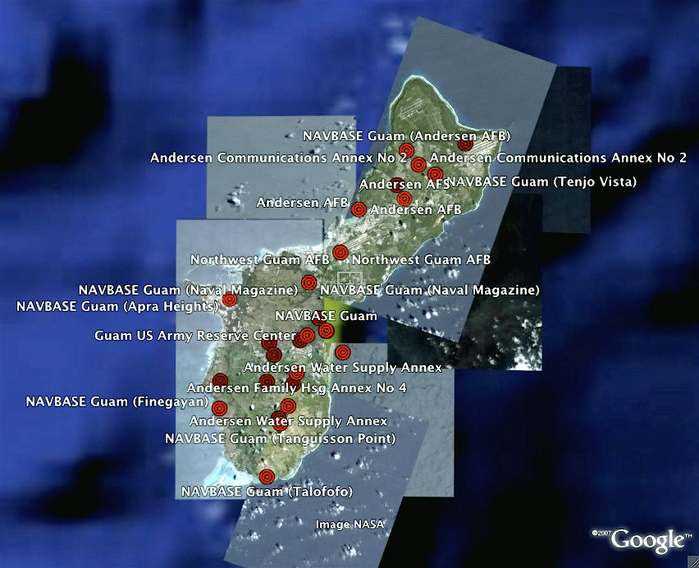
Text Fwd: The Explosive Growth of U.S. Military Power on Guam Confronts People Power 괌의 폭팔하는 미 군사력은 괌 민중의 힘과 대립


* Image source: same as the link


* Text thankfully forwarded by Martha Duenas on Dec. 6, 2010


The Asia-Pacific Journal: Japan Focus
The Explosive Growth of U.S. Military Power on Guam Confronts People Power
: Experience of an island people under Spanish, Japanese and American colonial rule

LisaLinda S. Natividad and Victoria-Lola Leon Guerrero


The United States Department of Defense is planning a massive military build-up on Guahan (Guam) that threatens to change the entire make-up of the island. Guahan, nestled at the southern-most tip of the Marianas Archipelago in the Micronesian region of Oceania, is a mere 212 square miles in area, barely bigger than a dot in most world maps. The island is similarly small in the consciousness of most American and Japanese taxpayers, who will be funding the military expansion. Guahan, however, has a large and rich history. While the island and her people remained in relative isolation from the Western world for over 3,500 years from the earliest indications of settlement, its strategic location as a crossroad between East and West has resulted in colonization by successive maritime powers over the last six centuries.

Spain became the island’s first colonizer after Ferdinand Magellan stumbled upon Guahan in 1521. The Spanish maintained control until they were defeated in the Spanish-American War in 1898.

The United States then took Guahan as a spoil of war and made the island a U.S. possession. Guahan was governed much like a naval ship with a naval governor at the helm. In 1941, the United States did not defend the island when Japan invaded on December 8.Guahan surrendered two days later and was occupied by the Japanese Imperial Army from 1941-1944.

The United States returned and used the island to win the war with Japan. Guahan’s strategic military value was solidified and the United States secured its presence on the island.

Today, it remains a possession of the United States as an “unincorporated territory,” a colonial relic in a professed era of democratization and post-colonialism. As an unincorporated territory, island residents do not have the rights of full U.S. citizens – they are not eligible to vote in U.S. presidential elections, nor does their one elected congressional representative have the right to vote on the floor level of the U.S. Congress.

Further, Guahan is limited in its ability to develop a viable economy as prescribed in specific federal-territorial policies like the Jones Act, which requires that all goods be carried to Guahan exclusively in U.S. ships. This increases the cost of shipping and diminishes the island’s ability to trade.

Guahan was added to the United Nations’ list of non-self-governing territories in 1946, deeming the island a colony in need of self-determination. However, both the United States and the United Nations have done very little to decolonize Guahan. In fact, the U.S. has made concerted efforts to further colonize the island over the decades. The United States has consistently pointed to the U.S. Congress’ passage of an Organic Act for Guahan in 1950 as evidence of why international monitoring bodies such as the UN should not intervene to protect the rights of its people. However, Guahan’s Organic Act, which designed a government for the island and gave Guahan residents limited U.S. citizenship, is a far cry from decolonization. It is a proxy constitution that creates the illusion of local control over governance but grants the U.S. Department of Interior and the U.S. Congress ultimate power over the island. The Act authorizes the Federal Government to use powers such as eminent domain, which continue to be considered illegal in international law. It also allows the United States to increase their military presence on the island without seeking consent from Guahan’s people.

READ MORE

____________________________________

See also the below(* Texts forwarded from Martha Duenas on Dec. 6, 2010)

Overseas Territories Review
05 December 2010
International Governance Expert Discusses Changes in Northern Marianas Covenant
'It's always good to assess NMI political status periodically'
By Haidee V. Eugenio, Reporter


Overseas Territories Review
30 November 2010
Governance Expert to Speak at University of Guam
Will discuss recent developments in small island governance


Guam News Watch
Literary Arts Group to Honor Insular Guard's Defens of Guam on Invasion Anniversary
News Release
Monday, 06 December 2010 08:33

Saturday, November 13, 2010

Video Fwd: [Ten Thousand Things] Vandana Shiva on industrial agriculture's use of war chemicals 반다나 시바, 기업 농업의 전쟁 화학물질 사용, 또한 식량 주권에 반대되는 신식민주의에 대해 강연

Ten Thousand Things
Friday, November 12, 2010
Vandana Shiva on industrial agriculture's use of war chemicals and food sovereignty versus the new colonialism


This is an excerpt of Vandana Shiva's eye-opening talk about the role of war chemicals (pesticides, fertilizers) in industrial agriculture's new colonization in her talk on food and seed sovereignty at the International Meeting on Resisting Hegemony held 2-5 August 2010 in Penang, Malaysia. The complete presentation and others from the meeting are available at the TV Multiversity channel on Vimeo:
For more reading

Text Fwd: NATO Trains Iraqi Armed Forces In Universal Military Language 나토, 이라크 무장 병력에게 영어 군사 용어 교육

* Image source: same as the link
Ar Rustamiyah – (From left) Brig. Mark Pountain, NTM-I Training, Education and Doctrine Advisory Division chief; Maj. Andrew Radzinski; Wing Cdr Paul Scott, NTM-I Fwd Ar Rustamiyah commander; and MG Claudio Angelelli, NTM-I deputy commander, meet with the first English Language teachers to arrive here Oct. 27.
(Photo by NTM-I).


Stop NATO

North Atlantic Treaty Organization
Allied Command Operations
November 10, 201

NTM-I unveils English Language Training Program

AR RUSTAMIYAH: The NATO Training Mission – Iraq began its English Language
Training Program Nov. 1 at the Iraqi Military Academy in Ar Rustamiyah (IMAR).

The course, taught by more than 100 U.S. Department of Defense and contracted
instructors, will prepare Iraqi Security Forces for specialized training in
fields requiring proficiency in English, such as aviation.

Maj. Gen. Claudio Angelelli, NTM-I deputy commander, stressed the importance of
the program to the first seven instructors Oct. 27.

"With your help, Iraq will become more established in the international
community,” said General Angelelli

"We are happy to see that everything here is prepared for the fruitful work, and
we are looking forward to begin our mission,” said Mr. Troy Brousso, English
language teacher.

Initially, U.S. contractors will teach the course while Iraqi instructors
complete instructor training. After, the Iraqi instructors will co-teach with
the contractors until a future date when the Iraqis will assume complete
responsibility for the English language program.
===========================
Stop NATO
Blog site

Saturday, October 23, 2010

[국문 번역] Text Fwd: Clinton and the colonial paradigm 클린턴과 식민지 패러다임

* Image 이미지: same as the link 같은 링크
'아태 사령부 로고를 배경으로 한 클린턴'


___________________________________________________________

* Text sent from Kyle Kajihiro, DMZ Hawai'i, through No US APbases list on Oct. 23, 2010
* 2010년 10월 23일 DMZ 하와이, 카일 카지히로, 보냄


Statehood Hawaii 스테이트후드 하와이
Clinton and the colonial paradigm
클린턴과 식민지 패러다임
Oct. 22, 2010
2010년 10월 22일


Secretary of State Hillary Rodham Clinton will travel to Hawaii, Vietnam, Cambodia, Malaysia, Papua New Guinea, New Zealand, and Australia, October 27-November 8.

미 국무 장관 힐러리 로드햄 클린턴은 10월 27일 부터 11월 8일까지 하와이, 베트남, 캄보디아, 말레이시아, 파푸아 뉴기니아, 뉴질랜드, 그리고 오스트레일리아를 방문할 것이다.

Secretary Clinton arrives in Honolulu on October 27 where she will meet with Japanese Foreign Minister Seiji Maehara to discuss a broad range of issues, including our close coordination during our back-to-back Asia Pacific Economic Cooperation (APEC) host years. This meeting underscores the enduring importance of the U.S.-Japan alliance as a cornerstone of American engagement in the Asia-Pacific. On October 28, for the second time in Hawaii, the Secretary will deliver a major policy speech on the United States’ role as a Pacific nation.

클린턴 국무 장관은 10월 27일 호놀룰루에 도착해 일본 외무 장관 세이지 매하라를 만나 연속적인 아시아 태평양 경제 협력 회의 (Asia Pacific Economic Cooperation (APEC)) 주최 해 기간들 동안 가까운 협력을 포함, 넓은 범위의 이슈들을 토론할 것이다. 이 회의는 미국의 아시아 태평양 참여에 있어 미-일 동맹을 토대로 하는 것의 지속적 중요성을 강조한다. 10월 28일, 하와이에선 두번째로, 국무 장관은 태평양 국가로서 미국의 역활에 대한 주요한 정책 연설을 할것이다.

Clinton’s five principles that has articulated the U.S. Pacific Policy:

미국의 태평양 정책을 표현한 클린턴의 5가지 원칙들

1. Using our bilateral alliance relationships as the cornerstone of our regional involvement while pursuing other partnerships and dialogues with regional players;

1. [더 많은] 지역의 주체들과 다른 협력(관계)과 대화를 추구함과 동시에 우리의 양자 동맹 관계들을 우리의 지역적 참여의 토대로 사용;

2. shaping regional institutions to advance shared objectives such as economic development and democracy;

2. 경제 개발과 민주주의등 공유된 목표들을 진전시키기 위해 지역 기관들을 형성하기;

3. ensuring that regional institutions are effective and results-oriented;

3. 지역 기관들이 효과적이고 결과가 중요시되는 방향으로 되는 것을 확실하게 하기

4. maintaining flexibility in pursuing objectives, including through sub-regional institutions; and

4. 지역 하부 기관들을 통한 과정들을 포함, 목표들을 추구하는데 있어 유연성을 유지하기; 그리고

5. determining which Asia-Pacific regional institutions are the defining ones that include all key stakeholders.

5. 어느 아시아 태평양 지역 기관들이 모든 핵심 이해 관계자들을 포함하는 결정적인 기관들일가를 결정하기.

This new plan, as stated in testimony by Asst. Sec. of State Kurt Campbell, has articulated that the U.S. will work in cooperation with the Pacific Island Forum Secretariat and the participating organizations, citing PIF as the cooperating regional players.” (For more information on the Pacific Plan go to: http://www.forumsec.org.fj/pages.cfm/about-us/the-pacific-plan/)

미 국무 차관보 커트 캠벨의 증언에 의해 진술된 것처럼, 이 새로운 계획은 태평양 제도 포럼(Pacific Island Forum)의 “협력하는 지역적 주체들”을 인용하며 미국이 태평양 제도 포럼 사무 총장, 그리고 협력 조직들과 일할 것임을 일목요연하게 했다. (태평양 계획들에 대한 더 많은 정보는 여기를 가시길: http://www.forumsec.org.fj/pages.cfm/about-us/the-pacific-plan/)

The five principles that Clinton has articulated lays the frame for further militarization of the Pacific through the use of Development Aid for strategic control over energy and other pacific resources.

클린턴이 정리한 5가지 원칙들은 에너지 및 다른 태평양 자원들에 대한 전략적 통제를 위하여 개발 원조의 사용을 통한 태평양의 더 많은 군사화를 위한 틀을 마련한다.

A good example of the kind of plan that is being perpetrated is the production of Palm Oil in Papua/New Guinea. In a 2009 report entitled “Commodity Colonialism,” David Gilbert describes the economic, environmental conditions imposed upon PNG, Palm Oil production by U.S. agribusiness, Cargill, which has created not only massive environmental degradation, but also the spread of debt, prostitution, alcoholism and violence in the oil palm regions.

그 계획이 저질러진 좋은 예는 파푸아 뉴기니아의 야자 기름 생산이다. “상품 식민주의”라고 제목붙여진 2009년 보고서에서 데이비드 길버트는 미국 농업 기업 카길이 파푸아 뉴기니아 야자 기름 생산에 부과한 경제적, 환경적 조건들을 묘사하는데, 그것은 기름 야자 지역들에서 대량의 환경적 감퇴뿐만 아니라 또한 빚, 매춘, 알코올 중독과 폭력의 확산을 가져왔다.

The combination of militarization, development aid, as well as traditional and new commodities in the Pacific, is well elaborated in the US State Dept. Pacific plan.
The upcoming G20 and APEC meetings among the larger countries around the Pacific will undoubtedly prepare for further exploitation of Pacific resources.

태평양에서의 전통적이며 새로운 상품들과 마찬가지로 군사주의, 개발 원조의 결합은 미 국무부 태평양 계획에 잘 묘사되어 있다. 다가오는 G20과 태평양 주위 더 큰 국가들간의 아시아 태평양 경제 회담은 의심의 여지없이 태평양 자원들의 더 큰 착취를 준비할 것이다.

In this critical era of acute climate change, this policy already accepts the reality of global warming, an assumption that threatens the existence of many Pacific Island nations and peoples. The use of militarization and aid, the logic of maintaining military presence as insurance to disaster relief programs, the continued exploitation of forests and natural resources in the Pacific; together, these all suggest the continuation of an old colonial paradigm.

기후 변화라는 이 심각한 시대에 이 정책은 이미 많은 태평양 제도 국가들의 존재를 위협하는 가정이란 지구 온난화의 현실을 받아들인다. 군사화와 원조의 사용, 재난 구호 프로그램들을 위한 보험으로 군사 주둔을 유지하기 위한 논리, 태평양의 숲들 그리고 천연 지원들에 대한 계속되는 착취: 이 모든 것은 구 식민지 패러다임의 계속성을 암시한다.

Wednesday, October 20, 2010

Text Fwd: [famoksaiyanfriends] [Michael Bevacqua,Guam]"Maolek na Finaisen" [괌, 마이클 베박쿠아] 괌 언어 사용에 대하여

* Text sent from Martha Duenas on Oct. 20, 2010

Marianas Variety
"Maolek na Finaisen"
Michael Bevacqua
Wednesday, 20 October 2010

As I wrote about in my last column, the Chamorro Language Program at UOG is organizing a “Fino’ Chamoru na Inadaggao,” or Chamorro Language Forum, where political candidates will respond to questions asked in the Chamorro language (hopefully in the Chamorro language).

This week there are three forums for the senatorial candidates, and next Monday on the 25th, the gubernatorial teams will face off.

I took some time recently in my classes at UOG to discuss with my students the importance of the forum and give them all the opportunity to write down some possible questions to be asked, which would then be translated into Chamorro. The discussion was very spirited, because I pushed my students to be very intentional about what they were going to ask. I asked them not to fall into the usual traps that these events or these questions take, where politicians are asked the most generic and pointless questions, which don’t challenge them, don’t reveal anything important about them or the issue, and allow them to merely regurgitate something they’ve already said 8,000 times that same week.

I told my students to not be chained to what the “big” and “important” issues are usually thought to be, but to instead focus on something they felt was real in their lives. I knew that the following two questions, “What are your plans to fix the economy?” and “What are your plans to fix education?” were most likely the ones they felt were the most important, but I urged them to resist simply asking what they were supposed to ask, and focus on what they felt needed to be asked.

My students naturally asked, what kind of questions are the ones that “need to be asked?” I gave a number of different examples, such as the following after one student asked whether it would be okay to ask how she might phrase a question about whether or not the candidate could be trusted. Because in my World History class we were covering the origins of Christianity, I decided to give it a bit of Biblical flavor: “Jesus Christ said that it is easier for a camel to pass through the needle of an eye than for a rich man to get to heaven. Is this something that we should take seriously when choosing our leaders? If you are a person of financial means running for office, how can people trust you to make sure that you do not govern to promote yourself or your class, but are truly interested in helping everyone else on the island?” This is something that not only the wealthy should deal with, but all leaders as well. How can you ensure that you are acting for the benefit of all or most and not just for the few who are closest to you?

Some students found this and other similar questions too confrontational, and didn’t feel that this sort of thing was appropriate and that we should be more respectful to those who are our leaders, or wish to be our leaders. I didn’t criticize them, especially on Guam, where it’s very natural to think such a thing. Others found the bluntness refreshing and liberating, and in truth, that was how I was hoping they’d respond. That is after all the feeling of not just enjoying democracy, but actually participating in it. It stems from going beyond that abstract feeling of simply being part of a democracy, but being a part of it which can make intelligent decisions your society, and does not just cast a mindless vote, but actually attempts to educate oneself and find out what is the best choice.

I received several hundred questions from my students, and wanted to share in this column some of my favorites. By far the most blunt, honest and critical question is the last one. The questions:

1) Trash is a very important issue for any island, since your space is very limited. But Guam has very little recycling. We are living in a fantasy world and not facing the fact that if we don’t truly start to recycle and stop importing more trash into this island. We might just end up capsizing! How would you propose to help wake up Guam and start making recycling a big part of our lives?

2) Do you think that we should make it required that all of our leaders in the Executive and Legislative Branches should be able to understand or speak Chamorro since it is an official language of Guam and they are the representatives of the island? Even if we don’t all speak Chamorro now, this could be a great chance to help encourage people to learn!

3) The US military has promised that new troops will be given cultural sensitivity training to help them adapt to living here in respectful ways. What kind of programs do you propose we can develop to help teach them about real Chamorro culture and real Chamorro history?

4) If aliens landed on Guam the day you are sworn into office, what would your first official act in response to their arrival?

5) Senator Frank Aguon submitted a bill last year which would increase the number of senators in the Guam Legislature from 15 back up to 21. With the rapid increase of Guam’s population, do you support an increase of senators in the legislature? Why or why not?

6) So many of Guam’s current and possible leaders have claimed that there is nothing that we can do about the US military buildup and that it is a done deal or not in our power to change. If the power was in your hands, if you were in charge of the buildup, would you stop it? How would you change it? Please do not say that it will happen no matter what, because then frankly you shouldn’t be anyone’s leader.

Monday, October 18, 2010

Text & Video Fwd:[Guam] Power to the People of the Pacific!! Imperialism & Resistance in the Pacific Islands [괌] 태평양의 민중들이여, 힘내 ! 태평양 군도에서의 제국주의와 저항

* Text from Erica Benton on Oct. 17, 2010

[famoksaiyanfriends] AGUPA'!! SOUL SUNDAY SCHOOL :
Power to the People of the Pacific!! Imperialism & Resistance in the Pacific Islands

3 to 5pm : Sunday : October 17th 2010
at SOUL : 1904 Franklin (@19th) Suite 904
Oakland

SOUL and Famoksaiyan invite you to a Sunday School on the fight for survival and self-determination in the Pacific Islands. Please join us for a presentation & discussion about the legacy of US imperialism in the region and emerging movements to resist militarization.


*Photo: We Are Guahan's Realize Our Destiny rally, October 1st 2010
by Masako Watanabe/Pacific Daily News

We will be joined by anti-militarization organizers who work in the Pacific and locally, against empire at home and abroad, including Moñeka de Oro from We Are Guåhan.

A current site of struggle in the fight against US military domination, the small Pacific island of Guåhan/Guam is currently targeted for a US military base expansion that threatens widespread displacement and destruction. The US military already directly controls over one-third of Guåhan's territory and wants even more, to strengthen its ability to wage existing wars and threaten new ones. We Are Guåhan is an island-based organization that works to educate residents about the impending military buildup, and organizes them in defense of their land and resources. They have been a leading popular force against militarization, and have mobilized thousands of people to take action to protect their island.

Speakers:

Moñeka de Oro / We Are Guåhan
Raquel Redondiez / BAYAN-USA
Miho Kim / TRAI-US Transpacific Research & Action Institute for the Hisabetsu Nikkei
Alicia Garza / POWER People Organized to Win Employment Rights & War Times Newspaper

Please RSVP to info@schoolofunityandliberation.org or at www.facebook.com/schoolofunityandliberation

More on We Are Guahan here & here.

Protect Pagat Community Action 7/23/10 Guam


School Of Unity & Liberation
::: a school to build a movement :::
www.schoolofunityandliberation.org
www.facebook.com/schoolofunityandliberation

________________________________________________________

Wednesday, October 13, 2010
Text Fwd: [famoksaiyanfriends] [Michael Bevacqua, Guam] Realizing Our Destiny
[마이클 베박쿠아, 괌] 우리의 운명을 실현하기


Saturday, October 2, 2010
Photos Fwd: [famoksaiyanfriends][Guam] Realizing Our Destiny
[괌] 우리의 운명을 실현하자

Monday, July 19, 2010

Text Fwd: [famoksaiyanfriends] When the Moon Waxes - Decolonization Before Our Eyes

* Text Fwd from Martha Duenas on July 17, 2010

Marianas Variety
When the Moon Waxes - Decolonization Before Our Eyes
Wednesday, 14 July 2010 04:01
by Michael Lujan Bevacqua

FANHASSO. Fanhita. Fanachu. These are strong, deep words which we should keep with us as we face, whether as a community or individuals, the challenges of our lives. Reflect. Come together. Rise.

These three words come from the title of a play which I co-wrote with Victoria Leon Guerrero, directed by Cliff Guzman and was performed recently by the Chamorro cultural dance group Inetnon Gefpago in celebration of their 10th anniversary. The content of the play was a mixture of the huge collection of dances which Inetnon Gefpago has created or adapted over the years, with a story of Chamorro empowerment through the celebration of Chamorro history and culture.

Although there are many different interpretations and understandings on Guam about what decolonization is or might mean out there; some cultural (reviving practices), some political (changing political status), some fearful (turning back the clock), one of the reasons why I was so excited to work with Inenton Gefpago, one of the now numerous Chamorro cultural dance groups on Guam, is because of the way they have over the past 30 years brought about a very real example of what decolonization is.

We all know the tragedies whereby Chamorros were prohibited from practicing certain cultural forms when the Spanish colonization began in the late 17th century. The transmission of some knowledge, history and culture was radically disrupted. As a result, we do not know what those dances looked like.

But, the true tragedy of that loss is not how the dances themselves were lost, but how Chamorros from that point would see themselves fundamentally differently, and among other things, incapable of creating their own dances again. Under the Spanish and up until today, Chamorros lost their sovereignty, or their ability to see themselves as not just a distinct people, but one who is not simply battered about by the violent waves of the world, but a people who have control over their culture and their destiny.

From then on, even though Chamorros continue to exist as a people with their own language and culture, whatever happens after that moment is always tainted with the notion that it is not really theirs. Chamorros borrow new dances from other cultures and eventually make them their own. They constantly qualify their dancing as never really belonging to them, always saying that this dance isn’t really Chamorro, but comes from Spain, Mexico, the Philippines or the United States. Even though Chamorros had the ability and creativity to start their traditions anew, for centuries a set of paralyzing thoughts dominated the minds of Chamorros: that because the continuity of their culture was disrupted, they could never authentically claim these art forms again. There could never truly be “Chamorro dances” again.

Thirty years ago, that began to change. People started to research what information could be found on ancient dances.

They traveled to other islands to see what sorts of themes native various Pacific dances and chants had. Eventually new Chamorro dances were created. They were not meant to represent how Chamorros danced 400 years ago, rather each was a recreation or an homage to that era. At first, these dancers were sometimes mocked and laughed at for “making things up,” but much of that changed in time. When we look around the island today, Chamorro dances are fixtures at all public events, and there are dozens of different groups and styles to watch or join.

This is the nature of decolonization. It can start off small and something which most people resist or refuse to believe because it seems to contradict the very flow of history, but when it does happen, literally the ground beneath our feet changes, and most don’t even notice. For example, the crowds of people who snickered at the first generation of Chamorro dancers now eagerly send their children and grandchildren to join the same dance groups.

We should all congratulate the many teachers and leaders who have made this act of decolonization possible, and we should look to this as an example of how, even though the tragedies of history bear down heavy upon the Chamorro people, that trauma should not and must not define our lives.

The violence of colonization, recent or ancient, haunts a people and makes them at times feel cursed, inferior or dependent. Decolonization is something which each passing generation takes on in their own way and is at its core about the empowerment of the colonized, the instilling in them a feeling of control over their present and future. But when a true act of decolonization takes place, it is truly a marvel to witness. For it is the feeling of seeing something which was assumed impossible for so long, manifest right before your very eyes.

Friday, July 2, 2010

Video Fwd_Best Female Rapper in Korea and racism in Korea


* Video thankfully informed by G. on June 30, 2010

Best Female Rapper in Korea (English Subbed) (Video URL)


'This is a story about a girl who's forced to live as a stranger in Korea, enduring racial prejudice. Tasha (korean name- yoon mi rae) is half African American and half Korean. as she grew up, she had a hard time searching for self identity.
Yeah, korea was a sort of narrow minded society colorwise. The situation is getting better though, i think it's still not better enough. feel sorry for her and ashamed for this :( Go Tasha!! U ROCKS!)!' (From the link)
__________________________________________________________

# With shameful feeling, I cannot but think of the ordeal of the migrant workers' in South Korea as well. Please see.

Hankyoreh
Government crackdown on migrant workers escalates prior to G20
: The government has continued to receive criticism for the violent tactics used and infringements on human rights

July 1, 2010
'An official of the Migrants’ Trade Union (MTU), center, speaks during a press conference held to launch “Cat’s Eye,” a group to monitor human rights infringements against migrant workers during crackdowns in South Korea, June 30.'

Excerpt:

"In September 2008, the Justice Ministry said it would reduce the number of illegal migrant workers by 10 percent from the 220 thousand recorded at the time by 2012. In fact, according to Korea Immigration Service statistics from the end of last year, the number of staff hired to facilitate crackdowns has continued to increase, from 20,455 in 2007 to 30,831 in 2008 and 31,506 in 2009. The Justice Ministry said it is currently conducting its first crackdown from June 7 to July 6, but it has yet to determine exactly how many individuals it has arrested."

Sunday, May 30, 2010

Text fwd: Priorities and Concerns of Civil Society Relating to the Decolonization of Guam as a UN Non Self-Governing Territory

* Text informed by Martha Duenas on May 30, 2010 and also in DMZ Hawai'i
“Priorities and Concerns of Civil Society Relating to the Decolonization of Guam as a UN Non Self-Governing Territory”

May 29, 2010 by kyle

http://overseasreview.blogspot.com/2010/05/perspectives-on-decolonisation-of-guam.html

STATEMENT OF GUAHAN COALITION FOR PEACE AND JUSTICE and THE CHAMORRO STUDIES ASSOCIATION

By HOPE A. CRISTOBAL

THE UNITED NATIONS SPECIAL COMMITTEE ON DECOLONISATION

Pacific Regional Seminar

Noumea, New Caledonia

18 – 20 May 2010

“Priorities and Concerns of Civil Society Relating to the Decolonization of Guam as a UN Non Self-Governing Territory”

CHAMORU SELF-DETERMINATION PA’GO

I. INTRODUCTION

Hafa Adai! (Greetings) Your Excellency Mr. Chairman and distinguished members of the Special Committee on Decolonization.

Dangkolu na si Yu’os ma’ase (sincere thank you) for your invitation to participate at this revolving seminar to assess the progress of decolonization and to discuss priorities regarding the Question of Guam on the final year of the Second International Decade for the Eradication of Colonialism in the 21st century.

Also, I bring warm Hafa Adei greetings from our indigenous Chamorro people to our fellow Kanaky people of New Caledonia. We thank you for graciously hosting this United Nations Pacific Seminar. We extend a heartfelt “Dangkolu na si Yu’os ma’ase” (sincere thank you) for the opportunity to join Your Excellency, the Special Committee and my esteemed fellow delegates today.

As you may know, the Chamorro people of the Mariana Islands have cultural and linguistic ties to the Kanaky people of New Caledonia through our common Austronesian heritage that spans Oceania. As peace loving peoples of the great Pacific, we hope one day to be able to share in a history of freedom from colonial dominance espoused by this Special Committee and the rest of the UN body.

I am Hope Alvarez Cristobal, a Chamorro former Senator of Guam. I am here as a representative of Guåhan Coalition for Peace and Justice, a Guam based coalition made up of grassroots organizations advocating for the political, cultural, social, environmental and human rights of the people of Guam. We formed in September 2006 as a result of the announcement of the United States-Japan Realignment Initiatives signed in May 2006 in our awareness and desire (consistent with our traditionally matrilineal social order) to organize and give voice to concerns of women and female children in a highly militarized environment.

Our focus on peace and justice is central in light of the ongoing issue of the denial of our Chamorro people’s inalienable human right of self-determination and decolonization of Guam as a modern-day colony of the United States. Particular emphasis is made on keeping Guam, our island home, safe and sustainable for our children and generations to come. The Guåhan Coalition for Peace and Justice is comprised of the following member organizations: Chamorro Studies Association; National Association of Social Workers, Guam Chapter; Conscious Living; Guam’s Alternative Lifestyle Association; and Nasion Chamoru.

II. THE LAND AND THE PEOPLE OF THE LAND

Guam’s unincorporated (permanent colony) status designation under the 1950 Organic Act of Guam legitimized US military land takings with rights of eminent domain of the only 147,000 acres of land—with only 116.5 miles of natural shoreline available to it for all purposes. Of this 147,000 acres, the military currently possesses 40,000 acres constituting 27.21% of the island’s landmass with the US National Park Service possessing 695 acres for 0.47% and the US Fish & Wildlife Service currently possessing 385 acres for 0.26% of the island. The local government possesses 37,673.36 acres for 25.6% of that total and with private lands consisting of only 68,246 acres for 46.43% of Guam’s land mass. [Ref. legislative Resolution 258-30 (COR)].

With a history of US land takings and the possibility of more land condemnation through the current US militarization plans, the 29th Guam Legislature passed public law 29-113 which clarifies that the disposition of public lands is exclusively the purview of the Guam Legislature and not the US military. This law stipulates that duly enacted legislation by the Guam Legislature is needed to authorize “the acquisition by condemnation or otherwise of private property” by means of Congressional appropriation to acquire property for public use.

The current 30th Guam Legislature also passed another law which tasks the local government’s Guam First Commission to determine which land the Federal Government may intend to lease or sublease, exchange for other land, or purchase, and to report their findings to the Guam Legislature and the Governor of Guam. This law also requires the Legislature’s approval of any federal acquisition of Government of Guam property, whether by lease, sub-lease, exchange or sale.

Guam’s colonial status continues to pave the way for US application of federal laws over our air space and sea lanes; our 200-mile Exclusive Economic Zone; all our resources, control of exit and entry of our borders, control of our land, the environment and whatever can be defined as “a possession of but not a part of the United States.” It is clear that the Guam Legislature is now struggling as it finds itself with little power to protect local government assets under the laws of the administering power. For a small colonial people, the alienation of property by laws of the colonial power is one of the fundamental tenets of colonialism. In Guam, so much of the alienation has occurred through military seizure—but other forms of alienation have the same effect.

III. SECOND INTERNATIONAL DECADE FOR THE ERADICATION OF COLONIALISM

Mr. Chairman, people of the 16 remaining NSGTs still under the yoke of colonialism have been denied the benefits of decolonization as provided by the UN Declaration on the Granting of Independence to Colonial Countries and Peoples [UN Resolution 1514 (XV)] and that despite the Special Committee’s diligent work emphasized in the proclamation of the two International Decades for the Eradication of Colonialism the world’s political map have not had any major transformation. We can honestly say that in the case of Guam, rather than the eradication of colonialism, the US administering Power has deepened its colonial roots.

What we find unacceptable, Mr. Chairman, is that the administering power’s WWII adversary, Guam’s brutal occupier of WWII, Japan, is now complicit in Guam’s modern day colonization and militarization through its joint Bi-lateral Agreement with the U.S. With respect to Guam, the Special Committee’s work was not only stymied; rather, it has been made to fail in its mission to make colonialism a fact of the past—in not having developed a programme of work for the decolonization of the NSGT of Guam in view of the US’s active, massive militarization plans. Included is the failure in dispatching a UN visiting mission at the time Guam was actively negotiating its political status over two decades ago; and today, with US plans for our militarization.

For 21st century Guam, it is déjà vu old-style colonialism again. This time it is not 17th C. Spain but the US administering Power utilizing its military forces in a kind of “reduccion” process of “subduing, converting and gathering the natives through the establishment of missions and stationing of soldiers to protect those missions.” (Ref. Rob Wilson, 21st Annual Conference, “Crosscurrents: New Directions in Pacific and Asian Studies,” University of Hawaii, Manoa, March 10, 2010.) The exploitation of our colonial status as a people, U.S. militarization, assimilationist immigration policies, the rising tide of cultural genocide, environmental degradation and contamination, the dispossession of our lands, etc., are direct violations of our rights as NSG people under:

a. The UN Charter, in particular, Articles 1, 55 and 73e which addresses the rights of peoples in non self-governing territories who have not yet attained a full measure of self-government, and commands states administering them to “recognize the principle that the interests of the inhabitants are paramount.” Furthermore, that administering powers, accept as a “sacred trust” the obligation to develop self-government in the territories, taking due account of the political aspirations of the people.

b. UN Resolutions 1514 that states, the subjection of peoples to alien subjugation, domination, and exploitation constitutes a denial of fundamental human rights, is contrary to the Charter of the UN and is an impediment to the promotion of world peace and cooperation.

c. UN Resolution 1541 affirming three ways NSGTs could attain a full measure of self-government that must be the result of the freely expressed wishes of the peoples of NSGTs.

d. UN Declaration on the Rights of Indigenous Peoples—the latest UN international human rights instrument to explicitly expand the universe of the holders of the right of self-determination with its Article 3 that specifically recognizes, using the classic formulation of the right of self-determination enshrined in the 1966 Human Rights Covenants, that indigenous peoples hold the right.

e. International Covenant on Civil and Political Rights and the International Covenant on Economic, Social and Cultural Rights, (known collectively as the 1966 Human Rights Covenants) that enshrine self-determination as a right.

f. And, other relevant UN documents on decolonization.

Clearly, the US continues to behave contrary to its concrete UN obligations as the administering Power over Guam. There is no mistaking that US dominance and subordination of Guam is a consequence of US military power dynamics over the Asia-Pacific region. And, without the United Nations assertion of its moral authority and oversight of its non self-governing territory of Guam, our home island and our people will continue to be treated as inferior having no sovereignty or agency in relation to US foreign policy and security interests. Gone unchallenged, the possibility of a free, decolonized and self-governing Guam will be sealed and buried under by our own administering Power.

At his opening statement of the House Armed Services Committee hearing on March 25, 2010, Congressman Ike Skelton spoke about the rebasing of U.S. Marines from Japan to Guam as “one of the largest movements of military assets in decades”—estimated to cost over ten billion dollars. He further stated that the changes being planned as part of that move will not only affect U.S. bilateral relationship with Japan; they will shape U.S. strategic posture throughout the critical Asia-Pacific region for 50 years or more. Congressman Skelton stated that the US “must be proactively engaged in the Asia-Pacific region on multiple fronts,” and that U.S. actions may well influence the choices and actions of others.”

For Guam, our exclusion from the decision made about the massive militarization of our island home through US military expansion and restructuring of its bases and military operations is unconscionable. Moreover, we have had no choice and no options offered vis-à-vis our colonial status or US actions having political implications on our colonial status. Guam is a colony and remains a colony until the Chamorro people is allowed to exercise our human right of self-determination and is allowed to decolonize.

IV. OUR HUMAN ENVIRONMENT

Mr. Chairman, the U.S. military’s militarization plans bodes great harm for the people and our island home environment. These plans include the construction of facilities and structure to support the full spectrum of warfare training for some 8,600 marines (and their dependants) being relocated from Okinawa to Guam; the construction of a deep-draft wharf in Guam’s only harbor to provide for nuclear-powered aircraft carriers, destroying over 287,000 sqm (71 acres) of healthy and endangered coral reef; the construction of an Army Missile Defense Task Force modeled on the Marshall Islands-based Ronald Reagan Ballistic Missile Defense Test Site, for the practice by US military personnel of intercepting intercontinental ballistic missiles; the forcible land-grabbing of an additional 2,200 acres of indigenous Chamorro land; the desecration of Pagat, one of Guam’s oldest ancient villages dating back to 2,000 B.C.; the dangerous over-tapping of Guam’s water system to include the drilling of 22 additional wells; and the denial of the most fundamental human right of the Chamorro people of Guam to self-determination.

The militarization plan calls for an alarming 80,000 new residents within the next five years. These new residents include the 8,600 Marines and 1,000 Army troops with 9,000 of their dependents and large numbers of construction workers that will add to our current 180,000 residents. This is obviously not about demographics alone as we see US hegemony flourish and cultural genocide work for the administering power. As non-US citizens after WWII, we were over 95% of the population. As United States citizens 50 years later, our population is reduced to 42% (2000 Census). Five years ago, we comprised some 35% of our home population. But with the new US plan, the Chamorro population can be expected to drop to around 24%! This is perhaps the most plausible reason why all information impacting our people’s lives were kept secret until the official release of the draft environmental impact study last November 20, 2009.

This Draft Environmental Impact Statement (EIS)/Overseas Environmental Impact Statement (OEIS) was intended to, “assess the potential environmental effects associated with the proposed military activities” (DEIS, Executive Summary, Abstract) for the relocation of US marines to Guam, enhancement of infrastructure and logistic capabilities, improvement of pier/waterfront infrastructure for transient US Navy nuclear aircraft carrier (CVN) and placement of US Army ballistic missile defense (BMD) task force. It is supposed to report the overall impacts that the military’s plans will have on Guam’s environment. It was a document of 11,000 pages and we were given a 90-day window to comment (ending Feb. 17, 2010) with a Final EIS to be completed in July and a Record of Decision to be released in 30 days.

The selective and exclusive sharing of information on the military’s plans prevented our full participation and served to silence our voices in this critical process. The community scrambled to respond to the 11,000-page report within the rigid schedule. The “record speed” of a two-year environmental impact study for such unprecedented militarization of a non self-governing territory was obviously suspect. We were not told about the 80,000 people or that the US had planned to go outside their existing footprint. At the public outreach meetings, hundreds spoke resoundingly against the military’s plans. At the close of the public comment window, the military received over 10,000 comments from various indigenous Chamorro groups, community members and stakeholders and other external stakeholders.

The fear of being overwhelmed by the construction of a new US Marine base has permeated the community. In reference to the local government’s costs grossly underfunded in the plan, Lt. Governor Michael Cruz, M.D. who himself is a Colonel in the Army National Guard, stated “Our nation knows how to find us when it comes to war and fighting for war, but when it comes to war preparations—which is what the military buildup essentially is—nobody seems to know where Guam is.” Government officials put the total direct and indirect costs of coping with the military buildup at about $3 billion, including $1.7 billion to improve roads and $100 million to expand the already overburdened public hospital.

Last January 22, the 30th Guam Legislature adopted a resolution expressing the “strong and abiding opposition of the Guam Legislature and the People of Guam to any use of eminent domain [condemnation] for the purpose of obtaining Guam lands for either the currently planned military buildup or other U.S. Federal Government purposes, or both.” Copies were transmitted to the President of the United States, the Speaker of the House of Representatives of the United States, the President Pro-Tem of the U.S. Senate, to UN Secretary General, Ban Ki-moon, and other officials. Another resolution (No. 275-30 (LS)) was introduced and adopted relative to presenting to President Obama and the US Congress, the sentiments expressed by the people of Guam regarding the Draft Environmental Impact Statement for the Guam military build-up; to enumerating the findings of the Legislature that have led to the conclusion that the DEIS is grossly flawed; to providing a list of essential elements which must be favorably resolved; to restate Guam’s agenda of priority concerns relative to federal-territorial issues that must be addressed concurrently with the buildup; and to asserting additional findings on actionable items relative to the DEIS.

Of grave concern is the fact that Chamorro self-determination and decolonization was not even addressed by the military in the DEIS and the fact that decisions have been made in the context of a huge power imbalance in which the US has the ultimate decision-making power with the social, cultural and political implications to the Chamorro community being grossly understated. It is no secret that the US and its military representatives are fully cognizant of the irreversible and significant consequences that their decision will have on its colonial people. Broad concerns relating to local infrastructure, environmental, labor and workforce, socio-economic and health and human services are being discussed among government and military officials. But the difference is: The US has completely ignored the negative implications to its colonial people’s human, political and legal right to self-determination. Just as select private businesses collectively predict positive gain by Guam’s militarization, the Chamorro people alone have historically and will predictably bear the unequal proportion of the burden.

On the last day of the public comment period, the federal Environmental Protection Agency issued the lowest possible rating of the DEIS of “environmentally unsatisfactory” and providing “inadequate information.” In its strongly worded six-page letter, the US EPA stated that “The impacts are of sufficient magnitude that..…action should not proceed as proposed and improved analyses are necessary to ensure the information in the EIS is adequate to fully inform decision makers.” Specifically, the EPA stated that the military’s plan would lead to:

a. A shortfall in Guam’s water supply, resulting in low water pressure that would expose people to water borne diseases from sewage.

b. Increased sewage flows to wastewater plants already failing to comply with the Clean Water Act regulations.

c. More raw sewage spills that would contaminate the water supply and the ocean.

d. “Unacceptable impacts” to the 287,000 sqm (71 acres) of a high quality coral reef.

But even with this indictment of its draft EIS, the military continues with its military expansion and restructuring plans today.

In Congress, Guam’s delegate introduced a bill that would provide for public education on Guam’s political status options. This bill was amended in the House of Representatives and now includes the other two NSGT’s: American Samoa and the US Virgin Islands and would “include but not (be) limited to the 3 internationally recognized options.

The implication is that the educational program could also include other options, albeit not defined in the bill. There is no reference to any referendums nor provision of a specific budget although Congressional estimate of the costs is some $2 million in the next 5 years for all the territories. It remains to be seen what will happen in the US Senate.

If the draft Guam Commonwealth bill or the Guam War Reparations bill or the bill to amend the US Radiation Exposure Compensation Act (to give compensation to the “down winders” (Guam included)) are any example, it will end up taking many forms over many years without resolution or action. Only time will tell. And, time, Mr. Chairman is not on our side.

V. OBSTACLES/OPPORTUNITIES/RECOMMENDATIONS

The Question of Guam shall remain a question of Chamorro self-determination and decolonization for Guam. As a process of decolonization, the exercise of Chamorro self-determination must necessarily occur outside the influences of the administering Power and with the cooperation of the United Nations.

We make the following recommendations to this seminar:

1. That the inalienable right of the Chamorro people of Guam to self-determination in conformity with all relevant UN documents be given utmost priority by the Special Committee on Decolonization in view of the administering power’s massive militarization planned from 2010 to 2014.

2. That a customized process of decolonization for the Chamorro people of Guam be immediately adopted in view of the severe irreversible impacts on Guam by the US administering power.

3. That an investigation be conducted as to the compliance of the administering power with its treaty obligations under the Charter of the United Nations to promote the economic and social development and to preserve the cultural identity of the Territories as related earlier in this text.

4. That a study must be conducted on the implications of US militarization plans on Guam’s decolonization and that UN funding be allocated immediately.

5. That the UN denounce the militarization of the non-self-governing territory of Guam without the consent of the people of Guam due to irreparable harm to the inalienable human rights of the Chamorro people and interests of the people of Guam.

6. That a work programme be adopted by the Special Committee to carry out its objectives for the decolonization of Guam.

VI. CLOSING

Thank you, Mr. Chairman and delegations for the opportunity to make this presentation. My people’s journey towards decolonization is at a very critical juncture. We can only rely on the United Nations to assure that the US live up to its obligations under the United Nations Charter and to its promise of self-determination and decolonization for the people of Guam.