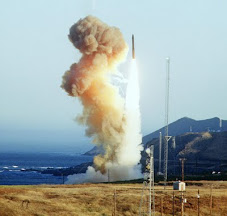
'저는 그들의 땅을 지키기 위하여 싸웠던 인디안들의 이야기를 기억합니다. 백인들이 그들의 신성한 숲에 도로를 만들기 위하여 나무들을 잘랐습니다. 매일밤 인디안들이 나가서 백인들이 만든 그 길을 해체하면 그 다음 날 백인들이 와서 도로를 다시 짓곤 했습니다. 한동안 그 것이 반복되었습니다. 그러던 어느날, 숲에서 가장 큰 나무가 백인들이 일할 동안 그들 머리 위로 떨어져 말과 마차들을 파괴하고 그들 중 몇몇을 죽였습니다. 그러자 백인들은 떠났고 결코 다시 오지 않았습니다….' (브루스 개그논)


For any updates on the struggle against the Jeju naval base, please go to savejejunow.org and facebook no naval base on Jeju. The facebook provides latest updates.
Showing posts with label Predator. Show all posts

Tuesday, September 22, 2009

[국문 번역] Text Fwd: Drones and Missile Defense to be Linked

Image source: same as the article below
'Avenger of General Atomics'
제너럴 어타믹스의 애번저(*복수자)

* Informed by Bruce Gagnon on Sept. 21, 2009
위 기사는 브루스 개그논이 "무인비행기와 미사일 방어의 연관성" 이란 제목으로 9월 21일 이메일로 보낸 것입니다.


Predator Execs Eye Global Expansion
프리데이터는 전 지구적 확장으로 눈을 연다.
By David Fulghum, Aug. 14, 2009, Aviation Week
데이비드 펄검, 2009년 8월 14일, 아비에이션 위크 (항공 주간)

There is a sleeper in the race for fielding more unmanned aerial vehicle (UAV) capability worldwide — General Atomics Aeronautical Systems is already flying a reduced-signature Predator C and the company is looking to bank its existing gains.

전 세계적으로 더욱 더 많은 무인 비행기 (UAV) 능력을 놓을려는 경쟁의 동면자, 재너럴 어타믹스 에어노티컬 시스템은 이미 축소판 프리테이터C (PredatorC) 를 날리며 이미 획득한 이득을 경사 선회시키려 하고 있다. (•gains: 이득: 전기에서 증폭기의 입력에 대한 출력의 비율)

“They already have the ground stations and infrastructure in place. Predator C plugs right into that,” says General Atomics chief Tom Cassidy. “Right now there is no prohibition about selling Predator C overseas to NATO countries, Japan or Australia. The entire Predator family is in Missile Technology Control Regime category one.”

“그들은 이미 지상 스테이션과 하부 구조를 갖고 있읍니다. 프리테이터C는 바로 그 것에 들어맞죠”, 라고 재너럴 어타믹스 회장 팀 캐시디는 말한다. “프리테이터C를 해외 나토 국가들, 일본이나 호주에 파는 거는 현재 전혀 금지된 일이 아닙니다”. 전체 프리데이터 가족은 미사일 기술 통제 제도(Missile Technology Control Regime)’의 제 1 분야입니다.

The new Predator C has a turbojet engine with hidden exhaust and recessed air intakes, swept wings and V-tail for redirecting radar reflections, and some shaping. Depending on how much a customer wants to spend, the signature can be reduced to the point that by using standoff weapons and cooperative tactics with other aircraft, even advanced air defenses can be finessed and avoided.

새로운 프리테이터C는 숨겨진 배기 장치와 우묵하게 감추어진 공기 흡입구를 지닌 터빈식 분사 추진 기관, 후퇴익 날개들, 레이다 반사 방향을 바꾸게 하고 모양까지 만드는 V형 꼬리를 갖고 있다. 고객이 얼마만큼 돈을 쓸 수 있느냐에 달린 것으로 그 서명의 흔적은 멀리 떨어진 무기들과 다른 비행기와의 협조적 전술을 이용하는 데 까지 갈 수 있고 진보된 항공 방어들조차 책략으로 피할 수 있다.

The capability is making it interesting to the U.S. Navy, Britain and Italy, and widespread interest in what could be a cheaper, modular, alternative to other stealth designs begs the question of how many different missions the new aircraft could address.

그 능력은 미 해군, 영국, 이탤리의 눈독을 들이고 다른 스틸쓰 디자인들보다 더 싸고 더 단위분리적이고 대안적인가에 대한 광범위한 관심은 그 새로운 비행기가 얼마나 많은 다른 임무들을 보일 수 있는가에 대해 애탄 질문들을 보태고 있다.

The issue would turn around increasing capabilities without the design becoming too large, slow, expensive and vulnerable.

그 이슈는 디자인이 너무 크거나 느리거나 비싸거나 취약하지 않으면서 어떻게 배가한 능력들을 보이느냐이다.

“Ballistic missile defense is another area we’re looking hard at,” Cassidy tells Aviation Week. “Boost-phase intercept [would be possible] by carrying an interceptor missile that would be cued by other detection devices, as well as an onboard sensor. Or the UAV sensors could cue ground-based or shipboard interceptor missiles. It could go both ways.”

“탄도 미사일 방어는 우리가 두 눈 뜨고 찾는 또 다른 영역이다,”라고 캐시다는 아비에이션 위크에 말한다. “시작 단계의 요격은 선내 센서와 마찬가지로 다른 탐지 장치들에 의해 신호받는 요격 미사일을 적재함으로 [가능할 것입니다]. 또는 무인 비행기 센서들은 지상 이나 군함의 미사일들에 신호를 보낼 수 있읍니다. 이것은 두 개 다 할 수도 있죠.”

An Aegis-based Standard Missile-3 already has destroyed an ailing U.S. intelligence satellite in orbit. Raytheon is being eyed as the source of an air-launched interceptor missile — a longer-range, faster variant of its AIM-120 Advanced Medium-Range Air-to-Air Missile.

이지스에 적재된 스탠다드 3미사일은 이미 궤도에 있는 노쇠한 미 첩보 위성을 파괴했다. 레이시온은 항공 발사 요격 미사일의 원천으로 주시된다. 레이시온의 AIM-120 선진 중거리 공대공 미사일의 더 장거리이고 더 빠른 변종이다.

“We’re looking at Predator C as a player in that,” Cassidy says. In addition, “We could do a lot of the signals intelligence and electronic attack mission from the Predator C since the EA-6Bs are going away. We’re putting 45 KVA [kilovolt-ampere] generators on the Predator B. That’s plenty of electric power to hang jammers on the wings. Predator C would be a natural for that too. We have not decided what level of electric power we will have on the Predator C. We’ll see what kind of new jammer capabilities are out there.”

“우리는 프리테이터C가 그 역활을 할 것으로 봅니다.”라고 캐시디는 말한다. 게다가 “우리는 프리테이터C를 통해 많은 신호 정보와 전자적 공격 임무를 치룰 수 있죠. 왜냐하면 EA-6B는 없어지고 있거든요. 우리는 현재 프리테이터 B에 45 KVA [kilovolt-ampere]발전기들을 놓고 있읍니다. 날개에 전파 방해 장치를 실을 수 있는 많은 전력이죠. 프리테이터C도 그 것에 딱 들어맞습니다. 우리가 프리테이터C에 어떤 수준의 전력을 가질 것인가는 결정하지 않았읍니다. 우리는 어떤 새로운 전파 방해 능력들이 있는지 조사할 것입니다.”

Predator C illustrations have shown it with a tailhook and folding wings, which indicates an anticipated role on aircraft carriers.

프리테이터C 도해는 그것이 꼬리 고리와 접혀지는 날개를 지닌 것을 보이는데 항공모함들에게 앞으로 어떤 역활을 할 것인가를 암시한다.

“The Navy has an interest in Predator C,” Cassidy asserts. “We can make it carrier-suitable. We just have to beef up the landing gear, put a tailhook on it and add a nose tow for the catapult. The control system and throttle response is adequate.”

“해군은 프리테이터C에 눈독을 들이고 있어요,”라고 캐시디는 주장한다. 우리는 그것을 항공모함들에 들어맞게 만들 수 있어요. 우리는 단지 착륙기를 강화하고 그 위에 꼬리 고리를 달고 비행기 사출 장치에 맞게 예인 돌출부를 보태면 됩니다. 통제 시스템과 조절판 반응은 적절합니다.”

There also is a move to promote modularity and flexibility of payloads and weapons with interchangeable wings.

또한 미사일 탄두와 무기들에 변형 가능 날개들을 담으로써 단위화와 유연성을 추진하려는 움직임들이 있다.

“We’re looking at the inner-wing box and how the outer panels attach to it,” he says. “We have a wing fold there and we can put on alternative outer wing panels with a several-foot wing tip extension to get longer endurance out of the airplane. It will take a few knots off the top-end speed as a tradeoff for a couple of hours extra endurance.”

“우리는 날개 내부 상자와 밖의 판넬이 그에 어떻게 부착할 수 있는지 찾고 있어요,”라고 그는 말한다. “우리는 그 곳에 날개를 접어 넣고 한 3~4 피트 연장할 수 있는 대체 바깥 날개 판넬을 설치할 수 있어요. 더 긴 내구성을 얻기 위해서요. 2시간여분의 내구성을 얻는 대신 최고 속도는 약간 줄여질 지 모릅니다.”

Global Network Against Weapons & Nuclear Power in Space 우주의 무기와 핵을 반대하는 모임
PO Box 652
Brunswick, ME 04011
(207) 443-9502
http://www.space4peace.org
globalnet@mindspring.com
http://space4peace.blogspot.com (Blog)

Monday, September 14, 2009

Tex Fwd: COLGAZETTE: AFA cadets learn to fly planes half a world away

* Text informed by Bill Sulzman, Citizens for Peace in Space, Colorado on Sept. 13, 2009

AFA cadets learn to fly planes half a world away
September 11, 2009 5:35 PM
TOM ROEDER
THE GAZETTE

Welcome to the 21st century of aerial combat. Cockpits have become cubicles and airborne robots controlled by airmen half a world away are doing the fighting.

It’s a future the Air Force Academy is preparing cadets for, even if a lot of them long for the good old days of supersonic aerobatics.

“You talk to a kid who has seen ‘Top Gun’ 25 times and tell them they’re going to fly an unmanned aircraft, they are not going to be happy,” said Lt. Col. Dean Bushey, who is leading a class of 12 cadets into the Air Force’s new robotic world.

Every other day, the cadets gather at a training area on the south side of Fort Carson to learn skills that weren’t high-profile until the 9/11 terrorist attacks prompted the invasion of Afghanistan and put satellite-controlled planes on front lines.

Now, the Air Force’s Predator and Reaper drones have been so stellar in spying on insurgents and killing them with missiles, that Defense Secretary Robert Gates has said the F-35 fighter now in production may be the last fighter the Air Force buys that carries a pilot.

That doesn’t mean the remote planes are super stars at the Air Force Academy, where the cadet wing’s favorite acronym is IHTFP for “I’m here to fly planes.”

“There are some who are against the whole concept,” said drone flyer in training Rocco LiBrandi, a sophomore.

The history of unmanned American warplanes dates to World War II, when generals pushed the idea of using old bombers loaded with explosives to take out targets by remote control.

In the 1950s, the drones were used as targets for fighter pilots. In the 1960s and 1970s, drones were used for spying over China and Vietnam. The systems became more common in the 1980s, and one drone launched from a battleship in the 1991 Persian Gulf War became famous when Iraqis tried to surrender to it.

Advancements in electronics and communication gear allowed the drones to do more by 2001. Instead of shooting film for later review on the ground, the drones now send live video. They’re also armed with the Hellfire missile, which can vaporize a truck or send a tank turret airborne.

The key to the advancement has been satellite control, which allows airmen in Nevada and California to control the planes over the Middle East from computer terminals, where they use the drone’s cameras to watch the ground and on-board sensors to monitor speed, altitude and flight path.

Friday morning, cadets were doing the same thing, although their battlefield was Fort Carson’s training area and their plane was the 15-foot-long Viking, an unarmed drone about half the size of the Air Force Predator.

The class is unlike any other at the academy. There are no textbooks. Instead of learning theory, cadets are flying the Viking and searching for targets, most often classmates acting as the enemy.

It’s even more exciting than jumping out of planes, one said.

“You have a totally different experience here,” said cadet Christina England.

The academy is pushing cadets into the world of drones from the rivets up.

Engineering laboratories are dedicated to building the aircraft, including a 10-foot-long jet-powered test plane that will take to the air next year.

Researchers are studying tiny drones, figuring out what it will take to make a sparrow-sized spy plane that can haunt its unknowing prey.

All drones can do things that planes carrying pilots cannot. Combat drones of the future will be able to endure maneuvers that would kill humans. The tiny drones envisioned at the academy can sneak places no other craft could enter.

And drones don’t get funerals, they get replaced.

Tom McLaughlin, who runs the academy’s aerodynamic research laboratory, said cadets are fascinated with the technology that will change warfare in the future.

It is the sort of thing you can see in the Air Force 10-20 years from now,” McLaughlin said of the tiny drones.

But cadets who dream of being pilots are still warming up to the thought of a cubicle-bound career, said Steve Brandt, a professor whose students are working on the jet-powered drone.

“I think they’re generally not very enthusiastic about that future, though we all see advantages to it,” Brandt said.

Saturday, August 22, 2009

Text Fwd: Blackwater arming US drones for CIA: NYT

Blackwater’s role in the program shows the extent to which the CIA now depends on private contractors to carry out some of the agency’s most crucial assignments. — Photo by Reuters

* Informed in Keep Space for Peace Week Campaign, 2009

Blackwater arming US drones for CIA: NYT
Friday, 21 Aug, 2009

According to a New York Times report, the Blackwater private security firm (now known as Xe) has taken up a role in America’s most important and contentious counterterrorism program: the use of unmanned drones to kill al-Qaeda leaders.

These operations are being executed from hidden basis inside Pakistan and Afghanistan where Blackwater’s contractors gather and load Hellfire missiles and 500-pound laser-guided bombs on remotely operated Predator aircraft, the NYT quotes company and government officials as saying.

Previously this was done by CIA employees. Now, Blackwater employees also provide security at these bases, the officials said.

Blackwater’s role in the program shows the extent to which the CIA now depends on independent, private contractors to carry out some of the agency’s most crucial assignments.

A CIA spokesman declined comment.

On Thursday, the NYT reported that the CIA has hired Blackwater in 2004 as part of a secret program to local and assassinate top al-Qaeda leaders.

Later on Thursday, current and former government officials provided new information regarding Blackwater’s links with the assassination program which began in 2004. Soon after, Porter Goss took over the CIA.

The officials however said the CIA did not dispatch Blackwater operatives with a ‘license to kill’. Instead, the CIA ordered the contractors to start collecting information on the leaders’ whereabouts, carry out surveillance and train for missions that may be likely.

‘The actual pulling of a trigger in some ways is the easiest part, and the part that requires the least expertise,’ said one government official familiar with the cancelled CIA program. ‘It’s everything that leads up to it that’s the meat of the issue.’

Any such measure of capturing or killing militants was to be approved by the CIA director and presented to the White House before being carried out, officials told the New York Times.

The program was however cancelled by the agency’s current director Leon Panetta who had also informed the Congress of the program’s existence in a meeting in June.

The details of the business between CIA and Blackwater have largely been hidden, but its contract with the State Department to provide security to US officials in Iraq has been intensely scrutinised.

Blackwater lost its job in Iraq this year after five of its employees were involved in shootings in 2007 that left more than a dozen Iraqis dead. However, Blackwater still has other, less prominent State Department work.

Five former Blackwater guards have already been indicted on charges regarding the 2007 Iraq shootings.

A Blackwater (Xe) spokeswoman declined to comment over the role of the company with regard to these cases.

The company’s intelligence work is carried out by Blackwater Select, a special division of Blackwater.

Blackwater’s first principal contract with the CIA was signed in 2002. It entailed providing security for the agency’s Kabul station.

Blackwater operatives assigned to the Predator bases are trained at the Nellis Air Force Base in Nevada. They are taught how to load Hellfire missiles and laser-guided smart bombs on the drones, current and former employees say.

The agency has for many years operated Predator drones out of a remote base in Shamsi, Pakistan. However, a second site at an air base in Jalalabad, Afghanistan has been secretly added, company and US government officials said.

The existence of the Predator base in Jalalabad has not previously been reported, the New York Times said.

Meanwhile, now the CIA conducts most of its Predator drone strikes on targets in the Afghanistan-Pakistan border region from the Jalalabad base, with drones landing or taking off almost hourly. The base in Pakistan is still in use.

Officials say the US decided to open the Afghanistan operation partly because of the possibility that the Pakistani government, facing growing anti-US sentiment at home, might force the CIA to close the one in Pakistan.

Blackwater is not involved in selecting targets or actual strikes, the NYT says. Targets are selected by the CIA. However, only a handful of the agency’s operatives actually work at the Predator bases in Afghanistan and Pakistan.

Blackwater’s current and former employees say the company’s direct role in these operations has occasionally led to disputes with the agency. When a drone misses a target, CIA operatives accuse Blackwater of poor bomb assembly, they say. In one instance in 2008 a 500-pound bomb dropped off a drone before hitting the target. That lead to a frantic search for the unexploded bomb in the Pak-Afghan border region. The bomb was eventually found about 100 yards from the actual target.

The role of contractors in intelligence operations expanded after September 11 as intelligence agencies had to fill gaps created by reduced work forces during the 1990s.

At this point, more than a quarter of the intelligence community’s work force constitutes of contractors who carry out tasks of intelligence gathering and analysis, and until recently, terrorist suspects’ interrogation.

‘There are skills we don’t have in government that we may have an immediate requirement for,’ Michael Hayden, who ran the CIA from 2006 until early this year, said.

Hayden, who succeeded Goss at the agency, recognised that the CIA program continued under his watch. He said the program was never ‘prominent’, which was one reason he did not notify Congress. He said it did not engage private contractors by the time he came in.

Senator Dianne Feinstein, the California Democrat who presides over the Senate Intelligence Committee, said the agency should have notified Congress in any event.

‘Every single intelligence operation and covert action must be briefed to the Congress,’ she said. ‘If they are not, that is a violation of the law.’

Friday, July 31, 2009

Text Fwd: Will drones push fighter pilots out of the cockpit?


* Informed by Bruce Gagnon on July 29, 2009

* Image Source
1. Airman 1st Class Caleb Force, a Predator sensor operator, helps 1st Lt. Jorden Smith, a Predator pilot, locate simulated targets during an MQ-1 Predator training mission at Creech Air Force Base in Nevada. (Nadine Y. Barclay / Air Force)

2. Air Force Maj. Bryan Dresser does a pre-flight check on an A-10 Thunderbolt II before takeoff at Davis-Monthan Air Force Base. (Jill Torrance / Arizona Daily Star)

3. The MQ-1 Predator is among the unmanned aircraft, or drones, that some see as the future of the Air Force. (Leslie Pratt / Air Force)

The Arizona Daily Star
07.26.2009
Will drones push fighter pilots out of the cockpit? Fliers face future where planes work by remote control By Carol Ann Alaimo ARIZONA DAILY STAR

For as long as Col. Paul Johnson has been in the cockpit, the fighter pilot has been an icon of American military might.

Now, after nearly a quarter century in uniform, he's witnessing the beginning of the end of that era.

Increasingly, the U.S Air Force is turning to unmanned aircraft to perform work once done exclusively by aviators like Johnson, the wing commander of Davis-Monthan Air Force Base.

At the highest levels of the Pentagon, plans are under way to reduce the role of warplanes, and rely more heavily on remotely piloted craft.

"This is massive," said Johnson, an A-10 pilot with more than 2,000 hours in the skies, describing the potential changes ahead.

"It's a head-exploding topic," he said. But "for us to sit on the sidelines and ignore this new technology would be irresponsible."

In the space of a generation or two, officials say, Air Force bases like D-M could be doing much of their business by remote control, reducing jet noise over urban areas while saving money, improving effectiveness and preventing risk to the lives of military personnel.

How much of the service's work can be done by drones is the subject of intense research and debate in Washington, and there are many unknowns about how quickly such technology will advance.
Already, though, some are envisioning the end of the Air Force as we know it.

Peter Singer, director of the 21st Century Defense Initiative at the Brookings Institution, one of Washington's oldest and most respected think tanks, predicts a vast array of missions for unmanned craft, from stealth bombing to electronic warfare — even dogfights.

"It's not just intelligence and bomber pilots who will be replaced with machines," said a recent article by Singer, a campaign adviser on defense policy to President Obama.

"Planning is proceeding on UCAVs, unmanned combat aerial vehicles, which will replace fighter jocks, too."

Last manned fighter?

Defense Secretary Robert Gates is among those gazing into the future.

In a May appearance before the Senate Armed Service Committee, Gates suggested that the Joint Strike Fighter or JSF — the warplane due to replace the A-10 attack jets flown at D-M — could be America's last manned fighter.

"We're at a real time of transition here in terms of the future of aviation," Gates told senators, according to a transcript.

"The whole issue of what's going to be manned, what's going to be unmanned, what's going to be stealthy, what isn't, how do we address these threats … it's changing," he said.

"There are those that see JSF as the last manned fighter, or fighter-bomber, or jet. And I'm one of — you know, I'm one that's inclined to believe that. I don't know if that's exactly right. But this all speaks to the change."

This year, for the first time in history, the Air Force expects to train more unmanned aerial vehicle pilots — 240 — than conventional fighter-bomber pilots — 214.
Col. Eric Mathewson, head of the Air Force's unmanned aircraft task force at the Pentagon, said the service plans to examine all its missions to see which can be adapted for unmanned flight.

He doesn't picture pilots going away completely — at least, not anytime soon. But he can't predict what's ahead, he said, because UAV technology is still in its infancy.
"You can't judge UAVs by what you see today. That would be like judging all aircraft by looking at the Wright Flyer," Mathewson said, referring to the first powered plane, built by the Wright brothers in 1903.

"Phenomenal" performers

UAVs have been used in various forms since the Civil War but were limited by low technology. They didn't come into heavy use until recently in Iraq and Afghanistan, and their stellar showing there is a big part of what's driving the current push to find other uses.

The most common Air Force UAVs — the Predator, and its supercharged sibling, the Reaper — are armed with Hellfire missiles. They're used for reconnaissance and surveillance and can carry out strikes against smaller targets.

Col. Trey Turner, a former Navy F-14 pilot who now oversees Air Force UAV training at the Pentagon, said the Predator and the Reaper are "phenomenal" performers in counterinsurgency work.
Even in their infancy, they outshine piloted aircraft for some tasks, Turner said.

A manned jet, for example, typically needs refueling after an hour or so, and human pilots need rest breaks.

A UAV never tires. It can stay aloft for 18 hours or more, staring at hot spots and attacking insurgents caught on camera planting roadside bombs or hauling weapons. And at the end of a shift the mission can be handed off to another UAV, allowing for 24/7 coverage.

Live video feed from UAV cameras is beamed to commanders on the ground and around the world because they typically are flown via satellite link by operators stationed in the United States.

D-M has been home to a Predator unit since 2007. The Air National Guard's 214th Reconnaissance Group now flies missions around the clock in Iraq and Afghanistan from its quarters at the Tucson base.
In perhaps a sign of how high demand is, 214th personnel were too busy flying Predators to be interviewed for this story.

To meet soaring requests for the Predator's services overseas, the Air Force is funneling hundreds of young pilots straight out of flight school into UAV units. The service also is training officers who aren't pilots to fly UAVs and is looking at allowing non-officers to fly some of them.

Finding enough UAV operators may be challenging since the job doesn't have the allure of manned flight, said analyst Lawrence Korb, a former assistant defense secretary who oversaw military manpower and reserve affairs during the Reagan era.

"To fly a plane twice the speed of sound and come in for attack with missiles flying, there's a certain amount of glamour to that," said Korb, now a senior fellow with the Center for American Progress, another Washington think tank.

"There's not much glamour to sitting in Arizona or Nevada pushing buttons, even though it's just as important."

Less noise, pollution

Mathewson, a former F-15 pilot, said one factor that's come up in Pentagon discussions is the possibility of reduced environmental impact — less aircraft noise, less need for jet fuel and other military pollutants — at U.S. bases where pilots train to fly by remote control.

Some snags must be ironed out, though, before UAVs could take to American skies in areas where civilian airliners fly.

The Federal Aviation Administration, for example, has resisted the idea, concerned that public safety might be compromised without human pilots on board.

It's too early to say what impact more UAVs could have on the future need for Air Force bases and personnel, or how much money might be saved, Mathewson said.

Today's UAVs cost far less than manned fighters — $5 million for a Predator compared to $85 million for a Joint Strike Fighter — but they don't have anywhere near the same capabilities. Future UAVs may have much higher price tags as they become more advanced, he said.

As unmanned aircraft mature, certain jobs now handled by humans — bomb loading, ground refueling, some basic flight-line maintenance — could be automated. And, eventually, UAV operators may be able to fly many unmanned craft at once for certain types of missions.

"That's where you would see some savings," he said.

Mathewson couldn't say whether D-M might be a future candidate for more UAVs. But a military consultant who has advised Tucson City Hall thinks it would make sense.

"If you look 20 years into the future, they could be based out of D-M," said Eugene Santarelli, a retired Air Force lieutenant general and former D-M wing commander. "With the geographic location of D-M and the (Barry M.) Goldwater range nearby, it could be a good fit."

As the future unfolds, pilots like D-M's commander will be watching and pondering the implications — both practical and ethical.

"This is not just a discussion about air systems. It's a discussion about the nature of war," said D-M wing commander Johnson, noting that other branches of the military also are pursuing unmanned technology.

"Are we moving toward a battle space devoid of human beings? And, if so, how will that impact a nation's willingness or reluctance to wage war?

"While we are having these technological developments, we can't be afraid to couch them in some larger philosophical discussions about what war is, and what war will be."


Global Network Against Weapons & Nuclear Power in Space
PO Box 652
Brunswick, ME 04011
(207) 443-9502
http://www.space4peace.org
globalnet@mindspring.com
http://space4peace.blogspot.com (Blog)

Wednesday, June 24, 2009

Text Fwd: Like killing flies


Like Killing Flies
http://www.timesrecord.com/articles/2009/06/23/opinion/letters/doc4a410a46e9925659592879.txt

Tuesday, June 23, 2009
Times Record (Brunswick, Maine)

Dear Editor:
The national media made a big deal about President Obama killing a fly. His “I got the sucker” was even compared to a similar moment by honest Abe Lincoln.

But sadly little time in the national media is spent describing the tragic consequences to hundreds of innocent civilians in Afghanistan and Pakistan who have been killed by United States unmanned aerial vehicles, or “drones” as they are popularly called.

These drones are directed by military space satellites and flown by U.S. soldiers sitting at computer terminals inside Creech Air Force Base near Las Vegas, Nev. The Air Force named these drones the “Predator” and the “Reaper.” The pilots watch in “real time” as cameras on the drones send back images from the war zone and in split-second time a button is pressed and missiles are fired. Is it the Taliban? Is it a wedding?

Can there be the slightest doubt that this “hands off” way of killing today is absolutely repugnant? What does it say about us as a nation that we can cavalierly kill from a distance with little conscience or public outcry?

It’s as if we are just killing flies.

Bruce K. Gagnon
Coordinator
Global Network Against Weapons & Nuclear Power in Space
PO Box 652
Brunswick, ME 04011
(207) 443-9502
http://www.space4peace.org
globalnet@mindspring.com
http://space4peace.blogspot.com (Blog)


* Related Fwd article
http://www.facebook.com/ext/share.php?sid=131441413568&h=LG5kz&u=CKyiA&ref=nf
'Dozens dead' in US drone strike
June 24, 2009

Friday, May 15, 2009

Video & Text Fwd: CBS TV PROPAGANDA PIECE ON UAV'S

* Video & Text informed at Bruce Gagnon's blog
Tuesday, May 12, 2009
CBS TV PROPAGANDA PIECE ON UAV'S


'Here is the CBS TV's "60 Minutes" story on Unmanned Aerial Vehicle's (UAV). It is not a critical piece of journalism but is simply a piece of war promotional propaganda.

These systems (called Predator and Reaper) are the ones killing so many civilians in Afghanistan and Pakistan today. The reason the Pentagon gave "access" to 60 Minutes to do this story is because of the growing numbers of innocent people they are killing. This propaganda piece is to reassure the American people. Designed to show us that the Pentagon is careful to ensure the sanctity of life.

These "stand-off" weapons, controlled from satellites, are flown by soldiers using remote controlled joy-sticks while sitting inside Creech Air Force Base near Las Vegas, Nevada. It's war from space on the cheap.

These space directed systems for modern warfare will be the theme of our Keep Space for Peace Week this coming October 3-10. See our new poster here. You can order the poster for $3 each or five for $12.'


* Related Site (Site informed by Bev Hannon and Frank Cordaro on May 13, 2009

Bev Hannon on May 11, 2009

America's New Air Force
http://www.cbsnews.com/stories/2009/05/08/60minutes/main5001439.shtml

Increasingly, the U.S. military is relying on un-manned, often armed
aircraft to track and destroy the enemy - sometimes controlled from
bases thousands of miles away from the battlefront. Lara Logan
reports.

Watch it now: http://www.cbsnews.com/video/watch/?id=5004882n