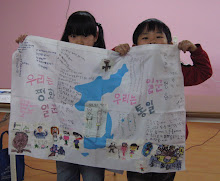
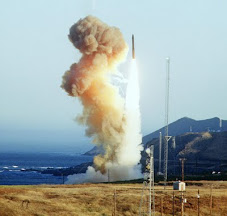
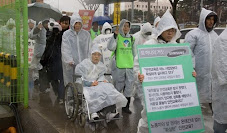
'저는 그들의 땅을 지키기 위하여 싸웠던 인디안들의 이야기를 기억합니다. 백인들이 그들의 신성한 숲에 도로를 만들기 위하여 나무들을 잘랐습니다. 매일밤 인디안들이 나가서 백인들이 만든 그 길을 해체하면 그 다음 날 백인들이 와서 도로를 다시 짓곤 했습니다. 한동안 그 것이 반복되었습니다. 그러던 어느날, 숲에서 가장 큰 나무가 백인들이 일할 동안 그들 머리 위로 떨어져 말과 마차들을 파괴하고 그들 중 몇몇을 죽였습니다. 그러자 백인들은 떠났고 결코 다시 오지 않았습니다….' (브루스 개그논)


For any updates on the struggle against the Jeju naval base, please go to savejejunow.org and facebook no naval base on Jeju. The facebook provides latest updates.
Showing posts with label Somalia. Show all posts

Tuesday, February 8, 2011

Text Fwd: One of four bullets from injured captain shot by S. Korean Navy: Coast Guard


Yonhap News
One of four bullets from injured captain shot by S. Korean Navy: Coast Guard
2011/02/07 17:19 KST

(3rd LD) One of four bullets from injured captain shot by S. Korean Navy: Coast Guard BUSAN/SEOUL, Feb. 7 (Yonahp) -- One of the four bullets removed from the injured South Korean captain of a chemical freighter hijacked by Somalis last month was shot by South Korean Navy commandos during their raid on the ship in the Arabian Sea, the South Korean Coast Guard said Monday, wrapping up a probe on five captured Somali pirates.

Seok Hae-kyun, the skipper of the 11,500-ton Samho Jewelry, who has drawn keen national attention since South Korean naval special forces stormed the ship on Jan. 21 to free it from Somali pirates, still remains in critical but stable condition due to his gunshot wounds.

Seeking to obtain evidence to prove the pirates' criminal charges, the Coast Guard has secured three bullets out of four taken from Seok's body and tentatively concluded that one of them was from either a pistol, MP5 9 mm machine gun or MP5 silencer gun used by the South Korean Navy, Coast Guard officials said, noting one bullet was lost in Oman, where Seok was initially hospitalized.

"One bullet is from an AK rifle used by the pirates, while the other is suspected of being debris from the ship that pierced Captain Seok's body due to the shells," chief investigator Kim Chung-gyu said, noting that the state forensic agency will produce the final result by next week. "We have not yet confirmed which bullet was shot into which part of Captain Seok's body."

Kim, however, ruled out the possibility of opening a separate investigation to identify the South Korean Navy commando who might have shot Seok, saying the incident took place while they were performing their "legitimate official duty" as part of the Jan. 21 pre-dawn rescue operation.
In Seoul, an official at the Joint Chiefs of Staff said Seok may have been shot by a stray bullet from one of the Navy commandos during the crossfire of the gun battle with the pirates.

"There is the possibility that the captain might have been hit by the stray bullet from one of Navy commandos during the gun battle, but we can confirm this only after a final forensic analysis is completed," the military official said.

The 58-year-old skipper underwent several surgeries, before and after arriving at Ajou University Hospital in Suwon, south of Seoul. He briefly recovered consciousness last Thursday but was put back on a respirator over the weekend. He has been suffering pneumonia and other lung problems but is showing growing signs of recovery as of Monday, according to hospital officials.


The special Coast Guard team said it has secured several pieces of evidence and testimonies to establish major charges against the five pirates, including maritime robbery, attempted murder, ship hijacking and obstruction of official duty.

Although Arai Mahomed, one of the pirates suspected of having shot Seok, is still denying the charges, two Korean crew members, two foreign crew members and two pirates told investigators that they saw him shoot the captain. The bullets from Seok's body and bullet traces from the floor of the ship's pilot house will be also used as corroborating evidence against the 23-year-old suspect, officials said.


After taking hostage the 21 sailors aboard the ship in mid-January, a team of 13 pirates stole 7 billion won (US$63 million) worth of freight and 27.5 million won of cash and goods from the crew, they noted. Eight others, including the pirates' leader and his second-in-command, were killed during the commando raid last month.

Under South Korean law, the pirates could be sentenced to at least five years in prison for hijacking the ship and life imprisonment or even death for firing at the captain from a close distance.

Investigators, however, said they have failed to find any evidence that the pirates deliberately pinpointed the Samho Jewelry as a target, saying that the pirates sailed for 23 days before they hijacked the freighter.

"The investigation has limitations, as the (pirates') leader who led the hijacking was killed, but it is unlikely that they targeted (the freighter) for kidnapping given various circumstances."

Suspicions had been raised that the pirates might have secured information on the Samho Jewelry's shipping route after learning that a South Korean supertanker owned by the same company was freed after the company paid a huge ransom. Last November, two dozen crew members of the 300,000-ton tanker, the Samho Dream, were released after being held hostage by Somali pirates for seven months. The company reportedly paid more than US$9 million in ransom.

The Coast Guard will send the case to the local prosecutors' office on Tuesday to officially press charges against the pirates in South Korea's first piracy trial, officials noted.

ejkim@yna.co.kr

Monday, January 31, 2011

Text Fwd: 5 Somali under investigation

* Image & caption source: Korea Times, Jan. 30, 2011
'Somali pirates Sunday enter the South Regional Headquarters of the Coast Guard in Namhae, South Gyeongsang Province, where an investigation team has been set up. They were taken into custody after a medical checkup./ Yonhap'
_________________________________________
The articles show South Korean racism and militarism seen through the arrest and investigation of Somalis...

Five Somali pirates arrested in S. Korean ship hijacking
2011/01/30 17:01 KST

Deny shooting ship's captain
By Kang Hyun-kyung

Five Somali pirates that have been brought to Seoul partly admitted their involvement in the hijacking of the 11,500-ton Samho Jewelry in the Arabian Sea on Jan. 15. But they denied shooting the ship’s captain, investigators said Sunday.

“We showed the pirates the ladder and speed boat that were used in hijacking the freighter. We asked them whether they used them, and they replied they did,” an official of the special investigation team led by the Korean Coast Guard was quoted as saying by Yonhap News Agency.

The development came hours after the team began questioning the pirates on charges of hijacking the chemical carrier, holding the crew hostage and shooting the captain Seok Hae-kyun.
The five men are reportedly cooperating with the probe but are adamantly denying the charges of shooting the captain.

Earlier, a Busan court approved the arrest of the pirates, who were captured during the recent rescue operation of the freighter in the Arabian Sea. The five were brought to the southern port city at 4:18 a.m. on a royal jet belonging to the United Arab Emirates.

The 58-year-old captain was seriously wounded and is currently receiving treatment at a hospital in Suwon, south of Seoul. The ship’s other 20 crewmembers were rescued unscathed, while the remaining eight Somali pirates were killed.

The pirates, whose ages range between 19 and 25, entered the court dressed in winter clothes wearing sneakers provided by the Korean Navy.

The names of the five Somali nationals are Serum Abdullah, Ali Abdullah, Ali Abukad-Aeman, Brallat Aul and Arai Mahomed, according to Yonhap.

Despite the beginning of Korea’s first prosecution of suspected Somali pirates, there was skepticism about penalizing them due to the complex legal process and language barrier.

If the five pirates are found to be guilty of the attempted murder of the captain, the hijacking and holding the 21 sailors hostage for ransom, the court could sentence them to life in prison.

Coast Guard investigators said they had already secured enough evidence, including seven Korean sailors’ statements and video clips capturing the entire military operation that can be used to prove the pirates’ guilt.

If the pirates are not cooperative, they plan to dispatch a team of investigators to Oman to question the Korean sailors aboard the chemical carrier to get further evidence. The latter are still aboard the Samho Jewelry as the Omani authorities will not let the ship dock as it still has the bodies of the eight dead pirates on board.

The language barrier is widely cited as a primary setback to the prosecution. The Coast Guard hired a Somali interpreter who can also speak English fluently and a local national to translate Korean into English, and vice versa to facilitate the investigation.

Experts pointed out that the consecutive interpretation during the investigation and trial may make it difficult for investigators to effectively interrogate the Somali men.

Under the U.N. Convention on the Law of the Sea, sovereign nations are entitled to seize and prosecute pirates. But many governments send the pirates to a third country such as Kenya because of difficulty in prosecuting them.

The nations that signed the agreements for bringing pirates to justice in the African nation on their behalf include the United States, United Kingdom, Canada, China and Denmark. These nations are committed to giving financial support to Kenya to cover the costs needed for the investigation and trial.

Last year, Kenya announced that it would no longer take on any more prosecution of pirates as some nations have failed to keep their word.

__________________________________
See also
Yonhap News
Five Somali pirates arrested in S. Korean ship hijacking
2011/01/30 17:01 KST
Five Somali pirates arrested in S. Korean ship hijacking

Tuesday, January 25, 2011

Text Fwd: Is There No Problem with Excessive Excitement over the Successful Operation to Neutralize the Somali Pirates?

ROK Navy, rescue operation of hostages were done this way. While concern about naval rescue operation heightened by the success of operation in saving sailors of the freighter Samho Jewelry, special combat personnel of the ROK armed forces are undergoing a maritime counter- terrorism training in the waters near ROK Navy 2nd Fleet Command in Gyeonggi Province on Saturday Jan 22, 2011. As the publicity concerning the operational success of the Korean Navy spread widely, it is also worried that Korean hostages may be killed by the Somali pirates. Indeed, The Somali pirates threatened to kill their captured Korean sailor hostages in an interview with the Reuters news agency. Photo by Yonhap News Caption by Seol Wontai
...................................................................................

Kyunghyang Shinmun
Is There No Problem with Excessive Excitement over the Successful Operation to Neutralize the Somali Pirates?
Posted on : 2011-01-24 12:58

Since the successful operation to rescue the sailors of the Samho Jewelry, the government and media have reported and publicized the event extensively.

Following President Lee Myung-bak's statement to the nation, where he said that he had ordered the rescue operation, broadcasters have devoted most of their news time to the story on a daily basis, while running special reports on the success of the operation.

That the sailors were rescued from the clutches of the pirates is something about which we, along with the rest of the nation, are of course glad. And we naturally congratulate the soldiers who risked their lives in the crackdown operation. We believe, however, that excessive reporting and publicity of the operation's success has several dangerous implications.

First of all, too much publicity may increase confidence in the use of military solutions, thereby narrowing the scope of choice and action when responding to similar events in future.

This success may prompt the rise of an adventurist way of thinking that holds that any situation can be resolved by military means. There is also a possibility that excessive praise for the operation may create an understanding that the problems with our military's capacity to maintain national security, which were revealed by the Cheonan and Yeonpyeong Island incidents, have to a considerable extent been solved.

The damage sustained by Korea during this operation is considerable. In the unsuccessful primary operation, three soldiers were injured. In the secondary operation, the captain of the chemical freighter the Samho Jewelry sustained a bullet wound from a pirate in his abdomen and is now in a serious condition.

Nonetheless, broadcasters continue to focus on singing the praises of a bold and elaborate operation, without addressing the dangers of a military operation in a balanced way.

Furthermore, they are introducing the weapon systems and circumstances of the operation as if the whole thing were a scene from a film. Some are pointing out that this exposure of weapon systems and operational concepts has made subsequent operations more difficult.

Such extensive publicity and reporting are enough to give rise to suspicions that they hide a different background. In other words, the Lee Myung-bak government sees this as a golden opportunity to restore its image, which was damaged by the Cheonan and Yeonpyeong Island shelling incidents, and has set out to publicize it more than necessary.

Solid national security and protecting the lives of the people is something that can never be achieved through publicity or rhetoric. An EU navy spokesman said, "the Korean navy rescued the sailors safely through its commando operation, but such an operation can place sailors in even greater danger and we will therefore not be carrying out a similar one."

This means not that the EU lacks operational capability, but that damage to human life during an operation brings greater political burdens. Another Korean ship, the FV Golden Wave, has still not been released since its capture by Somali pirates.

The government and news media must not forget that the excessive festival atmosphere regarding the success of the operation may impair our ability to take cool-headed decisions when it comes to the use of military force. (Ed. Jan 24, 2011)

__________________________________

See also


Jan. 24, 2011
Korea willing to swap pirates with hostages

Saturday, January 22, 2011

Text Fwd: S. Korean Commandos Prove "Toughness" By Killing Eight In Horn Of Africa

* Image source: Yonhap News, Jan. 21, 2011
Yonhap News, Jan. 21, 2011

* Image and caption: Yonhap News, Jan. 21, 2011
Lt. Gen. Lee Seong-ho speaks to reporters during a press conference in Seoul on Jan. 21. (Yonhap)

* Image & caption source: same as the above link
'South Korean special forces on the deck of the Samho Jewelry during a rescue operation on Jan. 21. (Yonhap) '
______________________________________________
* Text sent from Rick Rozoff on Jan. 22, 2011

Agence France-Presse
January 21, 2011
S. Korea Navy Kills Somali Pirates, Saves Crew
By PARK CHAN-KYONG

SEOUL: South Korean navy commandos on Jan. 21 stormed a ship hijacked by Somali pirates in the Indian Ocean, rescuing all the 21 crew and killing eight pirates, military officials said.

The SEAL special forces boarded the South Korean ship before dawn, freeing all the hostages and killing the pirates in cabin-to-cabin battles, they said.

"This operation demonstrated our government's strong will that we won't tolerate illegal activities by pirates any more," Lt. Gen. Lee Sung-Ho of the Joint Chiefs of Staff told a news briefing.
....
The rescue about 1,300 kilometers (800 miles) off northeast Somalia was seen as a major morale boost for the South's military. It has faced strong domestic criticism for a perceived weak response to North Korea's shelling of a border island last November.

President Lee Myung-Bak, who authorized the operation, said the military carried out the raid perfectly under difficult circumstances.

"We will not tolerate any activities that threaten the safety and lives of our people," he said.

The pirates seized the 11,500-ton ship and 21 crew members - eight South Koreans, two Indonesians and 11 from Myanmar - on Jan. 15 in the Arabian Sea when it was en route to Sri Lanka from the United Arab Emirates.

Seoul ordered a destroyer on patrol in the Gulf of Aden to give chase, and Lee ordered "all possible measures" to save the crew.

General Lee said the commandos moved in after receiving information that the "mother ship" for the pirates was leaving a Somali port.
....
To distract the pirates' attention, the destroyer fired warning shots and maneuvered close to the hijacked vessel. A Lynx helicopter provided covering fire as the commandos stormed the ship.

The Koreans were assisted by a U.S. carrier, which also provided a helicopter to transfer the wounded Korean skipper.

The military said the Jan. 21 rescue followed a brief gunbattle Jan. 18, when the destroyer encountered pirates who had apparently left the South Korean freighter to try to seize a nearby Mongolian vessel.

The South Korean commandos aboard a speedboat and a Lynx helicopter were dispatched to rescue the Mongolian ship.

That firefight left several pirates missing and thought killed, although their bodies have not been found, a JCS spokesmen said. Three commandos were slightly hurt.

Foreign Minister Kim Sung-Hwan broke the news at a New Year's reception Jan. 21 for the heads of foreign diplomatic missions in Seoul, bringing applause and cheers from the ambassadors, a foreign ministry official said.

The captured five pirates could be brought to South Korea or third countries for punishment, he said.
....
In 2008 the French military became the first to respond militarily to piracy in the region, when marines raided the yacht Carre d'As and freed two hostages being held by seven Somali pirates. One pirate was killed and the other six captured.
....


____________________________________


* See also


S. Korean Navy frees hijacked cargo ship, kills 8 Somali pirates


Jan. 21, 2011

Yonhap News
Lee praises Korean troops for 'perfect' raid on Somali pirates
2011/01/21 16:33 KST
By Lee Chi-dong

Yonhap News
Timeline of rescue operation on hijacked South Korean ship
2011/01/21 15:28 KST

Monday, October 18, 2010

Text Fwd: S. Korean fishing boat hijacked by Somali pirates near Kenya 남한 어선, 케냐 근처에서 피랍

Yonhap News
S. Korean fishing boat hijacked by Somali pirates near Kenya

Oct. 17, 2010

SEOUL/NAIROBI, Oct. 17 (Yonhap) -- A South Korean fishing boat has been hijacked by Somali pirates in Kenyan waters, the foreign ministry here said Sunday.

The ministry said the 241-ton trawler "Keummi 305," with two South Koreans, two Chinese and 39 Kenyans aboard, was hijacked on Oct. 9 by the pirates while fishing in waters about 10 miles off Lamu, Kenya, near the Indian Ocean.

A South Korean citizen living in the Kenyan port city of Mombasa told Yonhap News Agency that the boat had been in the area for about a month and was taken to Harardhere, the base for pirates north of Mogadishu, the capital of Somalia.

"Given past instances, it would put the hostages in even more danger if the government tried to negotiate directly with the pirates," a ministry official said. "We're trying to find out more about the incident using all possible channels."

One of the South Koreans aboard was a 54-year-old captain surnamed Kim. He is the president of Keummi Fishers based in the southern port city of Busan.

Officials at the boat dealership for Keummi said the fisheries company shut down its Busan office in 2007 due to financial problems, and Kim had been steering the ship himself for two years to save costs.

"We haven't heard from the pirates yet," one dealership official said. "It could take up to four days to reach their base (from where the ship was hijacked) and we expect to be contacted soon."

The Keummi 305 had been fishing in waters considered safe from pirates since the area was more than 400 kilometers away from the pirates' base and the Kenyan navy sent regular patrols.

Since 2006, there were six hijackings of South Korean boats or vessels by Somali pirates. Most recently, a supertanker, Samho Dream, with five South Koreans and 19 Filipinos aboard, was seized in April this year in the Indian Ocean. The ship remains in captivity.

jeeho@yna.co.kr

Wednesday, June 9, 2010

Text Fwd: U.S. 'secret war' expands globally as Special Operations forces take larger role

*Corazon Valdez Fabros informed the text.

Washington Post
U.S. 'secret war' expands globally as Special Operations forces take larger role
By Karen DeYoung and Greg Jaffe
Washington Post Staff Writer
Friday, June 4, 2010; A01

Beneath its commitment to soft-spoken diplomacy and beyond the combat zones of Afghanistan and Iraq, the Obama administration has significantly expanded a largely secret U.S. war against al-Qaeda and other radical groups, according to senior military and administration officials.

Special Operations forces have grown both in number and budget, and are deployed in 75 countries, compared with about 60 at the beginning of last year. In addition to units that have spent years in the Philippines and Colombia, teams are operating in Yemen and elsewhere in the Middle East, Africa and Central Asia.

Commanders are developing plans for increasing the use of such forces in Somalia, where a Special Operations raid last year killed the alleged head of al-Qaeda in East Africa. Plans exist for preemptive or retaliatory strikes in numerous places around the world, meant to be put into action when a plot has been identified, or after an attack linked to a specific group.

The surge in Special Operations deployments, along with intensified CIA drone attacks in western Pakistan, is the other side of the national security doctrine of global engagement and domestic values President Obama released last week.

One advantage of using "secret" forces for such missions is that they rarely discuss their operations in public. For a Democratic president such as Obama, who is criticized from either side of the political spectrum for too much or too little aggression, the unacknowledged CIA drone attacks in Pakistan, along with unilateral U.S. raids in Somalia and joint operations in Yemen, provide politically useful tools.

Obama, one senior military official said, has allowed "things that the previous administration did not."

'More access'

Special Operations commanders have also become a far more regular presence at the White House than they were under George W. Bush's administration, when most briefings on potential future operations were run through the Pentagon chain of command and were conducted by the defense secretary or the chairman of the Joint Chiefs of Staff.

"We have a lot more access," a second military official said. "They are talking publicly much less but they are acting more. They are willing to get aggressive much more quickly."

The White House, he said, is "asking for ideas and plans . . . calling us in and saying, 'Tell me what you can do. Tell me how you do these things.' "

The Special Operations capabilities requested by the White House go beyond unilateral strikes and include the training of local counterterrorism forces and joint operations with them. In Yemen, for example, "we are doing all three," the official said. Officials who spoke about the increased operations were not authorized to discuss them on the record.

The clearest public description of the secret-war aspects of the doctrine came from White House counterterrorism director John O. Brennan. He said last week that the United States "will not merely respond after the fact" of a terrorist attack but will "take the fight to al-Qaeda and its extremist affiliates whether they plot and train in Afghanistan, Pakistan, Yemen, Somalia and beyond."

That rhetoric is not much different than Bush's pledge to "take the battle to the enemy . . . and confront the worst threats before they emerge." The elite Special Operations units, drawn from all four branches of the armed forces, became a frontline counterterrorism weapon for the United States after the Sept. 11, 2001, attacks.

But Obama has made such forces a far more integrated part of his global security strategy. He has asked for a 5.7 percent increase in the Special Operations budget for fiscal 2011, for a total of $6.3 billion, plus an additional $3.5 billion in 2010 contingency funding.

Bush-era clashes between the Defense and State departments over Special Operations deployments have all but ceased. Former defense secretary Donald H. Rumsfeld saw them as an independent force, approving in some countries Special Operations intelligence-gathering missions that were so secret that the U.S. ambassador was not told they were underway. But the close relationship between Defense Secretary Robert M. Gates and Secretary of State Hillary Rodham Clinton is said to have smoothed out the process.

"In some places, we are quite obvious in our presence," Adm. Eric T. Olson, head of the Special Operations Command, said in a speech. "In some places, in deference to host-country sensitivities, we are lower in profile. In every place, Special Operations forces activities are coordinated with the U.S. ambassador and are under the operational control of the four-star regional commander."

Chains of command

Gen. David H. Petraeus at the Central Command and others were ordered by the Joint Staff under Bush to develop plans to use Special Operations forces for intelligence collection and other counterterrorism efforts, and were given the authority to issue direct orders to them. But those orders were formalized only last year, including in a CENTCOM directive outlining operations throughout South Asia, the Horn of Africa and the Middle East.

The order, whose existence was first reported by the New York Times, includes intelligence collection in Iran, although it is unclear whether Special Operations forces are active there.

The Tampa-based Special Operations Command is not entirely happy with its subordination to regional commanders and, in Afghanistan and Iraq, to theater commanders. Special Operations troops within Afghanistan had their own chain of command until early this year, when they were brought under the unified direction of the overall U.S. and NATO commander there, Gen. Stanley A. McChrystal, and his operational deputy, Lt. Gen. David M. Rodriguez.

"Everybody working in CENTCOM works for Dave Petraeus," a military official said. "Our issue is that we believe our theater forces should be under a Special Operations theater commander, instead of . . . Rodriguez, who is a conventional [forces] guy who doesn't know how to do what we do."

Special Operations troops train for years in foreign cultures and language, and consider themselves a breed apart from what they call "general purpose forces." Special Operations troops sometimes bridle at ambassadorial authority to "control who comes in and out of their country," the official said. Operations have also been hindered in Pakistan -- where Special Operations trainers hope to nearly triple their current deployment to 300 -- by that government's delay in issuing the visas.

Although pleased with their expanded numbers and funding, Special Operations commanders would like to devote more of their force to global missions outside war zones. Of about 13,000 Special Operations forces deployed overseas, about 9,000 are evenly divided between Iraq and Afghanistan.

"Eighty percent of our investment is now in resolving current conflicts, not in building capabilities with partners to avoid future ones," one official said.

Questions remain

The force has also chafed at the cumbersome process under which the president or his designee, usually Gates, must authorize its use of lethal force outside war zones. Although the CIA has the authority to designate targets and launch lethal missiles in Pakistan's western tribal areas, attacks such as last year's in Somalia and Yemen require civilian approval.

The United Nations, in a report this week, questioned the administration's authority under international law to conduct such raids, particularly when they kill innocent civilians. One possible legal justification -- the permission of the country in question -- is complicated in places such as Pakistan and Yemen, where the governments privately agree but do not publicly acknowledge approving the attacks.

Former Bush officials, still smarting from accusations that their administration overextended the president's authority to conduct lethal activities around the world at will, have asked similar questions. "While they seem to be expanding their operations both in terms of extraterritoriality and aggressiveness, they are contracting the legal authority upon which those expanding actions are based," said John B. Bellinger III, a senior legal adviser in both of Bush's administrations.

The Obama administration has rejected the constitutional executive authority claimed by Bush and has based its lethal operations on the authority Congress gave the president in 2001 to use "all necessary and appropriate force against those nations, organizations, or persons" he determines "planned, authorized, committed, or aided" the Sept. 11 attacks.

Many of those currently being targeted, Bellinger said, "particularly in places outside Afghanistan," had nothing to do with the 2001 attacks.

Friday, April 30, 2010

Text Fw: Japan's First Overseas Base Aims At Expanding Military Boundaries

* Text informed by Stop NATO on April 29, 2010

Xinhua News Agency
April 28, 2010
Japan's first overseas base aimed at expanding military boundaries
Yu Zhixiao

BEIJING: Japan is building its first overseas military base in Africa's Djibouti
on the Gulf of Aden in an attempt to probe what waters its military can legally
reach farthest, analysts say.

In the name of better combating notorious Somali pirates, Japan is busy setting
up a 40-million-U.S.-dollar military base, which is expected to be completed
early next year.

Currently, some 150 Japanese soldiers battling piracy are stationed in a U.S.
base in Djibouti, which is at the southern end of the Red Sea.

The Japanese authorities say some 2,000 Japanese vessels, accounting for 10
percent of the world total, sail through the Gulf of Aden each year. Some 90
percent of Japanese exports rely on the crucial sea lane, which has been overrun
by rampant piracy.

On occasion, Japanese vessels have been hijacked by pirates.

The Japanese base, undeniably, would add momentum to the country's anti-piracy
efforts in the region.

But observers say that by establishing the base, the Japanese government is also
exploring how far it can go in increasing its military clout in the world.

According to the Peace Constitution ratified in 1947 after World War II, Japan,
to abstain from waging war, couldn't have a standing army and its warships
couldn't operate overseas.

But in October 2001, soon after the Sept. 11 terrorist attacks, Japanese
lawmakers approved the Anti-Terrorism Special Measures Law, which allowed the
dispatch of Japanese warships and soldiers overseas.

Moreover, in July 2009, Japanese lawmakers passed the Anti-Piracy Law, which
provided Japanese self-defense forces with more mobility to use military power.
It also stipulated that the Japanese prime minister could send troops overseas
to conduct "anti-piracy" operations without approval of the parliament.

The base in Djibouti is Japan's latest effort to increase its military influence
in the world, analysts say.

Many countries are watching closely, and hope the base can play a constructive
role in cracking down on Somali pirates and contribute to regional peace and
stability.
===========================
Stop NATO
Blog site

Wednesday, April 28, 2010

Text Fw: South Korea Takes Over U.S.-Led Horn Of Africa Warship Group

* Text informed by STOP NATO on April 26, 2010

Stars and Stripes
April 27, 2010
South Korea takes Task Force 151 helm


The South Korean navy has assumed command of Combined Task Force 151, the international group of military personnel conducting counterpiracy operations off the eastern coast of Somalia and in the Gulf of ALinkden, officials stated in a news release.

Rear Adm. Boem-rim Lee took command Wednesday. He replaces Rear Adm. Bernard Miranda, of the Singapore navy, who commanded the task force since January, according to a Combined Maritime Forces news release.

The U.S. Navy created the task force in January 2009 to counter piracy of commercial vessels and fishing boats in the regional waters.

The European Union and NATO operate similar maritime patrols in the region, as do nations that deploy ships independent of the task forces, including China, India, Japan and Russia.
===========================
Stop NATO

Blog site:

Text Fw: Japanese Military Joins U.S. And NATO In Horn Of Africa

Japanese Military Joins U.S. And NATO In Horn Of Africa
Rick Rozoff
April 25, 2010

Link
Japanese navy commander Keizo Kitagawa recently spoke with Agence France-Presse and disclosed that his nation was opening its first overseas military base – at any rate since the Second World War – in Djibouti in the Horn of Africa.

Kitagawa is assigned to the Plans and Policy Section of the Japan Maritime Self-Defense Force, as his nation’s navy is called, and is in charge of the deployment.

AFP quoted the Japanese officer as stressing the unprecedented nature of the development: “This will be the only Japanese base outside our country and the first in Africa.” [1]

The military installation is to cost $40 million and is expected to accommodate Japanese troops early next year.

Djibouti rests at the confluence of the Red Sea and the Gulf of Aden, across from strife-torn Yemen, and borders the northwest corner of equally conflict-ridden Somalia. The narrow span of water separating it from Yemen is the gateway for all maritime traffic passing between the Mediterranean Sea and the Indian Ocean via the Suez Canal, the Red Sea, the Gulf of Aden and the Arabian Sea.

Naval deployments to the Gulf of Aden by several major nations and alliances – the U.S., NATO, the European Union, China, Russia, India, Iran and others – are designed to insure the free passage of commercial vessels through the above route and to protect United Nations World Food Programme deliveries to Somalia. The second concern in particular led to the passage of United Nations Security Council Resolution 1838 in 2008, which requests that nations with military vessels in the area suppress the capture of ships and their crews for ransom. An anti-piracy mission.

However, the above-mentioned Japanese naval officer was more direct in identifying his nation’s interest in establishing a military base in Africa. Kitagawa also told AFP that “We are deploying here to fight piracy and for our self-defence. Japan is a maritime nation and the increase in piracy in the Gulf of Aden through which 20,000 vessels sail every year is worrying.”

The term self-defense is not fortuitous. Article 9 of the 1947 Japanese Constitution explicitly affirms that “the Japanese people forever renounce war as a sovereign right of the nation and the threat or use of force as means of settling international disputes. To accomplish the aim of the preceding paragraph, land, sea, and air forces, as well as other war potential, will never be maintained. The right of belligerency of the state will not be recognized.”

As such, in the post-World War Two period the nation’s armed forces have been called the Japan Self-Defense Forces (JSDF).

The Constitution also expressly prohibits the deployment of military forces outside of Japan, stating that it is “not permissible constitutionally to dispatch armed troops to foreign territorial land, sea and airspace for the purpose of using military power, as a so-called overseas deployment of troops, since it generally exceeds the minimum level necessary for self-defense.”

For MORE READING

Monday, April 5, 2010

Text Fw: Destroyer Dispatched to Stop Somali Hijackers

* Image source: MBC
The red square is the spot that the ship, 'Samho Dream' was kidnapped by the 'believed' pirates.
The South Korean Navy's Cheonghae Unit, comprised of the Yi Sun-shin, the KDX II destroyer, will be dispatched
from the port of
Salalah (yellow circle), Oman.

Korea Times
Destroyer Dispatched to Stop Somali Hijackers
By Jung Sung-ki
Staff Reporter

South Korea has dispatched a 4,300 ton destroyer engaged in anti-piracy patrols in waters off Somalia to intercept pirates who seized a South Korean oil tanker Sunday, the Joint Chiefs of Staff said Monday.

The 300,000-ton Samho Dream, carrying $170 million worth of crude oil, was hijacked on its way to the United States from Iraq, and its crew of five South Koreans and 19 Filipinos was taken hostage.

The Ministry of Foreign Affairs and Trade said the pirates have made no contact yet concerning the hijacking.

``We believe the ship has been seized by Somali pirates, based on the details of our last communication with the ship,'' a ministry officials told reporters.

The Seoul government is dealing with the situation, putting top priority on the lives and safety of the crewmembers, but it won't be engaged in any direct negotiation with the pirates for the safe release of the ship and its sailors, the official said.

The South Korean Navy's Cheonghae Unit is comprised of the Yi Sun-shin, a Chungmugong-class KDX-II destroyer.

The destroyer is equipped with an Mk 45 127mm gun, Harpoon ship-to-surface missiles, RAM Mk 31 ship-to-air guided missiles and a 30mm Goalkeeper system for engaging sea-skimming anti-ship missiles and torpedoes. The 150-meter-long, 17-meter-wide ship has a top speed of 29 knots.

Since its deployment in March last year, the unit has successfully escorted domestic and foreign cargo ships through the troubled waters and thwarted attempts by pirates to hijack ships.

The destroyer also has a Lynx anti-submarine helicopter and a group of 30 UDT/SEAL forces onboard.

Increasingly brazen pirate activity and hefty ransoms have driven up insurance costs and forced some ships to go around South Africa instead of through the Suez Canal.
gallantjung@koreatimes.co.kr

_________________________________________________________________
* Related article

Korea Times
Korean Oil Tanker Hijacked by Somali Pirates
04-05-2010 08:44
_________________________________________________________________
* Reference blog

http://nobasestorieskorea.blogspot.com/2010/02/text-fwd-yemen-and-militarization-of.html
Wednesday, February 10, 2010
[국 문 번역] Text Fwd: Yemen and The Militarization of Strategic Waterways
예멘과 전략적 물길들의 군사화

Saturday, January 2, 2010

Text Fwd: COURAGE TO END TOTAL WAR


* Image source: same as the blog below

Bruce Gagnon blog on Jan. 1, 2009
COURAGE TO END TOTAL WAR

It’s a brilliant strategy if you think about it. Make the public afraid of each other. Every person could be a terrorist - everyone is suspect. There is no better way to defeat an organized anti-war opposition than to make the people terrified of each other.

The corporate oligarchy is now doing under Obama what it could not accomplish under Bush. Total war. The anti-Bush movement in the US and worldwide was gaining too much ground. So the oligarchy let the air out of that balloon. In Bush’s place they put in a magician who has proved very effective at keeping the left off balance and thus unable to pump new life into the reeling anti-war movement.

So now it’s Iraq, Afghanistan and Pakistan. Somalia and Yemen. Next could be Turkmenistan, Uzbekistan, Tajikistan, and Kyrgyzstan. National Public Radio (NPR) reporter Tom Gjelten did a story called “Afghan War Could Spill Over Into Central Asia” on December 31 that upped the fear meter and brought back the Vietnam-war era worry of the “domino theory”. You must watch the slight of hand ….the modus operandi in action again.

Bush, or John McCain for that matter, would have been resisted at every step of this new escalation. But many “progressives” are frozen into place by the handiwork of the magician and a deferential Congress under the control of the other war party. The “execution” of this masterstroke has worked as well as the insides of an expensive Swiss watch.

The oil and military industrial oligarchy have created a situation where the public is so primed for fear by the slavish media that they are ready to strip their constitutional rights down to the bare bone in order to be “protected” by big daddy.

Few are asking the legitimate question of why people are fighting against the US around the world? What are they upset about? Could it possibly be that we are increasingly occupying their lands and grabbing their natural resources? Does it take a rocket scientist to see this? All the talk about our troops protecting our freedoms overseas is pure bloviation.

In the end this total war plan is destroying our economy at home. More than 40 states are now in fiscal crisis. Here in Maine public education is being eviscerated and social programs are next on the block to have their heads removed. But teachers or workers inside of the social service agencies are unwilling to raise their voices and say the obvious – bring our war $$ home so we can maintain social progress. They have been made job scared. Instead, they call for more taxes that an already belabored public rejects out of hand, and they are dismissed as socialists. Thus those trying to preserve domestic tranquility get marginalized. Meanwhile, few are willing to make the connections and speak the truth about the very real, local consequences of endless war.

So as Obama’s total war rages overseas it is also being waged on us here at home. Except, because they have us focused 24-7 on the antics of a hapless airplane bomber, we are taking our eyes off the ball that is being ripped right out of our hands. That is the value of Obama, the magician.

We have sadly become slaves, chained to wars, as we watch our very social fabric torn apart. But we remain silent, as we have been programmed to do. And still, in the midst of all that, we boast about our great freedoms here at home as we strip down to our underpants at the airline security check-in.

There is a way out but it takes courage. The courage to speak up, to defend our constitution, to defend social progress, to defend the future generations. Real courage is needed to call for an end to total war.

posted by Bruce Gagnon | 11:11 AM
___________________________________________________________________
2 Comments:

Blogger BuelahMan said...

Bruce,

You forgot one corner of the world that our military presence is ever expanding: S America (specifically in Columbia's 7 new bases).

It MUST include S America to be full spectrum.
1/1/10 12:10 PM

Blogger Bruce Gagnon said...

Right, thank you for pointing out that serious omission
1/1/10 12:13 PM


Friday, January 1, 2010

Text Fwd: 2010: U.S. To Wage War Throughout The World

Rick Rozoff (also in)Stop NATO
2010: U.S. To Wage War Throughout The World
December 31, 2009
Rick Rozoff

January 1 will usher in the last year of the first decade of a new millennium and ten consecutive years of the United States conducting war in the Greater Middle East.

Beginning with the October 7, 2001 missile and bomb attacks on Afghanistan, American combat operations abroad have not ceased for a year, a month, a week or a day in the 21st century.

The Afghan war, the U.S.'s first air and ground conflict in Asia since the disastrous wars in Vietnam and Cambodia in the 1960s and early 1970s and the North Atlantic Treaty Organization's first land war and Asian campaign, began during the end of the 2001 war in Macedonia launched from NATO-occupied Kosovo, one in which the role of U.S. military personnel is still to be properly exposed [1] and addressed and which led to the displacement of almost 10 percent of the nation's population.

In the first case Washington invaded a nation in the name of combating terrorism; in the second it abetted cross-border terrorism. Similarly, in 1991 the U.S. and its Western allies attacked Iraqi forces in Kuwait and launched devastating and deadly cruise missile attacks and bombing sorties inside Iraq in the name of preserving the national sovereignty and territorial integrity of Kuwait, and in 1999 waged a 78-day bombing assault against Yugoslavia to override and fatally undermine the principles of territorial integrity and national sovereignty in the name of the casus belli of the day, so-called humanitarian intervention.

Two years later humanitarian war, as abhorrent an oxymoron as the world has ever witnessed, gave way to the global war on terror(ism), with the U.S. and its NATO allies again reversing course but continuing to wage wars of aggression and "wars of opportunity" as they saw fit, contradictions and logic, precedents and international law notwithstanding.

Several never fully acknowledged counterinsurgency campaigns, some ongoing - Colombia - and some new - Yemen - later, the U.S. invaded Iraq in March of 2003 with a "coalition of the willing" comprised mainly of Eastern European NATO candidate nations (now almost all full members of the world's only military bloc as a result of their service).

READ MORE

Wednesday, December 30, 2009

Text Fwd: Mission of Korean Anti-Piracy Forces Off Somalia Extended

Korea Times
12-29-2009 19:34
Mission of Korean Anti-Piracy Forces Off Somalia Extended
Jung Sung-ki, Staff Reporter

The National Assembly passed a motion Tuesday to extend the mission of the Navy's anti-piracy Cheonghae Unit, which is in waters off Somalia, until the end of next year.

Since its deployment in March, the 300-strong unit has successfully escorted more than 300 domestic and foreign cargo ships through the troubled waters and thwarted nine attempts by pirates to hijack ships.

The contingent consists of a 4,500-ton KDX-II destroyer, a Lynx anti-submarine helicopter and a group of 30 UDT/SEAL forces.

Last month, a third contingent left for the Somali littorals as part of a four-month rotation.

The KDX-II destroyer is equipped with an Mk 45 127mm gun, harpoon ship-to-surface missiles, RAM Mk 31 ship-to-air guided missiles, and a 30mm Goalkeeper system for engaging sea-skimming anti-ship missiles and torpedoes. Built in 2003, the 150-meter-long, 17-meter-wide ship has a top speed of 29 knots. Located along the route of a crude-oil pipeline connecting the Red Sea to the Indian Ocean and racked by civil war, Somalia has become infamous for piracy.

Each year, about 20,000 ships sail through the Gulf of Aden headed for the Suez Canal, an important shipping route for international trade that links Europe to the Middle East and Asia. The International Maritime Organization counted 111 attacks in 2008 in waters near Somalia, the most notorious location for piracy in the world.

gallantjung@koreatimes.co.kr

Wednesday, December 2, 2009

Text Fwd: Military Slamed for Neglecting Soldiers' Welfare


* Image source: same as the article below

Korea Times
[Exclusive] Military Slamed for Neglecting Soldiers' Welfare
By Jung Sung-ki
Staff Reporter
Dec. 2, 2009

The military is under fire for turning its back on requirements for the safety and welfare of soldiers in the field.

A case in point is the upgrade plan of K1A1 battle tanks. In 2007, the Joint Chiefs of Staff (JCS), the Army and the developer of the tank, Hyundai Rotem, consulted one another about the requirements for the K1A1 upgrade.

Several upgrade items were decided on at that time with a focus on equipping the tank with the C4I network-centric battlefield management systems. The modification work is scheduled to start in 2012 after the production of the K1A1s has been completed.

Ignoring a suggestion by the Army and Hyundai Rotem, however, the JCS excluded the installation of an air conditioning system in the tank from the list of upgrade requirements, according to a military source.

``The military has come up with an ambitious catch phrase of developing advanced and digitalized armed forces. But the mindset of decision-makers in the military has rarely changed and appears to remain in the older, analog era,'' the source said.

The rationale behind the JCS's decision was that ``an air conditioning system doesn't affect field operations much, and soldiers can and should overcome such a difficulty in the field,'' the source said on condition of anonymity.

Critics say such an argument is anachronistic and contradictory to the military's pursuit of improving the welfare of soldiers.

The soldiers have also begun to complain about JCS's negligence.

``In the summer, it's quite tough to conduct a field exercise inside a battle tank. Tank operators sometimes suffer heat exhaustion and may suffer heat stroke on extremely hot days,'' a sergeant at a mechanized division in Gyeonggi Province told The Korea Times.

``If the military plans to spend money for upgrading the K1A1 tank to an up-to-date one, why doesn't it consider installing the air conditioning system? The military leadership should understand what soldiers in the field really want, not just speaking of military modernization.''

Most high-end tanks in operation around the world, including the M1A1 tank used by the U.S. Forces Korea, are equipped with the air conditioning system, a basic operational requirement. The indigenous K2 Black Panther main battle tank, which will begin service in the coming years, will also have the system.

Hyundai Rotem is worried that the lack of an air conditioning system might negatively affect exporting the K1A1 to Southeast Asia and other nations in warmer regions.

During the Seoul International Aerospace and Defense Exhibition (ADEX) 2009 held in October, delegates from Thailand, Malaysia and Saudi Arabia showed keen interest in the K1A1 upgrade plans and the K2 tank, according to officials at the Defense Acquisition Program Administration (DAPA).

Against that backdrop, Hyundai has already invested in developing an air conditioning system for the K1A1, without budget support from the military.

``We're developing an air conditioning system for the K1A1 and hope that the JCS and DAPA will review the plan positively in terms of the welfare of soldiers as well as the tank's future exports,'' a Hyundai official said, requesting to remain anonymous.

Earlier this year, the JCS was under fire for neglecting the safety of sailors operating in waters off the piracy-ridden Somalia coast. Even after receiving a warning about the possibility that Somali pirates could acquire surface-to-air guided missiles, the JCS didn't' take any measure to protect its sailors there, nor did they install missile protection equipment in a destroyer's Lynx helicopter.

Almost all navies deployed to the Somali waters are operating maritime helicopters equipped with flare launchers, infrared guided missile countermeasure devices and radar warning receivers.

The JCS at that time promised it would come up with countermeasures to cope with any potential threat but has failed to deliver on its promise since then. The only measure it took was to supply 25-kilometer-range marine binoculars for spotters in the helicopter of the Cheonghae unit.

Intelligence authorities said Somalia's pirates were presumed to have obtained Stinger shoulder-launched anti-aircraft missiles from al-Qaeda. The Stinger missile can hit targets flying as high as 3,500 meters at a speed of Mach 2. It has a range of 8 kilometers.

The Somali pirates also run sophisticated operations using high-tech equipment such as satellite phones, rocket-propelled grenade (RPG) launchers and GPS receivers. They are also known to have acquired Soviet-era anti-aircraft missiles such as the SA-7 and SA-18.

leeth@koreatimes.co.kr


Wednesday, November 25, 2009

Text Fwd: Aside From Afghanistan: NATO Discusses Global Missions

Stop NATO

Associated Press
Nov. 24, 2009
NATO holds talks on global missions, except Afghanistan
Associated Press
November 24, 2009

BRUSSELS, Belgium — NATO military officials are pledging forces for the
alliance's global military missions, except the war in Afghanistan which is
still awaiting President Barack Obama's decision on whether to commit new
troops.

NATO spokesman Col. Greg Julian says Tuesday's staff-level meeting will focus on
generating contributions for NATO's force in Kosovo, its anti-piracy patrols off
Somalia, a naval mission in the Mediterranean, and the alliance's various
headquarters.

A special meeting on Afghanistan has tentatively been scheduled for Dec. 7 after
Obama's expected announcement and a meeting of NATO foreign ministers.

The alliance holds regular annual conferences where allies pledge troops,
equipment and other resources to fulfil the requirements of NATO missions
abroad.
===========================
Stop NATO


* Related article

StopNATO
NATO Sets December 7 Meeting To Increase Afghan War Troops
VERTEX News
November 24, 2009

Monday, October 5, 2009

Photo Fwd: Anti-piracy operations?


Image source/ caption: Korea Times, Oct. 4, 2009

'Anti-piracy operations: South Korean, left, and Japanese naval officers exchange views on operations to capture pirates on a Korean ship in waters off Somalia, Friday. Korea’s Cheonghae unit, including a 4,500-ton destroyer and an anti-submarine Lynx helicopter, began operations last April to escort the country’s commercial vessels in the piracy-ridden African region.

/ Courtesy of Joint Chiefs of Staff'

Thursday, October 1, 2009

Text Fwd: Lee Touts Global Role of Military

* Image Source/ Caption: Yonhap News
'Lee attends Armed Forces Day ceremony
Oct. 1, GYERYONG, South Korea -- President Lee Myung-bak (R) reviews troops during a celebration marking the 61st anniversary of the South Korean armed forces at Gyeryongdae military compound, some 165km south of Seoul, on Oct. 1. (Yonhap)'


Korea Times
0-01-2009 18:15
Lee Touts Global Role of Military
By Jung Sung-ki
Staff Reporter

President Lee Myung-bak pledged Thursday to further increase the South Korean military's global role and missions to respond to new types of threats and match the country's economic power.

Lee called for building a ``highly efficient and multifunctional'' military to support his government's ``Global Korea'' policy.

``Our military should not neglect efforts to cope with the world's fast changing security environment,'' the President said in a speech at a ceremony to mark the 61st anniversary of the founding of the nation's armed forces. The ceremony took place at the Gyeryongdae military compound in South Chungcheong Province, attended by some 3,200 incumbent and former military leaders, war veterans and citizens.

``North Korea's threat is becoming more diverse, and new global threats, such as terror and piracy on the open seas, are on the rise. And the international community's expectations for our country and military has also increased,'' Lee said.

To satisfy these needs, he added, South Korea's military should be developed and overhauled further to become an advanced military capable of playing diverse roles at home and abroad.

Lee referred to Seoul's hosting of the G20 summit next year as an example of the country's ever-upgraded global status.

``The hosting of the G20 summit reflects that South Korea now stands in the center of the global stage beyond the Asian region,'' he stressed.

South Korea has dispatched thousands of troops to Iraq, Afghanistan and other regions as part of a coalition of peacekeeping member states.

Currently, about 350 troops are stationed in Lebanon as part of United Nations forces there. Hundreds of other naval seamen are also conducting anti-piracy operations off the coast of Somalia.

The President reaffirmed a stronger posture against North Korea, which has been constantly developing its asymmetrical military capability.

``I want to make it clear that our values and principles (of the security on the peninsula) will remain unchanged despite the need for dialogue with the North,'' he said. ``Our military should not be swayed by any outside factors. When our military readiness is firm, the chance for inter-Korean dialogue and peace will come earlier.''

The ceremony included a parade by the honor guards of the three military services, the conferment of medals to war veterans, and a performance of military arts and tactical sky diving.

Also included is a ceremonial flight of 21 helicopters, including AH-1Ss and UH-60s, and T-50 supersonic jets.

Under the Defense Reform 2020 package initiated in 2005, the number of South Korean forces will be downsized from the current 650,000 to 520,000 in stages. Instead, the military plans to introduce more advanced weapons systems to offset the decrease in troop levels.

gallantjung@koreatimes.co.kr

Saturday, September 26, 2009

Text Fwd: SONIC CANNON USED IN PITTSBURGH

* Bruce Gagnon blog
Saturday, September 26, 2009
SONIC CANNON USED IN PITTSBURGH


The Guardian in the UK reports, "Only a few hundreds protesters took to the streets of Pittsburgh to mark the opening day of the G20 summit of world leaders, but the police were taking no chances.

Sonic weapons or long-range acoustic devices have been used by the US military overseas, notably against Somali pirates and Iraqi insurgents.

But US security forces turned the piercing sound on their own citizens yesterday to widespread outrage. Pittsburgh officials told the New York Times that it was the first time "sound cannon" had been used publicly."

Our government has declared open war on our citizens - at least those of us who disagree with official policy. Peaceful protest in the US is now seen as a declaration of war by the corporate controlled government. They are telling us to submit to their authority......

Thursday, September 17, 2009

Text Fwd: South Korean, Russian Admirals to Discuss Ties

Korea Times
09-15-2009 21:48
South Korean, Russian Admirals to Discuss Ties

By Jung Sung-ki
Staff Reporter

Vice Adm. Sidenko Konstantin Semenovich, commander of Russia's Pacific Fleet, arrived in Korea Monday for his second visit here, the Navy said Monday.

He will meet with South Korean Chief of Naval Operations Adm. Jung Ok-keun Wednesday and discuss ways of promoting cooperation between the two sides in their fight against piracy in Somali waters, it said.

They will also discuss ways to better ensure the safety of passageways for merchant ships in the Pacific.

South Korea and Russia are each operating a naval unit in the Gulf of Aden to fight pirates under a U.S.-led multinational drive.

"The two will have talks over ways to cooperate in their fight against Somali pirates and promote the security of maritime passageways in the Northeast Asian region that is emerging as the center of the global economy," a Navy spokesman said.

Semenovich and Jung will also discuss plans to commemorate the 20th anniversary of diplomatic relations between the two countries next year, he said.

Next year also marks the 100th anniversary of the creation of the Russian Pacific Fleet, which Semenovich has commanded since December 2007.

Semenovich's four-day visit marks the ninth exchange between high-ranking naval officers of the two countries.

gallantjung@koreatimes.co.kr

Friday, July 3, 2009

Text Fwd: (Lead)S. Korea naval unit conducts anti-piracy drill ahead of Somali deployment

* Image source: Same as below*
Yonhap News
2009/07/03 14:17 KST (LEAD)
S. Korea naval unit conducts anti-piracy drill ahead of Somali deployment

By Sam Kim

SEOUL, July 3 (Yonhap) -- The next batch of 300 South Korean troops to be deployed to Somali waters conducted an anti-piracy drill Friday, using a mock pirate boat off the southern coast of South Korea, the Navy said.

"The troops practiced chasing pirate ships away and rescuing hostages from them, using a mock high-speed pirate craft," Lt. Cdr. Oh Se-seong said by phone.

The unit, which will depart for the Gulf of Aden on July 16, also practiced maneuvering a helicopter out of danger in case pirates obtained and fired portable surface-to-air missiles, Oh said.

A South Korean destroyer, Munmu the Great, has been operating with a 300-strong crew as part of a U.S.-led anti-piracy campaign in the gulf, mainly convoying South Korean commercial vessels.

Its replacement, the Dae Jo Yeong destroyer, is expected to join the Combined Task Force in the region on Aug. 22, according to the Ministry of National Defense.

The destroyer will carry a Linx anti-submarine helicopter and a UDT/SEAL special operation team of about 30, the Navy said in its release.

The drill took place at a naval port in the city of Jinhae, 410 kilometers south of Seoul, it said.

The Cheonghae unit, named after an ancient Korean naval base, has escorted about 30 South Korean ships and conducted six rescue operations since its deployment in April, the ministry said.

The 4,500-ton Dae Jo Yeong belongs to the same class as the Munmu the Great. It was commissioned in 2003 and can travel at a maximum speed of 29 knots.
South Korean officials believe Somali pirates have yet to acquire Stinger missiles which could be fired from boats at aircraft.

Approximately 500 South Korean ships ply the Gulf of Aden each year. About 150 of them are vulnerable to pirate attacks because of their low speed, according to the ministry.

Somalia has not had a functional government since its dictator was overthrown by warlords in 1991. Poverty has driven a large number of locals to piracy, and black market sales of weapons run rampant.

samkim@yna.co.kr
(END)