'저는 그들의 땅을 지키기 위하여 싸웠던 인디안들의 이야기를 기억합니다. 백인들이 그들의 신성한 숲에 도로를 만들기 위하여 나무들을 잘랐습니다. 매일밤 인디안들이 나가서 백인들이 만든 그 길을 해체하면 그 다음 날 백인들이 와서 도로를 다시 짓곤 했습니다. 한동안 그 것이 반복되었습니다. 그러던 어느날, 숲에서 가장 큰 나무가 백인들이 일할 동안 그들 머리 위로 떨어져 말과 마차들을 파괴하고 그들 중 몇몇을 죽였습니다. 그러자 백인들은 떠났고 결코 다시 오지 않았습니다….' (브루스 개그논)


For any updates on the struggle against the Jeju naval base, please go to savejejunow.org and facebook no naval base on Jeju. The facebook provides latest updates.
Showing posts with label JDAM. Show all posts

Wednesday, July 21, 2010

Photo and article Fwd: One man protest /S. Korea-US joint exercise to be held July 25-28


* Image source: Solidarity for Peace And Reunification of Korea
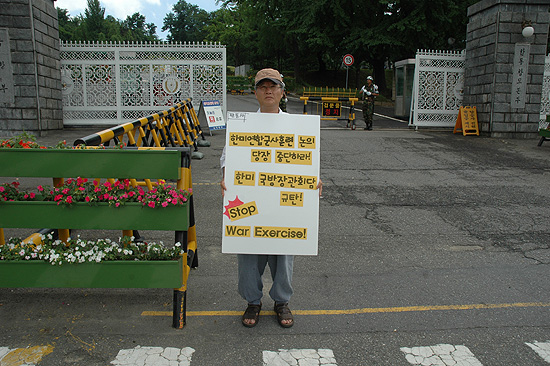
SPARK secretary, Kim Jong-Il in front of the Ministry of National Defense, ROK, July 20, 2010

"Immediately stop the discussion on the ROK-US war exercise!
"We denounce the
meeting by the ROK-US Defense Secretary& Minister"


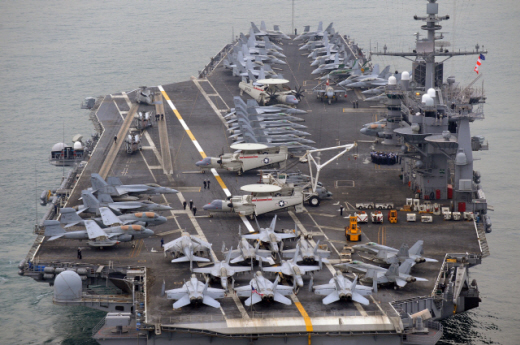
* Image source: Hankyoreh, 'The USS George Washington aircraft carrier'

____________________________________________________________


http://www.koreatimes.co.kr/www/news/nation/2010/07/205_69826.html

F-22 'Raptors' to join naval drill
S. Korea-US joint exercise to be held July 25-28

By Jung Sung-ki, Staff reporter
07-20-2010 18:57


Four state-of-the-art U.S. stealth fighters will join a massive combined air and naval exercise to be held by South Korea and the United States in the East Sea later this month in a show of the allies’ strong deterrence plans against North Korean provocations, South Korean and U.S. defense officials announced Tuesday.

The plan was made public after consultations between Defense Minister Kim Tae-young and his U.S. counterpart Robert Gates in Seoul. The two defense chiefs discussed a series of combined maritime and air readiness drills in waters around the peninsula in the coming months.

Gates arrived in Seoul late Monday to attend the “2+2” meeting that will include Secretary of State Hillary Clinton, South Korean Foreign Minister Yu Myung-hwan and Defense Minister Kim Tae-young.

The exercise, “Invincible Spirit,” will be the largest in scale with the participation of 8,000 Army, Air, Navy and Marine forces from the South Korean and U.S. militaries. The drill will be held from July 25 to 28.

About 200 fighter jets, and naval aircraft and helicopters will fly training missions in and around Korea. In addition, approximately 20 warships, including the U.S. nuclear-powered aircraft carrier USS George Washington, the South Korean Navy’s 14,000-ton Dokdo large-deck landing ship, and attack submarines will participate in the exercise.

The deployment of the F-22 Raptor, the world’s most advanced aircraft, will be symbolic in heralding the solid and broader alliance of the two governments against emerging regional threats, including a North Korean provocation, said Maj. Gen. John A. Macdonald, director of the ROK-U.S. Combined Forces Command’s operations bureau.

“The Raptor is the capability that we brought here to help in the defense of the Republic of Korea. It is part of the ROK-U.S. alliance,” Macdonald said.

“We will have four Raptors to participate in the exercise, and they will be involved in strike operations that will take place on ranges.”

This will be the first time that the “fifth-generation” radar-evading aircraft will participate in exercises with South Korea. The F-22, built by Lockheed Martin, is equipped with an active electronically scanned radar for cruise missile detection and is capable of evading advanced air defenses to bomb ballistic missile launch sites.

The single-seat fighter can fly at a maximum speed of Mach 1.8 and has an operational radius of 2,000 kilometers. Its weapons systems include AIM-9 Sidewinders and Joint Direct Attack Munitions (JDAM).

Macdonald added allied troops will be engaged in “network defense” to ensure they are secure in adverse conditions.

“The exercise will sharpen our military readiness by improving interoperability and the combined operational capability of the ROK-U.S. combined forces, while demonstrating the resolve and strength of the alliance,” Gen. Han Min-koo, chairman of the ROK Joint Chiefs of Staff, said in a statement. “We stand fully prepared to respond militarily to any further North Korean provocation.”

The exercise was originally scheduled to be held in the West Sea, but defense authorities in Seoul and Washington changed the venue apparently after strong protests from China.

The USS George Washington carries nearly 5,000 crew and flight staff, including 400-plus officers and more than 4,000 enlisted sailors.

The 97,000-ton vessel carries more than 65 aircraft, including F/A 18 Hornets, F/A 18 E/F Super Hornets, EA6B Prowlers, E2C Hawkeyes, C-2 Greyhounds and SH-60 Seahawk helicopters.

Joining the East Sea exercise will be the USS McCampbell, USS John S. McCain and USS Lassen (* Aegis Destroyers)

Earlier this month, the U.N. Security Council issued a statement that expressed “deep concern” over the sinking of the frigate Cheonan in the West Sea in March, but did not identify who was responsible for sinking the ship.

China, North Korea’s most important ally, was reportedly the main force behind the watering down of the Security Council resolution. It is also very uneasy about the ROK-U.S. joint exercise involving a U.S. nuclear-powered aircraft carrier.

_________________________________________________________

You may also see Hankyoreh
http://english.hani.co.kr/arti/english_edition/e_national/431169.html
ROK-U.S. plan additional joint naval exercises
The exercises, to be held in the Yellow Sea, are expected to draw additional criticism from China

Posted on : Jul.20,2010 12:33 KST

Excerpts

The South Korean media reported that the country developed a cruise missile ‘Hyunmoo 3-C’ with a 1500 km range that can reach Beijing and northeast region of China. Observers said that South Korean government leaked the fact in order to place a power check on China. (* South Korea has become the forth nation to develop the 1500km long range missile after the United States, Russia, Israel. The Korean media reports)

One Chinese newspaper, which took a hardline stance in response to the joint ROK-U.S. military exercises, posted on the front page of its Monday edition, “South Korean Cruise Missile’s Range Covers the Region. It is Feared that Tensions Will Increase Around the Region.”

_________________________________________________________

You may also see
http://www.globalresearch.ca/index.php?context=va&aid=20149
Confronting both China and Russia: U.S. Risks Military Clash With China In Yellow Sea
Rick Rozoff

http://rickrozoff.wordpress.com
_________________________________________________________

* Other related articles from Rick Rozoff on July 20, 2010

Voice of Russia
US, South Korea to conduct war games
July 20, 2010

Google
U.S. Deploys Nuclear-Powered Aircraft Carrier To South Korea
Associated Press
July 19, 2010
By ANNE FLAHERTY

Excerpts:

The carrier was expected to be in South Korea's port of Busan by Wednesday and could participate in an upcoming military exercise.

The nuclear powered carrier, one of the world's largest warships, will be accompanied by three destroyers — the McCampbell, the John S. McCain and the Lassen.

The Cheonan's sinking was considered South Korea's worst military disaster since the Korean War, which ended in a cease-fire in 1953. No formal peace treaty was ever signed, and more than 28,000 U.S. troops remain stationed in the south with a vow to protect its critical ally.

The deployment of the aircraft carrier could be seen by North Korea as a particularly aggressive move by the United States because of the ship's sheer size. According to a Navy website, the George Washington is 244 feet high from keel to mast and can accommodate some 6,250 crew members.

Friday, March 12, 2010

Text Fwd: USFK Deploys New Jets for Precision Strikes

* Image source: same as the below link

"An A-10C Thunderbolt II aircraft sits in a hangar at Osan[= Songtan] Air Base, Gyeonggi Province, in this file photo taken on March 3. / Courtesy of U.S. 7th Air Force"

Korea Times
03-12-2010 15:14
[Exclusive] USFK Deploys New Jets for Precision Strikes
By Jung Sung-ki
Staff Reporter

A U.S. Air Force squadron in South Korea has deployed three new A-10 ground attack jet aircraft capable of carrying precision - guided bombs, which can be used to neutralize North Korean artillery units hidden in mountain caves and tunnels near the inter-Korean border, a source at the U.S. Forces Korea (USFK) said Friday.

The move comes as the USFK has been pushing to modernize its air assets on the Korean Peninsula ahead of the planned transition of wartime operational control of South Korean forces from the United States to South Korea in 2012.

The USFK has pledged it will shift to a naval and air-centric supporting role after 2012, relinquishing most of the ground troops' command-and-control to Korean commanders.

According to the source, the three jets arrived at the 25th Fighter Squadron of the 51st Fighter Wing in Osan, about 35 kilometers south of Seoul, on March 3 to replace retiring older A-10A planes. Two more A-10Cs will land at Osan Air Base soon, the source said.

"Their arrival marks the beginning of the end for the transformation of the A-10 fleet," the source told The Korea Times. "The new jets' enhanced capability will provide lethal, precision firepower in any potential close air support scenario."

The A-10 Thunderbolt II is a single-seat, twin-engine, straight-wing aircraft developed in the early 1970s. It was designed to provide close air support to ground forces by attacking tanks, armored vehicles and other ground targets with a limited air interdiction capability.

Last year, the U.S. Air Force announced a plan to replace hundreds of older aircraft, including the A-10, with upgraded versions or brand new planes in stages over the next few decades. The A-10 will be replaced in 2028 or later.

For USFK's operations, the A-10 is a key air asset, along with the F-16 fleet, in deterring a potential North Korean invasion. Some 20 A-10As are assigned to the Osan Air Base.

The A-10 has been upgraded since 2005 to the C model, which includes a new data link, a new flight computer, new glass cockpit displays and controls, improved fire control system and electronic countermeasures.

The modified variant, in particular, can carry smart weapons, such as the Joint Direct Attack Munition (JDAM) and Wind Corrected Munitions Dispensor.

The JDAM is a satellite-guided bomb capable of making accurate and high-precision strikes in any weather. It has a range of 24 kilometers and can strike within 13 meters of its target. The bomb can penetrate up to 2.4 meters of concrete.

The older A-10, armed with the AGM-65 Maverick air-to-surface missile, the AIM-9 Sidewinder air-to-air missile and cluster bombs, is not able to conduct accurate bombing due to a lack of high-end weapon control systems.

The A-10C has an integrated targeting pod, such as the North Grumman LITENING targeting pod or the Lockheed Martin Sniper XR Advanced Targeting Pod, and a remotely operated video enhanced receiver that provides sensor data to personnel on the ground.

gallantjung@koreatimes.co.kr

Saturday, August 8, 2009

Text Fwd: Korea to Develop F-16 Simulators

Korea Times
08-07-2009 21:00
Korea to Develop F-16 Simulators
By Jung Sung-ki
Staff Reporter

South Korea will develop a dozen of its own F-16/KF-16 fighter flight simulators by 2014 as part of efforts to help pilots keep up with fighter upgrades and conduct sustainable flight training amid high oil prices, according to the Defense Acquisition Program Administration (DAPA) Friday.

The agency awarded Korea Aerospace Industries, the country's only aircraft maker, a 130-billion won ($106 million) contract to develop up-to-date flight simulators and unit training devices for F-16/KF-16 pilots, as well as upgrade existing simulation systems, DAPA officials said.

Previously, airmen used flight simulators developed by Raytheon.

The new systems will help pilots train skills in tactical flight, landings and take-offs, and emergency landings, the officials said.

Production will begin after the development of the new simulators is completed by November 2014, they said.

``Once entering service, the new simulators are expected to not only help resolve the shortage of flight trainings for pilots, resulting from high oil prices, but also improve pilots' aircraft operational capabilities to an extent,'' a DAPA official said.

The Air Force operates an older fleet of 34 Block 32 F-16s purchased in the 1980s and a newer fleet of 135 KF-16s manufactured locally to the Block 52 standard from the mid-1990s to the mid-2000s.

Earlier this year, the Air Force unveiled plans to upgrade its KF-16 fighters. The upgrades will include arming the aircrafts with precision-guided JoJoint Direct Attack Munitions (JDAM) and other guided weapons.

Another key upgrade will be a replacement for the fighter's radar systems.

jsungki@defensenews.com

Tuesday, June 30, 2009

Text & Graphic Fwd: S. Korea’s new defense plans stimulates speculation regarding joining MD


http://english.hani.co.kr/arti/english_edition/e_northkorea/362901.html

S. Korea’s new defense plans stimulates speculation regarding joining MD:
While S. Korea concentrates on strengthening ground forces against N. Korean nuclear weapons, experts say purchasing SM-3 and PAC-3 missiles would meet a MD precondition
June 29, 2009

While S. Korea concentrates on strengthening ground forces against N. Korean nuclear weapons, experts say purchasing SM-3 and PAC-3 missiles would meet a MD precondition

Criticism is surfacing that S. Korea’s planned defense measures against North Korean nuclear weapons and missiles, as revealed by the Ministry of Defense on Friday in its basic plan for defense reform, could be interpreted by surrounding nations like China as joining the U.S.-led Missile Defense (MD) system.

Lieutenant General Kim Ki Soo of the Joint Chiefs of Staff said that due to North Korea’s second nuclear test and missile launch, Seoul will be reevaluating its response strategy to the North Korean nuclear and missile threat to secure the fighting strength it needs. Analysts say he may be referring to the possibility of using the 2 satellites and the Global Hawk high-altitude UAV to detect signs of a North Korean missile launch, and if necessary, attacking North Korean missile bases and intercepting ballistic missiles using JDAMs launched from F-15Ks, interceptor missiles fired from the Aegis-equipped Sejong the Great-class warships , and ground-based Patriot missiles.

A Defense Ministry official said they were considering the introduction of SM-3, SM-6 and sea-based PAC-3 missiles for its Aegis ships and PAC-3 missiles as land-based interceptors.

Analysts are taking that while the Defense Ministry’s basic plan for military reform weighs the adoption of SM-3 and PAC-3 missiles in the name of preparing for the North Korean nuclear threat, it is concentrating on strengthening ground forces with additional tanks and artillery, and is postponing plans to introduce new weaponry for the Navy and Air Force.

Until now, the South Korean military has adopted or made plans to adopt less-capable SM-2 and PAC-2 missiles as part of its “independent air defense.” Experts have pointed out that if South Korea is to join the MD system, it must first purchase the SM-3 and PAC-3 missiles, capable of high-altitude missile interception at ranges of over 160km. The SM-3 and PAC-3, capable of intercepting ballistic missiles, are considered a first step to joining the MD system.

Kim Jong-dae, the editor-in-chief of the defense journal “D&D Focus,” says if South Korea introduces these weapon systems, it moves closer to the MD system regardless of its intention.

It is a matter of debate whether the SM-3 and PAC-3 missiles would be militarily useful in the security environment of the Korean Peninsula. This is because even if South Korea, whose capital is about 50km from the DMZ, were to adopt SM-3 and PAC-3 missiles, they would have limited military effectiveness against North Korean ballistic missiles, and would be of significance only against missiles flying in from long range, such as from China.

Please direct questions or comments to [englishhani@hani.co.kr]

© 2006 The Hankyoreh Media Company.


* Related article

http://english.hani.co.kr/arti/english_edition/e_editorial/362900.html
[Editorial] For full comprehensive talks to resolve North Korea nuclear issue
June 29, 2009


* Related blogs

http://nobasestorieskorea.blogspot.com/2009/06/text-fwd-s-korea-to-acquire-new.html
Sunday, June 28, 2009
Text Fwd: S. Korea to acquire new missiles for Aegis destroyer

http://nobasestorieskorea.blogspot.com/2009/06/map-fwd-korean-defense-reform.html
Sunday, June 28, 2009
Graphic Fwd: Revised Korean Defense Reform 2020

Sunday, June 28, 2009

Text fwd: US Nuclear Umbrella: Double-Edged Sword for S. Korea

Korea Times
By Jung Sung-ki
Staff Reporter, June 24, 2009

Amid growing concern about North Korea's high-stake nuclear gamesmanship, the United State has vowed to provide an ``extended'' nuclear umbrella to South Korea, where no tactical nuclear weapons are present.

Debates are under way, however, on the effectiveness of this in the case of conflict on the Korean Peninsula.

Proponents say the U.S. commitment to providing extended nuclear deterrence capabilities will help prevent the North from ``miscalculating'' that it would gain anything from missile and nuclear tests.

Opponents argue the U.S. nuclear deterrence pledge could only provoke the communist North and send the wrong message that Pyongyang is a recognized nuclear state.

``The U.S. extended deterrence means a stronger and broader defense against the North's chemical, biological and missile attacks as well as nuclear attacks. So this is huge step in the joint defense of South Korea and the United States against North Korea,'' a senior researcher at the Korea Institute for Defense Analyses (KIDA) said.

``But there is concern, at the same time, that talking too much of the nuclear umbrella would give North Korea a good excuse to claim itself to be a nuclear power,'' the researcher said.

At the June 16 summit in Washington, U.S. President Barack Obama reaffirmed that the United States would provide an ``extended nuclear umbrella'' to South Korea in response to increasing nuclear threats from North Korea. Pyongyang conducted a second nuclear test last month and test-fired several short-range missiles, defying calls by the international community to give up its nuclear ambitions.

This was the first time for a U.S. leader to clarify at a summit coverage of South Korea under its nuclear umbrella.

The U.S. government has promised since 1978 that it will provide necessary nuclear deterrence capabilities for South Korea against North Korea in the annual South Korea-U.S. defense ministers' meetings, but the issue had not been discussed at a summit level.

Under the extended nuclear deterrence pledge, military experts say, the U.S. military would mobilize all necessary capabilities to neutralize North Korean nuclear provocations.

For example, the U.S. Air Force could send B-2/52 bombers and other fighter aircraft carrying nuclear bombs, such as the B-61, to hit nuclear facilities in the North. Tomahawk cruise missiles could be launched from nuclear-powered submarines to strike targets.

The B-61 bomb is known to have a ``dial able'' explosive power of 0.3 to 340 kilotons and believed to be capable of destroying North Korea's key underground facilities.

U.S. fighter aircraft would also be ready to conduct surgical strikes with high-end bombs, such as bunker busters.

Redeployment of US nuclear weapons in S. Korea?

Some conservatives argue the government should ask the U.S. Forces Korea (USFK) to re-deploy its tactical nuclear weapons to deter nuclear-armed North Korea.

Tactical nuclear weapons (TNWs) typically refer to short-range weapons, including land-based missiles with a range of up to 500 kilometers and air- and sea-launched weapons with a range of around 600 kilometers.

The USFK removed its TNWs in 1991. Prompted by mounting concerns about the security of nuclear weapons in the former Soviet Union, then U.S. President George Bush announced in September 1991 that the United States would eliminate its entire worldwide inventory of ground-launched TNWs and would remove all nuclear weapons from surface ships and attack submarines.

Jeon Seong-hoon at the Korea Institute for National Unification said, ``As North Korea's nuclear capability increases, the effectiveness of the U.S. nuclear umbrella could decrease. In that context, I believe, the redeployment of USFK's tactical nuclear weapons, at least on a temporary basis, could be the best option.''

A military official concurred. The official, who requested to remain anonymous, said the USFK should deploy tactical nuclear weapons again as long as it is not violating the 1991 Washington-Moscow arms control agreement.

``Redeployment of air-launched tactical nuclear weapons do not violate the 1991 agreement,'' the official said. ``If there were 10 tactical nuclear weapons in the South, North Korea's nuclear threat could be easily neutralized.''

An Army commanding general, who has been in charge of military operations, expressed a negative view about the redeployment of tactical nuclear weapons to the South.

``Realistically, it's impossible and not feasible,'' the officer said, asking not to be named. ``Politically, such a move would face severe opposition from China.''

Self-Reliant Deterrence

South Korea's military is also planning to acquire weapons systems to help deter North Korea's lingering nuclear and missile threats on its own.

The military plans to increase the procurement numbers of precision-guided Joint Direct Attack Munitions (JDAM) and air-launched cruise missiles. It aims to buy 1,400 JDAMs by 2013 to bring its total number to 4,551.

The JDAM is a guidance tail kit that converts existing unguided free-fall bombs into accurate, adverse weather munitions. Carried by advanced fighter jets, including F-15Ks, the bomb has a glide range of 24 kilometers and can strike within 13 meters of its target. It can penetrate up to 2.4 meters of concrete.

The South Korean Air Force is also seeking to equip some of its KF-16 fleet with JDAMs.

In addition, the South plans to acquire about 270 joint air-to-surface, standoff (cruise) missiles (JASSM) by 2011. The JASSM, developed by U.S. Lockheed Martin, is an autonomous, long-range, air-to-ground, precision missile designed to destroy high-value, fixed and mobile targets.

Nuclear Submarines?

Beginning in 2018, South Korea plans to build indigenous 3,000-ton KSS-III submarines fitted with domestically built submarine combat systems aimed at automating target detection, tracking, threat assessment and weapons control. The heavy sub will be armed with indigenous ship-to-ground cruise missiles and be capable of underwater operations for up to 50 days with an advanced AIP system, Navy officials said.

According to informed government sources, the Navy wants to deploy about six KSS-III submarines and then may push to develop a nuclear-powered submarine as a hedge against future uncertainties in Northeast Asia.

Many observes admitted the Navy needs nuclear-powered submarines in the long term but are skeptical about the plan, citing the potential political and diplomatic backlash, particularly from the United States.

South Korea initially pushed for developing a nuclear-powered sub in 2004 but canceled the initiative later for these reasons.

``A nuclear-powered submarine plan involves both military and political aspects,'' a defense analyst said. ``Nuclear subs will, of course, offer benefits to the Navy in terms of much longer operational range and fuel efficiency. But the thing is, unless legal and political problems are resolved first, we can't go forward with the plan.''

The analyst apparently referred to a 1991 inter-Korean non-nuclear declaration and the Nuclear Non-Proliferation Treaty, in which non-nuclear weapon states such as South Korea are required to place all of their nuclear materials under inspection by the International Atomic Energy Agency to ensure they are not used to develop atomic weapons.

Some proponents say that because nuclear-powered submarines use low-grade nuclear fuel, they do not violate the denuclearization pledge. Opponents say that since a nuclear-powered sub would require enriched uranium fuel, the ability to enrich uranium also could be used to produce material for building nuclear weapons.

Nuclear submarines can remain underwater much longer than conventional submarines, propelled by diesel generators, and are considered a strategic weapon second only to aircraft carriers.

To thwart North Korea's asymmetrical capabilities and other regional hostile forces, the Navy has emphasized strengthening its submarine fleet. The Navy has nine German-made Type-209 1,200-ton submarines and three Type-214 1,800-ton submarines, first built locally under technical cooperation with HDW of Germany. They are all diesel- and electric-powered.

``Submarine fleets are seen as one of the most powerful features of any military force,'' said the analyst. ``For South Korea, the requirements and roles of advanced attack submarines are essential to help neutralize the North's increasing asymmetrical capabilities.''

Six more Type-214 subs are scheduled to be commissioned by 2018, when the Navy will inaugurate a submarine command. The Type-214 submarine, a core part of the future strategic mobile squadrons, is armed with modern torpedoes and submarine-to-surface missiles.

The 65.3-meter-long sub can submerge to depths of up to 400 meters, with a maximum submerged speed of 20 knots. With the help of Air Independent Propulsion (AIP), which improves its underwater performance and gives it stealth capability, the submarine can carry out underwater operations for as long as two weeks, putting Guam in its operational range, according to the Navy.

The sub's ISUS-90 integrated sensor enables operators to detect about 240 targets simultaneously and track 32 targets.

gallantjung@koreatimes.co.kr

* Related blog *

Letter Fwd: Letter Sent to the Presidents of the Republic of Korea and the United States on the Occasion of the Korean-US Summit Conference (2009.6.16)

Thursday, June 4, 2009

US to sell 'bunker-buster' bombs to SKorea: official


* Image source: Wikipedia

* Text informed by Agneta Noberg on June 3, 2009 *

US to sell 'bunker-buster' bombs to SKorea: official
by Staff Writers
Seoul (AFP) June 2, 2009

The United States has agreed to sell "bunker-buster" bombs to South Korea that are capable of destroying underground facilities in North Korea, a military official said Tuesday.

Washington recently approved the sale of GBU-28 bombs, which were used during the 1990-91 Gulf War to destroy underground command centres in Iraq, a defence ministry official told AFP on condition of anonymity.

The laser-guided bombs, which could be used to hit North Korean missiles and aircraft stored underground, will be delivered to South Korea between 2010 and 2014, South Korea's Yonhap news agency reported.

It said that in the event of war South Korean jet fighters would carry the bombs to attack underground targets such as North Korea's nuclear facilities and artillery hidden in caves.

South Korea also plans to purchase other high-tech bombs such as JDAMs, JASSMs and GBU-24s, Yonhap said.

GBU-24s perform better at low altitudes and under poor visibility conditions. JDAMs with global positioning systems would be effective against North Korean artillery while JASSMs are precision cruise missiles, Yonhap said.

"These high-tech bombs are some of the most urgently needed weapons for us to deal with North Korean missile sites and artillery guns," a source told the news agency.

Military officials here say the North's artillery deployed in tunnels along the border poses a serious threat to South Korea.

General Walter Sharp, the top US commander in the South, said in April that the North has the world's largest artillery force.

He said the North is believed to have some 13,000 artillery pieces deployed along the border.

South Korea has generally favoured defence equipment from the United States, which has kept troops here since the 1950-53 Korean War to deter aggression by North Korea.

More than 600,000 South Korean troops, backed by 28,500 US troops, are confronting the potential threat from the North's 1.1 million-strong military.


* Yonhap News Seoul(Korean)
北핵.지하시설 파괴용 GBU-28 수십발 도입
美 판매 승인..'2010~2014 중기계획' 반영
[2009-06-02 10:45 송고]

(서울=연합뉴스) 김귀근 기자 = 유사시 북한의 핵시설과 동굴속 장사정포 등 지하군사시설을 뚫고 들어가 폭파시키는 레이저유도폭탄(GBU-28) 수십 발이 도입된다.

군 소식통은 2일 "미국은 그간 전략무기로 분류해 국외 수출을 엄격히 통제했던 GBU-28 폭탄을 한국에 판매키로 최근 승인했다"면서 "우리 군은 '2010~2014년 국방중기계획'에 이 폭탄 구매계획을 반영했다"고 밝혔다.

미국이 한국에 GBU-28 폭탄을 판매키로 한 것은 북한이 두 차례 핵실험을 하고 장거리 미사일을 발사하는 등 핵과 미사일 위협이 가중되고 있어 이에 대응하는 차원이라고 소식통은 말했다.

그는 "미국이 한국에 전략무기인 무인정찰기 글로벌호크 판매를 승인한 데 이어 GBU-28 폭탄까지 판매키로 한 것은 양국 신뢰관계를 반영하는 것"이라며 "GBU-28 폭탄을 도입한 데 이어 글로벌호크도 구매하는 방안을 적극적으로 고려하고 있다"고 강조했다.

일명 '벙커버스터'로 불리는 GBU-28은 미국이 1991년 걸프전쟁 때 지하 30여m 깊이의 벙커에서 전쟁을 지휘하는 이라크군 사령부를 공격하기 위해 특별히 설계됐다.

스텔스 폭격기나 F-15A 전폭기를 이용, 공중에서 투하한 뒤 레이저로 유도해 목표물에 도달한다. 폭탄에 장착된 2천kg의 탄두는 지상에서 바로 터지지 않고 지하 20~30여m(콘크리트는 6m)까지 뚫고 들어가 폭발하도록 설계되어 있다.

지난 2001년 '테러와의 전쟁'에서는 탈레반과 오사마 빈 라덴의 지하 요새를 공격하기 위해 수도 카불과 탈레반 거점 도시인 칸다하르 등지에 투하된 것으로 알려졌다.

군은 F-15K 전투기에 GBU-28 폭탄을 장착해 유사시 핵시설과 동굴속 장사정포, 지하군사시설 등을 격파한다는 계획이다. GBU-28 폭탄의 제원은 길이 3.8m, 지름 36.8cm, 무게 2천250kg 등이다.

한편 지난 주 평양 산음동 병기연구소에서 대륙간탄도미사일(ICBM)을 싣고 평안북도 철산군 동창리 미사일기지에 도착한 화물열차는 화물칸이 비어 있는 상태로 산음동으로 되돌아온 것으로 알려졌다.

이 때문에 첩보당국은 덮개로 가려진 ICBM이 동창리 기지에서 내려져 조립건물로 옮겨진 것으로 추정하고 있다. 현재 동창리 기지에는 고급 승용차가 빈번하게 출입해 북한군 수뇌부가 방문한 것으로 관측되고 있다.

threek@yna.co.kr

* Related Korean articles

http://www.munhwa.com/news/view.html?no=20090602010301270260040
軍, 북핵 대응 ‘벙커버스터’ 도입
북핵·지하시설 파괴용… 美 수십발 판매 승인
정충신기자 csjung@munhwa.com

http://search.munhwa.com/main.jsp?q=%BA%A1%C4%BF%20%B9%F6%BD%BA%C5%CD