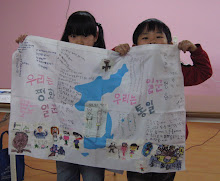
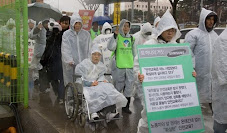
'저는 그들의 땅을 지키기 위하여 싸웠던 인디안들의 이야기를 기억합니다. 백인들이 그들의 신성한 숲에 도로를 만들기 위하여 나무들을 잘랐습니다. 매일밤 인디안들이 나가서 백인들이 만든 그 길을 해체하면 그 다음 날 백인들이 와서 도로를 다시 짓곤 했습니다. 한동안 그 것이 반복되었습니다. 그러던 어느날, 숲에서 가장 큰 나무가 백인들이 일할 동안 그들 머리 위로 떨어져 말과 마차들을 파괴하고 그들 중 몇몇을 죽였습니다. 그러자 백인들은 떠났고 결코 다시 오지 않았습니다….' (브루스 개그논)


For any updates on the struggle against the Jeju naval base, please go to savejejunow.org and facebook no naval base on Jeju. The facebook provides latest updates.
Showing posts with label Space debris. Show all posts

Friday, June 11, 2010

Some points that should be Noticed from the failed Naro Rocket launch

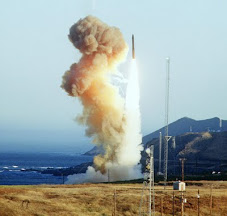
The Naro space rocket with the payload of a science satellite lifts off from the launch pad at the space center in Goheung, South Jeolla Province, Thursday evening. At right are three sequential shots taken from footage by television station KBS that show, from top, the rocket exploding. / Korea Times

* Image source: Jeju News, May 13, 2008 'Jeju tracking center'

* Image source: Global Security, 'Naro Space Center'

"The Naro Space Center is on 5 million square meters of reclaimed land on Naro Island in Goheung County, South Jeolla, about 485 kilometers south of Seoul. The spaceport, under the management of the Korea Aerospace Research Institute, includes a launch pad, a control building, rocket assembly and test facilities, facilities for satellite control testing and assembly, electric power station, a space science museum and a landing field.

The construction of the Korea Space Center began in August 2003 with a budget of 315.5 billion won.As of November 2008, the Naro Space Center had already completed construction of the launch pad, the main control center, radar tracking stations and other facilities. Engineers were conducting autonomous tests of the facilities which were expected to be completed by the year's end. The first launch was originally planned for December 2008 but was postponed till 2Q, 2009. Once the facility becomes fully operational, Korea will be able to achieve its goal of building a satellite and rocket with local technology and launching it into space from its own launch center."


* Image source: hankyoreh on June 8, 2010

# According to the Korea Times regarding the failed rocket launch, on June 10, 2010,

"A number experts of also suggested that the country was fortunate to
avoid a disaster as ground control was unable to command the wayward
rocket to self-destruct with communications being out, which may have
led to shuddering consequences had debris crashed onto land."

"KARI later confirmed that the debris has fallen in the waters off the
southern coast of Jeju Island."

# The Jeju tracking station in the Korean bird-eye view in the Korean Hankyoreh newspaper on June 8, 2010

# More on Naro Space Center

__________________________________________________________
# Related blog

http://nobasestorieskorea.blogspot.com/2009/08/2_30.html
[영문 번역: Article Fwd] Why Don't Make Voice against the Rocket Naro?
Weekly Kyunghyang, Sept. 1, 2009
[인터뷰] 왜 나로호에 목소리 내지 않는가?, 위클리 경향, 2009년 9월 1일자 발간

Thursday, June 3, 2010

Text Fwd: SPACE NUCLEAR POWER - OBAMA GIVES GO AHEAD FOR MORE

* Bruce Gagnon blog
Tuesday, June 01, 2010
SPACE NUCLEAR POWER - OBAMA GIVES GO AHEAD FOR MORE

video

This video (all in French but with important archival film footage) is about Cosmos 954, a Soviet nuclear-powered space surveillance satellite that was launched on September 18, 1977 and crashed in the region of Great Slave Lake near Yellowknife, Canada. Canada and the U.S. launched an immediate cleanup and recovery, called "Operation Morning Light". This report was aired on Canadian Broadcasting Corporation a few months after the accident.

The Russian satellite disintegrated and rained radioactive debris which covered some 124,000 square kilometers. Two hundred and twenty Canadian Armed Forces and the U.S. Department of Energy Nuclear Emergency Search Team combed the area until October 1978, trying to salvage fragments of the satellite. But according to the Atomic Energy Control Commission (now the Canadian Nuclear Safety) only 0.1% of the atomic energy source on Cosmos 954 was recovered.

There have been several other space nuclear power accidents over the years. According to journalist Karl Grossman, "In 1964 a U.S. Navy navigational satellite with a SNAP-9A (SNAP for Systems Nuclear Auxiliary Power) nuclear generator on-board failed to achieve orbit and fell to the Earth, disintegrating upon hitting the atmosphere. The 2.1 pounds of plutonium fuel dispersed widely. A study by a group of European health and radiation protection agencies subsequently reported that 'a worldwide soil sampling program carried out in 1970 showed SNAP-9A debris present at all continents and at all latitudes.' Long linking the SNAP-9A accident to an increase of lung cancer in people on Earth was Dr. John Gofman, professor of medical physics at the University of California at Berkeley, who was involved in isolating plutonium for the Manhattan Project."

Then in 1996 the Russian Mars '96 space mission failed to achieve orbit after launch and burned up as it reentered Earth's atmosphere. The space craft was carrying 200 grams of plutonium on-board and the flaming reentry was witnessed by a NASA scientist who was on a star gazing trip as it landed in the mountains of Chile and Bolivia. Those governments, not having the capability to locate the radiological debris, asked then President Bill Clinton to send them assistance. He refused and only the Boston Globe and Christian Science Monitor reported the accident as most of the media ignored this important story.

In 2003 the NASA space shuttle Colombia burned up when it reentered Earth's atmosphere due to heat shields having blown off during launch. All the astronauts on-board were killed. The flaming reentry was watched on TV as the debris was spread across several southern states. NASA immediately sent in search teams and told the public to stay away from the debris. One local sheriff was heard on National Public Radio telling the public that NASA told him the debris could be radioactive. I myself saw NASA personnel in haz-mat suits on TV and it was clear that a nuclear generator or reactor had to have been on the shuttle. To this day NASA denies the story.

In the soon to be published Global Network newsletter, Space Alert, Karl Grossman writes about Obama's plan to restart plutonium production at the Department of Energy nuclear labs across the nation. This is being done as Obama intends to increase the use of nuclear power for missions to Mars and for nuclear rockets.

All we need is one failed rocket, or one falling nuclear powered spacecraft, to spread deadly plutonium-238 across the planet. This stuff lasts for thousands of years and we can't take a chance by playing space nuclear Russian roulette.

Tuesday, February 2, 2010

Text Fwd: SPACE SECURITY

* Text sent from J. Narayana Rao on Feb. 2, 2010

SPACE SECURITY

By J.Narayana Rao,
General Secretary, All India Peace&Solidarity Organisation,
Maharashtra State Committee, Nagpur, India

HOW SPACE IS USED:We depend on Space for Navigation, Environmental Monitoring, Meteoroligy, Map making, Whether and Climate monitoring, Surveillance etc. All these activities are made through artiificial Satellites. Artificial Satellites are man made objects launched in space. The first artificial satellite Sputnik was put in orbit in space by the Soviet Union on 4 October 1957.There after more than 1000 satellites have been put in orbit. These are (1) Astronomical satellites for observation of distant planets, galaxies and other objects in Space. (2)Bio-Satellites to Carry living organisms for scientific experiments. (3) Communication Satellites for telecommunications. (4) Navigation Satellites to measure locations. (5) Reconnaisance satellites for military communications. (6) Earth Observation Satellites for environmental monitoring meteoroligy and map making. (7) Whether Satellites for monitoring Weather and Climate. (9) Space Stations for human beings to live in outer Space.

These Satellites will be in orbit in space at three stages in altitude. (1) Low Earth Orbit(LEO) is upto 2000 K.M from the earth. (2) Medium Earth Orbit (MEO) is higher than 2000 KM and below 35,786 Km. (3) Higher Earth Orbit is above 35,786 Km.

THREAT TO SPACE SECURITY: Space Security is threatened by weaponisation of Space, Space Junk and Space Debris.

On 23 March 1983 President Ronald Regan of USA announced the Strategic Defence Initiative programme which has become well known as Star Wars Programme. Subsequently, his successor H.W.Bush changed it as National Missile Defence Programme. Thereafter George W.Bush convrted it as Ballistic Missile Defence. All these programmes are linked with Space Wars whater ever may be the nomenclature.

The plan for US domination of space has been outlined in the US Space Command document Vision For 2020. The salient feature of this document are (1) Dominating Space dimension of Military Operations to protect US interests and investments. (2) Integrating Space forces into war fighting capabilities across the full spectrum of conflict. (3) The medium of Space is the fourth medium of warfare along with land, sea and air. (4)The emerging synergy of space superiority with land,sea and air superiority will lead to full spectrum domination. (5) Space power is vital element in moving towards the joint vision goal of being persuasive in peace,decisive in war and pre-eminent in any form of conflict. (6)And to counter to the world wide proliferation of Weapons of Mass Destruction.

The perception of US to dominate Space and use it for War has invited condemnation from many countires and warned that it will lead to arms race in Space.

TYPE OF SPACE WEAPONS: Space Weapons have not yet become common and popularly known except in military circles. Some of these are (1) Laser Beams. (2) Anti Satellite Weapons. (3) Space based ballistic Missiles. (4) Orbiting Satellites Capable of intercepting and disabling other satellites.(5) Satellites that carry weapons capable of hitting target.

IMPACT OF WEAPONISATION OF SPACE: There will be an Arms Race In Space as it happened with Nuclear Weapons. When USA tested and dropped Atomic Weapons on Hiroshima and Nagasaki,it created an Arms Race of Nuclear Weapons. This will also result in the violation of various UNO Treaties which prohibit deployment of weapons in Space. Space doest belong to any one nation and it belongs to the entire mankind.More and more countries will try to reach Space for Military purposes if weaponisation of space is not prevented.

SPACE JUNK AND SPACE DEBRIS:There are 2300 dead and defunct Satellites in Space.Collision and exploisions of satellites create debris.On Feb 2009 two Satellites Iridium 33 and defunct Cosmost 2251 collided at a height of 470 miles orbiting with a speed of 22000 mph.Pegasus rocket launched in 1994 exploded and created a cloud of some 300,00 fragments bigger than 4 mm.Olympus was hit by a meteor on 11 Aughst 1993.On 24 July 1996 Cerise a French Satellite was hit by fragments of Arian H10 upper stage booster which exploded in 1986.On 29 March 2006 the Russian Express AM II Communication Satellite was struck by an unknown object.In 2007 a Chinese defunct satellite was blasted by a missile (ASAT) at an altitude of 860 Km.It created more that 2300 golf ball size pieces,over 36000 pieces of 1 cm or larger and 1 million peces of 1 mm or lesser size..On 19 Feb 2007 a Russion Briz M Booser stage rocket eploded over Australia.In 1985 an Anti Satillite Test conducted by US destroyed a one tonne satellite orbiting at 625 Km altitude.On 20 Feb 2008 US destroyed a defective spy satellite of their own by a SM-3 missile. In March 2000 a Chinese Long March upper stage exploded in orbit.The oldest debri is the space is the US Satellite Vanguard I launched on 17 March 1968.It worked for 6 years only.Cosmos 1275 of the USSR disappeared on 24 July 1981,only one month after launch.

LOST EQUIPMENT:When the astronauts make space walks and also under takes repairs to the Space wehicles many articles will be lost into the space.A glove was lost by Edward White during the first US Space walk in 1965. It was in orbit for six months orbiting at a speed of 28000 kmph.Astronaut of Gemini 10 Michael lost a Camera near the Space Craft. Near about 200 bags of garbage were thrown out by the Soviet Cosmonauts from the MIR Space Station. Sunita William also lost a Camera during her space walk. Spent Rocket parts, defunct and unused satellites, explodedfragments,paint flakes, slags from solid rocket motors, small needles,nuts and bolts also come under space debris.

HOW MANY DEBRIS IN SPACE:The NASA estimated in 2009 that that the number of large pices of debris over 10 cms are `9,000. Between 1 and 10 cms at 500,000 and smaller that 1 cm exceed tens of millions. Another study made in 1999 relveal that there are some 4 million pouns of spae junk in the Low Earh Orbit. During the last one decfade the estimated objects of over 10 cms in the Lower Earth Orbit have more than doubled from 8500 in 1990 to 19,000 in 2009.Space debris revolve around the globe at speeds of upto 25,000 mph with altitude ranging from hundred to thousands of miles.

SATELLITE PROTECTIVE MEASURES:Damage to the Space Crafts from the Space Debris is prevented by additing a thin layer of metal foil outside the main space craft body. When debris collide with foil with high velocity the debris will be vaporized and the plasma spreads out quickly. By this process, damage to the inner wall of the space craft is protected. Space Crafts powered by Solar Panels are liable to be affected badly because the front portion of the Panel are positioned directly towards the Sun As a result they get punctured by the debris.

UNITED NATIONS SPACE TREATY: The United Nations Organization adopted a treaty in the year 1967 on the Principles Governing the Activities of States in the Exploration and Use of Outer Space including the Moon and Other Cellestial Bodies. Interalia this Treaty confers the right to all Nations to use and explore the Outer Space for the benefit of all peoples irrespective of different economic or scientific developments in accordance with the International Law. Exploration and use of Outer Space should be only for peaceful purposes. The establishment of military bases, installations and fortifications, the testing of any type of weapons and conduct of military manoeuvres on celestial bodies is forbidden.

KEEP SPACE FOR PEACEFULL PURPOSES: Respecting the UN Treaty on the peaceful use of outer space and to prevent any Nation how powerfull it may be to weaponise Space, lest it results in an arms race in outer space, all countries must take steps to keep Space for peacefull purposes only. In this direction the Global Network Against Weapons and Nuclear Power in Space is campaigning world wide, to prevent Space from becoming another battle ground. Russiaa,China and Canada are seeking an international agreement on Preventing an Arms Race in Outer Space(PAROS).But United States of America and Israel are preventing PAROS talks Col. Gen.Vladimir Popovkin of Russia warned in September 2007 that should any country deploy weapons in space,then the laws of armed warfare are such that retaliatory weapons are certain to appear. Former President Dr. A.P.J.Abdul Kalam while speaking on Space Security in Nov 2007 said that the main security concern is that Outer Space should be free of weapons.We must recognize the necessity for the world, space community to avoid terrestrial geo-political conflict to be drawn into outer space thus threatening the space asses belonging to humanity.
---------

Friday, December 4, 2009

Text Fwd; SPACE SECURITY(Power point CD)

* Text fwd from J. Narayana Rao(jnrao36@rediffmail.com) on Dec. 4, 2009

For Power point CD
SPACE SECURITY
By .J.NARAYANA RAO,GENERAL SECRETARY
ALL INDIA PEACE & SOLIDARITY ORGANISATION,
MAHARASHTRA STATE COMMITTEE, NAGPUR.

( For making a power point CD)

1.HOW WE USE SPACE NOW.

For Communications, Entertainment, weather observations, Navigation, surveillance etc.

2.THREAT TO SPACE SECURITY.

1.Weaponisation of Space.
2.Space Junk and Space Debris.

3.WHAT IS WEAPONISTION OF SPACE.

1.On 23 March 1983 President Ronald Regan of US announced Strategic Defence Initiative
Which became well known as Star Wars Programme.
2.Subsequently H.W.Bush changed it as National Missile Defence Perogramme.
3.There after George W.Bush made it as Ballistic Missile Defence.

4. TYPES OF SPACE WEAPONS

1.Laser Beams.
2.Anti Satellite Weapons.
3.Spacebased ballistic missiles which will be used to destroy ballistic missiles either in
Boost phase or in the mid course trajectory.
4.Orbiting satellites capable of ih-ntercepting or disabling other satellites.
5 Satellites that carry weapons capable of hitting targets.

5. IMPACT OF DEPLOYING OF SPACE WEAPONS.

1.Arms race in Space.
2.Violation of UN Treaties.
3.More and more Countries will join the space war programs.

6.THREAT TO SPACE SECURITY.

1.The greatest threat to Space Security comes from the US planning for space weaponization and space domination. The Vision for 2020 of the US Space Command document outlines the US Policy for
Space domination.
2.Dominating the space dimension of military operations to protect US interests and investments.
3.Integrating space forces into war fighting capabilities across the full spectrum of conflict.
4.The medium of space is the fourth medium of warfare along with land, sea and air.
5.The emerging synergy of space superiority with land, sea and air superiority will lead to full spectrum
Domination.
6.Space power is a vital element in moving towards the joint vision goal of being persuasive in peace, decisive in war, and pre-eminent in any form of conflict.
7.Development of ballistic missile defenses using space systems and planning for precision strike from space offers
a counter to the worldwide proliferation of WMD.

7. SPACE JUNK AND SPACE DEBRIS.

1 2300 Dead Satellites.
2.Debris created because of Collisions and & Explosions.
3.On Feb 2009 two Satellites-Iridium 33 and a defunct Cosmos 2251 collided at a height of 470 Miles
orbiting with a speed of 22000 mph.
4.Pegasus Rocket launched in 1994 exploded which created a cloud of some 300,000 fragments
Bigger than 4 mm.
5.Olympus was hit by a meteor on 11 August 1993.
6.On 24 July 1996 “Cerise” a French Satellite was hit by fragments of Arian-1410 which exploded in 1986.
7.on 29 March 2006 the Russian Express AM II Communication Satellite was struck by an unknown object.
8.In 2007 a Chinese defunct satellite was blasted by a Missile (ASAT) at an altitude of 850 Km. It created more
Than 2300 golf ball size pieces, over 35000 pieces of 1 Cm size or larger and 1 million pieces of 1mm or l larger size.
9.On 19 Feb 2007 a Russian Briz M Booster stage rocket exploded in orbit over Australia.
10.In 1985 an Anti Satellite Test conducted by US destroyed a one tone satellite orbiting at 525 Km altitude.
11.On 20 Feb 2008 US destroyed a defective spy satellite of their own by a SM-3 missile.
12.The oldest debris is the space is the US Satellite Vanguard I launched on 17 March 1958.It worked for
6 years only.
13..On March 2000 a Chinese Long March upper stage exploded in orbit.

7. LOST EQUIPMENT

1.A glove was lost by Edward White during the First US Space walk in 1965.It was in
Orbit for six months orbiting at a speed of 28000 kmph .
2.Astronaut of Gemini 10 Michael Collins lost a Camera near the Space Craft .
3.Near about 200 bags of garbage bags were thrown out by the Soviet Cosmonauts from the MIR Space Station.
4.Sunita Williams also lost a Camera during her space walk.

8.HOW MANY SPAcE DEBRIS IN SPACE.

1. Spent Rocket Parts, Defunct and unused satellites, exploded fragments, paint flakes, slags from solid rocket motors, small needles, nuts and bolts etc come under space debris.
2. In a mid 2009 appraisal the NASA estimated that the number of large pieces of debris over 10 cms are 19,000,
Between 1 and 10 cms at 500,000 and smaller than 1 cm exceed tens of millions. Another study made in 1999 reveal that there are some 4 million pounds of space junk in the Low Earth Orbit(LEO).During the last one decade the estimated objects of over 10 cms in the LEO have more than doubled from 8500 in 1990 to 19,000 in 2009.
3. Space debris revolve around the globe at speeds of up to 25,000 mph with altitudes ranging from hundreds to thousands of miles.

9. SATELLITE PROTECTIVE MEASURES.

1.Damage to Space Crafts from the space debris is prevented by adding a thin layer of metal foil outside of the main space craft body.
2.When the debriscollide with foil with high velocity the debris will be vaporized and the plasma spreads out quickly. By this process damage to the inner wall of the space craft is protected.
3.Space crafts powered by Solar Panels are liable to be affected badly because the front portion of the Panel are positioned directly towards the Sun. As a result they get punctured by the debris.

10. UNITED NATIONS SPACE TREATY.

1.UN Treaty on the Principles Governing the Activities of States in the Exploration and Use of Outer Space Including the Moon and Other Cellestial Bodies of 1967.
2.Exploration and use of Outer Space should be carried on for the benefit of all peoples irrespective of the difference of economic or scientific development in accordance with the International Law.
3.Exploration and use of Outer Space should be only for peaceful purposes.
4The establishment of military bases installations and fortifications, the testing of any type of weapons and conduct of military maneuvers on celestial bodies shall be forbidden.

11. KEEP FOR PEACEFUL PURPOSES.

1.Stop US to dominate and militarize space.
2.Strengthen the movement launched by GLOBAL NETWORK AGAINST WEAPONS AND NUCLEAR POWER IN SPACE.
3.Be careful that one day you may be caught in the Traffic Jam in Space when you venture for a rendezvous.

KEEP SPACE FOR PEACE ONLY.

Sunday, November 29, 2009

Text Fwd: SPACE JUNK AND SPACE DEBRIS

J. Narayana Rao(jnrao36@rediffmail.com) on Nov. 28, 2009

SPACE JUNK AND SPACE DEBRIS
J. Narayana Rao

As we are facing environmental and ecological problems on earth, similar problems are also cropping up in Space. Within a period of 52 years only ever since the first satellite Sputnik was launched by USSR in 1957 we are encountering with the danger of environmental and ecological problems in Space.Traffic congestions as on earth are also not uncommon in Space. While more and more satellites are launched in Space, the care that has to be taken for these satellites to be in orbit safely is no less important than any vehicles moving on the road on earth. Satellites colliding is also taking place in Space.It may be surprising that how accidents and traffic congestion happen in space .

At present there are 240 Civil & Military Communication Satellites and more than 800 remote sensing reconnaissance Satellites are in Space.We are launching the satellites for using in Telecommunications,weather observations, navingation, reconnaissance and many other benefits for the mankind. Accummulation of Space Junk and Space Debris are the causes of environmental and ecological damage to the space.

ACCUMMULATION OF SPACE JUNK

Space debris also known as orbital debris space junk and space waste. Spent Rocket Parts, defunct and unsed satellites, exploision fragments, paint flakes, slags from solid reocket motors, small needles, nuts and bolts are the basic source of space debris and space junk. When these objects Collide with each other or explode or blasted they get fragmented into small pices. In a mid 2009 appraisal, the NASA estimated that the number of large pices of debris of 10 cms and over at 19,000, between 1 and 10 cms at 500,000 and smaller than 1 cm probably exceed tens of millions. A 1999 study estimated that there are some 4 million pounds of space junk in the low earth orbit. During the last one decade the estimated objects of over 10 cms in the Low Earth Orbit have more than doubled from 8,500 in 1990 to 19,000 in 2009. In 17 March 1958 US launched it’s second satellite the Vanguard I. It functioned only for 6 years and remained in space. It became as one of the longest surviving piece of Space Junk. On 24 July 1996 “Cerise” a French microsatellite in the Earth Low Orbit was hit by fragments of Arian upper booster which exploded in November 1986. On 29 March 2006 the Russian Express AM II Communication satellite was struck by an unknown object which rendered it inoperative.
Rocket Boosters contribute a good number of debris. On 11 March 2000 a Chinese upper stage booster exploded in orbit and created a cloud of debris. On 19 Feb 2007 a Russian Briz. M Booster stage exploded in orbit. On 24 January 78 Cosmos 954 of the USSR, powered by an onboard Nuclear Reactor fell from orbit crashing into the northwest territories of Canada. It scattered nuclear debris over a huge area. At present there are 37 Nuclear powered satellites put in space by USSR and US.The operation of these satellites is over. But the radioactive fuel in them is still hot and lethal.These are likely to fall on earth in future.

TESTING OF ANTI SATELLITE WEAPONS

Another major source of debris is testing Anti Satellite weapons. US, USSR and China contribute to this. The Chinese test of 2007 in which a defunct satellite was blasted produced 2,300 pices of trackable pices of debris of Golf Ball size. Over 35,000 pices of 1 cm or larger and 1 million pices of 1 mm or large size. In 1985 a US test destroyed a 1 tonne Satellite orbiting at 525 km altitude. It created thousandsof pices of debris larger than 1 cm. On 20 February 2008, the US launched a SM-3 missile to destroy a defective US spy satelliteat about 250 km altitude.

MATERIAL LOST IN SPACE.

Gemini 4 Astronaut of US, Edward White who performed the first Space Walk lost a Glove in Space. It stayed in orbit circling with a speed of 28,00 kmph. Michael Collins another Astronaut lost a Camera near the Space Craft Gemini 10.Soviet Cosmonauts pushed out more than 200 garbage bags from the MIR Space Station.Sunita Williams also lost a Camera in Space.

According to a BBC study, a 1 mm metal chip could do as much damage as a 22 caliber rifle bullet.A pea sized ball moving at a speed of 36,000 kmph is as dangerous as 400 lb safe travelling at 60 mph. A metal sphere the size of a tennis ball is as lethal as 25 sticks of dynamite.

PROTECTIVE MEASURES.

Damage to the space crafts from the space debris is protected by applying a thin layer of metal foil outside of the main Space Craft body.When the debris collide with the foil with high velocity,the debris will be vaporized and the plasma spreads out quickly. By this process damage to the inner wall of the Space craft is protected. Space crafts powered by Solar Panels are liable to be affected badly because the front portion of the panels are positioned directly exosed to the Sun.As a result they get punctured by debris. When large pices of space debrice collide with space crafts the damage is much heavy.

COLLISIONS IN SPACE.

The US Olympus space craft was rendered dead after it collided with a meteor. The first major collision with space debris was on 10 February 2009 when a deactivated 950 kg Cosmos and an operational 560 kg Irridium 33 collided at an altitude of 800 km over northern Siberia. Both the satellites were destroyed scattering considerable debris. In 2006 Atalantis Shuttle of US was hit by debris and got small hole through the radiaton panel. In 2007 Endevour was hit by unknown debris which bore a hole of several centimeters in diameter through the panel.
Most debris are likely to bur up in the atmosphere.But larger objects can reach the ground and present a risk. In the 2009 European Air and Space conference at the University of Southampton, UK, Hugh Lewis a researcher predicted that the threat from space debris would rise 50 percent in the coming decade and quadruple in the next 50 years.

With the ongoing programme of weaponisation space by the US in which even Nuclear Reactors are likely to be put in space to create sufficient energy to create Laser Beams the problem of Space Junk and Space Debris will further gets accentuated,
--------