'저는 그들의 땅을 지키기 위하여 싸웠던 인디안들의 이야기를 기억합니다. 백인들이 그들의 신성한 숲에 도로를 만들기 위하여 나무들을 잘랐습니다. 매일밤 인디안들이 나가서 백인들이 만든 그 길을 해체하면 그 다음 날 백인들이 와서 도로를 다시 짓곤 했습니다. 한동안 그 것이 반복되었습니다. 그러던 어느날, 숲에서 가장 큰 나무가 백인들이 일할 동안 그들 머리 위로 떨어져 말과 마차들을 파괴하고 그들 중 몇몇을 죽였습니다. 그러자 백인들은 떠났고 결코 다시 오지 않았습니다….' (브루스 개그논)


For any updates on the struggle against the Jeju naval base, please go to savejejunow.org and facebook no naval base on Jeju. The facebook provides latest updates.
Showing posts with label Turkey. Show all posts

Saturday, November 20, 2010

Text Fwd: NATO Meeting to Expand Missile Offense Systems 나토 회담, 미사일 공격 시스템 확장할 것임

* Text sent from Bruce Gagnon on Nov. 19, 2010

NTI
NATO Won't Cite Iran in Missile Defense Plan
Thursday, Nov. 18, 2010

NATO this week does not intend to explicitly make the connection between its proposed missile shield and fears of an Iranian missile strike, alliance head Anders Fogh Rasmussen told the Financial Times (see GSN, Nov. 16).

The move is intended to win the support of Turkey, which could host part of the system and which has voiced strong reservations against singling out its neighbor.

"We do not want to single out particular countries," Rasmussen said. "More than 30 countries already have -- or are aspiring to acquire -- missile technologies with a range that can hit NATO territory. So there is no need to single out or name specific countries, because this is an evolving threat."

Leaders from the 28 NATO nations are meeting tomorrow and Saturday in Lisbon, Portugal, to consider a new mission statement that would address strategies for dealing with modern-day security challenges. The heads of state are anticipated to determine whether to officially include missile defense among NATO objectives, paving the way for an initiative to integrate and augment the protective systems of member states.

An Obama administration plan to gradually field land- and sea-based missile interceptors around Europe would be incorporated into NATO missile defense plans. A draft of the organization's new mission statement reportedly calls for shield infrastructure to be deployed in Romania, Poland and Turkey.

Even if Tehran is not specifically identified as a missile threat, Ankara might still oppose allowing a radar base to be located on its soil while giving its backing to missile defense as a core NATO objective, alliance diplomats said. That could require further talks down the line (James Blitz, Financial Times, Nov. 17).

Ankara wants the missile shield's command-and-control architecture to be established on Turkish soil, Politico reported today.

Turkish Prime Minister Recep Tayyip Erdogan said this week if command-and-control was not located in Turkey then it would be impossible for his government to agree to host the radar base.

Obama administration officials, however, do not want wish to see foreign nations hosting the command infrastructure. They anticipate instead it would be situated at U.S. military installations in Germany.

READ MORE

Global Network Against Weapons & Nuclear Power in Space
PO Box 652
Brunswick, ME 04011
(207) 443-9502
globalnet@mindspring.com
www.space4peace.org
http://space4peace.blogspot.com/ (blog)

Monday, November 1, 2010

Text Fwd: Production of K2 tank to start soon K2 탱크 생산 곧 진행될 것임

Korea Times
Production of K2 tank to start soon
By Jung Sung-ki

The production of the homegrown K2 Black Panther main battle tank will begin soon after a one-year delay due to a problem with the tank’s “power pack” transmission system, the Defense Acquisition Program Administration (DAPA) said Monday.

[...]

Unveiled in 2007, the K2, developed by the state-funded Agency for Defense Development and Hyundai Rotem, is a major defense product to fulfill domestic needs and sales overseas. The K2 technology was exported to Turkey years ago.

Tuesday, June 8, 2010

Text Fwd: Was the Obama Administration involved in the Planning of the Israeli Attack on the Gaza Freedom Flotilla?: The Broader Military Agenda

* Text thankfully informed by M. S. on June 8, 2010

“Japan's relationship with NATO and Israel seems to be growing,
while many citizens here are preoccupied with Okinawa base problem.
But in a broader perspect, the Okinawa relocation base and that in Guam are connected
to the security of the 'Sea Lane' from the Mediterranean to Hawaii for the conveniences of the US,
NZ and Australia on its east end.
And the new fact of the sea off the coast of Gaza as a place of natural gas reservoir explains
why some countries give secret supports for Israel, while expanding PSI.
http://www.globalresearch.ca/index.php?context=va&aid=19573

So the efforts for thwarting the US ambition in Okinawa and Guam are meaningful in that respect as well. Without Japan's payment, both plans would be impossible.
Thus, the US sends in a lot of influential intellectuals to persuade any Japanese government to keep its words, saying the Guam agreement between US-Japan alliance 'transcends any policymaker' in Japan Gates).” (M. S. on June 8, 2010)

____________________________________________________

'Israel's blockade of Gaza is in large part motivated by the broader issue of control of Gaza's territorial waters, which contain significant reserves of natural gas. What is at stake is the confiscation of Palestinian gas fields and the unilateral de facto declaration of Israeli sovereignty over Gaza's maritime areas. If the blockade were to be broken, Israel's de facto control over Gaza's offshore gas reserves would be jeopardy.' (quote from the article)
____________________________________________________

Was the Obama Administration involved in the Planning of the Israeli Attack on the Gaza Freedom Flotilla?
: The Broader Military Agenda

Global Research, June 6, 2010

The Israeli Navy Commando had prior knowledge of who was on the Turkish ship including where passengers were residing in terms of cabin layout. According to Swedish author Henning Mankell, who was on board the Marmara , "the Israeli forces attacked sleeping civilians."

These were targeted assassinations. Specific individuals were targeted. Journalists were targeted with a view to confiscating their audio and video recording equipment and tapes.

"We were witnesses to premeditated murders," said historian Mattias Gardell who was on the Mavi Marmara.

"...Asked about why activists on the Turkish ship had attacked the Israeli soldiers, Gardell stressed "it is not as if Israel is a police officer whom no human being has the legitimate right to defend him or herself against":

"If you are attacked by commando troops you of course must have the right to defend yourself ... Many people on this ship thought they were going to kill everyone. They were very frightened ... It's strange if people think one should not defend oneself. Should you just sit there and say: 'Kill me'?" he said." (See Mahdi Darius Nazemroaya, Detailed Compiled Eyewitness Accounts Confirm Cold-Blooded Murder and Executions by Israeli Military, Global Research, June 1, 2010)

“They even shot those who surrendered. Many of our friends saw this. They told me that there were handcuffed people who were shot,” (quoted by Press TV)


The Israeli Commando had an explicit order to kill.

What was the role of the United States?

The raids on the Gaza Freedom Flotilla, bear the mark of previous Israeli operations directed against unarmed civilians. It is a well established modus operandi of Israeli military-intelligence operations, which is tacitly supported by the US administration.

The killing of civilians is intended to trigger a response by Palestinian resistance forces, which in turn justifies Israeli retaliation (on "humanitarian" grounds) as well as a process of military escalation. The logic of this process was contained in Ariel Sharon`s "Operation Justified Vengeance" (also referred to as the "Dagan Plan") initiated at the outset the Sharon government in 2001. This Operation was intent upon destroying the Palestinian Authority and transforming Gaza into an urban prison. (See Michel Chossudovsky, "Operation Justified Vengeance": Israeli Strike on Freedom Flotilla to Gaza is Part of a Broader Military Agenda, Global Research, June 1, 2010).

The Israeli attack on the Flotilla bears the fingerprints of a military intelligence operation coordinated by the IDF and Mossad, which is now headed by Meir Dagan. It is worth recalling that as a young Coronel, Dagan worked closely with then defense minister Ariel Sharon in the raids on the Palestinian settlements of Sabra and Shatilla in Beirut in 1982.

There are indications that the US was consulted at the highest levels regarding the nature of this military operation. Moreover, in the wake of the attacks, both the US and the UK have unequivocally reaffirmed their support to Israel.

There are longstanding and ongoing military and intelligence relations between the US and Israel including close working ties between various agencies of government: Pentagon, National Intelligence Council, State Department, Homeland Security and their respective Israeli counterparts.

These various agencies of government are involved in routine liaison and consultations, usually directly as well as through the US Embassy in Israel, involving frequent shuttles of officials between Washington and Tel Aviv as well as exchange of personnel. Moreover, the US as well as Canada have public security cooperation agreements with Israel pertaining to the policing of international borders, including maritime borders. (See Israel-USA Homeland Security Cooperation, See also Michel Chossudovsky, The Canada-Israel "Public Security" Agreement, Global Research, 2 April 2008)

The Role of Rahm Emmanuel

Several high level US-Israel meetings were held in the months prior to the May 31st attacks.

Rahm Emmanuel, Obama's White House chief of Staff was in Tel Aviv a week prior to the attacks. Confirmed by press reports, he had meetings behind closed doors with Prime Minister Netanyahu (May 26) as well as a private visit with President Shimon Peres on May 27.
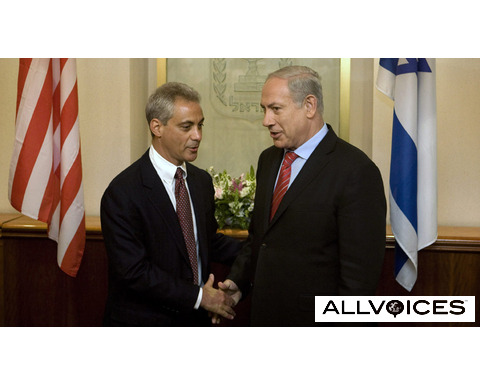
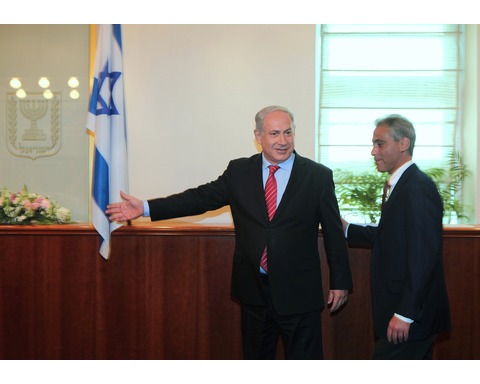
May 26 meeting between Rahm Emmanuel and Prime Minister Binyamin Netanyahu

Official statements do not indicate whether other officials including cabinet ministers or IDF and Mossad officials were present at the Rahm Emmanuel-Netanyahu meeting. The Israeli press confirmed that Rahm Emmanuel had a meeting with Defense Minister Ehud Barak, whose Ministry was responsible for overseeing the Commando attack on the Flotilla. (Rahm Emanuel visits Israel to celebrate son's bar mitzvah - Haaretz Daily Newspaper | Israel News, 23 May 2010). The White House also confirmed that Rahm Emmanuel was to meet other high-ranking Israeli officials, without providing further details. (Rahm Emanuel in Israel for Son's Bar Mitzvah, May Meet With Officials)

"Our Man in the White House"

While born in the US, Rahm Emmanuel also holds Israeli citizenship and has served in the Israeli military during the First Gulf War (1991).

Rahm is also known for his connections to the pro-Israeli lobby in the US. The Israeli newspaper Maariv calls him "Our Man in the White House" (quoted in Irish Times, March 13, 2010). Rahm Emmanuel gave his support to Obama in the November 2008 presidential elections following Obama`s address to the pro-Israeli lobby AIPAC.

At the time of Rahm Emmanuel's confirmation as White House chief of staff, there were reports in the Middle East media of Rahm Emanuel's connections to Israeli intelligence.

The exact nature of Rahm Emmanuel's ties to the Israeli military and intelligence apparatus, however, is not the main issue. What we are dealing with is a broad process of bilateral coordination and decision-making between the two governments in the areas of foreign policy, intelligence and military planning, which has been ongoing for more than 50 years. In this regard, Israel, although exercising a certain degree of autonomy in military and strategic decisions, will not act unilaterally, without receiving the "green light" from Washington. Rahm Emmanuel`s meetings with the prime minister and Israeli officials are part of this ongoing process.

Rahm Emmanuel's meetings in Tel Aviv on May 26 were a routine follow-up to visits to Washington by Prime Minister Netanyahu in March and by Minister of Defense Ehud Barak in late April. In these various bilateral US-Israel encounters at the White House, the state Department and the Pentagon, Rahm Emmanuel invariably plays a key role.

While the pro-Israeli lobby in the US influences party politics in America, Washington also influences the direction of Israeli politics. There have been reports to the effect that Rahm Emmanuel would "lead a team of high octane Democratic party pro-Israel political operatives to run the campaign for the Defense Minister Ehud Barak" against Netanyahu in the next Israeli election. (Ira Glunts, Could Rahm Emanuel Help Barak Unseat Netanyahu? Palestine Chronicle, June 2, 2010)

The April 27 meeting between US Defense Secretary Robert Gates and Defense Minister Barak pertained to "a range of important defense issues" directly or indirectly related to the status of the Palestinian territories under Israeli occupation:

"As President Obama has affirmed, the United States commitment to Israel's security is unshakable, and our defense relationship is stronger than ever, to the mutual benefit of both nations. The United States and our ally Israel share many of the same security challenges, from combating terrorism to confronting the threat posed by Iran's nuclear-weapons program.

For years, the United States and Israel have worked together to prepare our armed forces to meet these and other challenges, a recent major example being the Juniper Cobra joint exercise held last October. Our work together on missile-defense technology is ongoing, and the United States will continue to ensure that Israel maintains its qualitative military edge." (Press Conference with Secretary Gates and Israeli Defense Minister Barak, April 2010 - Council on Foreign Relations April 27, 2010)

These consultations pertained to ongoing military preparations regarding Iran. Both Israel and the US have recently announced that a pre-emptive attack against Iran has been contemplated.

Washington views Israel as being "'integrated into America’s military architecture,' especially in the missile defense sphere." (quoted in Emanuel to rabbis: US 'screwed up' Jerusalem Post, statement of Dennis Ross, who is in charge of the US administration’s Iran policy in the White House, May 16, 2010).

Targeting Iran

The attack on the Freedom Flotilla, might appear as a separate and distinct humanitiarian issue, unrelated to US-Israeli war plans. But from the standpoint of both Tel Aviv and Washington, it is part of the broader military agenda. It is intended to create conditions favoring an atmosphere of confrontation and escalation in the Middle East war theater;

"All the signs are that Israel has been stepping up its provocations to engineer a casus belli for a war against Hamas in Gaza and Hezbollah in Lebanon. Tel Aviv sees as unfinished business its inconclusive wars: the first in Lebanon in 2006, and the second in Gaza in 2008-09." (Jean Shaoul Washington Comes to the Aid of Israel over Gaza Convoy Massacre, Global Research, June 4, 2010)

Following Israel's illegal assault in international waters, Netanyahu stated emphatically "Israel will continue to exercise its right to self defence. We will not allow the establishment of an Iranian port in Gaza," suggesting that the Gaza blockade was part of the pre-emptive war agenda directed against Iran, Syria and Lebanon. (Israeli forces board Gaza aid ship the Rachel Corrie - Telegraph, June 5, 2010, emphasis added) .

Moreover, the raid on the Flotilla coincided with NATO-Israel war games directed against Iran. According to the Sunday Times, "three German-built Israeli submarines equipped with nuclear cruise missiles are to be deployed in the Gulf near the Iranian coastline." (Israel Deploys Three Nuclear Cruise Missile-Armed Subs Along Iranian Coastline).

While Israeli naval deployments were underway in the Persian Gulf, Israel was also involved in war games in the Mediterranean. The war game codenamed "MINOAS 2010" was carried out at a Greek air base in Souda Bay, on the island of Crete. Earlier in February, The Israeli air force "practiced simulated strikes at Iran's nuclear facilities using airspace of two Arab countries in the Persian Gulf, which are close territorially with the Islamic republic and cooperate with Israel on this issue." Ria Novosti,War Games: Israel gets ready to Strike at Iran's Nuclear Sites,, March 29, 2010)


Also, in the wake of the final resolution of the 2010 Review Conference of the Parties to the Treaty on the Non-Proliferation directed against Israel's nuclear weapons program, the White House has reaffirmed its endorsement of Israel's nuclear weapons capabilities. Washington's statement issued one day before the raid on the flotilla points to unbending US support to "Israel's strategic and deterrence capabilities", which also include the launching of a pre-emptive nuclear attack on Iran:

"a senior political source in Jerusalem said Sunday that Israel received guarantees from U.S. President Barack Obama that the U.S. would maintain and improve Israel's strategic and deterrence capabilities.

According to the source, "Obama gave [Prime Minister Benjamin] Netanyahu unequivocal guarantees that include a substantial upgrade in Israel-U.S. relations."

Obama promised that no decision taken during the recent 189-nation conference to review and strengthen the 40-year-old Nuclear Non-proliferation Treaty "would be allowed to harm Israel's vital interests," the sources said. Obama promised to bolster Israel's strategic capabilities, Jerusalem officials say - Haaretz Daily Newspaper)
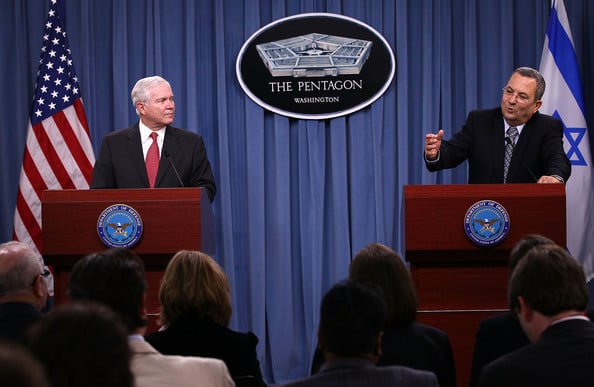

Robert Gates and Israel's Minister of Defense Ehud Barak, Press Conference, April 27, 2010


The Turkey-Israel Relationship in Jeopardy?

The actions of Israel against the Freedom Flotilla have important ramifications. Israel's criminal actions in international waters has contributed to weakening the US-NATO-Israel military alliance.

The bilateral Israel-Turkey alliance in military, intelligence, joint military production is potentially in jeopardy. Ankara has already announced that three planned military exercises with Israel have been cancelled. "The government announced it was considering reducing its relations with Israel to a minimum."

It should be understood that Israel and Turkey are partners and major actors in the US-NATO planned aerial attacks on Iran, which have been in the pipeline since mid-2005. The rift between Turkey and Israel has a direct bearing on NATO as a military alliance. Turkey is one of the more powerful NATO member states with regard to its conventional forces. The rift with Israel breaks a consensus within the Atlantic Alliance. It also undermines ongoing US-NATO-Israel pre-emptive war plans directed against Iran, which until recently were endorsed by the Turkish military.

From the outset in 1992, the Israeli-Turkish military alliance was directed against Syria, as well as Iran and Iraq. (For details see See Michel Chossudovsky, "Triple Alliance": The US, Turkey, Israel and the War on Lebanon, Global Research, 2006)

In 1997, Israel and Turkey launched "A Strategic Dialogue" involving a bi-annual process of high level military consultations by the respective deputy chiefs of staff. (Milliyet, Istanbul, in Turkish 14 July 2006).

During the Clinton Administration, a triangular military alliance between the US, Israel and Turkey had unfolded. This "triple alliance", which in practice is dominated by the US Joint Chiefs of Staff, integrates and coordinates military command decisions between the three countries pertaining to the broader Middle East. It is based on the close military ties respectively of Israel and Turkey with the US, coupled with a strong bilateral military relationship between Tel Aviv and Ankara.

Starting in 2005, Israel has become a de facto member of NATO. The triple alliance was coupled with a 2005 NATO-Israeli military cooperation agreement which included "many areas of common interest, such as the fight against terrorism and joint military exercises. These military cooperation ties with NATO are viewed by the Israeli military as a means to "enhance Israel's deterrence capability regarding potential enemies threatening it, mainly Iran and Syria." ("Triple Alliance": The US, Turkey, Israel and the War on Lebanon).

The Issue of Territorial Waters

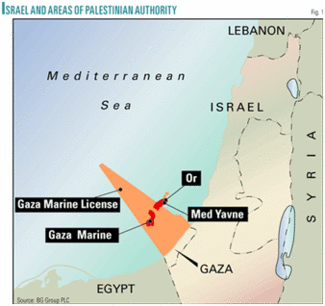
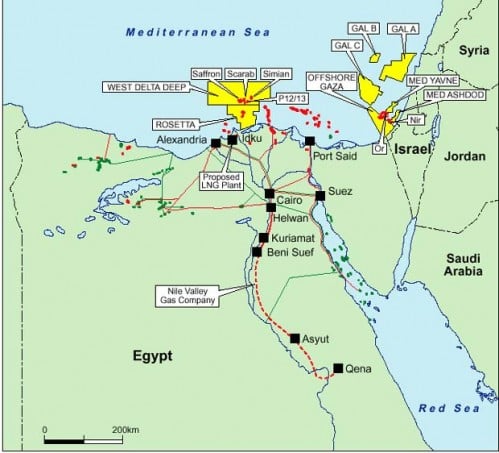
Israel's blockade of Gaza is in large part motivated by the broader issue of control of Gaza's territorial waters, which contain significant reserves of natural gas. What is at stake is the confiscation of Palestinian gas fields and the unilateral de facto declaration of Israeli sovereignty over Gaza's maritime areas. If the blockade were to be broken, Israel's de facto control over Gaza's offshore gas reserves would be jeopardy. (See Michel Chossudovsky,War and Natural Gas: The Israeli Invasion and Gaza's Offshore Gas Fields, Global Research, January 8, 2009. See also Michel Chossudovsky, The War on Lebanon and the Battle for Oil, Global Research, July 23, 2006)


Sunday, January 3, 2010

Text Fwd: K2 Tank Production Suffers Budget Cut

Image source/ caption: same as the link below
'K2 Black Panther tank' [So called 'Heukpyo']

"The budgetary plans endorsed by the legislature include 14.2 billion won [about $13million]to introduce a presidential jet; 10 billion won[about $9million] to build Type 214 submarines; 9.1 billion won [about $ 8.7 million] to build a KDX-III Aegis destroyer; and 5 billion[ about $ 4.7 million] to construct a naval base on Jeju Island."

Korea Times
01-03-2010 16:54
K2 Tank Production Suffers Budget Cut
By Jung Sung-ki (gallantjung (at) koreatimes.co.kr)
Staff Reporter

The planned production of homegrown K2 Black Panther main battle tanks this year has suffered a major setback due to a reduction of the related budget.

The National Assembly passed its 292-trillion-won (some $251 billion) spending plan for 2010, which included 29.5 trillion won in funding for defense, on Dec. 31.

The defense budget represents a 3.6-percent increase from last year but a decrease from the original plan proposed by the Ministry of National Defense, which called for a 7.9-percent increase.

Among the arms improvement programs, K2 tank production was hit the hardest by the cut. The Assembly slashed 50 billion from the proposed 88.2 billion won for producing the new tanks this year amid reports over technical problems with the tank's "power pack" system.

The Agency for Defense Development began field trials of the domestically-built engine and transmission system in July last year but problems emerged during the tests, according to the Defense Acquisition Program Administration.

Originally, the production of some 390 K2 tanks was scheduled to begin after field trials to replace the Army's K1 tanks and its aging M48 Patton tanks.

In a parliamentary session on Dec. 10, Defense Minister Kim Tae-young admitted the problem with the K2 power pack, which is comprised of a 1,500-horsepower, 12-cylinder diesel engine and transmission.

"The K2 program will be delayed by one year, but the production of 100 tanks in 2014 will be possible," Kim said.

Unveiled in 2007, the K2 is a major defense product for domestic needs and overseas sales. The K2 technology has already been exported to Turkey.

The K2 carries a three-person crew supported by an auto-loading system and a locally-developed 120-millimeter/55-caliber stabilized smoothbore gun. The fully-digitalized vehicle has an electric gun/turret driving system, automatic sensor input and power monitoring and control system.

Its 1,500-horsepower engine can power the tank to 70 kilometers per hour on paved roads and 50 kilometers off-road. It can cross rivers as deep as 4.1 meters, a considerable improvement over the K1 and K1A1, and fire as soon as it resurfaces.

The budgetary plans endorsed by the legislature include 14.2 billion won [about $13million]to introduce a presidential jet; 10 billion won to build Type 214 submarines; 9.1 billion won [about $ 8.7 million] to build a KDX-III Aegis destroyer; and 5 billion[ about $ 4.7 million] to construct a naval base on Jeju Island. [* According to the SPARK research, the budget, provided by the government for the dispatch to Afghanistan is 44 billion won which is about $40 million. The discussion on the agenda by the National Assembly on the dispatch to Afghanistan was delayed to February.]


* Related blog

http://nobasestorieskorea.blogspot.com/2009/11/spark-largely-cut-2010-defense-budget.html
Monday, November 23, 2009
SPARK: Largely Cut the 2010 Defense Budget!

Monday, December 28, 2009

Text Fwd: Landmark nuclear power plant deal sounds energy alarm within South Korea

* Image source/ caption: Same as the link below

'South Korean President Lee Myung-bak, seated, claps his hands together when Korea Electric Power Corporation (KEPCO) President and CEO Kim Ssang Su, left, and Emirates Nuclear Energy Corporation (ENEC) President Khaldoon Khalifa al-Mubarak, right, shake hands after signing a contract in Abu Dhabi Dec. 27.'


Hankyoreh
Landmark nuclear power p
lant deal sounds energy alarm within South Korea:As KEPCO consortia secures APR contract in UAE, environmentalists say nuclear power plant export is little cause for celebration in S.Korea
Dec. 28, 2009

South Korea has picked up project rights for a 40 billion dollar (47 trillion Won) nuclear power plant project in the United Arab Emirates (UAE). The Emirates Nuclear Energy Corporation (ENEC) announced Sunday (local time) that a consortium led by the Korea Electric Power Corporation (KEPCO) was selected as the final contractor for the project. The KEPCO consoritium beat out France’s AREVA and a U.S. consortia led by General Electric Co. and the Japanese firm Hitachi Ltd.

The UAE project is the largest-scale overseas project order ever picked up by South Korea. The selection is further significant in that it marks the first exportation of South Korea’s independently developed nuclear power plant model APR. Environmental groups, meanwhile, continue to question the safety and utility of nuclear power plants.

Project Details and Selection Factors

The KEPCO consortium will begin work on the power plant next year in Sila, a city located 330 kilometers west of the UAE capital of Abu Dhabi. There will be four 1,400 MW-capacity plants at the location generating a total of 5,600 MW of power. Analysts say out of the 40 billion dollars, an estimated 20 billion dollars will go into design, construction and early operating expenses, while the remaining 20 billion dollars will go towards after service expenses for a period of 60 years after construction is completed for items such as plant fuel, operating costs, maintenance and waste treatment.

The primary factor in the selection of the South Korean nuclear power plant model, which has never been exported before, was its cost competitiveness. According to data from the Ministry of Knowledge Economy, the APR’s construction unit cost of 2,300 dollars per kilowatt (kW) was lower than those of its competitors AREVA at 2,900 dollars per kW, and GE at 3,583 dollars per kW. In terms of electricity generation unit cost, the South Korean model’s 3.03 cents per kilowatt hour (kWh) was lower than AREVA’s 3.93 cents kWh, and less than half Hitachi’s 6.86 cents kWh.

Criticism from Environment Groups

Questions about its utility and safety make nuclear power a controversial energy source throughout the world. The chief concern has to do with fatal damages that could result from radiation leakage in the event of an accident. For this reason, environment groups have maintained that nuclear power cannot be a fundamental alternative for combating climate change and that the construction of nuclear power plants should be minimized.

These arguments factor into the dark shadow lurking behind all the praise about the export of South Korea’s first nuclear power plant model. Environmental activists are noting that the dazzling copy about the largest power plant export in South Korea’s history masks continued concerns about environmental safety. In particular, they are pointing out that while the Lee administration is heralding a “nuclear power Renaissance” and talking up nuclear power as a green energy resource, safety concerns and other issues remain topics of debate within the international community. Indeed, nuclear power, unlike other renewal energy sources like wind and solar power, is not included in the Clean Development Mechanism (CDM), an instrument for greenhouse gas reductions included under article 12 of the Kyoto Protocol. Although countries like France and Japan place a high emphasis on nuclear power and have been arguing for its inclusion, no conclusion was reached on the matter at the recent climate change conference in Copenhagen.

Environmental activists are also claiming that the benefits of nuclear power plant construction as a future industry are questionable, since global demand for nuclear power plant construction is not very large and Korea still has not secured original technology. “There is a demand for new plants mainly in countries where civil society is not active, like China and countries in the Middle East, but there is no explosive demand at the worldwide level,” said Energy Justice Actions head Lee Heon-seok. “Also, because we still do not have the original technology, nuclear power plants lack future prospects in industry terms,” Lee noted.

Yanglee Won-young, head of Korean Federation for Environmental Movement’s committee on climate and energy, says, “Nuclear power may conceivably be a necessary temporary substitute for fossil fuels, but a better alternative would be to promote energy efficiency or develop renewable energy sources.” Yanglee added, “It is undesirable for South Korea to go all in on nuclear power.”

Please direct questions or comments to [englishhani@hani.co.kr] 


* Related article

Yonhap news
2009/12/28 10:07 KST
S. Korea eyes nuclear plant deal from Turkey: officials


* Related blog

http://nobasestorieskorea.blogspot.com/2009/12/text-fwd-s-korea-becomes-worlds-6th.html
Sunday, December 27, 2009
Text Fwd: S. Korea becomes world's 6th nuclear reactor exporting nation

Friday, December 25, 2009

Text Fwd: Taiwan: Raytheon Gets $1.1 Billion Advanced Patriot Missile Order

Text Fwd fro Rick Rozoff (StopNATO) on Dec. 24, 2009

Defense News
December 23, 2009
Raytheon Gets $1.1B Patriot Missile Systems Order From Taiwan
By ANTONIE BOESSENKOOL

-Configuration 3 is Raytheon's most advanced Patriot system and allows the use of Lockheed Martin's Patriot Advanced Capability-3 (PAC-3) missiles Raytheon's Guidance Enhanced Missile-Tactical (GEM-T) missiles and allows missile launchers to be placed miles in front of the radar of the system, rather than right next to the radar as in earlier Patriot systems.
-"We've been in Taiwan for 40 years. We are embedded (there) and are honored that they continue to trust Raytheon with the defense of their country."

Raytheon received a $1.1 billion order from Taiwan for new Patriot missile systems, Raytheon said Dec. 23.

The order for the four new Patriot fire units, made as a Foreign Military Sale, is a $966 million contract for ground-system hardware and a $134 million contract for spares. It will include new advances in technology, improved man-machine interface and reduced life-cycle costs, Raytheon said.

Raytheon already won smaller contracts for Taiwan in January 2009 and in 2008 for upgrades to the Patriot systems the country already had. Those contracts were to upgrade the systems to Configuration 3, the same upgrade the company is completing for the U.S. Army.

Configuration 3 is Raytheon's most advanced Patriot system and allows the use of Lockheed Martin's Patriot Advanced Capability-3 (PAC-3) missiles Raytheon's Guidance Enhanced Missile-Tactical (GEM-T) missiles and allows missile launchers to be placed miles in front of the radar of the system, rather than right next to the radar as in earlier Patriot systems.

The four new systems under the latest contract will be built as Configuration 3 systems, said Dan Smith, Raytheon Integrated Defense Systems president.

"We've been in Taiwan for 40 years," Smith said. "We are embedded (there) and are honored that they continue to trust Raytheon with the defense of their country."

Twelve countries, including the U.S., are Patriot system customers. Raytheon is in discussions with customer countries that haven't yet upgraded to the Configuration-3 status, like Saudi Arabia, and is looking at adding new customers, like Turkey, which currently has a competition going for an air and missile defense system.

"With the countries that have not yet upgraded to the Config 3 baseline, we are in discussions with those countries, along with the U.S. Army, in terms of getting their plans in order to upgrade to the baseline for all nations," Smith said.

Raytheon, based in Tewksbury, Mass., is the prime contractor for Patriot air and missile defense systems and system integrator for PAC-3 missiles.
===========================
Stop NATO
Blog site:

Monday, December 21, 2009

Text Fwd: UK-Italy Firm Vying for Korean Attack Chopper Bids

* Image source: same as the link below

'AgustaWestland is bidding for a contract to provide Korea with its T-129 attack helicopters.
The T-129, being developed for the Turkish Army, is an upgraded variant of the Agusta A129 Mangusta
/ Courtesy of AgustaWestland '

Korea Times
UK-Italy Firm Vying for Korean Attack Chopper Bids

By Jung Sung-ki
Korea Times Correspondent

VERGIATE, Italy ― It was a sunny autumn day and the "chop-chop" sound of the rotor blade of a helicopter was heard from the air. A blue and white helicopter was sinking out of the blue sky and approaching the ground.

"That's the helicopter for Samsung," Roberto Caprarella, a media relations official of AgustaWestland, an U.K.-Italy helicopter company, said Nov. 11 while leading a tour of a plant here, located about 45 kilometers northwest of Italy's northern city of Milan.

The helicopter was the first of the two AW139 medium-sized utility helicopters ordered by Samsung Techwin, a defense business arm of Samsung Group, the largest conglomerate in South Korea, Carprella said.

The helicopter, used to transport of Samsung VIPs and top executives, was there for pilot training before final delivery, he said. The other is to be delivered for the first quarter of next year.

The helicopter manufacturer believes the order from Samsung, the world's largest conglomerate, is very symbolic and will help further open the door for the commercial helicopter market in Korea.

"As you know, Samsung is leading commercial variants in Korea, so it's driving the requirements of others," an AgustaWestland official in charge of commercial marketing said, requesting not to be named. "If Samsung is flying the helicopter, others will follow suit. So we expect (Samsung's order) will finally open the door for the commercial market in Korea."

The helicopter firm is in discussions with several other Korean companies to sell its utility helicopters for VIP and corporate transport, the official said.

He expressed hope that his firm will provide utility helicopters to Korean TV broadcasting companies and the government for emergency medical service (EMS).

The standard AW139 configuration provides a 12-passenger seating capacity in a large, unobstructed cabin that offers ease of access and egress via large sliding cabin doors. The number of seats and other interior layout features can be modified in accordance with different missions ranging from offshore transport, search-and-rescue (SAR) and EMS, VIP and corporate transport to law enforcement and homeland security.

The twin-engine helicopter has a top cruising speed of 311 kilometers per hour and a maximum takeoff weight of 14,110 pounds. It has a maximum range of 1,250 kilometers and an endurance of nearly six hours.

Orders for nearly 440 AW139s have been placed by around 120 customers globally, according to the firm.

AgustaWestland helicopters have already been popular among Korean law-enforcement authorities.


Earlier this year, an AW139 helicopter was delivered to the Gangwon Fire Fighting Department. In August, the National Police Agency (NPA) ordered an eight-seat single-engine AW119Ke. The NPA has been flying two AW190 helicopters since 1994.

On Dec. 10, two AW139 helicopters for search-and-rescue missions were delivered to the Korea Coast Guard (KCG), which is considering buying four more units.

The helicopters had been modified to KGC's operational requirements, which include a maximum speed of 304 kilometers per hour and an operational range of 819 kilometers. The KCG models have a seating capacity of 10 and are equipped with a long-range radar and thermal imager system.

Bids for Korea Attack Helicopter

Besides the Korean commercial market, AgustaWestland, owned by Italy's Finmeccanica, is ambitious about entering Korea's burgeoning military helicopter market, which will require more than 250 attack helicopters through the local development of the Korea Attack Helicopter (KAH) and the AH-X direct purchase plans.

It remains to be seen whether or not both programs will go ahead as originally planned due mainly to budget constraints. But informed sources say Seoul's Ministry of National Defense is in favor of keeping the two alive to create a high/low mix concept.

The ministry believes that operating both heavy AH-X and light KAH attack helicopters will enhance the operational effectiveness of the Army's attack helicopter fleet.

Both the AH-X and KAH programs are aimed at replacing the Army's aging 500MD TOWs and AH-1Ss. About half of the 500MD TOWs will reach their life span of 30 years by 2013, and AH-1S helicopters have also been operated more than 16 years.

Against that backdrop, the AH-X effort calls for buying 36 foreign heavy attack helicopters and the KAH plan requires building about 270 homegrown helicopters in partnership with a foreign manufacturer.

The Defense Acquisition Program is now reexamining the required operational capability (ROC) of the KAH, which had originally called for a light attack version, and is scheduled to finalize the requirements by March.

According to sources, the agency supports the development of a light-weight KAH.

"Regarding the KAH requirements, a consensus has been built among the DAPA, the Army and the JCS that it will be more feasible to keep both the AH-X and KAH programs,'' a military source told The Korea Times. ``The plan has already been reported to Defense Minister Kim Tae-young and presidential aides. It is awaiting approval from President Lee Myung-bak.''

For both the AH-X and KAH initiatives, AgustWestland is offering the T-129 version, currently under development for the Turkish Army. The T-129 is an upgraded variant of the Agusta A129 Mangusta. The T-129 development is led by Turkish Aerospace Industries (TAI), with AgustaWestland as the primary partner.

"It depends on the ROC for the KAH, but the T-129 model is very competitive both for the AH-X and KAH," said an AgustaWestland official in charge of marketing in Northeast Asia.

If South Korea buys T-129s for its AH-X needs, the T-129 platform will be used in developing a KAH with cost effectiveness for service, support and training, the official said.

The T-129 could also be retrofitted with Korean equipments developed for the KAH, he said.

Should South Korea select the T-129 for the KAH program, it would help Korea get easier access to the international collaborative program as well as reduce the estimated development time, costs and risks regarding the KAH, he noted, adding the T-129 will also ensure access to export market sales.

The first prototype of the T-129 made its successful first flight in September with four more prototypes scheduled to be built in 2010. Under a 2007 contract, the team of TAI, AgustaWestland and other local subcontractors will produce 50 T-129s with an option for a further 41 aircraft.

TAI is in charge of developing an indigenous mission computer, avionics, weapons systems, self-protection suites and the helmet-mounting cuing systems. Turkey has full marketing and intellectual property rights for the T-129 platform, and there are also no restrictions imposed on it for the export or transfer of the platform to other countries.

Powered by two LHTEC T800 engines, the T-129 has an operational range of 561 kilometers and can cruise at a speed of 269 kilometers per hour. It has a maximum takeoff weight of 11,023 pounds. Weapons systems will include UMTAS locally-developed anti-tank missiles, Stinger AA missiles, a 20mm canon and unguided rockets.

If the KAH's ROC calls for a light attack helicopter, the AW109 light utility helicopter would be a feasible platform, the official said.

"The AW109 offers a low cost alternative for the 'low concept' of the KAH," he said. Among the possible collaborative projects for the AW109 are the design-development of mission weapon systems-avionics, component/sub assembly manufacture, final assembly and in-service support, said the official.

The AW109 is a light-weight, twin engine multipurpose helicopter. It has a maximum speed of 285 kilometers per hour and a ferry range of 964 kilometers. The aircraft has a service ceiling of 5,974 meters. It has a maximum takeoff weight of 6,283 pounds.

Korea-Turkey Procurement Imbalance

Industrial sources here say possible cooperation between Korea and Turkey over the T-129 program, in particular, will help resolve an imbalance in defense procurement between the two governments.

Ankara is the biggest arms importer for Seoul. Turkey has bought a host of Korean defense systems in recent years. These include the $100 million contract over the K9 155m self-propelled howitzer in 2001 for the Turkish army; the $500 million deal to deliver 55 KT-1 Woongbi basic trainers for the Turkish air force in 2007; and the $400 million contract to help Turkey develop a main battle tank.

Turkey is also considering purchasing Korea's amphibious large-deck landing ships, tank landing ships and K-10 ammunition re-supply vehicles.

During the Seoul International Aerospace & Defense Exhibition in October, Murad Bayar, undersecretary for defense industries of the Turkish Ministry of National Defense, raised this issue when he met his Korean counterpart DAPA Commissioner Byun Moo-keun, according to the sources.

"In a meeting with the DAPA commissioner, Bayar asked Korea to consider buying the T-129 or joining the Turkey-Italy helicopter program," an industry source said on condition of anonymity. "Byun responded he would review the option in a careful manner."

The DAPA, in fact, asked AgustaWestland to provide information on the T-129 for examination earlier this year, according to officials of the procurement agency.

The agency plans to begin exploratory development of the KAH next year with an investment of about 3 billion won ($2.6 million).

The T-129 is expected to compete with the refurbished Apache Longbow helicopters offered by the U.S. Army for the AH-X program. For the KAH, it would compete with Eurocopter, which is developing the Korea Utility Helicopter with Korea Aerospace Industries.

gallantjung@koreatimes.co.kr


* Related blog

http://nobasestorieskorea.blogspot.com/2009/12/text-fwd-exclusive-s-korea-plans-to.html
Sunday, December 20, 2009
Text Fwd: [Exclusive] S. Korea Plans to Develop Light Attack Helicopter

Monday, September 14, 2009

Text Fwd: USA-patriotmissiler till Turkiet

Text Fwd by Agneta Noberg on Sept. 11, 2009

http://news.yahoo.com/s/nm/20090911/pl_nm/us_turkey_usa
U.S. eyes $7.8 billion missile sale to Turkey
By Jim Wolf
Fri Sep 11, 5:06 pm ET

WASHINGTON (Reuters) – The Obama administration has notified Congress of a possible $7.8 billion sale of Patriot PAC-3 antimissile batteries and related gear to Turkey, the only NATO ally bordering Iran.

The sale would include 13 Patriot "fire units," 72 Patriot Advanced Capability-3 missiles and a range of associated hardware for ground-based air defense, the Pentagon's Defense Security Cooperation Agency said in a notice made public Friday.

It estimated the cost at $7.8 billion, which would be one of the biggest U.S. government-to-government arms sales in years and would mark a return of Turkey as a major U.S. arms buyer.

Turkey would use the PAC-3 guided missiles to boost its missile-defense capability, strengthen its homeland defense and deter regional threats, the defense agency said.

"Turkey is a partner of the United States in ensuring peace and stability in the region," it said. "It is vital to the U.S. national interest to assist our North Atlantic Treaty Organization ally in developing and maintaining a strong and ready self-defense capability that will contribute to an acceptable military balance in the area."

Secretary of State Hillary Clinton warned Iran's leaders on July 26 that if they were seeking nuclear weapons, "your pursuit is futile," days after she raised the possibility of a U.S.-built "defense umbrella" over the Middle East to counter Iranian clout.

In separate notices to Congress released Friday, the Obama administration announced a potential $220 million artillery rocket sale to Jordan and a possible $187 million sale of F-16 fighter-carried weapons to Morocco.

The primary contractors for the Turkish sale would be Raytheon Co and Lockheed Martin Corp. The notice of a potential sale is required by law. It does not mean a sale has been concluded.

In the case of a NATO member such as Turkey, Congress has 15 days to block a proposed arms deal by passing a joint resolution of disapproval, though it never has stopped a sale once formally notified.

The proposed supply of the equipment to Turkey, along with U.S. logistical support, would not alter the basic military balance in the region, the notice to Congress said.

This would mark the first Turkish purchase of PAC-3 missiles, it said. It would reverse a Turkish trend away from U.S. arms purchases in recent years, said Soner Cagaptay, an expert on Turkey at the Washington Institute for Near East Policy, a nonpartisan research group.

Such a purchase would represent "a big consolidation of U.S.-Turkish military ties," he said.

The Patriot PAC-3 missile would provide Turkey some capability to defend against short-range Iranian SCUD missiles with a range of 500 kms to more than 800 kms, said Steven Hildreth, a missile-defense expert at the nonpartisan Congressional Research Service.

Iranian missiles are currently capable of reaching all of Turkey, Hildreth said.

Turkey's geostrategic importance for the United States depends partly on Incirlik Air Base, located near Adana in southeast Turkey. KC-135 refueling planes operating out of Incirlik have delivered more than 35 million gallons of fuel to U.S. warplanes on missions in Iraq and Afghanistan, the research service said in a report last year.

Carol Migdalovitz, an expert on the country at the research service, said the proposed sale showed Turkey was hedging its bets on improved ties with Iran.

"While it has improved (bilateral) trade and energy ties, Turkey remains wary of Iran's nuclear program," she said.

(Reporting by Jim Wolf, editing by Matthew Lewis, Bernard Orr)

Copyright © 2009 Yahoo! Inc. All rights reserved.

= + =

Blessed are the peacemakers. (Matthew 5:9)
Kevin Hall
Senior Researcher
http://Antiwar.com
NO WEAPONS IN or WAR FROM SPACE.
Please support:
http://Space4Peace.org

Monday, September 7, 2009

Text Fwd: Report: [nousbases] U.S. to Scrap E. Europe Missile Shield Bases

*Text Fwd from Bruce Gagnon on Aug 28, 2009

Report: U.S. to Scrap E. Europe Missile Shield Bases
AGENCE FRANCE-PRESSE
Published: 27 Aug 2009 05:25

WARSAW, Poland - Washington will scrap plans to put anti-missile bases in Poland and the Czech Republic and is looking at alternatives including Israel and Turkey, a Polish newspaper reported Aug. 27, citing U.S. officials.

The U.S. plan, intended for defense against attacks from Iran, has met with fierce objections from Russia, which regarded the eastern European bases as a threat to its own security.

Leading Polish daily Gazeta Wyborcza cited administration officials and lobbyists in Washington in support of its story.

Pro-missile shield lobbyist Riki Ellison said the signals from the Pentagon were "absolutely clear," with U.S. authorities scouting for alternatives sites, the paper reported.

No immediate comment was available from U.S., Polish or Czech officials.

Gazeta Wyborcza said Washington was now considering deploying anti-missile interceptors on naval vessels and at bases in Israel and Turkey, as well as potentially in the Balkans.

Ellison told the paper that a conference last week, U.S. generals "never once" mentioned the plan, which was initiated by the previous U.S. administration of President George W. Bush.

After taking office this year, Bush's successor, Barack Obama, launched a review of the controversial system.

Gazeta Wyborcza cited a source at the U.S. Congress, whom it did not identify, as saying that Washington had been "testing the water" among lawmakers for weeks about scrapping the eastern European part of the plan.

In 2008, Warsaw and Washington struck a deal on deploying 10 U.S. long-range interceptor missiles in Poland as part of a global air-defense system.

The system, which was meant to be operational by 2013, also foresaw a radar base in the Czech Republic, Poland's southern neighbor.

Washington said the goal was to ward off potential Iranian attacks, pointing to Tehran's nuclear program.

But Moscow condemned what it said was a U.S. threat on its doorstep and threatened to train nuclear warheads on Poland and the Czech Republic.

Warsaw and Prague broke from the crumbling communist bloc in 1989 and joined NATO 10 years later.

Victoria Samson
Washington Office Director
Secure World Foundation
1779 Massachusetts Ave., NW
Washington, DC 20036
1.202.462.1841
www.SecureWorldFoundation.org

Sunday, August 2, 2009

Text Fwd: US Military Chief: Turkey Valued NATO Ally From Korean To Afghan War

StopNATO
US Military Chief: Turkey Valued NATO Ally From Korean To Afghan War

http://www.defenselink.mil//news/newsarticle.aspx?id=55309
U.S. Department of Defense
American Forces Press Service
July 29, 2009

U.S.-Turkish Relationship 'Exceptionally Strong,' Mullen Says

By Gerry J. Gilmore

WASHINGTON - (Editor's note: American Forces Press Service published the
following article June 2, 2009. The original version contained an erroneous
background-information statement that Turkey fought on the side of the Allies in
World War II. In fact, Turkey remained neutral until it declared war on the Axis
on Feb. 23, 1945, shortly before the war ended. The declaration facilitated
Turkey's participation in the Conference on International Organization, from
which the United Nations emerged. We regret the error. Here is a corrected
version of the article.)

WASHINGTON, June 2, 2009 - The United States and the Republic of Turkey remain
steadfast allies and friends in a modern-day relationship that stretches back
decades, the U.S. military's top officer said here yesterday.

The U.S. and Turkish governments worked together during the Cold War to surmount
"some big, big challenges," Navy Adm. Mike Mullen, chairman of the Joint Chiefs
of Staff, said during his keynote remarks at the 28th Annual Conference on
U.S.-Turkish Relations dinner held at the Gaylord resort and convention center
at National Harbor, Md.
....
Turkey joined the United Nations after World War II. The then-Soviet Union's
demands to place military bases in the Turkish Straits prompted U.S. President
Harry S. Truman to establish the Truman Doctrine in 1947....Turkey joined NATO
in 1952, and its soldiers fought alongside U.N. troops during the Korean War.

The relationship between the United States and Turkey today is "exceptionally
strong" and "vitally important," Mullen said. Turkey has deployed troops to
Afghanistan as part of Operation Enduring Freedom since 2001.
....
Mullen said the United States in recent years has provided more support to
Turkey in its fight against Kurdistan Workers' Party *terrorists*, known by the
acronym PKK. The PKK wants to establish a socialist, Kurdish state....

The increased American support for Turkey in its battle against the PKK, Mullen
pointed out, has contributed toward a vast improvement of U.S.-Turkish
relations.

Mullen also cited President Barack Obama's early April visit to Turkey's capital
of Ankara, where he addressed the Turkish parliament.
....
Turkey also has good relations with Pakistan, Mullen said, noting that he has
discussed that issue with senior Turkish military leaders, including Gen. Ilker
Basbug, the chief of the Turkish General Staff.

The Pakistani military is currently engaged in an offensive against Taliban
militants that operate in Pakistan's northwestern region near its border with
Afghanistan.
....
===========================
Stop NATO