* Text informed by Bruce Gagnon on April 8, 2010
Wahingtonpost
U.S. looks to nonnuclear weapons to use as deterrent
By Craig Whitlock
Washington Post staff writer
Thursday, April 8, 2010
As the White House pushes for cuts in the U.S. nuclear arsenal, the Pentagon is developing a weapon to help fill the gap: missiles armed with conventional warheads that could strike anywhere in the world in less than an hour.
U.S. military officials say the intercontinental ballistic missiles, known as Prompt Global Strike weapons, are a necessary new form of deterrence against terrorist networks and other adversaries. As envisioned, the conventional missiles would give the White House a fresh military option to consider in a crisis that would not result in a radioactive mushroom cloud.
The Prompt Global Strike program, which the Pentagon has been developing for several years, is already raising hackles in Moscow, where Russian officials predict it could trigger a nonnuclear arms race and complicate President Obama's long-term vision of ridding the world of nuclear weapons. U.S. military officials are also struggling to solve a separate major obstacle: the risk that Russia or China could mistake the launch of a conventional Prompt Global Strike missile for a nuclear one.
"World states will hardly accept a situation in which nuclear weapons disappear, but weapons that are no less destabilizing emerge in the hands of certain members of the international community," Russian Foreign Minister Sergei Lavrov told reporters Tuesday in Moscow.
The White House says that development of Prompt Global Strike is not affected by the new Strategic Arms Reduction Treaty (START), which Obama and Russian President Dmitry Medvedev are scheduled to sign Thursday in Prague. Analysts say, however, that any conventional ballistic missiles would count the same as nuclear ones under the treaty, which places new limits on each country's stockpile.
Deployment of a conventional ballistic missile is not expected until 2015 at the earliest. But the program has received a recent boost from the Obama administration, which sees the missiles as one cog in an array of defensive and offensive weapons that could ultimately replace nuclear arms.
The administration has asked Congress for $240 million for next year's Prompt Global Strike development programs, a 45 percent increase from the current budget. The military forecasts a total of $2 billion in development costs through 2015 -- a relative bargain by Pentagon standards.
After years of preparation, the Air Force is scheduled to perform an initial flight test of a prototype next month.
"Capabilities like an adaptive missile defense shield, conventional warheads with worldwide reach and others that we are developing enable us to reduce the role of nuclear weapons," Vice President Biden said in a February speech at the National Defense University. "With these modern capabilities, even with deep nuclear reductions, we will remain undeniably strong."
Nuclear arms have formed the backbone of U.S. deterrence strategy for six decades. Although the strategy worked during the Cold War, military leaders say they need other powerful weapons in their arsenal to deter adversaries who assume that the United States would refrain from taking the extreme step of ordering a nuclear strike.
"Deterrence can no longer just be nuclear weapons. It has to be broader," Marine Gen. James E. Cartwright, vice chairman of the Joint Chiefs of Staff and a leading proponent of Prompt Global Strike, told a conference last month.
Some U.S. military officials say their current nonnuclear options are too limited or too slow. Unlike intercontinental ballistic missiles, which travel at several times the speed of sound, it can take up to 12 hours for cruise missiles to hit faraway targets. Long-range bombers likewise can take many hours to fly into position for a strike.
"Today, unless you want to go nuclear, it's measured in days, maybe weeks" until the military can launch an attack with regular forces, Cartwright said. "That's just too long in the world that we live in." Other military officials said potential scenarios might include the discovery of an imminent plot by terrorists to use a weapon of mass destruction, or indications that an enemy state was preparing to launch a missile attack on a U.S. ally.
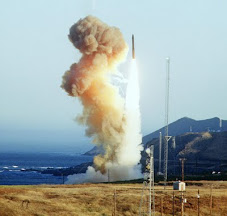
The Air Force prototype Prompt Global Strike design is a modified Peacekeeper III intercontinental ballistic missile. If it is successful, the plan is to deploy a handful of the missiles at Vandenberg Air Force Base in California.
The weapons would be overseen by the U.S. Strategic Command, which is responsible for the U.S. nuclear arsenal. Air Force Gen. Kevin P. Chilton, who leads the command, based near Omaha, has said he sees Prompt Global Strike as a niche weapon, not one that could substitute for nuclear arms.
"I look at that as an additional weapon in the quiver of the president to give him options in time of crisis today, in which he maybe only has a nuclear option for a timely response," Chilton told a House committee last month.
Although it is technically simple to replace nuclear warheads on a missile with conventional ones, Prompt Global Strike has been dogged by a significant problem: how to ensure that Russia could tell the difference if a launch occurred.
To alleviate the risk of an accidental Russian nuclear retaliation, the Air Force is developing a conventional, land-based ballistic missile that would fire into space at a much lower altitude than nuclear warheads, something that could be detected by Russian early-warning radar systems. U.S. military officials have also said they might be willing to grant access to Russian inspectors, or warn Moscow about a conventional strike on a third-party target.
The Army is working on a separate design that is not as far along in its development. The Navy had been preparing yet another design -- a conventional version of its submarine-based Trident missile -- but Congress curtailed that program two years ago because of concerns that it was too difficult to distinguish from a nuclear-armed Trident.
Critics acknowledge that the technological hurdles are surmountable. But they say a more basic problem is that taking the nuclear part out of the equation could make it too easy for the White House to order a Prompt Global Strike attack. Intelligence in fast-breaking crises is rarely rock-solid, they note, and could result in a rushed strike on the wrong target.
"People watch '24' and think that's how intelligence comes in," said Jeffrey G. Lewis, director of the Nuclear Strategy and Nonproliferation Initiative at the New America Foundation. "It's not like the president has his brain cybernetically linked to satellite images."
But proponents of Prompt Global Strike said its primary value would be in adding a level of deterrence to the U.S. nuclear arsenal. "At the end of the day, anybody who would be your adversary walks away thinking, 'If I'm going to do this, I'm going to pay dearly,' " Cartwright said last month. "There just can't be any doubt in their mind."
Global Network Against Weapons & Nuclear Power in Space
PO Box 652
Brunswick, ME 04011
(207) 443-9502
globalnet@mindspring.com
www.space4peace.org
http://space4peace.blogspot.com/ (blog)
Showing posts with label Air Force Global Strike Command. Show all posts
Showing posts with label Air Force Global Strike Command. Show all posts
Friday, April 9, 2010

Wednesday, December 2, 2009
Text Fwd: US: Global Strike Command Takes Over ICBMs Today
StopNATO
Australia.to
December 1, 2009
Global Strike Command Assumes Ballistic Missile Mission
WASHINGTON: Air Force Global Strike Command assumes the U.S. Air Force's
Intercontinental Ballistic Missile mission today.
The transfer of the mission is part of a phased approach, which began in August
with the activation of the Global Strike Command, to unify all Air Force
nuclear-capable assets under one command, officials said.
"We are well on our way to consolidating all of our Air Force assets in this
critical mission area under a single command - one that will serve as a single
major command voice to maintain the high standards necessary for stewardship of
our nation's most powerful weapons," said Lt. Gen. Frank G. Klotz, commander of
the Global Strike Command.
The new command gains three missile wings, one each at F.E. Warren Air Force
Base, Wyo.; Malmstrom Air Force Base, Mont.; and Minot Air Force Base, N.D.,
with the assumption of the entire 20th Air Force mission, including that
organization's responsibility for all of the United States' 450 ICBMs.
The 576th Flight Test Squadron at Vandenberg Air Force Base, Calif., as well as
the 625th Strategic Operations Squadron at Offutt Air Force Base, Neb., also now
come under the Command's responsibility. Previously, all of those units were
part of Air Force Space Command.
"The creation of this new command reflects the Air Force's firm and unshakable
conviction that nuclear deterrence and global strike operations are a special
trust and responsibility — one that we take very seriously," Klotz said.
On Feb. 1, Global Strike Command also will gain 8th Air Force, based at
Barksdale, and along with it, 8th Air Force's nuclear-capable bombers. At that
time, the command also will acquire the B-52 Stratofortress wings at Barksdale
and Minot, and the B-2 Spirit wing at Whiteman Air Force Base, Mo.
The Air Force Global Strike Command was established in an effort to boost
security and reduce errors.
In a 2007 incident, nuclear weapons were loaded aboard a B-52 bomber at Minot
Air Force Base and flown to Barksdale before the mistake was discovered. In
another incident, nuclear nose cones mistakenly were shipped to Taiwan. As a
result, then-Air Force Secretary Michael Wynne and then-Air force Chief of Staff
Gen. T. Michael Moseley resigned. Another 15 officers, including six generals,
were disciplined.
The new command is part of a roadmap to improving the Air Force's Stewardship of
its nuclear program, Air Force Secretary Michael B. Donley said during an
October 2008 Pentagon media roundtable to introduce the plan.
"This is a critical milestone for us. It's a new starting point for
reinvigoration of this enterprise," he said then. "The changes we make today
will help us focus on this enterprise regardless of other changes in Air Force
missions along the way, and regardless of how big or small the nuclear
enterprise is."
---------------------------------------------------------------------------
KSLA-TV
November 30, 2009
KSLA News 12 visits Global Strike Command Headquarters
BARKSDALE AFB, LA: At midnight Monday night 10,000 airmen from around the
country officially begin work under Barksdale's new Global Strike Command.
Monday morning KSLA News 12 was given a first-hand look at the Global Strike
Command's new headquarters at Barksdale Air Force Base.
Lt. General Frank Klotz visited with us just moments before leaving to meet with
airmen at bases in Montana, North Dakota and Wyoming.
The Global Stike Command gains those three missile wings and the responsibility
of their intercontinental ballistic missile operations, or I.C.B.M's.
So outside Barksdale's gates, what should we expect?
"There should be no impact to the local community outside of the gates, other
than the fact that people working in the headquarters will continue to move to
the Shreveport-Bossier City area," says Lt. General Frank Klotz. "Therefore
they'll be looking for houses, they'll be looking for apartments to rent, and
they'll be placing children in local schools."
By the end of next summer, Lt. General Klotz says 23,000 will fall under Global
Strike's command, with close to 900 new airmen calling Barksdale home.
....
===========================
Stop NATO
* Related article:
AirForce Times
Nuclear wings set to join Global Strike Command
By Michael Hoffman - Staff writer
Posted : Tuesday Dec 1, 2009 15:55:55 EST
(Informed in Defense News)
Australia.to
December 1, 2009
Global Strike Command Assumes Ballistic Missile Mission
WASHINGTON: Air Force Global Strike Command assumes the U.S. Air Force's
Intercontinental Ballistic Missile mission today.
The transfer of the mission is part of a phased approach, which began in August
with the activation of the Global Strike Command, to unify all Air Force
nuclear-capable assets under one command, officials said.
"We are well on our way to consolidating all of our Air Force assets in this
critical mission area under a single command - one that will serve as a single
major command voice to maintain the high standards necessary for stewardship of
our nation's most powerful weapons," said Lt. Gen. Frank G. Klotz, commander of
the Global Strike Command.
The new command gains three missile wings, one each at F.E. Warren Air Force
Base, Wyo.; Malmstrom Air Force Base, Mont.; and Minot Air Force Base, N.D.,
with the assumption of the entire 20th Air Force mission, including that
organization's responsibility for all of the United States' 450 ICBMs.
The 576th Flight Test Squadron at Vandenberg Air Force Base, Calif., as well as
the 625th Strategic Operations Squadron at Offutt Air Force Base, Neb., also now
come under the Command's responsibility. Previously, all of those units were
part of Air Force Space Command.
"The creation of this new command reflects the Air Force's firm and unshakable
conviction that nuclear deterrence and global strike operations are a special
trust and responsibility — one that we take very seriously," Klotz said.
On Feb. 1, Global Strike Command also will gain 8th Air Force, based at
Barksdale, and along with it, 8th Air Force's nuclear-capable bombers. At that
time, the command also will acquire the B-52 Stratofortress wings at Barksdale
and Minot, and the B-2 Spirit wing at Whiteman Air Force Base, Mo.
The Air Force Global Strike Command was established in an effort to boost
security and reduce errors.
In a 2007 incident, nuclear weapons were loaded aboard a B-52 bomber at Minot
Air Force Base and flown to Barksdale before the mistake was discovered. In
another incident, nuclear nose cones mistakenly were shipped to Taiwan. As a
result, then-Air Force Secretary Michael Wynne and then-Air force Chief of Staff
Gen. T. Michael Moseley resigned. Another 15 officers, including six generals,
were disciplined.
The new command is part of a roadmap to improving the Air Force's Stewardship of
its nuclear program, Air Force Secretary Michael B. Donley said during an
October 2008 Pentagon media roundtable to introduce the plan.
"This is a critical milestone for us. It's a new starting point for
reinvigoration of this enterprise," he said then. "The changes we make today
will help us focus on this enterprise regardless of other changes in Air Force
missions along the way, and regardless of how big or small the nuclear
enterprise is."
---------------------------------------------------------------------------
KSLA-TV
November 30, 2009
KSLA News 12 visits Global Strike Command Headquarters
BARKSDALE AFB, LA: At midnight Monday night 10,000 airmen from around the
country officially begin work under Barksdale's new Global Strike Command.
Monday morning KSLA News 12 was given a first-hand look at the Global Strike
Command's new headquarters at Barksdale Air Force Base.
Lt. General Frank Klotz visited with us just moments before leaving to meet with
airmen at bases in Montana, North Dakota and Wyoming.
The Global Stike Command gains those three missile wings and the responsibility
of their intercontinental ballistic missile operations, or I.C.B.M's.
So outside Barksdale's gates, what should we expect?
"There should be no impact to the local community outside of the gates, other
than the fact that people working in the headquarters will continue to move to
the Shreveport-Bossier City area," says Lt. General Frank Klotz. "Therefore
they'll be looking for houses, they'll be looking for apartments to rent, and
they'll be placing children in local schools."
By the end of next summer, Lt. General Klotz says 23,000 will fall under Global
Strike's command, with close to 900 new airmen calling Barksdale home.
....
===========================
Stop NATO
* Related article:
AirForce Times
Nuclear wings set to join Global Strike Command
By Michael Hoffman - Staff writer
Posted : Tuesday Dec 1, 2009 15:55:55 EST
(Informed in Defense News)
Monday, November 16, 2009
Text Fwd: Ready To Strike: U.S. Unified Nuclear Global Strike Command
 * Image source/ caption: Eloise Ogden/Minot Daily News
Members of the 91st Security Forces with the 91st Missile Wing at Minot Air Force Base train
for close quarters combat Nov. 5. The wing will be under a new command, Air Force Global Strike Command,
as of Dec. 1 but the jobs of wing personnel will not change.
The 5th Bomb Wing becomes part of the new command Feb. 1.
 * Image source/ caption: Eloise Ogden/Minot Daily News
A crew with the 54th Helicopter Squadron at Minot Air Force Base gets ready to leave the base Nov. 5
to support the mission of the 91st Missile Wing in the Minot missile field.
When the helicopter squadron members and others in the missile wing become part of Air Force Global Strike Command on Dec. 1, their jobs remain the same. The 5th Bomb Wing will join the new command Feb. 1.

* Text informed by Rick Rozoff (rwrozoff@yahoo.com)
'It is the only base in the Air Force with dual nuclear-capable wings the 5th Bomb Wing and its B-52 bombers and the 91st Missile Wing and its 150 intercontinental ballistic missiles in underground facilities in northwest and north-central North Dakota.
When the new command is fully operational, it will have more than 23,000 people....Air Force Global Strike Command, which will bring together all strategic nuclear forces under one commander, was activated Aug. 7 at Barksdale AFB, the base selected for its headquarters.'
Minot Daily News
November 15, 2009
Ready to strike
Missile, bomb wings to become part of Global Strike Command
By ELOISE OGDEN, Regional Editor (eogden@minotdailynews.com)
MINOT AIR FORCE BASE Members of the 91st Missile Wing at Minot Air Force Base will make history Dec. 1 when they become part of a new command Air Force Global Strike Command. The new command will oversee all of the Air Force's nuclear forces intercontinental ballistic missiles and bombers.
They'll be under a new command but the men and women who serve in the Minot missile wing won't notice much change in their jobs, except they'll be wearing the new Global Strike Command patch on their uniform, say new command officials.
Neither will airmen with the 5th Bomb Wing at the Minot base see a major change in their jobs when that wing becomes part of the new command on Feb. 1.
However, Minot AFB will be the most unique Air Force base in the new command, as it is now.
It is the only base in the Air Force with dual nuclear-capable wings the 5th Bomb Wing and its B-52 bombers and the 91st Missile Wing and its 150 intercontinental ballistic missiles in underground facilities in northwest and north-central North Dakota.
When the new command is fully operational, it will have more than 23,000 people, said Lt. Gen. Frank G. Klotz, commander of Global Strike Command, who visited the base and Minot community last month.
Klotz, who has a nuclear background, is a former commander of the 91st Missile Wing at Minot AFB.
The new command was established as part of a roadmap developed by the Secretary of the Air Force and Chief of Staff of the Air Force to refocus energy on the Air Force's nuclear enterprise, Klotz said.
Lt. Col. John Thomas, director of Public Affairs for Global Strike Command, said what is less visible in this reinvigoration of the nuclear enterprise is an organization which has been created in the Air Staff at the Pentagon, which is just about nuclear issues.
Thomas accompanied Klotz to the Minot base and Minot community last month.
Air Force Global Strike Command, which will bring together all strategic nuclear forces under one commander, was activated Aug. 7 at Barksdale AFB, the base selected for its headquarters.
Currently, there are about 250 people at the headquarters. More people come in the door every day," Thomas said. "By the end of summer 2010, there will be 900 or so people who are just dedicated to the reinvigoration of the nuclear enterprise," he said.
The new command will be taking on the nuclear-capable missiles ICBMs and bombers B-52s and B-2s. The B-1 bombers will not become part of the new command because that bomber does not have a nuclear role, Thomas said.
A second squadron of B-52s, the 69th Bomb Squadron at Minot AFB, was reactivated in September and joins the 23rd Bomb Squadron at the Minot base.
Laurie Arellano, chief of Public Affairs at the Minot base, said about 200 military members have arrived at the base out of the 700 or so military members plus their families projected for the new B-52 squadron.
The new squadron should be fully operational by October 2010, she said. "We will be operational with all planes by that time," she said. The base will be getting more planes from Barksdale AFB to add to its existing fleet.
When the ICBM units come under the new command on Dec. 1 and the bomber units on Feb. 1, the command will be fully operational.
But Thomas said they won't be fully operational and capable until the end of the summer. "It will take a while to build out that whole structure. In the meantime, Air Combat Command and Air Force Space Command are there to make sure nothing is dropped," he said.
-
Host wing, installation commander
Under the new command, the 5th Bomb Wing will remain as it is now as the host wing at the Minot base and its commander will remain in his capacity as bomb wing commander and installation commander, Klotz said.
Col. Douglas Cox became commander of the bomb wing replacing Col. Joel Westa Oct. 30. Earlier in October, Col. Fred Stoss III replaced Col. Chris Ayres as missile wing commander.
Even for the short time that the missile wing is under the new command and the bomb wing still is under Air Combat Command, the relationship of the bomb wing being the host wing will be unchanged, Thomas said. He said the Public Affairs Office at the Minot base also will remain under the bomb wing and support both wings as it does now.
Although there aren't major changes planned for Minot AFB, Klotz is looking to replace the helicopters for larger, speedier ones to support the post 9-11 mission. The 54th Helicopter Squadron, which is a unit of the 91st Missile Wing, flies UH-1N helicopters.
By being unified under a single major command, Thomas said perhaps it will make it easier for resourcing the base.
Global Strike Command officials will be keeping a close watch on two important reviews being done by the Department of Defense.
Those reviews the Nuclear Posture Review and the Quadrennial Defense Review are under way now, Klotz told members of the Minot Area Chamber of Commerce when he spoke to them last month.
The reviews determine force structure requirements and final reports for both reviews will be provided to Congress in early 2010.
Whatever the outcome is of the reviews, Klotz said the role of the airmen at the Minot base will be the same.
__________________________________________________________________
Fact Box
Air Force Global Strike Command units
As of Dec. 1, 20th Air Force, with its headquarters at F.E. Warren Air Force Base, Wyo., will come under Air Force Global Strike Command, along with its units:
- 91st Missile Wing at Minot AFB
- 90th Missile Wing at F.E. Warren AFB
- 341st Missile Wing at Malmstrom AFB, Mont.
All three missile wings are intercontinental ballistic missile wings.
As of Feb. 1, 8th Air Force, with its headquarters at Barksdale AFB, will come under the new command, along with its units:
- 5th Bomb Wing at Minot AFB
- 2nd Bomb Wing at Barksdale AFB
- 509th Bomb Wing at Whiteman AFB, Mo.
The Minot and Barksdale wings have B-52s and the Missouri wing has the B-2.
Two direct reporting units also will be part of the new command:
- 576th Flight Test Squadron (ICBM test) at Vandenberg AFB, Calif.
- 625th Strategic Operations Squadron at Offutt AFB, Neb.
____________________________________________________________________
===========================
Stop NATO
Subscribe to:
Posts (Atom)

![[URGENT PLEA: In Update] EMERGENCY in GANGJEONG Since AUG. 24, 2011](https://blogger.googleusercontent.com/img/b/R29vZ2xl/AVvXsEiQvpaNf6EePZVucu97_JphYsFS5IgumnSiA4YAmen1PZcim6vMmW7XjZ7J6nLh-Cu36mwBN5n1evrA3ey0vYMpwlAGsgnSFggv6a1w4Qx9BvvqOB0hy0BIcBkL2Exfs3zIxBsBuDGa1kzg/s227/jejusit.jpg)


![[Solidarity from Japan for the Jeju] 253 individuals and 16 groups/organizations](https://blogger.googleusercontent.com/img/b/R29vZ2xl/AVvXsEivji7100kBkr0hzvqYfh4IBBilkZ6XgDIg89jOxS6kTssxsVKC6Wm-fZbKOEsiy3zcO-9gW6GHspD5R_2C9WsGx5S1Z5VPj_OVRF7H6dxdaT0S-2H1eqsDsYvIwOV26VscxTHnKmP5iZmh/s227/jeju_12_10j.jpg)

![[Translation] Korean organizations' statement: Immediately cancel the joint ROK-US drill Nov 26](https://blogger.googleusercontent.com/img/b/R29vZ2xl/AVvXsEgfKDMo-qyEjm5asUtHlREyJY_5Ou-2tyB8SH6aUxiViRbbKR-8W_rirFiGp5DYSoD_KaeNOPMWR0af0ZPUIbJKmR89ImDvADHsGAIqsJVBvJNBEIl5wLd3G_zhPDW3Z2SxsHXadOsXe8st/s227/1.jpg)
![HOT! [Hankyoreh Hani TV] Beneath the Surface: the investigation into the sinking of the Cheonan](https://blogger.googleusercontent.com/img/b/R29vZ2xl/AVvXsEh80rL3Qv9GnfHSqbYMfivdqX5gZN-1O_VQj3A_Gk3yjWdybHwJCsprA3l6cEQB0cYCP2oNeaLo2ohLGIy0Uqqkv_fRkBevGJ2f-qkKD5eP1ZGsKeQ-r-jHUUb79WvucIN7hpEtXza4xXCL/s227/HaniTV+Cheonan.gif)


![[Translation]Statement against illegal inspection and unjust lay-off by the Kunsan USAFK!(Nov_2010)](https://blogger.googleusercontent.com/img/b/R29vZ2xl/AVvXsEg3JlQ-lreusCIJo5Yv2e3ZrRwrSMUE7UQxlrDVjmBehl0Pa24QZIAbZ5vUpgnnExbkKL9PdCwxVYSHWJkr_XK0FM4EhU3CMFhqfborVNu_p4v3bEFpNm3ia-aEHnvMMuEBI27aB7_BETuJ/s227/gunsan+protest.gif)
![[Translation] Korean organizations' statement against dispatching special force to the UAE on Nov.](https://blogger.googleusercontent.com/img/b/R29vZ2xl/AVvXsEiU7TNhTDLLwZkKP0Z78JsCZKp6je-QSFll3_ThmLES_y_nPLXEzeakrsZXoNxhN5blopEhy6xGV2tneJrniPdTR-JvOQMmSLr_HhlucxFvbusxk4oKvvMO2laBOHSIkB9OOeOxrQlqCA0O/s227/antiwarpeace.jpg)
![[Translation] Stop, Joining MD!: South Korean activists' statement and writing on Oct. 25, 2010](https://blogger.googleusercontent.com/img/b/R29vZ2xl/AVvXsEggGIHVei8j7LCJPJB5HIrspd942q436daNTquP-pFd45Cl70Ml_1JFiFDHgKu6FcoqNgFVKIFqjeuSPau2k_BwGHhx0cqFFL2-4ybZSTlmua0_AsERBtKYQa7jZk7uNj41LX6rj2vksHbo/s227/StopMD.jpg)
![[In Update] People First, NO G-20 (Nov. 6 to 12, Korea)](https://blogger.googleusercontent.com/img/b/R29vZ2xl/AVvXsEhZl8VTqeL7o2ndliGIE-sZFCikbTgfB9KCc3AtZvDaYijBBEhdfultMEOpyrCaD5gzpH8mqfWjU20KXMbSUl-5KM7yQeHU6z3BWV8tiOy4UKaCudz9VKWoi5x58xdC_gQpJTjkR5u7O9xf/s227/left21_G20.jpg)
![[International Petition] Stop US helipad plan in Okinawa to save great nature](https://blogger.googleusercontent.com/img/b/R29vZ2xl/AVvXsEihgYmdb0N8ViPvTFC_5i-Psbt4eX_LnAUEOtZkUngv_pGvRyWag1r6W60NicLLyTgWq-sPT1hBxLY5SadEIVv5McfZQ5uIhe-W0VoflQNqojsYZjFW6AH-gB1jsmSDGnGuKIFk2UkvNbFG/s227/yanbaru_w.jpg)
![[Global Network] against the first launch of Quasi-Zenith Satellite, Japan, on Sept. 11, 2010](https://blogger.googleusercontent.com/img/b/R29vZ2xl/AVvXsEj2sYpfodDDMIA7qXwuda0DmKapxXFB479fDnn8RKy7QNZqz0VEvWucNd-DleZ37hWNXC-Z8QtaqtM37VuPwac5SgclJ9_khBBSWOedvm19MRXIP1j1kcWrK6EW5IFjQdEEY2h7E6xuyNvC/s227/Qzss-45-0_09.jpg)
![[In update] Some collections on the Koreans’ protests against the sanction & war on Iran](http://4.bp.blogspot.com/_gnM5QlRx-4c/TJMvke6t8zI/AAAAAAAAFO4/tamQ8LUnOOA/S227/No+Sanction+on+Iran.jpg)
![[Three International Petitions] to End the Korean war and peace treaty(or peace resolution)](https://blogger.googleusercontent.com/img/b/R29vZ2xl/AVvXsEhlohLVYtpCg7iMsZhNYY4hBbhTi2dIheHMHWLDph9X2y78cjgZV1LeSfUJeu80elhJm70Q9E059q72lK-spSPvsRG4bPuCDIytltJB9IH3mWt9OG98HqhnTsPakwhvNeoCFUgF1xoxQ2EZ/s227/border.jpg)


![[Collection of Documents] No Base Learning and Solidarity Program_Korea(June 14 to 20, 2010)](https://blogger.googleusercontent.com/img/b/R29vZ2xl/AVvXsEix_HzjToh3nNGHBc-_5gasq-ykcaZ6GInLixILmZVyRJ5xoeHCxWOyYd9fSM7bmnuFsjSrYOGEPnQOwB1Dcyo-sN4Pw0cFPhUtKig_qlVnGL1Wi82ClvPqbEPWYhJiqdNF0DyzLIBETMB9/s227/No-Base-banner.jpg)
![Site Fwd:[John Hines] A U.S. Debate coach’s research trip on the Issues of Korea](https://blogger.googleusercontent.com/img/b/R29vZ2xl/AVvXsEg8yRra0zNhKHN74Auqhd3Nx9tZ7BWCGflRJHGH4CfzBT_yjhZ8Nl9b3OZuLpYWJ2exsjmR0oVl-Qq_cf832p2VdmOZhUi-lCFzCNeDSyVtweX1lWZPC-RlHmDMLtilHwHjNFTenBiM4Fk4/s227/Jeju-Peace-Tour.jpg)


![[News Update] Struggle Against the Jeju Naval Base since Jan. 18, 2010](https://blogger.googleusercontent.com/img/b/R29vZ2xl/AVvXsEhKfSTRC5QKBBSFIq_m7QIqXdlbL4-gF5GJYn9Q-pN__k7sV7uxGDcLY5L8xmU7QuWuUhBT_GhG-URBPO80RT3AfWfDrWJr06h1hFuZC6ZBVKe4U6PS1Cd7Kr6olO8TYQtk13Drox7IS6ea/s226/scrum1.jpg)


![[Urgent] Please spread the Letter!: There was no Explosion! There was no Torpedo! (May 26, 2010)](https://blogger.googleusercontent.com/img/b/R29vZ2xl/AVvXsEhSd2yWZ3xGwnJQXB73z5FgXCqSosAoB9_33-GLYprOmLqjmvgSAQp1BYI7e4slK1FDxHRi9KK4um-OpDaj8QOkXwAScVAgvvq6-ehbDA-hbkr96wT9oHNNmWnBPv8GU4hoZp9X8F9AZBX4/s227/grounded.jpg)
![Text Fwd: [Stephen Gowans]The sinking of the Cheonan: Another Gulf of Tonkin incident](https://blogger.googleusercontent.com/img/b/R29vZ2xl/AVvXsEi_L6hB3RZ1MovTXHe0A8yn_RfgMALGR0kM6poBuGp809xwvHtB_-PGWtS_WpyPWatyd9lB2pPqL2gOLc4dTCEdJ9sMvxJWEdapl-mMLm7WHAsV-jVpgqarVh8XBtdz_0c-Vohdh3HtJahD/s227/lee-myung-bak.jpg)
![[Japan Focus]Politics in Command: The "International" Investigation into the Sinking of the Cheonan](https://blogger.googleusercontent.com/img/b/R29vZ2xl/AVvXsEiHmTo8v-uCJnabRhMdnBAkC9J3s5bb2JsDKiT5leJHwbK8IDJHxfJmqQ_C0Is_bPC6UGMf05CA0exF2y4r2x9RhFUHT0kjsKviaME_MZXKnq775UyYAdb7w2SAzE75XvBfHp1al2q6i3cf/s227/wen_jiabao_and_lee_myungbak.png)
![[Japan Focus] Who Sank the SK Warship Cheonan? A New Stage in the US-Korean War and US-China](https://blogger.googleusercontent.com/img/b/R29vZ2xl/AVvXsEiKSS5ULT5QBaMGYpXXqBMX9jtwLwMLuK469b6Ku72GTJYKUObzTANaPjZqvvpPzYMJgPF53sjhvhK3DVa88ipYlggsJageykXlkxY6s8TW05xcU-_vfhf-pACUoaWuFbT-fsU1qEhm_yIi/s227/buoy_map.gif)
![[Updated on 12/13/10] [Translation Project] Overseas Proofs on the Damages by the Military Bases](https://blogger.googleusercontent.com/img/b/R29vZ2xl/AVvXsEikADE6JovUNspQyZUWVMTLAQg7yQNqXpVUbqZPk8f4uc_1723_xm1Cco6WAmstQXVPnaJAcb1mZA8Ny_3xONT_f5uh8MNLPnUhtqdGgy3HCtC1Vbbz4Q0ZY1Cssu-4cJEVNdrvznbS5UzO/s227/missile.jpg)
![[International Petition] Close the Bases in Okinawa](https://blogger.googleusercontent.com/img/b/R29vZ2xl/AVvXsEhNpQiHklwFbWVlFK7GDFXnBSOOSFEj3Il-We-N3uTDldKiidL2NGZs7X_LtTnatzTo_r8CexRkFe8NhfxYqmgp1knEEslROTfNjI5_mSb57cdbhPkftvanveYBaevAD9xuKDGoIxiTwoSb/s227/2.jpg)

![[In Update]Blog Collection: No Korean Troops in Afghanistan](https://blogger.googleusercontent.com/img/b/R29vZ2xl/AVvXsEjjEmCRXSNAG7_QBxKWbdksmxoWR4nyAovQTTdR1G2AuXh0jxtqNkI9OmYgYWRoLAJShvtBvE840QXuBWSVh3u3zMYqkNAFX6OWy3m5Nur4HM7uNK-pKT1ycyApJp-VLyhIFRRcoisYAh0E/s226/No-Troops-to--Afghanistan.jpg)


