'저는 그들의 땅을 지키기 위하여 싸웠던 인디안들의 이야기를 기억합니다. 백인들이 그들의 신성한 숲에 도로를 만들기 위하여 나무들을 잘랐습니다. 매일밤 인디안들이 나가서 백인들이 만든 그 길을 해체하면 그 다음 날 백인들이 와서 도로를 다시 짓곤 했습니다. 한동안 그 것이 반복되었습니다. 그러던 어느날, 숲에서 가장 큰 나무가 백인들이 일할 동안 그들 머리 위로 떨어져 말과 마차들을 파괴하고 그들 중 몇몇을 죽였습니다. 그러자 백인들은 떠났고 결코 다시 오지 않았습니다….' (브루스 개그논)


For any updates on the struggle against the Jeju naval base, please go to savejejunow.org and facebook no naval base on Jeju. The facebook provides latest updates.
Showing posts with label Migrants. Show all posts

Wednesday, March 23, 2011

Photo & Text Fwd: Up against discrimination


Hankyoreh
Up against discrimination
Posted on : Mar.22,2011

Michel Catuira, chairperson of the Seoul-Gyeonggi-Incheon Migrants’ Trade Union (MTU) in South Korea, and South Korean human rights activists urge the government to stop discriminative policy according to race, color and nationality at a news conference in front of the National Human Rights Commission of Korea on Mar. 21, International Day for the Elimination of Racial Discrimination.

In regards to the Ministry of Law’s rejection to his application for extension of stay on Mar. 18, Catuira said, “It was anticipated, but disappointing.”

Recently a court suspended an execution of the Immigration Office ordering his deportation, accepting the 39-year-old Filipino national’s request for suspension of administrative measure.

Tuesday, March 1, 2011

Text Fwd: Amnesty International Call for Action


Two Koreas: Movements, Politics, and Social Space on the Korean Peninsula
Wednesday, February 23, 2011
Amnesty International Call for Action

Here is an urgent call for action put out by Amnesty International in support of Michel Catuira, current MTU President.

URGENT ACTION

TRADE UNIONIST AT RISK OF FORCED DEPORTATION
Michel Catuira, President of the Seoul-Gyeonggi-Incheon Migrants’ Trade Union (MTU) in South Korea is at risk of being deported. The Korea Immigration Service has told him that he must leave the country by 7 March or he will become undocumented and subject to forcible deportation. Amnesty International believes he has been targeted for his role in the MTU.

As of 7 March 2011, Michel Catuira, a 38-year-old Filipino national and President of the MTU, will be subject to forcible deportation from South Korea. The government of South Korea refuses to recognize the legitimacy of the MTU and has staged a number of crackdowns on its leaders since it was founded in 2005.

The harassment of Michel Catuira began in July 2010. The Ministry of Employment and Labour ordered him and his employer to appear for an interview under suspicion of a false employment relationship. The Ministry did not find any prosecutable violation of labour or immigration law. However, it found that Caturia’s workplace, a shoe factory, had little business. As the main goal of the Employment Permit System (EPS) is to provide foreign labour to companies with labour shortages, the Ministry sent a memo to Michel Catuira’s employer suggesting that they file a change of workplace for him.

In November 2010, Michel Catuira was called to appear before an investigation team of the Korea Immigration Service on “suspicion of violation of the Immigration Control Act in the course of applying for a workplace transfer and with relation to actual performance of work duties at present”. They concluded that he was not working at the shoe factory, thus, the grounds for his work visa was “deceitful”, in breach of article 89.1 of the Immigration Control Act. On 10 February, the immigration authorities cancelled his visa, and on 14 February, he was told that he had until 7 March to leave South Korea.

The MTU has been very vocal during the past few years in favour of the respect, protection and promotion of the rights of migrant workers in South Korea. In particular the MTU has spoken out against restrictions placed on migrant workers’ freedom to change workplaces and against immigration raids, which have resulted in arbitrary arrests, collective expulsions and violations of law enforcement procedures, including the excessive use of force.

PLEASE WRITE IMMEDIATELY in English, Korean or your own language, urging the authorities of South Korea to:

Restore Michel Catuira’s visa status and refrain from forcibly deporting him;
Immediately stop all practices which result in obstacles or deterrents to actively participating in trade unions;

Immediately remove obstacles to participating in the Seoul-Gyeonggi-Incheon Migrants’ Trade Union (MTU), in particular by recognizing its status as a legal union in South Korea in line with domestic and international law and standards.

PLEASE SEND APPEALS BEFORE 07 MARCH 2011 TO:
Chief Commissioner of the Korea Immigration Service
SEOK Dong-hyun
Korea Immigration Service
1-19 Gwacheon, NC Building 8th Floor
Byeolyang-dong, Gwacheon
Gyeonggi Province 427-705
Republic of Korea
Fax: +82-2-500-9097/9059
Salutation: Dear Commissioner

Minister of Justice
LEE Kwi-nam
Ministry of Justice
Gwacheon Government Complex
88 Gwanmoon-ro, Gwacheon
Gyeonggi Province 427-720
Republic of Korea
Fax: +82-2-503-3532/7023
Email: webmaster@moj.go.kr
Salutation: Dear Minister

And copies to:
Minister of Employment and Labour
Bahk Jae-wan
Ministry of Employment and Labour
Gwacheon Government Complex
88 Gwanmoon-ro, Gwacheon
Gyeonggi Province 427-718
Republic of Korea
Fax: +82-2-503-6623
Email: molab506@moel.go.kr
Also send copies to diplomatic representatives accredited to your country. Check with your section office if sending appeals after the above date.

Sunday, February 20, 2011

Text Fwd: Stop Repression against the Migrants Trade Union in South Korea!

* Text informed by Steve Zeltzer on Feb. 17, 2011

Union Book
Stop Repression against the Migrants Trade Union in South Korea!
Posted by Wol-san Liem
on February 17, 2011 at 10:24am

-The South Korean Immigration Service has cancelled MTU President Michel Catuira’s visa and ordered him to leave the country by March 7.
-This is yet the last in a long series of acts of repression against MTU!

Background

In 2009, Michel Catuira was elected president of the Seoul-Gyeonggi-Incheon Migrants Trade Union (MTU), a union established for and by migrant workers in South Korea. Since then, he has worked tirelessly to improve the working and living conditions of migrant workers in South Korean society. He has spoken out against restrictions placed on migrant workers’ freedom to change workplaces and other problems in Employment Permit System (EPS), which make migrant workers subservient to their employers. He has also fought for the repeal of the South Korean government’s policy of arrest, detention and deportation of undocumented migrant workers, which has led to countless injuries, deaths and other human rights abuses.

Because he has been a vocal critic of unjust policies, the South Korean government has made President Catuira the subject of an unfair investigation with the ultimate goal of making him deportable. The nature of the investigation, which began in July 2010, is as follows:

By law, President Catuira, a documented EPS Filipino migrant worker, must be employed in order to maintain his legal residence status. President Catuira was lawfully employed by D company in fulfillment of this requirement. In July 2010, however, the Ministry of Employment and Labor summoned him and his employer for questioning, raising suspicions about the validity of their employment relationship. Finding no legal problem, the center continued to pressure President Catuira through his employer by sending a notice to the employer telling him to file to have President Catuira transferred to a different company.

Pressure increased in the wake of MTU activities protesting the death of the Vietnamese migrant worker as the result of an immigration raid. On 23 November 2010, President Catuira received a summons from the Seoul Immigration Service telling him to appear before the Immigration Service’s investigation team to be questioned based on “suspicion of violations of the Immigration Control Law in the course of applying for a workplace transfer and with relation to actual performance of work duties at present.” Inquiry by a lawyer working with MTU revealed that the investigation team was also considering raising suspicions that President Catuira was conducting political activities in violation of the Immigration Control Law. On 2 December 2010, the Ministry of Employment and Labor sent a fax to President Catuira’s employer, notifying him that his permit to employ migrant workers had been cancelled. On 22 December 2010, President Catuira appeared before the Immigration Service investigation team, who question him for roughly 2.5 hours on the nature of his employment.

On 14 February 2011, the Immigration Service informed President Catuira through his lawyer that his visa had been cancelled as of 10 February 2011 at that he was required to leave the country by 7 March 2011. The grounds given for the cancellation of the visa are as follows: that the company where President Catuira was employed did not in exist; that President Catuira was not in fact working at the factory and that, therefore, he was in violation of Article 89.1 of the Immigration Control Act. Article 89.1 states that a visa can be cancelled if it is found to have been obtained in a deceitful or other unlawful manner.

Facts of the Case

Contrary to the Immigration Service’ claims, President Catuira went through all of the necessary legal procedures before being employed at D company. As required, President Catuira received a list of companies registered to hire migrant workers from a Ministry of Employment and Labor Job Center. D company was on this list. After being hired, President Catuira against followed the correct legal procedures, registering his employment status with the Ministry of Employment and Labor and the Immigration Service.

The claim that D company does not exist is also not true. D company had little work after President Catuira was hired, and thus had to shut is door temporarily. However, this cannot be said to be President Catuira’s fault. In fact, during the original investigation in July 2010, the Ministry of Employment and Labor found no violation of the law and could respond only with a memo suggesting that President Catuira move to another workplace. Nonetheless, the Immigration Service went out of its way to find grounds for cancelling President Catuira’s visa so as to make it possible to deport him.

The Ministry of Employment and Labor and Immigration Service’s investigations of President Catuira were carried out in a manner completely outside these agencies’ normal mode of operation. If the South Korean government routinely investigated the companies where migrant workers are employed in such detail, it would find widespread violations including unpaid wages, sexual harassment, failure to submit proper documents, etc. If such investigations were made, perhaps the situation of migrant workers in South Korea would actually improve. Instead of doing this sort of work, however, these government agencies have used their time to target MTU’s president.

Another act of Labor Repression

The investigation and cancellation of Catuira’s visa are nothing more than an attempt to attack MTU and stop its rightful union activities. This attempt is similar to past acts of repression against MTU, in which the South Korean government used the vulnerable immigration status of migrant officers to prevent their union activities, in particular through arrest and deportation. Since MTU was founded in 2005, the government has arrested 6 of its officers, supposedly for violations of Immigration Control Act. Of these 6, 5 were deported. In addition, the South Korean government has refused to recognize MTU’s status as a legal union, claiming that its founders, who were undocumented, do not have the right to freedom of association granted all workers under the South Korean Constitution.

The situation is so severe, that the ILO has issued several recommendations recognizing the arrest and deportation of MTU officers as acts of labor repression and suggesting that they be stopped immediately. The ILO has also affirmed the right of all migrant workers, regardless of visa status, to freedom of association and recommended that the South Korean government recognize MTU’s legal union status.

Our Demands
-Repeal the cancellation of Michel Catuira’s visa and guarantee his secure residence status!
-Stop repression against MTU officers and recognize MTU’s legal union status!

Sunday, December 19, 2010

Text Fwd: [PSSP] From Ratification to Empowerment: Reflections on the 11th International Migrants Day 비준에서 힘강화로: 연간 11번째 국제 이주 노동자의 날을 돌아 보며

People' Solidarity for Social Progress
From Ratification to Empowerment: Reflections on the 11th International Migrants Day
16 December 2010
Wol-san Liem
Research Institute for Alternative Workers Movements

This December 18 with be the 11th International Migrants Day. Founded in December 2000, International Migrants Day marks the anniversary of the General Assembly’s adoption of the International Convention on the Protection of the Rights of All Migrant Workers and Members of the Families (hereafter, the Convention) on December 18, 1990. Around the world, migrant workers and their supporters will use this day to demand changes in national policies, work conditions and social practices that are discriminatory and oppressive towards non-nationals, and call on governments to ratify the Convention, which sets minimum basic standards states must respect.

In the last several decades, recognition of migration as a global phenomenon and the importance of migrant labor to the global economy has increased significantly. Most governments now at least give lip service to the need to protect migrants’ human rights. Nonetheless, only 43 countries, the majority of which are countries of origin, have ratified the Convention. South Korea is among the countries that has not.

If we look at South Korean policies towards migrant workers, this fact is not surprising. The Convention states that, &Migrant workers and members of their families shall be entitled to effective protection by the State against violence physical injury, threats and intimidation, whether by public officials or by private individuals, groups or institutions& (Article 16, clause 2) and that they &shall not be subjected individually or collectively to arbitrary arrest or detention& (Article 16, clause 4). The South Korean government’s sole method for dealing with undocumented migration, however, is to carry out indiscriminate and often violent immigration raids, detain all of those arrested and deport them with out trial. The tragic death of a migrant workers as a result of these policies last month, shows just how brutal they are. On October 29, immigration officers raided a factory in the Gasan district of Seoul during a concentrated immigration crackdown carried out ahead of the G20 Summit. When Trinh Cong Quan, a 35-year-old Vietnamese worker and the father of a 4-month old daughter, found all exits blocked he tried to escape through a second story window. Quan fell and was severely injured. After lying in a coma for several days, he passed away on November 3. Far from taking responsibility, the Seoul Immigration Service simply claimed it had followed legally prescribed procedures and therefore owed nothing to Quan’s bereaved family.

READ MORE

Wednesday, December 8, 2010

Text Fwd: Immigration raid fatalities 이주 노동자 급습 치명타들


Hankyoreh
Immigration raid fatalities
Dec. 7, 2010

Michel Catuira, president of the Migrants’ Trade Union in South Korea, sits among large portraits of migrant workers who died during crackdowns and deportations by the police. The portraits were displayed in an auditorium of the Korean Confederation of Trade Union’s Metropolitan Chapter, Seoul, Dec. 5.

The portraits include details about the cause and process through which the migrant workers reached their tragic death through police crackdowns, which have strengthened in intensity and violence since 2003.

In Catuira’s hands is the portrait of 35-year-old Vietnamese migrant worker Trinh Cong Quan. On Oct. 29, several days prior to the G-20 Summit in Seoul, immigration officers raided a clothing factory where Quan was working in the Gasan neighborhood of Seoul without presenting a warrant. Quan found himself trapped and tried to escape through a window on the second floor. He fell to the ground, and sustained serious head injuries. He was carried to the hospital, but died on Nov. 3.

His wife returned to her hometown in Vietnam holding their four-month baby and his remains.

Dec. 18 is International Migrants Day, designated by the General Assembly of United Nations.

Catuira said, “I hope that Quan is the last victim of the South Korean government’s vicious crackdown on undocumented migrants.”

Reference: http://migrant.nodong.net/?document_srl=54504#26

(Photo by Kim Bong-kyu)

Friday, July 2, 2010

Video Fwd_Best Female Rapper in Korea and racism in Korea


* Video thankfully informed by G. on June 30, 2010

Best Female Rapper in Korea (English Subbed) (Video URL)


'This is a story about a girl who's forced to live as a stranger in Korea, enduring racial prejudice. Tasha (korean name- yoon mi rae) is half African American and half Korean. as she grew up, she had a hard time searching for self identity.
Yeah, korea was a sort of narrow minded society colorwise. The situation is getting better though, i think it's still not better enough. feel sorry for her and ashamed for this :( Go Tasha!! U ROCKS!)!' (From the link)
__________________________________________________________

# With shameful feeling, I cannot but think of the ordeal of the migrant workers' in South Korea as well. Please see.

Hankyoreh
Government crackdown on migrant workers escalates prior to G20
: The government has continued to receive criticism for the violent tactics used and infringements on human rights

July 1, 2010
'An official of the Migrants’ Trade Union (MTU), center, speaks during a press conference held to launch “Cat’s Eye,” a group to monitor human rights infringements against migrant workers during crackdowns in South Korea, June 30.'

Excerpt:

"In September 2008, the Justice Ministry said it would reduce the number of illegal migrant workers by 10 percent from the 220 thousand recorded at the time by 2012. In fact, according to Korea Immigration Service statistics from the end of last year, the number of staff hired to facilitate crackdowns has continued to increase, from 20,455 in 2007 to 30,831 in 2008 and 31,506 in 2009. The Justice Ministry said it is currently conducting its first crackdown from June 7 to July 6, but it has yet to determine exactly how many individuals it has arrested."

Thursday, December 10, 2009

Text Fwd: Human Rights Day in S.Korea: 2,269 refugees in need of emergency relief measures


* Image source/ caption: same as below
'The couple, Mahoma, left, and Bena are from the Democratic Republic of Congo
and have applied for refugee status in South Korea.'


Hankyoreh
Human Rights Day in S.Korea: 2,269 refugees in need of emergency relief measures
NANCEN refugee human rights center reports that minors are being denied the baseline right to live
Posted on : Dec.10,2009 14:09 KST

Last Thursday, four-month-old “Mumbere” suddenly became short of breath. His mother “Bena,” age 30, took him to the hospital, but she had no health insurance and the costs of a four-day hospital stay for pneumonia amounted to one million Won. Bena worried that her two children might have caught the H1N1 influenza, but were unable to receive inoculation because they are “special foreigners.” Her husband, “Mahoma,” age 37, quit working last summer in compliance with refugee application requirements and their most immediate concern is hospital costs.

Mahoma’s family is unable to return to their home country of the Democratic Republic of Congo and applied for refugee status in South Korea in 2006. The South Korean government rejected their application, and their formal objection went unrecognized. The Ministry of Justice sent out a departure order, and the case is now in administrative adjudication.

Refugee applicants like Mahoma and Bena are legally allowed to stay in the country but are unable to do anything, including finding work and receiving an education. Meanwhile, the children they give birth to in South Korea remain without a nationality, unrecognized either in their parents’ home country or in South Korea. Their children are not considered eligible for South Korean citizenship in a society that opts for a jus sanguinis (right of blood) policy on citizenship, and refugees who have fled persecution in their home country are unable to file birth notices with their embassy. Both of the children Mahoma and Bena have had in South Korea are without nationality.

NANCEN, a refugee human rights center headed by Hong Se-hwa, reported Wednesday that as of late 2008 there were a total of 81 refugee minors aged 16 or younger in South Korea, including 65 applicants for refugee status and 16 with recognized refugee status. In 2009, the total number of refugees living in South Korea has reached 2,269. The information was obtained from the Ministry of Justice through an information disclosure request submitted just prior to Dec. 10 or Human Rights Day celebrated around the world.

NANCEN also reported that 28 refugee minors, or 34.7 percent of the total, are infants and small children aged 3 and under, including 23 applicants and five with recognized refugee status. NANCEN said, “These children are not receiving sufficient supplies of necessary inoculations, dry milk, diapers, and other essentials.”

NANCEN stressing that emergency relief measures are necessary and added, “The refugee minors’ situation in South Korea is one of ‘four Nos’ - no nationality, no health care, no education and no attention.”

In a survey of refugee human rights in South Korea issued last year by the National Human Rights Commission of Korea (NHRCK), 80.6 percent of the 309 participants answered that their children lacked nationality, while 81.4 percent reported having no health insurance of any kind. Additionally, some 25 percent said their children were not receiving any education.

Kim Sung-in, secretary general of NANCEN said, “Societal interest in international refugees and international relief efforts has risen greatly in recent years, yet people are apathetic about refugees in South Korea, and refugee minors in particular.”

Kim added, “This is a time when we urgently need the members of society to extend a warm helping hand so that the baseline right to live is protected for all refugees who come to South Korea.”

Please direct questions or comments to [englishhani@hani.co.kr]

Friday, November 13, 2009

Text Fwd: CESCR draws a grim picture of human rights in South Korea


* Image source: same as below

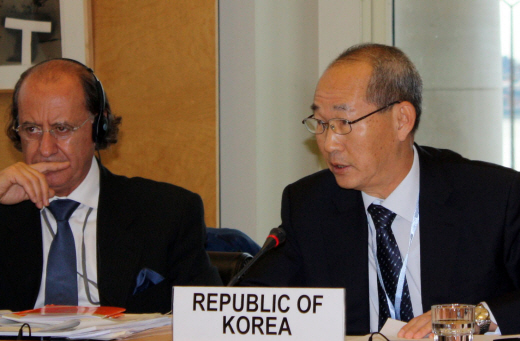
'Lee Sung-joo, the Permanent Representative of the Republic of Korea to the United Nations (UN) Office
at Geneva answers questions from the Experts of the Committee
on Economic, Social and Cultural Rights at the UN building in Geneva, Nov. 10.'


Hankyoreh
CESCR draws a grim picture of human rights in South Korea:
UN representatives points out concerns with migrant workers’ issues and forced evictions, and suggests funds for river project could be better spent elsewhere
Posted on : Nov.13,2009 12:01 KST

Experts of the United Nations (UN) Committee on Economic, Social and Cultural Rights (CESCR) has been examining current issues in South Korea, including the Yongsan tragedy, through the lens of the International Covenant on Economic, Social and Cultural Rights (ICESCR) at the UN building located in Geneva, Nov. 11. This is results of discussion on the South Korean issue.

On the National Human Rights Commission of Korea

An expert questioned why the staff of the National Human Rights Commission of Korea (NHRCK) had been reduced by 30 percent. Another expert noted that its budget had also been drastically reduced and that the Chairman of the Commission does not have competence in human rights. One expert wondered if the ICESCR was considered non-judiciable by the Republic of Korea. If so, the government would be denying even the minimum standards applicable to the provisions of the ICESCR.

On pursuing the privatization of public services

One expert said that the privatization of certain public services, such as healthcare, water and electricity, in the Republic of Korea has become a cause of concern because the state risks being no longer able to comply with its obligations under the ICESCR. The expert asked how the state party anticipates being able to comply with the essential minimum obligations to protect economic, social and cultural rights from the influence of third parties.

On the Four Major Rivers Restoration Project

Regarding development projects, an expert noted that the Four Major Rivers Restoration Project is being criticized because of its tremendous budget allocation, and because the economic return derived from it would be too little. They are saying the money used for it could have been better used.

One expert also clarified that she had not previously stated a concern in how the budget for the project had been taken from the government’s welfare budget, but rather had intended to highlight the fact that there have been no prior consultations held with groups directdly affected by the project.

On the downsizing at the Ministry of Gender Equality

An expert noted that the Ministry of Gender Equality has been downsized, and that this has had a weakening effect on plans to improve gender equality.

On labor issues

In addressing working hours, an expert noted that the Republic of Korea had the highest number of working hours in the Organization for Economic Co-operation and Development (OECD), the highest record of industrial accidents in the OECD area and also had a high rate of deaths in the workplace. There are currently only 350 labor inspectorates in the country. The expert said labor inspectors are apparently more focused on investigating undocumented migrant workers rather that inspecting corporations for safety and occupational hazards.

On demonstrations

Turning to the matter of strikes and demonstrations, one expert noted that holding demonstrations in downtown Seoul have become no longer possible due to an article of the penal code regarding obstruction of business. The expert questioned why trade unions’ rallies and demonstrations were being banned and the exact meaning of “obstruction of business.”

One expert made reference to a disproportionate number of military and police personnel deployed in Seoul around a peaceful demonstration she had witnessed.

On migrant workers

Turning to the situation of migrant workers in the Republic of Korea, one expert noted that there were several problems linked to restriction of labor mobility, safety and health, and services offered to foreign workers.

An expert said Amnesty International had reported about the problem of exploitation and trafficking of workers in the Republic of Korea’s entertainment industry. The country has signed, but not yet ratified the Protocol to Prevent, Suppress and Punish Trafficking in Persons, Especially Women and Children.

In addition, the Republic of Korea seems to have a very narrow definition of trafficking, which only includes trafficking for prostitution. However, there have been incidences of sex trafficking within the entertainment industry. Women from the Philippines are often recruited to work in bars and nightclubs and at the end of the day are very often forced to offer their sex services to the clients by their employers. If they fail to do so, the employer threatens to cancel their work permit and sends them back to their country. These workers do not fall within the definition of trafficking, under the current legislation.

On the Yongsan Tragedy

On forced evictions, an expert cited an event that had taken place in the Republic of Korea where 40 persons had been evicted by force. In response, 1,400 riot police officers plus members of private security forces were sent in and violence was used. This had resulted in the death of five protesters and one police officer. This clearly showed that excessive force is being used in forced evictions. Furthermore, no alternative settlement programs have been offered in this case and the bodies of the victims have not yet been buried as their families are still asking for an official apology and compensation.

The expert said the Republic of Korea must establish a law on forced evictions, and said this could be simply done by adopting the guidelines included in the Committee’s General Comment on forced evictions.

On the issue of the Korean National University of Arts

An Expert noted that the Korean National University of Arts had been asked by the government to concentrate only on practical teaching and its theoretical courses had been cut. The Expert questioned why the state felt that it had the right to dictate to academic institutions at the tertiary level what they should teach and to whom they should teach. The Expert added that this infringed on academic freedom.

On Press Freedom

Another expert mentioned and questioned the arrests of journalists who have written critical reports about Lee administration policies. The expert asked whether this did not amount to censorship of some kind.

Marchan Romero, Chairperson of the Committee, said that he hopes that the South Korean delegation will add leverage to how the South Korean government gives consideration to the Committee’s recommendations.

In response, Paik Ji-ah, director-general for International Organizations Bureau, Ministry of Foreign Affairs and Trade, said that the intense discussions have been highly constructive. She believes that the Committee’s advice and recommendations will serve as a valuable guide and source of inspiration for the government in years to come.

This was the third examination conducted in the eight years since South Korea ratified the ICESCR. The Committee will compile final results from its study and will be submitting its recommendations to the South Korean government.

Please direct questions or comments to [englishhani@hani.co.kr]


Tuesday, November 3, 2009

Text Fwd: Increasing Crackdown Terror on Migrant Workers

* Korea Indymedia

MTU released today following statement:


S.Korean Government's Repression against Migrant Workers Grows Stronger Everyday


-Stop the crackdown against undocumented migrant workers!
Other critics say it would cause environmental and ecological disasters.

The South Korean government has declared a concentrated crackdown on undocumented migrant workers to do from, October to December 2009. During this time, the government will raid throughout the country, arresting and deport as many undocumented migrants as possible, using every sort of illegal measure imaginable and leading to countless human rights violations, injuries and deaths. We have already witnessed the terrible results of the crackdown many times in the past. The worse case was a deadly fire that broke out at the Yeosu Foreigners Detention Center in 2007. The guards refused to open cell doors resulting in the deaths of 10 people. Since the government began its massive crackdown on undocumented migrants in November 2003, a total of 27 people have died result of these immigration procedures.

Despite heavy criticism of the crackdown, the current President, Lee Myeong-bak, who came to power in the beginning of 2008, has only strengthened the drive towards detention and deportation. In 2008 alone 30,576 people were deported—65% more than in 2007. In 2009 it appears the figure will be even higher. Immigration officers make surprise raids on factories, dormitories and houses without warrants; the stop people on the street, at bus stops and in marketplaces and arrest those who cannot produce documents. Even documented migrants who have not brought their identification cards are arrested. Due to this crackdown, the roughly 20,000 undocumented migrants now in South Korea live in a constant state of terrible fear.

"Eradicating Crimes by Foreigners"—An Excuse to Attack Migrants

The number of foreigners living in South Korea has now past 1 million, with foreign residents making up roughly 2% of the population. As their numbers have grown, it is only natural that the number of crimes committed by foreign residents has also gone up. The government is blowing this fact out of proportion so as to instigate Koreans’ fears of people from other countries.

National Assembly members from the ultraconservative Grand National Party have matched their tone with that of the conservative media to stir up hysteria about ‘foreigner crimes’, while the Lee Myeong-bak administration has put together a special ‘Anti-Foreign Crimes Unit’ composed of some 6 or 8 government agencies including the Prosecutors office, the police and the Ministry of Justice.

Statistics show, however, that all of this hype is completely divorced from reality.
According to a 2009 police whitepaper, the crime rate for foreign residents, 3.9 for every 100 persons, is actually lower than the rate for native Koreans—4.1 for every 100 persons. In addition, the percent of total crimes committed by foreigners in 2008 was only 1.65%. This is less than the percent of the population foreign residents represent (roughly 2%). The increase in the number of crimes committed by foreign residents has to be view in relation to the overall increase in crimes in Korean society. Last year the total number of crimes increased by 12.4%. Throwing out claims about crimes by foreigners without making reference to this fact is clearly an intentional distortion.

Stimulating fears about ‘foreigner crimes’ at the same time as the intensive crackdown on undocumented migrants is going on creates a climate in which the mere fact of undocumented residence is seen as a crime. It also likely that the government will highlight the few crimes in which undocumented migrants are involved so as to encourage people to see all undocumented migrants as criminals and thus justify strengthening its repression against them.

Growing Repression against ALL Migrants

This is not only an attack on undocumented migrants and the few foreigners who are involved in crimes, but on all migrants in South Korea. Among documented migrant workers there is no one without a friend or relative who is undocumented. The governments’ measures provide an excuse to the police to increase surveillance, investigation and attacks on these and other migrants, irrespective of their status.

This can also be seen in the dramatic increase in rejections of citizenship applications: the number of rejections has increased 6 times in the last two years. This is because people who have committed minor misdemeanors, such as traffic violations, are being rejected for having ‘criminal records’. Claiming to carry out a crackdown on fake marriages, the Ministry has also strengthened its investigation of foreigners who marry Korean nationals, creating severe hardships for would-be marriage migrants.

Discriminatory Immigration Policy

On the other hand, it has become much easier for a small group of people to enter and live in South Korea. The government has greatly loosened the requirements for permanent residency so that people who invest $500,000 and employ 5 or more native workers may reside in Korea without time restriction. But, for migrant workers it is almost impossible under the current system to gain even the right to apply for permanent residency. In addition, undocumented migrant workers who left the country are barred from returning for 5 years. Documented migrant workers face severe discrimination resulting from restrictions on their right to change workplaces and the authority granted to their employers to fire them at will. We are not only outraged by this discriminatory treatment, but also gravely concerned that the governments’ policies will increase racist thinking in Korean society.

- Migrants are not criminals!
- Stop the crackdown!
- Stop the repression of migrant activists!
- Legalize all migrant workers!
- Recognize the Migrants Trade Union!

Stop the Targeted Arrest of Migrant Activists

On October 8 the South Korean government ambushed and arrested Minod Moktan (38, Nepal), a long-time migrants rights activist. This case follows the pattern of targeted crackdown against migrant activists that has gone on since 2002, with immigration officers waiting in hiding near Minod’s workplace and confronting him on his way to work. Minod had been a migrant worker and was also one of the founders of the "Stop Crackdown!" band. He also helped to found a migrant workers television station, and was a well-respected teacher of multiculturalism. Minod had lived in South Korea in an undocumented status for 18 years, during which time he contributed a great deal as a cultural activist. Despite a growing struggle for his release, the government deported him on October 23. This attack against him signals the even greater repression against migrant workers and the migrant workers movement that is to come.

The Migrants Trade Union (MTU)

The Seoul-Gyeonggi-Incheon Migrants Trade Union (MTU) is a union founded for and by migrant workers in April 2005.

MTU was formed in the wake of a 381-day-long sit-in protest against the government’s crackdown on undocumented migrant workers and the enforcement of a new system for regulating migrant labor (the Employment Permit System), which went on from November 2003 to December 2004. The migrant workers who formed the heart of this struggle went on to found MTU in order to fight for equal labor rights, an end to the crackdown and legalization of all undocumented migrant workers.

The South Korean government has refused to recognize MTU as a legal union. Its main argument is the MTU’s membership is made up of undocumented migrant workers, who it says do not have the right to form or participate in unions. By MTU’s constitution say that all migrant workers, regardless of status, may become members and run for election as union officers. In fact, our membership includes documented and undocumented migrant workers, who are all struggling for our rights together. Moreover, we know that in both Korean and international law, all workers are entitled to the right to freedom of association, regardless of their social status.

Therefore, we began a lawsuit to challenge the government’s decision, and in 2007 the Seoul High Court found in our favor. The government, however, has appealed this decision to the Supreme Court and has shamelessly targeted our leaders for arrest and deportation in an attempt to smother our union. MTU’s leadership has been arrested 3 times in April 2005, November 2007 and May 2005. This pattern caused the ILO Committee of Freedom of Association to recommend to the South Korean Government to stop its targeting of MTU officers. We have not backed down in the face of government repression and continue to fight for the rights we justly deserve. We are currently waiting for a decision on our case for union registration from the Supreme Court.

The Employment Permit System (EPS): The government boasts that it is a successful system, but we know it is no more than modern-day slavery.

In its October 2009 report, Amnesty International makes the following critique of the Employment Permit System: "Now 5 years into the EPS work scheme, migrant workers in South Korea continue to be at risk of human rights abuses and many of the exploitative practices that existed under the Industrial Trainee System (ITS) still persist under the EPS.

One of the central problems of the EPS is that it places migrant workers in an extremely vulnerable position by tying their right to residence to their employment status and thus making them highly subordinate to their employers. The EPS severely restricts workers’ right to change workplaces and makes doing so possible only with the permission of the employer. It also gives employers the unilateral authority to terminate work contracts. By doing so, it invites exploitation and abuse: migrant workers routinely face verbal and physical abuse, do not receive allowances for overtime and nighttime work, and endure unpaid wages. Women migrant workers frequently experience sexual harassment and assault. The problem of industrial accidents is also very severe. For 2008 the rate of industrial accident for migrant workers was nearly 6 times that of native Korean workers.

While placing migrant workers in this situation of high-level exploitation, the South Korean government limits their period of residence to 3 years—with the possibility of a 2 year extension only in the case an employer wants it. This is a much shorter residency period than migrants need to pay off debts and support families, thus inducing them to overstay their visas. The government hopes to use its brutal immigration crackdown to stop documented migrants from even thinking about becoming undocumented.

The government claims that these restrictions on migrant workers are necessary to protect the jobs of native workers. In fact, however, giving equal rights to migrant workers will help raise the work conditions for native workers. As an alternative we are demanding a Work Permit System, under which migrant workers would have the same rights as native workers, be able to bring their families with them, be allowed to stay in South Korea for the length of time that they wished.

The Brutal Face of the Immigration Crackdown

The brutal nature of the government’s crackdown on undocumented migrant workers can be seen clearly in the following case.

On November 12, 2008, one of the largest raids on irregular migrant workers took place in Maseok, Gyeonggi province. Roughly 280 immigration officials and police officers ransacked factories and dormitories inside an industrial complex, arresting at least 110 regular and irregular migrant workers in less than an hour. Officials indiscriminately rounded up all non-South Korean workers without first making an attempt to verify their immigration status. It was only after those arrested were taking to immigration vans that attempt was made to separate those who were regular from those who were not.

Immigration and police officers entered buildings in the complex without first presenting a warrant or asking permission to enter the premises. In one instance, 10 immigration officers climbed over a dormitory wall and kicked in the door of a room where seven Filipino female migrant workers were sleeping. Officers grab the hair of two women who were still in their underclothes, and drag them to the awaiting van. Another woman who had been arrested was forced by immigration offers to urinate on the street in view of others. 10 people were injured while fleeing and had to be hospitalized. These and many other human rights abuses took place in the course of the raid.


Friday, April 10, 2009

Text fwd: Small business advances on exploitation of migrant workers


*Image Source/ Caption *
Same as the article below

“Migrant workers hold a demonstration in front of a government complex building in Seoul to urge the government to guarantee their rights, March 3.”

http://english.hani.co.kr/arti/english_edition/e_national/348882.html
Small business advances on exploitation of migrant workers: Korea Federation of Small & Medium Business’s propose to take away 20 percent of workers’ wages for providing room and board. 2009-04-09, 12:21:40 pm

Foreign workers, labor and civic groups say they plan to fight Korea Federation of Small & Medium Business’s (Kbiz) recently announced “Standards for Charging Foreign Laborers for Board and Lodging.” The new standards outline how companies that employ migrant workers are only obligated to pay minimum wage and not to provide room and board.

The Association for Migrant Workers, the Network for Migrant Workers, and 35 other labor, human rights, and civic organizations have joined together in the umbrella organization Joint Committee for Migrant Workers in Korea(JCMK) met in front of the Kbiz offices in Seoul’s Yeouido neighborhood on April 8 and read a statement saying that migrant workers “are already receiving minimum wage or less” and that it is “abusing its authority to speak on behalf of employers to say companies shouldn‘t provide for board and lodging.”

Kbiz sent member companies the statement of new standards on March 27. Specifically, it calls on companies to charge 20 percent of workers’ wages, approximately 180,000 won, if they are also providing a room and two meals a day. This would mean migrant workers receiving room and board would receive a reduction to 723,200 won a month in wages, based on a 44-hour workweek, compared to the current 904,000 won.

Article 6 of the current Minimum Wage Act stipulates that employers may give pay that exceeds minimum wage, but that the extra amount cannot then be calculated into what is reporting at the end of the month as its minimum wage pay. The basis for that part of the law is the belief that benefits for workers, including physical goods such as room and board, are unrelated to wages. “These ‘standards’ violate the Minimum Wage Act,” said labor law expert Yun Seon-ho. “Proposing that foreign workers not be given room and board also violates the ‘Law on the Hiring of Foreign Workers,’ which prohibits discrimination against foreign laborers.”

Yi Yeong of the Joint Committee for Migrant Workers in Korea said it “looks like the Korea Federation of Small and Medium Business is trying to make the idea of charging foreign workers for room and board well-known in anticipation that the ruling Grand National Party will pass its proposal to amend the Minimum Wage Act.”

Please direct questions or comments to [englishhani@hani.co.kr]


ⓒ (http://www.hani.co.kr).