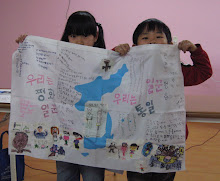
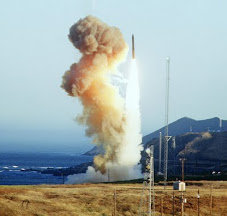
'저는 그들의 땅을 지키기 위하여 싸웠던 인디안들의 이야기를 기억합니다. 백인들이 그들의 신성한 숲에 도로를 만들기 위하여 나무들을 잘랐습니다. 매일밤 인디안들이 나가서 백인들이 만든 그 길을 해체하면 그 다음 날 백인들이 와서 도로를 다시 짓곤 했습니다. 한동안 그 것이 반복되었습니다. 그러던 어느날, 숲에서 가장 큰 나무가 백인들이 일할 동안 그들 머리 위로 떨어져 말과 마차들을 파괴하고 그들 중 몇몇을 죽였습니다. 그러자 백인들은 떠났고 결코 다시 오지 않았습니다….' (브루스 개그논)


For any updates on the struggle against the Jeju naval base, please go to savejejunow.org and facebook no naval base on Jeju. The facebook provides latest updates.

Tuesday, August 3, 2010

Text Fwd: INDIAN GOVERNMENT SAYS NO TO GLOBAL NETWORK SPACE CONFAB


A billboard in India touting their expanding space program

* Bruce Gagnon sent on Aug. 2, 2010.
Also in his blog on Aug. 2, 2010

We heard this morning that our October international space organizing conference that was to be held in Nagpur, India will not happen. For some strange undemocratic reason, our Indian hosts had to have the permission of their government in order to hold such an international peace confab. After shuffling the Indian organizers from one government office to another, the word finally came down from the External Affairs Ministry that it could not happen.

There is likely a connection between Obama's planned trip to India next November and them turning down our conference for October. There can be no doubt that the Indian government feared angering the U.S. by allowing such a conference to happen just before Obama's trip. It is no secret that the U.S. has for several years been pushing India to develop a Space Command and to become a junior partner in the Pentagon's growing Star Wars program.

Just a month ago we published our Space Alert! newsletter which had an article by Global Network board member Matt Hoey. The article was called "India Developing Space Weapons" and the opening paragraph read:

Indian military officials have set a target date to deploy an ambitious anti-satellite (ASAT) system, according to a report released in May by the Defense Research and Development Organization (DRDO). The report, titled Technology Perspective and Capability Roadmap (TPCR), states that the "development of ASAT for electronic or physical destruction of satellites in both lower earth orbit (LEO) and Geo-synchronous orbits" can be expected by 2015.

After publication of our newsletter Matt put his article up on several international web sites and there was an immediate response from the Indian government which strongly denied that they were pursuing an anti-satellite weapons test. I imagine this sequence of events might have made the Indian government a bit more worried about the potential of our October conference to expose their space weapons development plans even further.

I must ask, what kind of government that calls itself a democracy forces NGO's wanting to hold a peace conference to have to request permission in the first place? That kind of politics sounds more like a totalitarian dictatorship to me.

The U.S. aerospace industry sees the potential of the Indian space market and drools with delight. Despite the fact that India has 300 million people living in poverty, their growing economy represents a big market for the U.S. aerospace industry. And considering that India borders China, who the Pentagon is now militarily surrounding, ensures that the U.S. military sees the Indian continent as one more key outpost in its global military empire.

Sadly, we see that India is now on its way to becoming another military colony of another declining empire. Mahatma Gandhi would be rolling over in his grave if he could see the steps that India is taking today to join the U.S. in the space militarization game.

In it's 18th year of organizing such international space conferences, the Global Network has never had this experience of one particular country essentially blocking us from holding an educational meeting. Alternatively our Indian hosts have decided to go forward and still hold a conference anyway, albeit a national one rather than international. It is good that they plan to keep expanding the consciousness in their nation about the dangerous and provocative plans and consequences of India joining the U.S. Star Wars program.

Luckily the Global Network did hold an international membership meeting in New York City this past May during the UN's NPT Review Conference. So we were able to take advantage of the fact that many of our members were in New York for those events and we could meet and share information with one another.

We will now move ahead and begin work on our annual Keep Space for Peace Week of local actions during the period of October 2-9.

You can see the poster for our 2010 space week here

Text Fwd: [famoksaiyanfriends] Port Prepares for Buildup in Phases / 10,000 Comments Collected

* Text Fwd from Martha Duenas on Aug. 3, 2010

Pacific Daily News
Port Prepares for Buildup in Phases

By Brett Kelman • Pacific Daily News • August 3, 2010

One of the first federally funded upgrades to begin at the Port Authority of Guam will be the paving of a large, unused area on the facility's north end, which will become a new storage area for shipping containers.

By putting containers in this area, the commercial port will empty its current storage area, which then can be upgraded to handle even more shipments without interrupting the steady stream of cargo, which will grow over the next six years.

When those upgrades are finished, the Port will move on to another project that can be done without hindering day-to-day shipment operations.

This is how upgrades will proceed from 2011 to 2014, said Matthew Smith, a project manager with PB Americas Inc., the Port's modernization consultant.

Smith yesterday said that -- although officials once feared the Port would become a chokepoint that could derail the coming military buildup -- proper planning and sequencing will help Guam's port and population grow in tandem.

The military buildup is expected to increase Guam's population every year between now and 2016, when the boom will peak at 41,193 additional people. More than 14,500 new residents are predicted to arrive by the end of next year.

The Port can begin work on its first phase of upgrades in "mid-to-late 2011" because President Obama signed a law appropriating $50 million to the local agency over the weekend, according to a fact sheet provided at a press conference yesterday.

"The Port couldn't be built up in front of all this (growth), so what we designed is a phasing plan," Smith said during the conference. He added later: "We know we can handle the volume because we put together a flexible system."

Confidence

Smith said he had confidence in the Port's ability to upgrade itself and handle the increased flow of shipments because the "cargo forecast" that will guide the upgrades was based on older, higher population projections released by the Department of Defense last year.

Initially, the Defense Department said the buildup would bring about 79,000 people to Guam by 2014, but now it's clear this boom would have overwhelmed Guam's infrastructure, so the entire pace of the buildup has been slowed, cutting population projects by almost half.

If the Port was prepared to cope with the initial boom, it should be ready for the smaller boom expected now, Smith said.

And even if upgrades fall behind, the Port and the buildup will be able to adjust, said Enrique J.S. Agustin, the general manager of the Port Authority, because it will have a role on a Civil-Military Coordination Council, Agustin said.

The council will be composed of local and federal government officials who can recommend when the buildup should slow down or speed up, according to the final Environmental Impact Statement.

Last week, Joint Guam Program Office Executive David Bice, a retired Marine major general overseeing the buildup, said the council will be able to pre-empt problems that could arise if buildup projects aren't planned correctly.

Yesterday, Agustin said the Port would foresee any potential chokepoint "long before" it became the problem, which would allow the council to recommend the buildup tempo be adjusted appropriately.

At the press conference yesterday, Lt. Gov. Mike Cruz and Port board Chairman Monty Mesa thanked and congratulated the Port for the hard work needed to earn this federal funding.

The money appropriated over the weekend will allow the Port to access an additional $54.5 million loan from the U.S. Department of Agriculture. The money from both will fund a slew of projects in the first phase of three decades of upgrades.

"We did not give up," Cruz said. He is campaigning for governor, running with Sen. Jim Espaldon.

Another phase of port upgrades -- Phase 1B -- is expected to begin in 2014, when the first phase ends. No funding source has been found yet for that work.

"This is not the end of the funding request the port will be going after," Mesa said. "There will be more."

Getting ready: Lt. Gov. Mike Cruz, left, listens as Port Authority of Guam Chairman Monte Mesa shows the Port's plans to upgrade its facilities to prepare for increased activity stemming from the military buildup."


Getting ready: Lt. Gov. Mike Cruz, left, listens as Port Authority of Guam Chairman Monte Mesa shows the Port's plans to upgrade its facilities to prepare for increased activity stemming from the military buildup. (Photo courtesy governor's office)

UPGRADES
  • The Port Modernization Program as authorized by the Guam Legislature spans decades and is valued at a little more than $260 million.
Phase 1-A
  • Scope: This phase includes reconfiguration and expansion of the cargo terminals, creation of a new gate complex, reconfiguration and expansion of selected buildings, upgraded utilities and security features, and state-of-the-art terminal and gate operating systems.
  • Funding: This phase will cost $104.2 million. Most of the funding will come from a $50 million of federal funds and another $54.5 million federal loan.
  • Start date: This phase is expected to start in "mid-to-late 2011" and finish in 2014.
Phase 1-B
  • Scope: This phase includes wharf repairs, dredging, cranes, and additional security equipment.
  • Funding: No funding source yet, but the port is looking
  • Start date: This phase will start when Phase 1-B ends.
Phase 2
  • Scope: This program will occur 20 years into the future and focuses on the expansion needed to address the cargo demands of the long-term growth of Guam and its neighboring islands.
  • Funding: No funding source yet
  • Start date: This phase is decades away.
_____________________________________________________
* See also

Marianas Variety
Port Plans for Construction in 2011
Tuesday, 03 August 2010 04:00 By Jennifer Naylor Gesick | Variety News Staff

Pacific Daily News
10,000 Comments Collected
By Steve Limtiaco Aug. 3, 2010

Text Fwd: Toxic Legacy of US Assault on Fallujah 'Worse than Hiroshima'

*From The Nuclear Age Peace Foundation's 'Sun Flower Newsletter(Issue 157, Aug., 2010)'


Toxic Legacy of US Assault on Fallujah 'Worse than Hiroshima'

Since 2005, doctors in the Iraqi city of Fallujah have reported an overwhelming number of babies born with serious birth defects, and a sharp rise in cancers. A survey of 4,800 individuals, carried out in January and February 2010 confirmed that that city had experienced a four-fold increase in cancer, and a 12-fold increase in cancer for children under 14. Additionally, Fallujah’s infant mortality rate is more than four times that of neighboring Jordan’s, and a staggering eight times higher than that of Kuwait, Iraq’s neighbor to the South.

The types of cancer reported are “similar to that in the Hiroshima survivors who were exposed to ionizing radiation from the bomb and uranium in the fallout.” While Hiroshima survivors showed a 17-fold increase in leukemia, researchers in Fallujah found a 38-fold increase, accompanied by a 10-fold increase in female breast cancer, and significant increases in lymphoma and brain tumors. Doctors are also shocked and concerned by the speed with which various cancers are affecting the population.

Dr Chris Busby, a visiting professor at the University of Ulster and one of the authors of the survey, said that the extent of genetic damage suffered by inhabitants suggests the use of uranium in some form. Fallujah was besieged and bombarded by US Marines in April of 2004. Eight months later, the Marines stormed the city with artillery and aerial bombing. They later admitted that white phosphorous and other munitions were used in the attack. Busby said that he couldn’t be sure of the type of armaments used by the Marines, but guessed that “they used a new weapon against buildings to break through walls and kill those inside.”

Cockburn, Patrick, “Toxic Legacy of US Assault on Fallujah 'Worse than Hiroshima,'” The Independent, July 24, 2010.

Text Fwd: [Michel Chossudovsky] Preparing for World War III, Targeting Iran

Global Research
Preparing for World War III, Targeting Iran
Part I: Global Warfare
Aug. 1, 2010
by Michel Chossudovsky

Humanity is at a dangerous crossroads. War preparations to attack Iran are in "an advanced state of readiness". Hi tech weapons systems including nuclear warheads are fully deployed.

This military adventure has been on the Pentagon's drawing board since the mid-1990s. First Iraq, then Iran according to a declassified 1995 US Central Command document.

Escalation is part of the military agenda. While Iran, is the next target together with Syria and Lebanon, this strategic military deployment also threatens North Korea, China and Russia.

Since 2005, the US and its allies, including America's NATO partners and Israel, have been involved in the extensive deployment and stockpiling of advanced weapons systems. The air defense systems of the US, NATO member countries and Israel are fully integrated.

This is a coordinated endeavor of the Pentagon, NATO, Israel's Defense Force (IDF), with the active military involvement of several non-NATO partner countries including the frontline Arab states (members of NATO's Mediterranean Dialogue and the Istanbul Cooperation Initiative), Saudi Arabia, Japan, South Korea, India, Indonesia, Singapore, Australia, among others. (NATO consists of 28 NATO member states Another 21 countries are members of the Euro-Atlantic Partnership Council (EAPC), The Mediterranean Dialogue and the Istanbul Cooperation Initiative include ten Arab countries plus Israel.)

The roles of Egypt, the Gulf states and Saudi Arabia (within the extended military alliance) is of particular relevance. Egypt controls the transit of war ships and oil tankers through the Suez Canal. Saudi Arabia and the Gulf States occupy the South Western coastlines of the Persian Gulf, the Straits of Hormuz and the Gulf of Oman. In early June, "Egypt reportedly allowed one Israeli and eleven U.S. ships to pass through the Suez Canal in ....an apparent signal to Iran. ... On June 12, regional press outlets reported that the Saudis had granted Israel the right to fly over its airspace..." (Muriel Mirak Weissbach, Israel’s Insane War on Iran Must Be Prevented., Global Research, July 31, 2010)

In post 9/11 military doctrine, this massive deployment of military hardware has been defined as part of the so-called "Global War on Terrorism", targeting "non-State" terrorist organizations including al Qaeda and so-called "State sponsors of terrorism",. including Iran, Syria, Lebanon, Sudan.

The setting up of new US military bases, the stockpiling of advanced weapons systems including tactical nuclear weapons, etc. were implemented as part of the pre-emptive defensive military doctrine under the umbrella of the "Global War on Terrorism".

War and the Economic Crisis

The broader implications of a US-NATO Israel attack on Iran are far-reaching. The war and the economic crisis are intimately related. The war economy is financed by Wall Street, which stands as the creditor of the US administration. The US weapons producers are the recipients of the US Department of Defense multibillion dollar procurement contracts for advanced weapons systems. In turn, "the battle for oil" in the Middle East and Central Asia directly serves the interests of the Anglo-American oil giants.

The US and its allies are "beating the drums of war" at the height of a Worldwide economic depression, not to mention the most serious environmental catastrophe in World history. In a bitter twist, one of the major players (BP) on the Middle East Central Asia geopolitical chessboard, formerly known as the Anglo-Persian Oil Company, is the instigator of the ecological disaster in the Gulf of Mexico.

Media Disinformation

Public opinion, swayed by media hype is tacitly supportive, indifferent or ignorant as to the likely impacts of what is upheld as an ad hoc "punitive" operation directed against Iran's nuclear facilities rather than an all out war. War preparations include the deployment of US and Israeli produced nuclear weapons. In this context, the devastating consequences of a nuclear war are either trivialised or simply not mentioned.

The "real crisis" threatening humanity, according to the media and the governments, is not war but global warming. The media will fabricate a crisis where there is no crisis: "a global scare" -- the H1N1 global pandemic-- but nobody seems to fear a US sponsored nuclear war.

The war on Iran is presented to public opinion as an issue among others. It is not viewed as a threat to "Mother Earth" as in the case of global warming. It is not front-page news. The fact that an attack on Iran could lead to escalation and potentially unleash a "global war" is not a matter of concern.

The Cult of Killing and Destruction

The global killing machine is also sustained by an imbedded cult of killing and destruction which pervades Hollywood movies, not to mention the prime time war and crime TV series on network television. This cult of killing is endorsed by the CIA and the Pentagon which also support (finance) Hollywood productions as an instrument of war propaganda:

"Ex-CIA agent Bob Baer told us, "There’s a symbiosis between the CIA and Hollywood" and revealed that former CIA director George Tenet is currently, "out in Hollywood, talking to studios." (Matthew Alford and Robbie Graham, Lights, Camera… Covert Action: The Deep Politics of Hollywood, Global Research, January 31, 2009).

The killing machine is deployed at a global level, within the framework of the unified combat command structure. It is routinely upheld by the institutions of government, the corporate media and the mandarins and intellectuals of the New World Order in Washington's think tanks and strategic studies research institutes, as an unquestioned instrument of peace and global prosperity.

A culture of killing and violence has become imbedded in human consciousness.

War is broadly accepted as part of a societal process: The Homeland needs to be "defended" and protected.

"Legitimized violence" and extrajudicial killings directed against "terrorists" are upheld in western democracies, as necessary instruments of national security.

A "humanitarian war" is upheld by the so-called international community. It is not condemned as a criminal act. Its main architects are rewarded for their contributions to world peace.

With regard to Iran, what is unfolding is the outright legitimization of war in the name of an illusive notion of global security.

A "Pre-emptive" Aerial attack directed against Iran would lead to Escalation

At present there are three separate Middle East Central Asia war theaters: Iraq, Af-Pak, and Palestine.

Were Iran to be the object of a "pre-emptive" aerial attack by allied forces, the entire region, from the Eastern Mediterranean to China's Western frontier with Afghanistan and Pakistan, would flare up, leading us potentially into a World War III scenario.

The war would also extend into Lebanon and Syria.

It is highly unlikely that the bombings, if they were to be implemented, would be circumscribed to Iran's nuclear facilities as claimed by US-NATO official statements. What is more probable is an all out air attack on both military and civilian infrastructure, transport systems, factories, public buildings.

Iran, with an an estimated ten percent of global oil and gas reserves, ranks third after Saudi Arabia (25 %) and Iraq (11 %) in the size of its reserves. In comparison, the US possesses less than 2.8 % of global oil reserves. The oil reserves of the U.S. are estimated at less than 20 billion barrels. The broader region of the Middle East and Central Asia have oil reserves which are more than thirty times those of the U.S, representing more than 60% of the World's total reserves. (See Eric Waddell, The Battle for Oil, Global Research, December 2004).

Of significance is the recent discovery in Iran of the second largest known reserves of natural gas at Soumar and Halgan estimated at 12.4 trillion cubic feet.

Targeting Iran consists not only in reclaiming Anglo-American control over Iran's oil and gas economy, including pipeline routes, it also challenges the presence and influence of China and Russia in the region.

Map of Middle East

The planned attack on Iran is part of a coordinated global military road map. It is part of the Pentagon's "long war", a profit driven war without borders, a project of World domination, a sequence of military operations.

US-NATO military planners have envisaged various scenarios of military escalation. They are also acutely aware of the geopolitical implications, namely that the war could extend beyond the Middle East Central Asia region. The economic impacts on the oil markets, etc. have also been analyzed.

While Iran, Syria and Lebanon are the immediate targets, China, Russia, North Korea, not to mention Venezuela and Cuba are also the object of US threats.

At stake is the structure of military alliances. US-NATO-Israel military deployments including military exercises and drills conducted on Russia and China's immediate borders bear a direct relationship to the proposed war on Iran. These veiled threats, including their timing, constitute an obvious hint to the former powers of the Cold War era not to intervene in any way which could encroach upon a US-led attack on Iran.

Global Warfare

The medium term strategic objective is to target Iran and neutralize Iran's allies, through gunboat diplomacy. The longer term military objective is to directly target China and Russia.

While Iran is the immediate target, military deployment is by no means limited to the Middle East and Central Asia. A global military agenda has been formulated.

The deployment of coalition troops and advanced weapons systems by the US, NATO and its partners is occurring simultaneously in all major regions of the World.

The recent actions of the US military off the coast of North Korea including the conduct of war games are part of a global design.

Directed primarily against Russia and China, US, NATO and allied military exercises, war drills, weapons deployments, etc. are being conducted simultaneously in major geopolitical hotspots.

-The Korean Peninsula, the Sea of Japan, the Taiwan Straits, the South China Sea threatening China,

-The deployment of Patriot missiles in Poland, the early warning center in the Czech republic threatening Russia,

-Naval deployments in Bulgaria, Romania on the Black sea, threatening Russia

- US and NATO troops deployments in Georgia,

- A formidable naval deployment in the Persian Gulf including Israeli submarines directed against Iran.

Concurrently the Eastern Mediterranean, the Black Sea, the Caribbean, Central America and the Andean region of South America are areas of ongoing militarization. In Latin America and the Caribbean, the threats are directed against Venezuela and Cuba.

US "Military Aid"

In turn, large scale weapons transfers have been undertaken under the banner of US "military aid" to selected countries, including a 5 billion dollar arms deal with India which is intended to build India's capabilities directed against China. (Huge U.S.-India Arms Deal To Contain China, Global Times, July 13, 2010).

"[The] arms sales will improve ties between Washington and New Delhi, and, intentionally or not, will have the effect of containing China’s influence in the region.” quoted in Rick Rozoff, Confronting both China and Russia: U.S. Risks Military Clash With China In Yellow Sea, Global Research, July 16, 2010)

The US has military cooperation agreements with a number of South East Asian countries including Singapore, Vietnam and Indonesia, involving "military aid" as well as the participation in U.S.-led war games in the Pacific Rim (July -August 2010). These agreements are supportive of weapons deployments directed against The People's Republic of China. (See Rick Rozoff, Confronting both China and Russia: U.S. Risks Military Clash With China In Yellow Sea, Global Research, July 16, 2010).

Similarly and more directly related to the planned attack on Iran, the US is arming the Gulf States (Bahrain, Kuwait, Qatar and the United Arab Emirates) with land-based interceptor missiles, Patriot Advanced Capability-3 and Terminal High Altitude Area Defense (THAAD) as well as sea-based Standard Missile-3 interceptors installed on Aegis class warships in the Persian Gulf. (See Rick Rozoff, NATO’s Role In The Military Encirclement Of Iran, Global Research, February 10, 2010).

The Timetable of Military Stockpiling and Deployment

What is crucial in regards to US weapons transfers to partner countries and allies is the actual timing of delivery and deployment. The launch of a US sponsored military operation would normally occur once these weapons systems are in place, effectively deployed with the implementation of personnel training. (e.g India).

What we are dealing with is a carefully coordinated global military design controlled by the Pentagon, involving the combined armed forces of more than forty countries. This global multinational military deployment is by far the largest display of advanced weapons systems in World history.

In turn, the US and its allies have established new military bases in different parts of the world. "The Surface of the Earth is Structured as a Wide Battlefield". (See Jules Dufour, The Worldwide Network of US Military Bases , Global Research, July 1, 2007).

The Unified Command structure divided up into geographic Combatant Commands is predicated on a strategy of militarization at the global level. "The US Military has bases in 63 countries. Brand new military bases have been built since September 11, 2001 in seven countries. In total, there are 255,065 US military personnel deployed Worldwide." (See Jules Dufour, The Worldwide Network of US Military Bases , Global Research, July 1, 2007

Map-the World With Commander' Area of Responsibility

Source: DefenseLINK-Unified Command Plan

World War III Scenario

This military deployment is occurring in several regions simultaneously under the coordination of the regional US Commands, involving the stockpiling of US made weapons systems by America's allies, some of which are former enemies, including Vietnam and Japan.

The present context is characterised by a global military build-up controlled by one World superpower, which is using its numerous allies to trigger regional wars.

In contrast to the Second World War was a conjunction of separate regional war theaters. Given the communications technologies and weapons systems of the 1940s, there was no strategic "real time" coordination in military actions between broad geographic regions

Global warfare is based on the coordinated deployment of a single dominant military power, which oversees the actions of its allies and partners.

With the exception of Hiroshima and Nagasaki, the Second World War was characterized by the use of conventional weapons. The planning of a global war relies on the militarization of outer space. Were a war directed against iran to be launched, It would not only use nuclear weapons, the entire gamut of new advanced weapons systems, including electrometric weapons and environmental modification techniques (ENMOD) would be used.

The United Nations Security Council

The UN Security Council adopted in early June a fourth round of sweeping sanctions against The Islamic Republic of Iran, which included an expanded arms embargo as well "tougher financial controls". In a bitter irony, this resolution was passed within days of the United Nations Secrity Council's outright refusal to adopt a motion condemning Israel for its attack on the Gaza Freedom Flotilla in international waters.

Both China and Russia, pressured by the US, have endorsed the UNSC sanctions' regime, to their own detriment. Their decision within the UNSC contributes to weakening their own military alliance, the Shanghai Cooperation organization (SCO), in which Iran has observer status. The Security Council resolution freezes China and Russia's respective bilateral military cooperation and trade agreements with Iran. It has serious repercussions on Iran's air defense system which in part depends on Russian technology and expertise.

The Security Council resolution grants a de facto "green light" to wage a pre-emptive war against Iran.

The American Inquisition: Building a Political Consensus for War

In chorus, the Western media has branded Iran as a threat to global security in view of its alleged (non-existent) nuclear weapons program. Echoing official statements, the media is now demanding the implementation of punitive bombings directed against Iran so as to safeguard Israel's security.

The Western media is beating the drums of war. The purpose is to tacitly instil, through repeated media reports, ad nauseam, within people's inner consciousness, the notion that the Iranian threat is real and that the Islamic Republic should be "taken out".

A consensus building process to wage war is similar to the Spanish inquisition. It requires and demands submission to the notion that war is a humanitarian endeavor.

Known and documented, the real threat to global security emanates from the US-NATO-Israel alliance, yet realities in an inquisitorial environment are turned upside down: the warmongers are committed to peace, the victims of war are presented as the protagonists of war. Whereas in 2006, almost two thirds of Americans were opposed to military action against Iran, a recent Reuter-Zogby February 2010 poll suggests that 56 % of Americans favor a US-NATO military action against Iran.

Building a political consensus which is based on an outright lie cannot, however, rely solely on the official position of those who are the source of the lie.

The antiwar movement in the US, which has in part been infiltrated and co-opted, has taken on a weak stance with regard to Iran. The antiwar movement is divided. The emphasis has been on wars which have already occurred (Afghanistan, Iraq) rather than forcefully opposing wars which are being prepared and which are currently on the Pentagon's drawing board. Since the inauguration of the Obama administration, the antiwar movement has lost some of its impetus.

Moreover, those who actively oppose the wars on Afghanistan and Iraq, do not necessarily oppose the conduct of "punitive bombings" directed Iran, nor do they categorize these bombings as an act of war, which could potentially be a prelude to World War III.

The scale of antiwar protest in relation to Iran has been minimal in comparison to the mass demonstrations which preceded the 2003 bombing and invasion of Iraq.

The real threat to global security emanates from the US-NATO-Israel alliance.

The Iran operation is not being opposed in the diplomatic arena by China and Russia; it has the support of the governments of the frontline Arab states which are integrated into the NATO sponsored Mediterranean dialogue. It also has the tacit support of Western public opinion.

We call upon people across the land, in America, Western Europe, Israel, Turkey and around the world to rise up against this military project, against their governments which are supportive of military action against Iran, against the media which serves to camouflage the devastating implications of a war against Iran.

The military agenda support a profit driven destructive global economic system which impoverishes large sectors of the world population.

This war is sheer madness.

World War III is terminal. Albert Einstein understood the perils of nuclear war and the extinction of life on earth, which has already started with the radioactive contamination resulting from depleted uranium. “I know not with what weapons World War III will be fought, but World War IV will be fought with sticks and stones.”

The media, the intellectuals, the scientists and the politicians, in chorus, obfuscate the untold truth, namely that war using nuclear warheads destroys humanity, and that this complex process of gradual destruction has already commenced.

When the lie becomes the truth there is no turning backwards.

When war is upheld as a humanitarian endeavor, Justice and the entire international legal system are turned upside down: pacifism and the antiwar movement are criminalized. Opposing the war becomes a criminal act.

The Lie must be exposed for what it is and what it does.

It sanctions the indiscriminate killing of men, women and children.

It destroys families and people. It destroys the commitment of people towards their fellow human beings.

It prevents people from expressing their solidarity for those who suffer. It upholds war and the police state as the sole avenue.

It destroys internationalism.

Breaking the lie means breaking a criminal project of global destruction, in which the quest for profit is the overriding force.

This profit driven military agenda destroys human values and transforms people into unconscious zombies.

Let us reverse the tide.

Challenge the war criminals in high office.

Break the American inquisition.

Undermine the US-NATO-Israel military crusade.

Close down the weapons factories and the military bases.

Bring home the troops.

Members of the armed forces should disobey orders and refuse to participate in a criminal war.


Part II of this essay will be published shortly.

Preparing for World War III. Nature and History of the Planned Military Operation against Iran

Includes analysis of the role if Israel

Michel Chossudovsky is an award-winning author, Professor of Economics (Emeritus) at the University of Ottawa and Director of the Centre for Research on Globalization (CRG), Montreal. He is the author of The Globalization of Poverty and The New World Order (2003) and America’s “War on Terrorism” (2005). He is also a contributor to the Encyclopaedia Britannica. His writings have been published in more than twenty languages.


Video & Text Fwd: Demonstrators hit the streets of Kabul

* Image source: 'AFP – Afghan demonstrators take part in a protest rally in Kabul. Afghans held a rally in the capital Kabul …'
(From the Stop NATO Fwd article: Afghans protest alleged NATO civilian deaths (Aug. 1, 2010)

* Fwd from Stop NATO on Aug. 2, 2010

Yahoo News (UK & Ireland)
Demonstrators hit the streets of Kabul
: More than 400 demonstrators marched toward the presidential palace in Kabul on Sunday to protest against the alleged killing of 52 civilians by a NATO rocket strike in southern Afghanistan.
Aug. 1, 2010

NATO has repeatedly disputed the allegations of civilian deaths.

German Army Brigadier General Josef Blotz, a Nato spokesman, told reporters on Sunday in Kabul that a joint assessment team has only confirmed that one to three civilians may have been killed in the attack in Helmand province's Sangin district.

Witnesses told the assessment team that six to eight people were killed in the July 23 incident, most of them insurgents, according to Blotz.

Yet the Afghans gathered in downtown Kabul said they were sure the international forces were to blame. Participants in the protest carried photos of children allegedly injured or killed in the strike and shouted "Death to America! Death to Nato!"

The demonstrators did not threaten violence and they were guarded by Afghan police who had shut down the road for the them to hold their march.

Civilian casualties caused by international troops are a major source of friction between Afghan President Hamid Karzai and his international partners, even though the United Nations says the Taliban are responsible for most civilian deaths.

The United Nations says at least 2,412 civilians were killed in 2009 - the deadliest year since the world organisation began systematically collecting casualty data in 2007. The 2009 deaths represented a 14 per cent jump over the previous year, the UN said.

Text Fwd: U.S. Nuclear Supercarrier Was Within Striking Distance Of Beijing

'A U.S. Marine Corps C-130 Hercules aircraft leads a formation of F/A-18C Hornet strike fighters and A/V-8B Harrier jets over the aircraft carrier USS George Washington (CVN 73) in the East Sea of Korea, July 27, 2010. The Republic of Korea and the United States are conducting the combined alliance maritime and air readiness exercise "Invincible Spirit" in the seas east of the Korean peninsula from July 25 - 28, 2010. (Xinhua/Reuters)'

* Text Fwd from Stop NATO on Aug. 1, 2010

Xinhua News Agency
July 31, 2010
Big Brother flexes muscles
By Luo Yuan*

-[T]he theater of the US-ROK drill was only 500 km from Beijing. Considering that the nuclear-powered super-carrier USS George Washington's radius of action is up to 600 km, and the aircraft it carries can reach a speed of 1,000 km an hour, the joint drill was dangerously close to China's security threshold.

BEIJING: General Ma Xiaotian, deputy chief of general staff of the People's Liberation Army, and Qin Gang, Foreign Ministry spokesman, recently spoke out against foreign warships entering, and military aircraft passing over, the Yellow Sea or any other offshore areas, because they pose a threat to China's security.

Their objection is justified.

Referring to China's security, Chairman Mao Zedong once said that "others should not snore beside a sleeping person". [?] China has to be alarmed when other powers display their military might near its territory. Will the US allow China to conduct military drills with neighboring countries in the Gulf of Mexico? As the Golden Rule of the ethic of reciprocity goes, "Do not do unto others as you would that they should not do unto you."

From the perspective of strategic thinking, the bottom line is to read the dangers before they appear. We should prepare for the worst and fight for the best outcome.

The opposition of the Chinese to the joint military exercise of the United States and the Republic of Korea (ROK) in the Yellow Sea is more than justified. China needs to make its strategic bottom line clear to avoid misunderstandings or misjudgments.

Geographically, the Yellow Sea is the door to the Beijing-Tianjin-Hebei region, which has important security implications for the Bohai Sea Rim, an important economic zone in China. History speaks of a war between the Chinese and Japanese navies in the Yellow Sea in 1894, when the Beiyang fleet was headquartered in Weihai, Shandong province. The painful memories of that war make the waters a very sensitive area for China and it hopes they would not be violated by foreign powers.

Media reports say the theater of the US-ROK drill was only 500 km from Beijing. Considering that the nuclear-powered super-carrier USS George Washington's radius of action is up to 600 km, and the aircraft it carries can reach a speed of 1,000 km an hour, the joint drill was dangerously close to China's security threshold.

On the Korean Peninsula's security, the United Nations Security Council has issued a statement condemning the sinking of the ROK corvette, Cheonan, but it has asked all the players involved - including the US, the ROK and the Democratic People's Republic of Korea (DPRK) - to exercise restraint over the issue.

The incident has indeed heightened tensions on the peninsula, but the joint military exercise in the Yellow Sea has created more problems for the region rather than solving them.

China has to declare its solemn stance of maintaining good international relations, especially good military ties, for the sake of its relationship with the US and because it has always worked hard to ensure a smooth development of bilateral ties.

Though General Ma has said the US Defense Secretary Robert Gates was welcome in China at a more appropriate time, he has indicated three major barriers in Sino-US relations.

The first is America's sale of weapons to Taiwan. The second is the frequent entries of US military ships into the East China and South China seas and the flying of its aircraft over them. And the third is the retraining of up to 12 issues in Sino-US military exchange by the American National Defense Authorization Act in 2000 and the Delay Amendment.

Now the joint US-ROK military exercise has created more barriers by not only sending a nuclear-powered super-carrier, but also its military aircraft, warships, nuclear-powered submarine and the Arleigh Burke-class guided-missile destroyer for the joint drill.

China has reacted differently to the presence of US aircraft carriers at different places, periods and purposes. In 1994, China reacted strongly to the USS Kitty Hawk's entry into China's maritime boundary. But when the USS George Washington visited Hong Kong last year, it welcomed it warmly.

The US and the ROK say the USS George Washington was part of the exercise to "deter" the DPRK. But the exercise was held in the Yellow Sea, the gateway to China, and conducting reconnaissance missions in these waters could have been part of the US agenda. America's nuclear-powered aircraft carriers have strong detection and warning capabilities, and can get vital military information.

In one word, irrespective of what the military exercise was aimed at, it was a threat to China.

The US has bandied about the "China threat theory" for some time now. But this joint military exercise proves once and for all that the US, and not China, is a threat to the world.

Fortunately, according to General Ma, communications between the defense departments of China and the US have never ceased. Let's hope the two sides establish more mechanisms to enhance communications and negotiations, which would help the US understand China better and respect its security interests and concerns. The two countries have to handle their relationship properly to prevent the crisis from escalating out of hand.

*The author is a senior research scholar with the Academy of Military Science of the People's Liberation Army.
===========================
Stop NATO
http://groups.yahoo.com/group/stopnato

Blog site:
http://rickrozoff.wordpress.com/

Text Fwd: U.S. Completes 14-Nation Submarine Warfare Drills For East Asia

CINDY ELLEN RUSSELL / CRUSSELL@STARADVERTISER.COM Military brass conversed after holding a press conference yesterday at Pearl Harbor regarding the Rim of the Pacific exercises. Pictured are Marine Corps Brig. Gen. John Broadmeadow, left, Air Force Brig. Gen. Thomas Harwood, Navy Vice Adm. Richard Hunt, Japanese Maritime Self Defense Force Rear Adm. Kazuki Yamashita and Canadian Navy Rear Adm. Ron Lloyd. In the background is the Republic of Korea Navy's DDG 991 Sejong, which was participating in RIMPAC. Closing ceremonies for RIMPAC will be held tomorrow.

* Text Fwd: Rick Rozoff on Aug. 1, 2010

Star Advertiser
Sub training ends RIMPAC:
The maritime exercises involving 14 nations wrap up with closing ceremonies tomorrow
By William Cole
POSTED: 01:30 a.m. HST, Jul 31, 2010

Country "Orange" ignores all diplomatic and political requests to cease operations in country "Green," and a sea battle ensues.

That was the framework for the final "free play" tactical phase of Rim of the Pacific war games Sunday through yesterday as the big 40-day maritime exercise wraps up in Hawaii waters.

RIMPAC is advertised as interoperability practice between allied nations, but real-world threats are never far behind.

Diesel electric submarines from Japan and South Korea stalked the U.S. aircraft carrier Ronald Reagan in the final phase -- simulating a growing undersea worry as nonallied nations build up their stock of quiet subs in the Pacific.

Speaking to reporters yesterday, U.S. Navy Vice Adm. Richard Hunt said the training encounters were still being reviewed, "but I will say that the Reagan did very well -- moved quickly and smartly out there at sea."

He added, "The diesels (submarines) that came are incredibly capable and presented tremendous challenges throughout the exercise. (They) provided some of the best training that we had."

Another U.S. aircraft carrier, the George Washington, was at the center of war games off the east coast of South Korea this past week as a reproach to North Korea.

Adm. Robert Willard, head of U.S. Pacific Command at Camp Smith, said July 20 in South Korea that future exercises would be held in international waters in the West Sea (or Yellow Sea) west of South Korea, which China considers to be on its doorstep, as the U.S. seeks to maintain its reach in the region.

The U.S. Navy downplayed RIMPAC yesterday in the context of world events.

"RIMPAC is something that we do every two years. It's two years in planning, and we truly have been working this in detail for the last 12 months," Hunt said. "What we are trying to accomplish with RIMPAC is training for ourselves, not necessarily sending a message, but training preparedness."

Hunt and other senior officers from the U.S., Japan and Canada spoke pierside at Pearl Harbor in front of the South Korean destroyer Sejong the Great and the Japanese destroyers Atago and Akebono.

The 32 ships participating in this year's RIMPAC started pulling back into Pearl Harbor yesterday, officials said. Closing ceremonies for the exercise will be held tomorrow.

Five submarines, more than 170 aircraft and about 20,000 personnel took part in RIMPAC, which involved the Army, Navy, Air Force, Marine Corps and Coast Guard.

This year's exercise included units or personnel from Australia, Canada, Chile, Colombia, France, Indonesia, Japan, Malaysia, the Netherlands, Peru, South Korea, Singapore, Thailand and the U.S.

The Navy also said there were three observer nations: Brazil, India and New Zealand.

Participating countries conducted gunnery, missile, torpedo, anti-submarine and air defense exercises as well as maritime interdiction and vessel boardings, explosive ordnance disposal, diving and salvage operations, mine clearance operations and amphibious landings.

The Marines experimented with beach landings involving smaller company forces of about 180 Marines versus a battalion landing team of about 1,100 Marines coming ashore. The goal was to evaluate dispersing Marines in wider areas.

"I won't say it was a success across the board ... but we learned some very, very important things from it," said Marine Corps Brig. Gen. John Broadmeadow. "As you take a smaller force, spread it over a wider area, you can imagine the command and control issues that you are going to have."

1

Text Fwd: Ennis: Obama, Clinton, Gates in the dark about Henoko realities; Congress angry at faulty DOD Guam proposal

* Text Fwd from J. D., Martha Duenas, and Kyle Kajihiro on Aug. 1, 2010

This confirms the new base at Henoko is not going to happen (as Gavan McCormack foresaw); and a significant slow-down, maybe halt (?) to the proposed, equally half-baked, Guam "build-up."
(J. D.)
___________________________________________________________

PanOrient News

P. Ennis: Okinawa Problem Could Boil Over

Saturday, July 31, 2010

It's now about as "unofficially official" as it can get that the August and November deadlines concerning a Futenma replacement facility on Okinawa will not be met.

Indeed, the political underpinnings of the 2006 bilateral "Roadmap" for realignment of US forces in Japan, of which the relocation of some 8,500 US Marines from Okinawa to Guam and the construction of a Futenma replacement facility are cornerstones, are coming undone in both countries.

The confluence of three events on July 27 made this abundantly clear - as if additional clarity were needed.

On Tuesday, Assistant Secretary of State Kurt Campbell testified on US-Japan security ties before the House Armed Services Committee, and hinted at a schedule slip by failing to mention in his prepared remarks the August deadline for reaching agreement on the exact location, design, and construction method for the Futenma replacement facility. An August agreement would supposedly then set the stage for a final political decision in the Fall.

Also, the US government's Joint Guam Program Office (JGPO) released its much-anticipated Final Environmental Impact Statement concerning the on-going military buildup on Guam, and officials made clear that vital infrastructure and other critical preparations will not be anywhere near complete by the 2014 deadline for moving the 8,500 US Marines and their 9,000 dependents to Guam. Publicly, the JGPO says 2014 is still the goal, but with huge cost overruns already apparent, and a skeptical Congress slowing funding, the Marine redeployment faces significant delays.
Meanwhile in Tokyo, Prime Minister Naoto Kan gathered for the first time since taking office the four members of his Cabinet deeply enmeshed in the Futenma issue. Present were Chief Cabinet Secretary Yoshito Sengoku, who will function as the Cabinet's Futenma coordinator; Foreign Minister Katsuya Okada, who is the principal liaison to the United States; Defense Minister Toshimi Kitazawa; and State Minister for Okinawa Seiji Maehara. The participants let it be known not-so-privately that they will defer decisions until after the Okinawa gubernatorial election, scheduled for late November. This continued a pattern of leaks with the same message.

The Okinawa election is likely to institutionalize widespread opposition to construction of the Futenma replacement facility. Prime Minister Kan has already said he will not forcibly begin construction. To do so could easily spark broader opposition to US bases in Japan, which neither Washington nor Tokyo wants to see happen. So the stage is increasingly set for Tokyo, while ceaselessly voicing support for the replacement facility, to shrug its post-election shoulders and say it needs more (undefined) time to bring Okinawan opinion along.

September Test

The big question now is how the Obama administration will respond to a situation over which it is rapidly losing even the pretense of control.

An early test could come in September. Japanese officials make no secret of the fact that Prime Minister Kan would like to visit the US for a meeting with President Obama. The sense inside the administration is that Obama, assuming Kan is reelected DPJ president and remains prime minister, would like to "hit the reset button" with the DPJ, and would welcome a meeting with Kan, probably around the time of the UN General Assembly in late September.

An important sign will be whether the administration puts aside lingering bad feelings about the Futenma issue and genuinely celebrates the US-Japan alliance in this, the 50th anniversary of the signing of the bilateral security treaty.

The administration has apparently given the go-ahead for US Ambassador John Roos to participate in the peace memorial ceremony in Hiroshima on August 6th. He would be the first US official to do so.

Obama is also scheduled to visit Japan in mid-November for the APEC summit.

Internal Disconnect

One way or another, the United States eventually will have to show flexibility on the Futenma issue. What's not clear is whether the Obama administration will accept this reality smoothly, or if another, perhaps more serious episode of bilateral tension will be needed to force cabinet officials to focus on the issue.

A major problem inside the administration is a "disconnect" between the assistant secretary level of senior officials - Kurt Campbell at State, and Chip Gregson at the Pentagon - and the Cabinet secretaries they report to. Sources intimately familiar with the thinking of Campbell and Gregson report that the two know that the current plan for Marine basing on Okinawa will not work, but they have been unable to get their respective bosses - Hillary Clinton at State and Robert Gates at Defense - to face that facts.

Campbell and Gregson have scrupulously stuck to the "tough love" stance in public, and in talks with Japanese officials.

Campbell, for example, has suggested to Japanese officials that Tokyo could adopt a "special measures" law to override Okinawan opposition to construction of a new facility on Okinawa to replace Futenma. And Gregson, in his House testimony yesterday, said he fully expects details of the Futenma replacement facility to be settled by the end of August, and full political agreement to be reached by the Fall.

But they both can see the political writing on the wall. While they may continue to press Tokyo to abide by the existing accord, both accept the domestic political constraints at work in Japan.

By contrast, Gates and Clinton have shown little interest in Japan's domestic problems, considering them rather minor in comparison to the difficulties they face in dealing with Iraq, Afghanistan, China, and North Korea. Gates and Clinton believe they have delegated the issue to Campbell and Gregson, and want it resolved without requiring cabinet attention.

As a result, Gregson and Campbell have not really leveled with Gates and Clinton, failing to inform them in no uncertain terms that the Futenma replacement plan will not work. They know Gates and Clinton do not want to hear that message, and they have chosen for the time being to try to manage an unmanageable situation.

Message to Beijing

Another factor influencing the continuing hard line from Gates and Clinton on Okinawa issues is a desire to send a strong message to both China and North Korea.

Beijing is testing Washington (and Tokyo) in the South China Sea and other parts of the region, while the regime in Pyongyang, as usual, turns to aggressive means to fight for survival on its own brutal terms. The Gates-Clinton visit recently to the Korean DMZ, and the joint military exercises conducted with South Korea, were designed to make clear to one and all that the United States intends to remain as a source of balance and stability in East Asia. The concern of both Gates and Clinton is that any sign of discord between the United States and Japan over Okinawa could weaken that message.

The irony is that Japan has been fully cooperating with the United States in those efforts. Senior officers from Japan's Self Defense Forces were on hand to observe the US-ROK exercises. The nuclear-powered aircraft carrier USS George Washington, the key to the US force projection capability in East Asia, is operating from newly-modernized facilities at the Yokosuka naval base. The 5th Air Wing attached to the George Washington is operating from a just-opened US$2 billion facility at the US Marine Air Station Iwakuni, financed in large part by Japan.

The unnecessary flap over Futenma has overshadowed this very significant boosting in US-Japan military cooperation, and a flare-up will only hinder future collaboration.

Flexibility Not Easy

Unfortunately, a shift in US policy on Okinawa can only happen through intervention at the Cabinet level. There are simply too many powerful moving parts for a policy shift to be engineered by sub-cabinet officials.

As things stand now, the national security interagency process is heavily weighed down by Afghanistan and Iraq, not to mention Iran, China, North Korea, and a host of transnational issues. Forcing Okinawa and proper deployment of the III Marine Expeditionary Force back on the policy agenda would require both Gates and Clinton doing some very "heavy lifting" politically.

Rivalries between the US Marines and the Air Force would have to be tamed. It will be very difficult for the Marines to streamline their presence on Okinawa without significant Air Force cooperation.

Meanwhile, a Congress increasingly anxious to trim Pentagon budgets would be an unpredictable factor in any effort to reopen the Marine-Okinawa issue.

Congress has already strongly signaled intent to slow down funding for the Guam buildup, not so much because of political jockeying in Japan but because of anger over faulty Defense Department estimates of infrastructure needs on Guam. Texas Senator Kay Bailey Hutchinson, a member of the Senate Appropriations Committee with considerable say on military construction issues, made some waves in Washington earlier this month when she suggested that money earmarked for the buildup on Guam would be better spent in the continental United States.

To make matters worse, the administration doesn't relish the prospect of reopening the Okinawa issue after having spent the better part of a year falsely castigating the DPJ as somehow "pro-China" and "lacking a serious commitment" to security.

At this point, the best option might be for the two countries to simply postpone consideration of Okinawa issues for at least a year, providing time for a serious, in-depth dialogue on roles, missions, and basing arrangements to develop.

In that context, the prospect of significant construction delays on Guam could provide both countries with a face-saving opportunity to begin that process.

Peter Ennis is a long-time chronicler and analyst of Japan and US-Japan relations.


Dispatch Japan is written by Peter Ennis, a long-time chronicler and analyst of Japan and US-Japan relations. Since 1987, Peter has been US correspondent for Weekly Toyo Keizai, one of Japan’s leading political-economy magazines, where he is also a regular writer of the influential Outlook column. In 1997, Peter founded The Oriental Economist, and served as chief editor through 2009. Throughout his career, Peter has focused on US foreign and security policy, especially toward Northeast Asia, as well as Japanese politics, foreign policy, and US-Japan relations. He has written for a wide range of publications, from Foreign Affairs and the Christian Science Monitor, to Bungei Shunju, Chuo Koron, and Mainichi Weekly. He has also worked with NHK on documentaries about Japan's security policies. In addition to his work as a journalist in these areas, Peter has served on two Council on Foreign Relations task forces regarding Japan, regularly participates in the Pacific Forum’s annual conference on US-Japan defense relations, has spoken at numerous universities including Stanford, MIT, Berkeley, NYU, and Dartmouth, testified before Congress, and worked as a research fellow at Dartmouth’s Dickey Center for International Understanding. Dispatch Japan includes Peter’s reporting and commentaries on US politics and other American domestic issues.

Peter Ennis is also US Bureau Chief for TOE's sister publication, Weekly Toyo Keizai, with responsibility for coordinating coverage of economic and political developments in the United States. For the past 7 years, Mr. Ennis has written the "Inside Washington" column for Weekly Toyo Keizai.

Mr. Ennis has been reporting and writing about Japan and US-Japan relations for over 20 years. He began working for Toyo Keizai in 1985, first on a freelance basis, and then full time when the company opened its New York office in 1987. He became bureau chief in 1996.

Before joining Toyo Keizai, Mr. Ennis wrote for a host of publications, including Bungei Shunju, Chuo Koron, and the Christian Science Monitor. He also spent 3 years as a correspondent at the United Nations, covering economic issues affecting developing nations.

Over the years, Mr. Ennis has paid particularly close attention to Japan's defense policies and the US-Japan security relationship. He was widely recognized for his coverage of the FSX dispute between the US and Japan in 1989, and was the lead researcher on a television documentary on that subject produced by NHK.

During 1995 and 1996, Mr. Ennis broke numerous stories relating to the so-called "Nye Initiative" to upgrade the US-Japan defense relationship. He also wrote several acclaimed stories on the inside workings of the Japan Defense Agency.

In 1996, Mr. Ennis was a member of a Council on Foreign Relations study group that examined the future of the US-Japan security relationship. He also became a member of the US delegation to an annual gathering of American and Japanese security specialists organized by the Pacific Forum-CSIS and the Japan Institute for International Affairs.

Mr. Ennis is currently a Fellow of International Business Journalism at Dartmouth College's Tuck School of Business.

Mr. Ennis studied Japan and Spanish at Hunter College in New York City. He lives in New York with his wife and two sons.

Sunday, August 1, 2010

Photos Fwd: Koreans' Joint Action against War Exercise July 25 to 28

______________________________________________________
* Please see the Joint Action's Statement on July 25, 2010, HERE
____________________________________________________________

*Stop War Exercise, Start Peace Talk.

* The candles lit in front of the United States embassy for three nights from July 25 to 28, 2010.

* A Student dance group dance against ROK-US war exercise.

* Image source: Joint Action for the Truth Examination of the Cheonan ship Incident and Peace in the Korean Peninsula