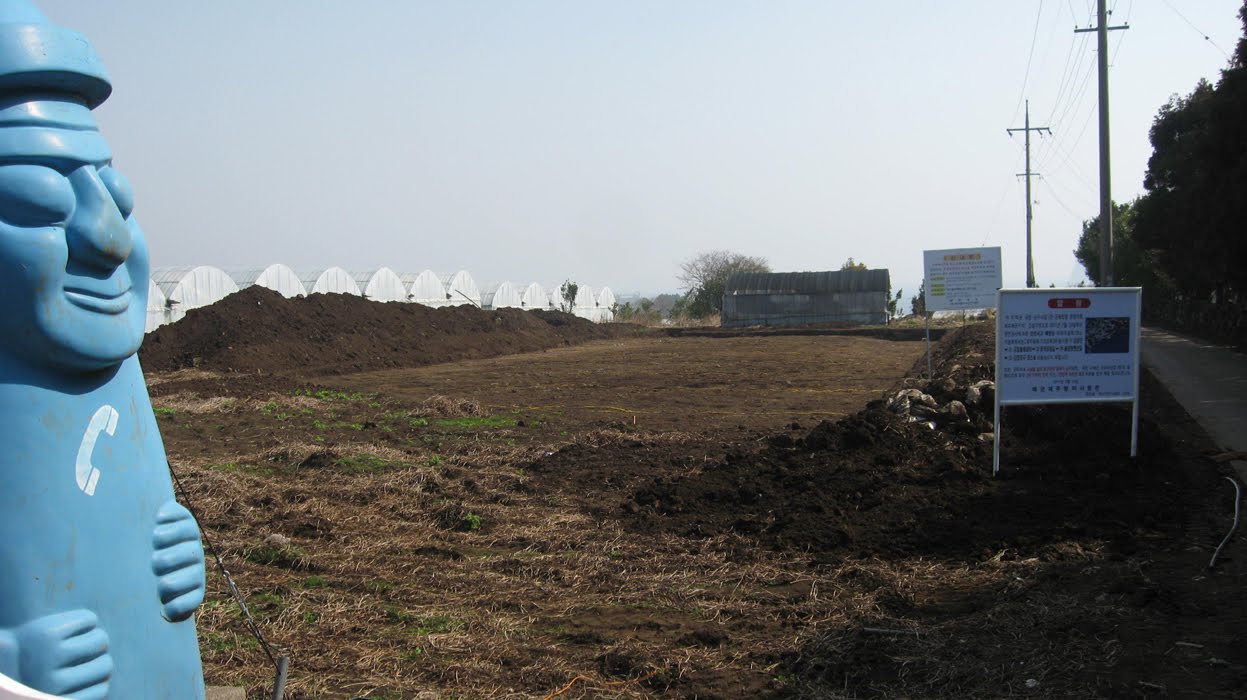
'저는 그들의 땅을 지키기 위하여 싸웠던 인디안들의 이야기를 기억합니다. 백인들이 그들의 신성한 숲에 도로를 만들기 위하여 나무들을 잘랐습니다. 매일밤 인디안들이 나가서 백인들이 만든 그 길을 해체하면 그 다음 날 백인들이 와서 도로를 다시 짓곤 했습니다. 한동안 그 것이 반복되었습니다. 그러던 어느날, 숲에서 가장 큰 나무가 백인들이 일할 동안 그들 머리 위로 떨어져 말과 마차들을 파괴하고 그들 중 몇몇을 죽였습니다. 그러자 백인들은 떠났고 결코 다시 오지 않았습니다….' (브루스 개그논)


For any updates on the struggle against the Jeju naval base, please go to savejejunow.org and facebook no naval base on Jeju. The facebook provides latest updates.

Saturday, February 26, 2011

Text Fwd: NATO Chief Convenes Emergency Session Of NAC ON Libya


North Atlantic Treaty Organization
NATO Secretary General convenes emergency meeting of the North Atlantic Council
February 25, 2011

NATO Secretary General convenes emergency meeting of the North Atlantic Council
During a visit to Budapest, the NATO Secretary General made the following statement:
What is happening in Libya is of great concern to all of us. It’s a crisis in our immediate neighbourhood. It affects the lives and safety of Libyan civilians and those of thousands of citizens from NATO member states. Many countries are now evacuating their citizens from Libya – clearly, a massive challenges.

I can tell you that I have convened an emergency meeting of the NATO council this afternoon to consult on the fast-moving situation. I will return to Brussels in a few hours. Before I do so, I will meet with EU Defence Ministers and discuss with them how we, in a pragmatic way, can help those in need and limit the consequences of these events.

Q (Reuters): What kind of possible action can NATO consider to help resolve this crisis? NATO Secretary General: I will not go into specifics at this time, but clearly priority must be given to evacuation and possibly, also, humanitarian assistance.

Q (Reuters): What kind of capabilities does NATO have to deploy and how quickly can they deploy these capabilities, if the need arises?

NATO Secretary General: I think, again, it’s a bit pre-mature to go into specifics, but it’s well known that NATO has assets that can be used in a situation like this and NATO can act as an enabler and coordinator, if and when, individual member states want to take action.
__________________________________________
See also Stop NATO
Report: NATO Prepares For Air Strikes Against Libya
The Teamasek Preview

NATO is preparing a possible strike on Libya if the Libyian Government continue to bomb protesters.

A NATO official who spoke to the Al-Quds al-Arabi newspaper in London said that U.S. and NATO planes stationed in southern Italy have been preparing for the mission since Thursday morning.

International momentum is building for action to punish Gadhafi’s regime for the bloody crackdown it has unleashed against the uprising that began on 15th February.

On Wednesday night, U.S. President Barack H. Obama said that the suffering and bloodshed in Libya “is outrageous and it is unacceptable”, adding that a NATO attack on Libya was a possibility.

British Foreign Minister William Hague said that the UK would initiate a World Court investigation into Libyan leader Muammar Qaddafi for crimes against humanity.

French Defense Minister Alain Juppé said that he hoped that Qaddafi would soon be deposed, and that if he was not, France would likely support sanctions against the country.

The U.N. Security Council held an emergency meeting that ended with a statement condemning the crackdown, expressing “grave concern” and calling for an “immediate end to the violence” and steps to address the legitimate demands of the Libyan people.

Reports said that thousands had been killed in Libya after being bombarded by air and naval strikes. (Alan Au)

Text Fwd: White House Pushing F-35 Joint Strike Fighter Sales Worldwide

Stop NATO
White House Pushing F-35 Joint Strike Fighter Sales Worldwide

GlobalPost
Obama’s F-35 sales push :
Why is Obama peddling Lockheed Martin’s stealth F-35 fighter around the world?
Barry Neild
February 24, 2011

With prices starting at $110 million per jet, the F-35 Lightning II fighter isn’t really the sort of thing for sale on Craigslist. But the way the Obama administration has been peddling this sophisticated aerial combat tool around the world, perhaps it wouldn’t be a surprise if it were.

While countries including Australia, Canada, Turkey, the United Kingdom and the Netherlands have all placed orders amounting to hundreds of F-35s, the president and his team of executive salesmen have been pitching hard elsewhere.

Late last year, U.S. Secretary of Defense Robert Gates was in Japan singing the praises of the stealth fighter that has cost his government billions to develop. And in Israel, ministers have reportedly been debating F-35 deals offered by Barack Obama as sweeteners in the Middle East peace process.

To some, it might seem odd that the commander-in-chief is willing to hand over keys to aircraft packed to the hilt with the latest U.S. military technology — particularly radar-evading stealth, which no other country yet has — even if the paying customers are allies.

At a time of global instability, particularly in the Middle East, some observers say this hard sell is risky. In the 1970s, the United States sold F-14 fighters to a friendly, seemingly-stable Iran. These later fell into hostile hands after a regime change.

So what’s behind this sales drive? Has F-35 builder Lockheed Martin proved so successful at lobbying the Obama administration that the presidential team is now effectively selling its products door-to-door? Is it about votes? Is it money? Analysts say the truth – like the aircraft – is far more complex.

The F-35’s back story is scattered with controversy. Still not yet in service, the next-generation aircraft has been beset by missed deadlines, and by budgets that have helped make its decade-long development the most expensive weapons program ever undertaken in the United States.

Lockheed says the F-35 will be worth the wait. When it does finally make it off the runway, many experts agree it should be an impressive machine, crammed with gadgetry. Some models will even be capable of performing vertical take offs and landings.

Still five years from completion, the aircraft has already faced hostilities. It has been criticized for performing poorly in simulations, and for including features beyond what’s needed on the battlefield. It has been deemed such a drain on resources that Gates now wants to cut America’s F-35 order to reduce the Pentagon’s budget.

This reluctance to buy a product at home might seem at odds with the U.S. government’s eagerness to promote it abroad, were it not for the fact that the F-35 has been specifically designed with foreign sales in mind.

Since its inception, the F-35 has been known as the “Joint Strike Fighter” in reference to the involvement of allies including Britain, the Netherlands, Canada, Denmark, Norway and Turkey. All have contributed in varying degrees to the jet’s funding and development.

Strategically, that’s an advantage to the U.S., both in getting other nations to help foot the defense bill, and arming friends with familiar “interoperable” technology, says Craig Caffrey, a military aviation analyst with Jane’s Information Group.

“The vast majority of military operations that America undertakes nowadays are coalition operations,” he said. “If you can have a platform in service with your main allied nations — the U.K. in particular is a good example — it makes sense.”

Gates’ recent mission to Japan was also, said Caffrey, an attempt to capitalize on recent high-profile test flight of the J-20, China’s first foray into stealth fighters. “There's obviously a sales pitch here. They're saying if you're worried about that Chinese fifth generation aircraft, we can supply you with one of your own.”

According to reports from the WikiLeaks cache of U.S. State Department documents, American diplomats put pressure on Norway to choose the F-35 instead of rival machines from Swedish SAAB’s JAS Grippen or Eurofighter (another multinational military aircraft project).

Some arms watchers have suggested that the U.S. is playing one country off of another in order to boost its arms trade. Though clearly arranged with a possible threat from Iran in mind, sales of F-35s to Israel could be seen as a way to encourage potential rivals such as Saudi Arabia to spend money upgrading and expanding their fleets of F-15 fighters, made in the United States by Boeing.

To what extent are Obama administration officials acting at the behest of manufacturers such as Lockheed Martin — or perhaps seeking to win key votes from districts involved in the defence industry?

Lockheed spends good money on promoting its interests. In 2010 its lobbying bill exceeded $12.7 million, according to the non-partisan watchdog OpenSecrets.org. Much of this lobbying appears to be aimed at staving off military budget cuts rather than promoting aircraft sales.

But while aggressive sales pitches overseas may suggest otherwise, the Obama administration doesn’t seem to be bowing to the company’s every demand. For example, despite requests from Lockheed Martin, the government has refused to allow overseas sales of another of its stealth fighters, the F-22, which is said to be too technologically sensitive for foreign customers.

Moreover, Obama has urged Congress to scrap funding to build an alternative F-35 engine, a project that currently employs 1,000 people in the swing state of Ohio. (The House of Representatives in early February voted with the president on this.)

It would seem, therefore, that he’s not viewing the aircraft program as a vote winner. Instead, said Caffrey, any promotion of Lockheed’s interests is likely to result from simple economics.

“One key reason why you get heads of states involved in selling this kind of equipment abroad is because they are major industrial deals; they are worth large sums of money, and keep large numbers of people employed in high tech jobs," he said. He pointed out that similar overseas missions have been carried out by British Prime Minister David Cameron and French President Nicolas Sarkozy.

“It’s big business, and it’s long term business. You don't sell an aircraft and that's the end of the company's involvement — it goes on for at least 30 years.”

Jeff Abramson, deputy director of the Arms Control Association, argues that attempts to sell the F-35 overseas are part of the Obama administration’s efforts to double U.S. arms exports and thus aid economic recovery.

But even if F-35s are merely being deployed against economic uncertainty rather than into aerial combat, Abramson warned of other consequences.

“In general, it is unwise to think of arms sales as just any other commercial transaction,” he said, suggesting that the F-35s could be vulnerable to misuse or even contribute to regional arms races and instability.

“Any transfer agreement must consider whether the proposed weapons are appropriate for their intended use, and whether they might contribute to regional arms races or instability. It’s not clear that all the discussions around F-35s have adequately taken these considerations in mind.”

Text Fwd: After Ivory Coast, AFRICOM Readies ASF For Central African Role

Stop NATO
U.S. Africa Command
U.S. Army Africa
February 24, 2011


Exercise Kwanza Review in Kinshasa Focuses on African Standby Force
U.S. Army Africa Public Affairs


-[T]he Economic Community of West African States (ECOWAS) -- an organization
like ECCAS -- diplomatically responded recently -- and could militarily respond
-- to the electoral crisis in the West African country of Cote d'Ivoire. The
ECCAS could respond to a crisis in its area of responsibility composed of
Angola, Burundi, Cameroon, Republic of Congo, Gabon, Equatorial Guinea, Central
African Republic, Democratic Republic of Congo, Sao Tome and Principe and Chad.


KINSHASA, Democratic Republic of the Congo: In his "Commander's Intent 2011"
message, one of U.S. Army General William E. "Kip" Ward's key approaches was
that, "??[U.S. Africa Command] will continue to support the African Union (AU)
to include strengthening the capabilities and interoperability of the African
Standby Force (ASF) and its sub-regional elements."

To forward that goal, Major George K. Allen Jr. of U.S. Army Africa and
Lieutenant Jonathan Goerk of U.S. Naval Forces Africa traveled to Kinshasa,
Democratic Republic of the Congo in October 2010, to participate in the
Conference Bilan et Retour d'experience de L'exercice Kwanza 2010 or Exercise
Kwanza After Action Review (AAR).

Economic Community of Central African States (ECCAS) held the exercise in order
to validate Central African Multinational Force (CAMF) to AU standards. The
force is one of five brigade-size elements that make up the AU's ASF--created to
respond to crises on the African continent.

Allen and Goerk sat alongside their ECCAS counterparts to gain a better
understanding of how CAMF performed during Exercise Kwanza in Cabo Ledo, Angola,
from May 22 to June 5, 2010. The observers' participation in the Exercise Kwanza
AAR follows their observation of the exercise this summer.
....
According to Allen, the Economic Community of West African States (ECOWAS) -- an
organization like ECCAS -- diplomatically responded recently -- and could
militarily respond -- to the electoral crisis in the West African country of
Cote d'Ivorie. The ECCAS could respond to a crisis in its area of responsibility
composed of Angola, Burundi, Cameroon, Republic of Congo, Gabon, Equatorial
Guinea, Central African Republic, Democratic Republic of Congo, Sao Tome and
Principe and Chad.

"ECCAS and CAMF are professional and ready to go," Goerk said. "Exercise Kwanza
proved that as an armed force, CAMF can work with diplomats, gendarmerie, and
Non-Governmental Organizations (NGOs) on the both the sea and ground."
....
"In working with CAMF and the other regional standby forces, AFRICOM and USARAF
could easily incorporate civilians and NGOs into our military exercise play and
operations," Allen said. "Joint, Interagency, Intergovernmental, and
Multinational (JIIM) personnel are already part of their formations. It is a
win-win proposition."

Friday, February 25, 2011

[Jeju Emergency] Construction was resumed on Feb. 25 제주 긴급: 2월 25일 공사 재개됨: 플랜트 받침대 건설 공사 돌입

The sub-contracting company of the Daerim, one of the main corporations for the naval base construction resumed construction on Feb. 25, 2011 after some pose sine Feb. 18, by installing the plant supports. See the videos in the below the photos. (Source: Gangjeong village people's council)
사진: 강정 마을회


Two Daerim sub-contracting company workers managing construction

Construction seen from the coast


The navy resumed construction on Feb. 25_part1

The navy resumed construction on Feb. 25_part2

[Jeju Update] Another excavation site of high possibility of relics was discovered in the planned naval base area on Feb. 24, 2011

_______________________________________________
* There are actually many important news about the Jeju. More news will be summarized later.
___________________________________________
* Click the map for larger view 지도를 클릭하시면 확대됨

2011년 2월 24일자 제주 해군 기지 예정 지역 내 문화재 발굴 조사 현황

The current situation of excavation research on cultural properties in the planned Jeju naval base area as of Feb. 24, 2011

지도 원본: 제주 문화 유산 (재단) Original map source: The Jeju Cultural Heritage (Foundation)

몇 참조글, 필요에 의해 추가됨 Some reference words were added for necessity
___________________________________________

The below are the photos of the site 4 in the map above. The site 4 is located in the middle of the planned naval base area, supposedly for the headquarter of the base. A large big white circle was discovered in the trench 1 of it while two small circles in the trench 2, in the morning. In the afternoon, the small white circles were increased to seven in the trench 2.


Trench1

Trench2
A big circle in the trench 1
Trench 3

Trench 4

................................................................

Afternoon


[Translation] The U.S. State Department-backed NED supports 450,000 dollar to the three Anti-NK groups in Korea

* 아래는 통일 뉴스 기사를 번역한 것입니다. (클릭)
* The below is an arbitrary translation of an article in a progressive South Korean media, 'Tongil News'

Tongil News
The NED supports 450,000 dollar to the three Anti-NK groups in Korea
Feb, 24, 201
by Kim Chi-Kwan

The National Endowment Democracy (NED) based on the United States has supported $450,000 to the three anti-North Korea media and organizations in South Korea.

On its Feb. 23 report, the Radio Free Asia, Citing Lynn Lee who is in charge of East Asia, NED, said that “[The NED] has supported the ‘Daily NK,’ an internet media specialized in the NK news, ‘Imjingang Publishing Company’ a magazine published by the underground reporters inside North Korea, and ‘Network for North Korean Human Rights and Democracy’ which is for the improvement of human rights in North Korea, through the decision of its board meeting held last January.”

The total cost that the NED has given to the three groups is $450,000 and the cost that each organization has received is $85,000 to $190,000 that is an increment of $10,000, compared to that of last account year.

The Radio Free Asia said that “There are total 14 organizations of the institutes located in the United States & Korea and the groups of the exiled from the NK, which have received support from the NED in last account year. And it is expected that the numbers of the NK-related institutes that would receive fund through additional decisions by its board meeting will be increased in the future. “ It also said that, “As it has decided the support on the research on the ‘Jangmadang’ in the North Korea’ for the first time, especially in last year’s account, the support for the exiled North Korean groups and research institutes for the NK Jangmadang economy, NK study, human rights improvement and information delivery would be continued this year.”

The National Endowment Democracy(NED) whose connection with the CIA has been raised is a non-profit organization having its headquarter in the Washington D.C. and is supporting democracy-related projects, sponsored by about 1,000 civilian groups in 90 countries in the world, receiving fund from the U.S. State Department.

The Radio Free Asia said that the NED selects its business contents and support targets after reviewing business contents and support targets on the improvement of human rights, delivery of information, and improvement of education & ability in the NK and that the US State Dept has allocated 104,000,000 dollar for the NED in its 2012 budget, which is a little reduced amount from 2011.

...........................................................................
Source from National Endowment Democracy
Baekdu-Halla Association
$30,000
To build the capacity of young North Korean defectors in South Korea and to encourage them to become more engaged on issues related to North Korean human rights and democracy. Baekdu-Halla will organize an online democracy education program and offline seminars, and provide young defectors with opportunities to interact and build networks.

Citizens’ Alliance for North Korean Human Rights
$150,000
To bring international attention to the human rights situation in North Korea. The Citizens’ Alliance will promote awareness among South Koreans about North Korea and test methods of assisting North Koreans living in South Korea to adjust to citizenship in a democratic society.

The Daily NK
$130,000
To disseminate accurate and timely information about North Korea. The Daily NK will produce an online newspaper serving audiences in South Korea and in the international community. The newspaper will include news and information about North Korean human rights issues as well as developments in North Korean politics and economics.

Database Center for North Korean Human Rights
$80,000
To make publicly available well-organized documentation on human rights conditions in North Korea. The database will organize information from interviews as well as published and unpublished written testimonies. The Center will also publish an annual white paper and special thematic reports in Korean and English, and will carry out individualized data searches upon request for researchers, governments, UN bodies and human-rights advocates.

Free North Korea Radio Station
$150,000
To support the free flow of information in North Korea. Free NK will produce and broadcast a daily radio program to increase the news, information, and independent commentary available to North Korean audiences.

Imjingang Publishing Company
$75,000
To provide a platform for North Korean citizens to share information and opinions about North Korean culture, economics, politics, and other developments. Imjingang will produce a Korean-language quarterly magazine using materials gathered by reporters and distribute copies throughout the Korean peninsula and to Korean-speaking experts in the international community.

InterMedia Survey Institute
$50,000
To promote the free flow of information. InterMedia will conduct survey research documenting various dimensions of the listenership response of international broadcasting in North Korea, and provide non-governmental broadcasters with independent, reliable data about audience behaviors and preferences as an aid to making future programming and formatting decisions.

Network for North Korean Human Rights and Democracy
$75,000
To develop democracy education materials suitable for people raised in repressive environments; and to raise awareness of democratic ideas and values. NKnet will work closely with North Korean citizens and experts to develop and test a multimedia curriculum that is user-friendly for those born and raised in North Korea.

Network for North Korean Human Rights and Democracy
$35,000
To provide a forum in Seoul for discussion of the future of North Korea. NKnet will hold strategy sessions to explore effective means of promoting economic and political liberalization in North Korea.

NK Communications
$175,000
To support the free flow of information into North Korea. NK Communications will produce the North Korea Reform Radio program, providing daily broadcasting of news, information, and commentary designed to encourage the development of independent public opinion inside the country.

North Korea Intellectual Solidarity
$70,000
To facilitate the free flow of information. NKIS will produce a digital magazine containing accurate and balanced news and information and diverse views about major issues in South and North Korea and around the world. This project will be a pilot test to assess the potential impact of this approach.

Open North Korea
$150,000
To support the free flow of information in North Korea. Open North Korea will maintain a radio platform that enables organizations and groups in South Korea and elsewhere to broadcast information and feature programs to North Korean audiences.

Radio Free Chosun
$150,000
To support the free flow of information in North Korea. Radio Free Chosun will broadcast its daily program, providing news and features on the Korean peninsula, to the North Korean public via shortwave radio and will maintain a web-based archive of programming for other interested listeners.

Young Defectors’ Alliance for North Korean Human Rights
$30,000
To build the capacity of North Korean defector students in South Korea and to encourage them to become more engaged on issues related to North Korean human rights and democracy. YDA will organize its leadership education program to help equip defector students to serve as bridges between South and North Korea and to take an active part in civic life in a future democratic North Korea.
________________________________________
통일 뉴스(클릭)
NED, 국내 반북단체 3곳 45만 달러 지원 [RFA]
2011년 02월 24일 (목) 14:24:42 김치관 기자

미국 ‘국립민주주의기금(NED)’이 한국의 반북매체.단체 3곳에 45만 달러를 지원했다.

<자유아시아방송(RFA)>는 23일자 보도에서 린 리 NED 동아시아 담당관의 말을 인용, “지난 1월에 열린 이사회의 결정을 통해 북한 뉴스를 전문으로 하는 인터넷 매체 'Daily NK'와 북한 내 지하 기자들이 만드는 잡지 '임진강', 그리고 북한 인권의 개선을 위한 '북한인권시민연합'에 자금을 지원했다”고 전했다.

NED가 이들 3개 단체에 지원한 금액은 총 45만 달러이며, 각 단체가 받은 금액은 8만 5천 달러에서 19만 달러로 지난 회계연도와 비교해 1만 달러가 늘었다는 것.

<자유아시아방송>은 “지난 회계연도에 '국립민주주의기금'의 지원을 받은 미국과 한국 내 기관, 탈북자 단체는 모두 14개로 앞으로도 추가적인 이사회의 결정을 통해 자금을 받는 북한 관련 기관은 더 늘어날 전망”이라며 “특히 지난 회계연도에는 처음으로 북한 장마당에 대한 연구에도 지원을 결정했듯이 올해도 북한의 장마당 경제와 북한 연구, 인권 개선, 정보의 전달 등을 위한 탈북자 단체와 연구 기관에 대한 지원은 계속될 예정”이라고 전했다.

CIA(미 중앙정보국)과의 연루설이 제기돼 온 NED(The National Endowment for Democracy)는 미국 워싱턴에 본부를 둔 미국의 비영리 단체로서 국무부의 자금지원을 받아 전세계 90여개 국에 1,000여 개의 민간단체가 주관하는 민주주의 관련 프로젝트를 지원하고 있다.

<자유아시아방송>은 NED는 1년에 4번의 이사회를 거쳐 북한의 인권개선과 정보의 전달, 교육과 능력 향상 등에 관한 사업 내용과 지원 대상을 검토해 선정하며, 미국 국무부는 최근 발표한 2012년 예산안에서 NED에 관한 항목으로 2011년보다 소폭 감소한 1억 400만 달러를 배정했다고 전했다.


자세한 영문 내역은 기사 참조

Text Fwd: Korea to market small nuclear reactors

* As in the case of the export on the nuclear power plant to the UAE, South Korean military expansion in other countries may be expected.

Korea Times
Korea to market small nuclear reactors
Feb. 24, 2011
By Kim Tae-gyu

Korea has diversified its product portfolio to boost the sales of nuclear power facilities. Demand is rapidly rocketing thanks to the world’s concerted efforts to reduce its heavy reliance on fossil fuels.

Korea Nuclear Energy Promotion Agency (KONEPA) Chairman Rhee Jae-hwan said in a recent interview with The Korea Times that the nation is working on the development of small-sized commercial nuclear power generation systems.

“Local researchers have finished much work on small-sized SMART nuclear reactors and have applied for global approval, which will be reviewed next year,” said Rhee who took charge of the state-run KONEPA in late 2009.

“The SMART reactor is a new-concept product, which will cater to the requirements of a city with a population of between 100,000 and 200,000. Many have shown interest in the innovative products including Kazakhstan.”

Asia’s fourth-largest economy has basked in the international spotlight over the past couple of years after it signed an $18.6 billion agreement to build four nuclear reactors in the United Arab Emirates by 2020.

They are mega-sized ones designed to generate a huge amount of electricity. In comparison, the SMART reactors are smaller-sized, tailor-made products with multiple functionalities.

Emerging countries tend to prefer small-sized facilities like the SMART reactor and demand is expected to be somewhere between 500 and 1,000 by 2050. This means that the overall market size will amount to $350 billion.

Many countries including Chile, Lithuania and Kazakhstan are seeking to embrace the mini-sized facilities and Korea is looking to preempt the lucrative market.

“With the help of its technical edge and experience, Korea will be able to carve out a substantial chunk of the markets for both the large- and small-sized nuclear reactors,” Rhee said.

Asked about the revision of the Atomic Energy Agreement between Korea and the United States, Rhee contended that the country has to be allowed to use nuclear fuel down the road.

“The capacity of Korea’s interim dumps for high-level radioactive waste will run out fast. It will hit full capacity in 2016 but we are struggling to build permanent waste sites,” he said.

“Knowing that it took almost two decades to set up the sites for low-level radioactive dumps, we will not be able to build ones for high-level waste by 2016. Hence, we have no other choice but to reuse the spent nuclear fuel. The worries on weaponization can also be blocked through safe pyroprocessing.”

Under a bilateral nuclear agreement signed in 1974, Seoul has not been able to reprocess any spent nuclear fuel. Since this is set to expire in early 2014, the Lee Myung-bak administration started talks on revising the deal.

One of the thorny issues is whether Korea will be allowed to reprocess spent nuclear fuel. The U.S. is against the idea, citing the possibility of enriching it for nuclear weapons.

In response, Korea countered that pyroprocessing of spent nuclear fuel will calm such concerns because the new technology can reprocess spent nuclear fuel only for power generation.

(voc200@koreatimes.co.kr )

[ROK MND News Cathch Up] South Korea's military ambition has been expanded

ROK MND News No 714
'Korean troops participate in 'Cobra Gold 2011'
Feb. 14, 2011 (Uploaded on Feb. 21, 2011)

An estimated 10,000 troops from Korea, the United States and Thailand participated in a joint landing exercise in Hat Yao on Feb. 10 as part of the 30th annual Cobra Gold exercise.
[..]
On this day, Korean marines and sailors implemented joint landing operation along with U.S. and Thailand servicemembers by using assault amphibious vehicles under the U.S. 31st Marine Expeditionary Unit in Okinawa, Japan. The unit known as the first unit to be deployed to Korea in case of emergencies.
[..]
Cobra Gold, which began in 1982, is one of the world's largest multinational military exercises taking place in the Pacific region. Service members from Korea, Japan, Singapore, Malaysia and Indonesia joined hosts of Thailand and the U.S.

Korea had participated in the drill as an observer until 2009 but dispatched regular military unit of 332 marines and sailors last year to join joint combat exercise.

Cobra Gold includes joint non-military convoy operation, live-fire demonstrations, field strategic exercise and community service projects. The joint drill ended on Feb. 18.
________________________________________


ROK MND News NO 714
Korea and Indonesia deepen military ties
Feb. 14, 2011 (uploaded on Feb. 21, 2011)


EXCERPT
Korean Minister of National Defense Kim Kwan-jin received Indonesian Defense Minister Purnomo Yusgiantoro on Feb. 15 and discussed ways to boost military exchanges, including arms industry cooperation.

[..]

Yusgiantoro, as a leader of special envoy team for defense exchange, visited Korea on Feb. 14 to discuss strategic measures to deepen arms cooperation with Kim.


On Feb. 14, the head of Defense Acquisition Program Administration of Korea and Defense Vice Minister of Indonesia held talks for measures to reinforce long-term and comprehensive arms trade.

Korea and Indonesia have been working hard to deepen military ties by holding minister-level talks such as during the Shangri-La dialogue held in Singapore in June last year, former Minister Kim Tae-young's official visit to Indonesia in August last year and the Asean Defense Ministers Meeting Plus in Vietnam in October last year.
____________________________________________________

Korea MND Recent News NO 713
KF-16 jets to be fitted with precision-guided missiles
Feb. 10, 2011 (uploaded on 2011-02-14)

EXCERPT

Korea's Air Force mainstay KF-16 fighter jets will have their performance enhanced by installing and dropping GBU-31 Joint Direct Attack Munition (JDAM) precision-guided missiles.

[..]

According to the Air Force, JDAM is a precision-guided bomb guided by an integrated inertial guidance system coupled to a Global Positioning System that can disable North Korea's long range artilleries and other strategic targets at the same time. So far, the state-of-the-art missile system has been operated on F-15K fighter jets. In order to operate JDAM on KF-16, producer has to either purchase proper software or develop it in Korea.

__________________________________________
Korea MND News NO 712
Feb. 10, 2011 (uploaded on 2011-02-14)
Defense minister visits Afghanistan and UAE

EXCERPT

The Minister of National Defense Kim Kwan-jin was on a five-day trip to Afghanistan and the United Arab Emirates, which embarked on Feb. 7 with an aim to encourage Korean troops and provincial reconstruction team (PRT) who are stationed there for peacekeeping activities, according to the Defense Ministry on Feb. 9.

[..]

The ministry said that Kim inspected bases where "Ashena Unit" and PRT are stationed in the morning on Feb. 8 and examined security and safety conditions. Followed by the inspection, Kim encouraged Korean troops. Some 340 troops are operating to protect PRT to help rebuild the war-torn country.

Ashena means "friend" in the country's local language.

In the afternoon, Kim had talks with U.S. Gen. David Howell Petraeus, the commander of International Security Assistance Force and U.S. Forces Afghanistan, and Abdul Rahim Wardak, Defense Minister of Afghanistan to discuss current situation in the local region and direction of mission performance.

During talks with Wardak, Kim asked for Afghanistan's support and cooperation for Ashena Unit.

As construction of unit's base ended on Jan. 24, Korean troops have moved from U.S. Bagram base to Charika base and it is preparing for its full-scale mission.

On Feb. 9, Kim headed for the UAE to meet some 130 Korean troops there.

In the UAE, Kim paid a courtesy visit to HH General Sheikh Mohammed Bin Zayed Al Nahyan, Crown Prince of Abu Dhabi and Deputy Supremem Commander of the United Emirates Armed Forces, and Lt. Gen. Hamad Mohammed Thani Al Rumaithi, Chief of Staff of the UAE Armed Forces. They discussed measures to boost bilateral military exchanges and enhance cooperaton in the defense industry.

In addition, Kim expressed his gratitude for the support of military operation to capture pirates and save sailors of hijacked Korean commercial ship last month.

Kim visited Korean contingent named "Akh Unit," which was dispatched to the UAE last month for a two-year mission to help train the UAE special forces, and inspect the base as well as encourage troops.

"Kim's oversea trips will be an good opportunity to not only boost morale of Korean troops stationed overseas but also expand military exchanges with the UAE and Afghanistan," said a defense official in Seoul.

Text Fwd: 7th Fleet Chief: U.S., Allies Boost Warships, Subs In Asia-Pacific

Stop NATO
Navy NewsStand
7th Fleet Chief: U.S., Allies Boost Warships, Subs In Asia-Pacific
February 22, 2011

'Commitment Remains Steadfast' in Asia-Pacific
By By Mass Communication Specialist 2nd Class (SW/AW) Kenneth R. Hendrix, U.S.
7th Fleet Public Affairs

-[T]he numbers of ships operating in the 7th Fleet on any given day are about 70 on average, which is about the same or more than it was a decade ago with increased capabilities aboard those ships today.

Van Buskirk cited the deployment to Japan of the nuclear-powered aircraft carrier USS George Washington (CVN 73) -- with greater speed, range, ammunition stowage and endurance, as an example of how the fleet's capabilities have increased.

HONG KONG: Commander, U.S. 7th Fleet Vice Adm. Scott R. Van Buskirk told members
of the Asia Society in Hong Kong on Feb. 21 that the Navy's increased capabilities and growing maritime partnerships reflect an enduring commitment...in the region.

"The 7th Fleet has actually increased its capabilities in several significant ways. The ships and aircraft that we operate today are vastly more capable than they were just a few years ago. At the same time, we have enhanced our maritime partnerships with navies around the region, enabling us to work together cooperatively more than ever before," Van Buskirk said.

He said the numbers of ships operating in the 7th Fleet on any given day are about 70 on average, which is about the same or more than it was a decade ago with increased capabilities aboard those ships today.

Van Buskirk cited the deployment to Japan of the nuclear-powered aircraft carrier USS George Washington (CVN 73) -- with greater speed, range, ammunition stowage and endurance, as an example of how the fleet's capabilities have increased.

He also cited the deployment of the Ohio-class fleet ballistic missile submarines (SSBN), the 60-40 split of attack submarines from the Atlantic to the Pacific and the recent deployment of the Virginia-class submarine USS Hawaii (SSN 776), which reflects the fleet's growing capability under the sea.

Van Buskirk added that upgrades to surface ships, including Ballistic Missile Defense capability and enhanced sonar suites, making them "increasingly potent."

He rejected the notion that the U.S., with its sluggish economy and military operations in Afghanistan, is lessening its commitment to the region.

"U.S. Navy and defense leadership continue to give me exactly the forces I need to do my mission," Van Buskirk said.

Improvements in capability have been made even stronger by a deepening of our alliances and partnerships around the region, Van Buskirk commented.

"Our alliance with Japan continues to be the cornerstone of our forward presence in Asia...." Van Buskirk said.

He also expanded on the alliance with the Republic of Korea, interoperability with the Royal Australian Navy and growth of navy-to-navy relations in Southeast Asia.
....
Van Buskirk reiterated that the U.S. Navy remains "committed and engaged".

"That is the message. We remain committed to this region, we remain committed to the Pacific and actively engaging where ever we can to foster maritime partnerships," he said.
______________________________

Stop NATO e-mail list home page with archives and search engine:
Stop NATO website and articles

Text Fwd: Bahraini MP: Arab Turmoil U.S. Greater/Broader/New Mideast Plot / Russia's Putin Warns West Against Whipping Up Mideast "Democracy"

Stop NATO
Bahraini MP: Arab Turmoil U.S. Greater/Broader/New Mideast Plot
Russian Information Agency Novosti
February 24, 2011

Bahrain lawmaker accuses U.S. of being behind Arab revolutions

-"These riots and revolutions we are observing today in Arab countries are the
implementation of the global U.S. project entitled 'New Middle East.' This
program started with Iraq [2003], followed by Lebanon [2005]."

Manama: The popular unrest in Arab countries that led to the fall of regimes in
Tunisia and Egypt is part of a U.S.-designed strategic project dubbed "New
Middle East," a Bahraini deputy said Thursday.

The term "New Middle East" was introduced in 2006 by then U.S. Secretary of
State Condoleezza Rice. Analysts say the project defines Washington's policy on
a vast territory including the Arab countries and Central Asian states.

"These riots and revolutions we are observing today in Arab countries are the
implementation of the global U.S. project entitled 'New Middle East.' This
program started with Iraq, followed by Lebanon," Bahraini deputy and journalist
Samira Rajab told RIA Novosti.

"A new stage of its implementation that will take at least a decade started from
2011," she said, adding that the U.S. strategy in the region is aimed at
weakening the ruling regimes and introducing opposition groups into their
governments.

A wave of unrest, which has already toppled authoritarian regimes in Tunisia and
Egypt, is sweeping through the Muslim world, stoking mass popular uprisings in
Libya, Bahrain and Yemen.

_____________________________
Stop NATO
Russian Information Agency Novosti
Russia's Putin Warns West Against Whipping Up Mideast "Democracy"
February 24, 2011

Putin warns against whipping up democratic processes

-Asked by European media whether he felt any concern about events in the Middle
East and their possible "echo" in the North Caucasus, Putin replied in the
affirmative, but added that the impact of those shocks would be felt not only in
the North Caucasus, but in all countries, including those in Europe.

BRUSSELS: Russian Prime Minister Vladimir Putin has warned Moscow's partners in
the West against attempts at whipping up democratic processes in other countries
in connection with the ongoing events in North Africa. He was speaking at a
joint news conference with European Commission President Jose Manuel Barroso,
devoted to the results of the full-scale meeting of the Russian government and
the EU Commission.

Asked by European media whether he felt any concern about events in the Middle
East and their possible "echo" in the North Caucasus, Putin replied in the
affirmative, but added that the impact of those shocks would be felt not only in
the North Caucasus, but in all countries, including those in Europe.

"We are concerned, firstly, about the number of casualties in the events in
North Africa. We are concerned about that despite the soothing claims a rise to
power or growth in the influence of radical groups in northern Africa are
unlikely."

"And if that really happens, it cannot but affect other parts of the world,
including, of course, the North Caucasus," he said.

"As you may know,??continued Putin, ? Today we express concern about what is
happening in Libya. Please, to take note of the fact that the North African cell
of al-Qaeda, too, is concerned about what is happening in Libya. Is that just a
coincidence???

Having made this historical allusion, Putin recalled that the former leader of
the Iranian revolution, Ayatollah Khomeini, before his return to Tehran and the
overthrow of the Shah's regime had lived in Paris, and the Western policy of
"inoculation of democracy??in the Palestinian territories caused bloody
conflicts and brought to power Hamas, very unpleasant for many in the West.

"The people are to be allowed to decide their own fate and their own future,?? he said. ? We must give them an opportunity to build their own destiny in a
natural way without any interference from outside."

"Society must move toward democratic institutions, toward self-regulation,
towards its own system, with reliance on the internal processes of development,"
underlined the prime minister.
_____________________________
Stop NATO e-mail list home page with archives and search engine:
Stop NATO website and articles:
_____________________________

Text Fwd: West Africa: U.S. Warship Continues Africa Partnership Station Visit

Stop NATO
Navy NewsStand
February 23, 2011
Robert G. Bradley Arrives in Gabon for APS West Mission
By Mass Communication Specialist 1st Class Darryl Wood, Commander, U.S. Naval
Forces Europe-Commander, U.S. Naval Forces Africa/ Commander, U.S. 6th Fleet
Public Affairs


LIBREVILLE, Gabon: USS Robert G. Bradley (FFG 49) arrived in Libreville, Gabon,
for port visit as part of the Africa Partnership Station (APS) West mission,
Feb. 23.

Building on the Chief of Naval Operations' Maritime Strategy, APS seeks to
enhance regional and maritime safety and security in Africa by developing
partnering capabilities and relationships.

While the Navy has conducted training during routine deployments in West Africa
for years, the focus of APS is increasing African maritime capabilities and
capacity....

"Robert G. Bradley is looking forward to its second theater security cooperation
engagement in Libreville, Gabon, fresh off a highly successful Togo visit," said
Cmdr. Darryl Brown, commanding officer of Robert G. Bradley.
....
"Robert G. Bradley hopes to strengthen U.S. relations with Gabon," said Brown.

APS is an international security cooperation initiative, facilitated by
Commander, U.S. Naval Forces Europe-Africa, aimed at strengthening global
maritime partnerships....

Robert G. Bradley, an Oliver Hazard Perry-class frigate, is homeported out of
Mayport, Fla., and is on a scheduled APS deployment to the West Coast of Africa.
_____________________________

Stop NATO e-mail list home page with archives and search engine:
Stop NATO website and articles