'저는 그들의 땅을 지키기 위하여 싸웠던 인디안들의 이야기를 기억합니다. 백인들이 그들의 신성한 숲에 도로를 만들기 위하여 나무들을 잘랐습니다. 매일밤 인디안들이 나가서 백인들이 만든 그 길을 해체하면 그 다음 날 백인들이 와서 도로를 다시 짓곤 했습니다. 한동안 그 것이 반복되었습니다. 그러던 어느날, 숲에서 가장 큰 나무가 백인들이 일할 동안 그들 머리 위로 떨어져 말과 마차들을 파괴하고 그들 중 몇몇을 죽였습니다. 그러자 백인들은 떠났고 결코 다시 오지 않았습니다….' (브루스 개그논)


For any updates on the struggle against the Jeju naval base, please go to savejejunow.org and facebook no naval base on Jeju. The facebook provides latest updates.
Showing posts with label Global Strike. Show all posts

Wednesday, May 5, 2010

Text Fwd: CATCHING UP ON [THE RECENT SPACE NEWS]


* Image source: same as the below link
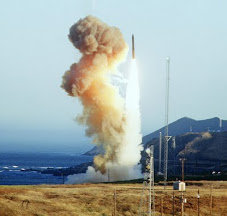
'The first test flight of the Falcon Hypersonic Technology Vehicle (HTV)-2 failed '

Bruce Gagnon blog
CATCHING UP
May 4, 2010

* Just back from New York City yesterday afternoon with much to catch up on. Feeling a bit groggy. Might be a second cup of tea morning. The sun is shining and the temperature outside more to my liking - cool. A beautiful Maine day. Our guest Rao has gone for a walk to the local library. Housemate Karen will take him for a ride out to the ocean today while I try to get my backlog of work done.

* Space News reports, "The U.S. Defense Department’s first test flight of a new hypersonic glider ended abruptly as communications with the vehicle ceased mid-flight, a setback in the Pentagon’s pursuit of a highly precise long-range strike weapon. The Defense Advanced Research Project Agency (DARPA)’s Falcon Hypersonic Technology Vehicle (HTV)-2 program is one of three designs in the running to serve as the basis for the Conventional Prompt Global Strike weapon the Pentagon wants to build in order to hit a target anywhere in the world within an hour with a non-nuclear munition. The first of three planned HTV-2 flight tests took place April 22."

"The administration of U.S. President Barack Obama has made clear its intention to maintain the nation’s strategic deterrent while reducing its dependence on nuclear weapons. As such, the New START nuclear arms reduction agreement signed with Russia on April 8 will not constrain any current or planned conventionally-armed ballistic missiles, according to an April 8 fact sheet posted on the U.S. State Department’s website."

The cost of this week's HTV test and a follow-on in 2011, together is $308 million. Your tax dollars in action enriching the aerospace industry and likely ensuring a new, expensive, arms race in space as Russia and China (who clearly understand they will be the targets) feel they must respond.

* I got an interesting email the other day about Obama's effort to privatize NASA and "civilian" space operations.

The article, by Steve Zeltzer, reports, "A full bore campaign is now being waged by the Obama administration to shutdown the U.S. unionized space program and turn it over to 'new age' speculators who want to build a new space program in a 'regulation free zone' in Florida. A key player in this plan is billionaire and former owner of Paypal, Elon Musk."

Musk, has set up SpaceX (Space Exploration Technologies Corporation) which appears to be on the way to running a taxi service for American astronauts. This is just another step toward eventual turning "ownership" of the planetary bodies over to corporations who envision making untold riches from mining the sky in years to come. You, the taxpayers, have paid the technology start-up costs and now the corporate elite will stand to make zillions in profits and pay little back in taxes.

You can see the full article here

* Yonhap News reports, "South Korea's first Aegis destroyer will undergo a comprehensive evaluation of its fighting capabilities near Hawaii in June, a Navy source said Monday.

"The source said Sejong the Great will conduct tests while taking part in the multinational Rim of the Pacific (RIMPAC) naval exercise. Lockheed Martin -- the developer of the Aegis system -- and U.S. Navy experts will act as observers and evaluate the weapons systems during the trial."

This is an indication that the South Korean Navy is now being fully integrated into the command structure of the U.S. Navy and that the Aegis destroyers that would be deployed at the proposed base on Jeju Island will in fact be a part of the larger U.S. military strategy of surrounding China's coastal region in order to create the ability to choke off their importation of oil via ship.

See the recent New York Times article on China's fear and response here.

* I head back to NYC on May 7 for a couple more international meetings including the Global Network annual meeting on May 9.

Monday, May 3, 2010

[Text Fw] The significance of a peace treaty for the denuclearization of the Korean Peninsula

* You can also see the SPARK NPT event photos HERE and HERE.
_________________________________________________________________
The significance of a peace treaty
for the denuclearization of the Korean Peninsula

Speech by Pyeon Yun-Sik, Co-Represntative of
Solidarity for Peace and the Reunification of Korea
May 1, 2010, New York, U.S.A.

Distinguished delegates and friends,

Why did N. Korea develop nuclear weapons?

Since the Armistice Agreement was signed on July 27, 1953, the Korean peninsula has been in a state of war for the last 60 years. Only two months after the Armistice Agreement came into force, S. Korea and the United States signed the Mutual Defense Treaty and entered into a relationship of alliance. An alliance is premised on "a provisional war community" and its deliberate intention to perpetuate a state of armistice, in other words a state of war.

Article Ⅳ 60 in the Armistice Agreement made explicit that within three months after the Armistice Agreement becomes effective, a political conference should be held to settle through negotiation the question of the withdrawal of all foreign forces from Korea and the peaceful settlement of the Korean question. Therefore, the establishment of the S. Korea-U.S. alliance is a violation against Article Ⅳ 60 that called for an immediate transition from the state of armistice into a state of peace on the Korean peninsula.

In 1957, the United States deployed nuclear weapons on the Korean peninsula and this can be considered as the origin of the so-called nuclear crisis on the Korean peninsula. Although the U.S. claims that it had pulled out its nuclear weapons from S. Korea since the 1990’s, the U.S. has provided its nuclear umbrella to S. Korea and integrated the strategy of preemptive nuclear strike against N. Korea into its national security policy. For example, the U.S. has five operation plans applicable to both war-time and peacetime, such as OPLAN 5027 and 5029. Central to those OPLANs is the possible scenario of a nuclear war through U.S.' preemptive strike against N. Korea, aimed at the overthrow of the N. Korean regime. Particularly, OPLAN 5029, designed for possible military deployment to N. Korea even during peacetime, is a very provocative and offensive plan and as such it is an intervention against N. Korea’s domestic affairs and a violation of international law.

In 2002, the Bush government designated N. Korea not only as one of seven countries that are potential targets for preemptive nuclear strike but also as a 'chronically military concern' alongside Iraq, and then later overthrew the Iraqi regime by means of an illegal military invasion. This led to a decisive moment for N. Korea, which faced no other option but to develop nuclear weapons for self-defense. "The Atlantic Council" in its report on N. Korea (April, 2007) stated that the reason for N. Korea's development of nuclear weapons is mainly due to U.S. military threats against N. Korea. Furthermore, 85% of S. Korean people consider N. Korea’s nuclear weapons as a means of deterrence and self-defense against U.S. war threats. (Unification Research Institute, 2005)

How to achieve the dismantlement of N. Korea's nuclear weapons?

There is a cause and effect relationship between the S. Korea-U.S alliance and N. Korea's nuclear development. Thus, the dismantlement of N. Korea's nuclear weapons is directly related to the abolishment of the S. Korea-U.S alliance. N. Korea has already stated its conditions for the abolishment of its nuclear weapons as "the withdrawal of hostile policies against N. Korea, the abolishment of the U.S. nuclear umbrella for S. Korea, and the abolishment of the S. Korea-U.S. alliance" (February 3-7, 2009).

N. Korea's position is clearly different from the positions of other nuclear-weapon states that talk about the reduction or dismantlement of nuclear weapons by means of various nuclear weapons reduction negotiations. The N. Korean proposal for the denuclearization of the Korean peninsula is very simple, and it suggests an easy and feasible way to achieve the dismantlement of the N. Korean nuclear weapons. Furthermore, from a military point of view, N. Korea is in an inferior position in terms of its conventional arms capacity. Thus, it is conceivable that when N. Korea eliminates its nuclear weapons, there would no longer be a security risk for S. Korea and the United State to abolish their alliance on the Korean peninsula.

Establishing a peace treaty with N. Korea is the key to the denuclearization of the Korean peninsula and North-East Asia.

Concluding a peace treaty on the Korean peninsula will make a defining moment leading to the dismantlement of N. Korea's nuclear weapons. Concluding a peace treaty will bring an end to the continued state of war on the Korean peninsula and lead to the substantial elimination of the hostility inherent in the S. Korea-U.S nuclear alliance and eventually to the abolishment of the hostile alliance.

The continued state of war on the Korean peninsula for the for the last 60 years is an appalling violence unprecedented in modern world history. The urgent task for a peace treaty to end such a war is crucial to making peace on the Korean peninsula and North-East Asia, and further to building a peaceful, nuclear-free, global village. Denuclearization of the Korean peninsula through concluding a peace treaty will be a cornerstone for the establishment of a nuclear-weapon-free zone in North-East Asia, and also have ripple effects in facilitating the establishment of nuclear weapons free zones around the globe. Thank you.

Monday, April 26, 2010

Text Fw: CHOMSKY IN PORTLAND

* Image source: same as the below link


SUNDAY, APRIL 25, 2010
CHOMSKY IN PORTLAND

Yesterday I drove two hours north to the University of Maine-Orono where the annual Hope Festival was held. Fellow Bring Our War $$ Home organizer Lisa Savage (Code Pink Maine) and I worked our table handing out literature and asking people in Maine's 2nd congressional district to call Rep. Mike Michaud and urge him to vote against the upcoming $33 billion war supplemental for Afghanistan.

We had a good table location right by the stage so our big Bring Our War $$ Home banner was easily seen by most of those attending the event. We had to leave early in order to then drive 2 1/2 hours south to Portland in time for the Peace Action Maine annual dinner that featured Noam Chomsky as the speaker.

When we arrived at the church, where a bread and soup dinner was held, our Bring Our War $$ Home door-hangers had already been put by each of the 300 settings on the dinner tables. Following the dinner the people moved into the church sanctuary and were joined by an estimated 450 more who came to hear Chomsky speak.

There likely were many Obama supporters in the large crowd last night but they had to come away from Chomsky's talk reeling from the stories he told about Obama over and over again proving to be Bush-lite on foreign policy issues.

Chomsky began his talk by stating that "half of the budget deficit is the military budget....the cost of past wars, veterans benefits, and the interest on the military spending share of the debt."

"Any hope for a decent economic recovery is up in smoke because of these military spending policies," he said.

Chomsky next quickly reviewed some of the new high-technology weapons systems being "escalated under the current administration - such as drones, nano technology drones that will be able to fly into a room inside a house and kill someone, super weapons [prompt global strike] to hit anywhere in one hour, and bunker busters." He told the packed church that the bunker busters were accelerated "as soon as Obama came into office" after having "languished under Bush" and are "now being deployed on the U.S. base in Diego Garcia."

Chomsky spent alot of time talking about the Middle East and said that there are "only two countries threatening force in the Middle East - the U.S. and Israel."

"On one hand Obama is talking about we need to move to a nuclear free world but on the other hand the U.S. is helping Pakistan, India, and Israel expand their nuclear forces - none of whom have signed the U.N.'s Nuclear Non-Proliferation Treaty (NPT)," Chomsky remarked.

"The U.S. is consciously creating anger and hatred around the world," Chomsky reflected, as he gave a strong endorsement for boycott, divestment, and sanctions against Israel due to their policies against the Palestinians. "Right now Obama is about the same as Reagan was with South Africa - alot of rhetoric but no actions," he said.

The ruling corporate oligarchy "are concerned with their own interests, not the impact of their policies," Chomsky replied to one question from the audience.

In conclusion Chomsky declared, "Power systems do not respond to economic [or moral] arguments, they want to do what they are doing.....We must create enough popular pressure on them - that is how change has come about in the past."

As the huge crowd began to leave the church Mary Beth and I made our way outside and held our Bring Our War $$ Home banner and urged people to call 1st congressional district Rep. Chellie Pingree and urge her to vote against any more war funding.

Sunday, April 25, 2010

Text Fw: MILITARY SPACE PLANES - FIRST-STRIKE SYSTEMS


Bruce Gagnon Blog
Friday, April 23, 2010
MILITARY SPACE PLANES - FIRST-STRIKE SYSTEMS

The new military space plane, called the X-37B, was launched yesterday from Cape Canaveral strapped to an Atlas V rocket. The X-37 will spend up to 270 days in space before landing at Vandenberg AFB in California. The space plane will mostly fly on "autopilot" since there is no human inside the craft.

Meanwhile yesterday at Vandenberg AFB, the Defense Advanced Research Projects Agency (DARPA) also test launched another space plane - the Hypersonic Technology Vehicle, known as the Falcon.

Analysts contend the Falcon is part of the Pentagon's effort to develop the capability to strike anywhere in the world with a conventional warhead in less than an hour - known as Prompt Global Strike.

Referring to the development of global strike weapons, the idea “really hadn’t gone anywhere in the Bush administration,” Defense Secretary Robert M. Gates, who has served both presidents, said recently on ABC News. But he added that it was “embraced by the new administration.”

The purpose of the X-37B program is less clear, largely because it remains classified.

The Washington Times reports, "The actual expense [of the X-37] is hidden in the Pentagon's 'black,' or classified, budget - is likely to cost more than $1 billion. The launch vehicle alone - a two-stage, liquid-propelled Atlas V rocket - costs as much as $200 million. Ten years of development on the plane - as the project was shuffled from NASA to DARPA and finally to its current institutional home in the Air Force - is likely to have cost hundreds of millions of dollars more."

The development of these new space planes is one reason that the Obama administration and the Pentagon are eager to reduce nuclear weapons stockpiles in Russia and China in the years to come. As key elements in the growing U.S. first-strike program, they become even more effective if the U.S. can get its potential rivals to reduce their nuclear retaliatory capability giving the Pentagon an ever greater chance of pulling off a successful decapitating attack.

Thus as the U.S. moves forward with these kinds of global strike systems it will be likely that Russia and China will be forced to respond by refusing to dramatically reduce their nuclear weapons and by developing new technologies to counter the U.S. program.

Sunday, April 11, 2010

Text Fw: Prompt Global Strike: World Military Superiority Without Nuclear Weapons

* Rick Rozoff on April 11, 2010

Prompt Global Strike: World Military Superiority Without Nuclear Weapons
Rick Rozoff
April 10, 2010

A war can be won without being waged. Victory can be attained when an adversary knows it is vulnerable to an instantaneous and undetectable, overwhelming and devastating attack without the ability to defend itself or retaliate.

What applies to an individual country does also to all potential adversaries and indeed to every other nation in the world.

There is only one country that has the military and scientific capacity and has openly proclaimed its intention to achieve that ability. That nation is what its current head of state defined last December as the world's sole military superpower. [1] One which aspires to remain the only state in history to wield full spectrum military dominance on land, in the air, on the seas and in space.

To maintain and extend military bases and troops, aircraft carrier battle groups and strategic bombers on and to most every latitude and longitude. To do so with a post-World War II record war budget of $708 billion for next year.

Having gained that status in large part through being the first country to develop and use nuclear weapons, it is now in a position to strengthen its global supremacy by superseding the nuclear option.

The U.S. led three major wars in less than four years against Yugoslavia, Afghanistan and Iraq from 1999-2003 and in all three cases deployed from tens to hundreds of thousands of "boots on the ground" after air strikes and missile attacks. The Pentagon established military bases in all three war zones and, although depleted uranium contamination and cluster bombs are still spread across all three lands, American troops have not had to contend with an irradiated landscape. Launching a nuclear attack when a conventional one serves the same purpose would be superfluous and too costly in a variety of ways.

On April 8 American and Russian presidents Barack Obama and Dmitry Medvedev signed a new Strategic Arms Reduction Treaty (START) agreement in the Czech capital of Prague to reduce their respective nation's nuclear arsenals and delivery systems (subject to ratification by the U.S. Senate and the Russian Duma). Earlier in the same week the U.S. released its new Nuclear Posture Review (NPR) which for the first time appeared to abandon the first use of nuclear arms.

The dark nuclear cloud that has hung over humanity's head for the past 65 years appears to be dissipating.

However, the U.S. retains 1,550 deployed nuclear warheads and 2,200 (by some counts 3,500) more in storage and a triad of land, air and submarine delivery vehicles.

More ominously, though, Washington is forging ahead with a replacement for the nuclear sword and shield - for blackmail and for deterrence - with a non-nuclear model that could upset the previous "balance of terror" arrangement that has been a criminal nightmare for six decades, but for sixty years without a massive missile war.

The new sword, or spear, entails plans for conventional first strike weapon systems employing the same triad of land, air and sea components - with space added - and the shield is a worldwide network of interceptor missile deployments, also in all four areas. The Pentagon intends to be able to strike first and with impunity.

The non-nuclear arsenal used for disabling and destroying the air defenses and strategic, potentially all major, military forces of other nations will consist of intercontinental ballistic missiles, adapted submarine-launched ballistic missiles, hypersonic cruise missiles and bombers, and super stealthy strategic bombers able to avoid detection by radar and thus evade ground- and air-based defenses.

Any short-range, intermediate-range and long-range missiles remaining in the targeted country will in theory be destroyed after launching by kinetic, "hit-to-kill" interceptor missiles. Should the missiles so neutralized contain nuclear warheads, the fallout will occur over the country that launches them or over an adjoining body of water or other nation of the U.S.'s choosing.

MORE READING

Friday, April 9, 2010

Text Fw: U.S. looks to nonnuclear weapons to use as deterrent

* Text informed by Bruce Gagnon on April 8, 2010

Wahingtonpost
U.S. looks to nonnuclear weapons to use as deterrent
By Craig Whitlock
Washington Post staff writer
Thursday, April 8, 2010

As the White House pushes for cuts in the U.S. nuclear arsenal, the Pentagon is developing a weapon to help fill the gap: missiles armed with conventional warheads that could strike anywhere in the world in less than an hour.

U.S. military officials say the intercontinental ballistic missiles, known as Prompt Global Strike weapons, are a necessary new form of deterrence against terrorist networks and other adversaries. As envisioned, the conventional missiles would give the White House a fresh military option to consider in a crisis that would not result in a radioactive mushroom cloud.

The Prompt Global Strike program, which the Pentagon has been developing for several years, is already raising hackles in Moscow, where Russian officials predict it could trigger a nonnuclear arms race and complicate President Obama's long-term vision of ridding the world of nuclear weapons. U.S. military officials are also struggling to solve a separate major obstacle: the risk that Russia or China could mistake the launch of a conventional Prompt Global Strike missile for a nuclear one.

"World states will hardly accept a situation in which nuclear weapons disappear, but weapons that are no less destabilizing emerge in the hands of certain members of the international community," Russian Foreign Minister Sergei Lavrov told reporters Tuesday in Moscow.

The White House says that development of Prompt Global Strike is not affected by the new Strategic Arms Reduction Treaty (START), which Obama and Russian President Dmitry Medvedev are scheduled to sign Thursday in Prague. Analysts say, however, that any conventional ballistic missiles would count the same as nuclear ones under the treaty, which places new limits on each country's stockpile.

Deployment of a conventional ballistic missile is not expected until 2015 at the earliest. But the program has received a recent boost from the Obama administration, which sees the missiles as one cog in an array of defensive and offensive weapons that could ultimately replace nuclear arms.

The administration has asked Congress for $240 million for next year's Prompt Global Strike development programs, a 45 percent increase from the current budget. The military forecasts a total of $2 billion in development costs through 2015 -- a relative bargain by Pentagon standards.

After years of preparation, the Air Force is scheduled to perform an initial flight test of a prototype next month.

"Capabilities like an adaptive missile defense shield, conventional warheads with worldwide reach and others that we are developing enable us to reduce the role of nuclear weapons," Vice President Biden said in a February speech at the National Defense University. "With these modern capabilities, even with deep nuclear reductions, we will remain undeniably strong."

Nuclear arms have formed the backbone of U.S. deterrence strategy for six decades. Although the strategy worked during the Cold War, military leaders say they need other powerful weapons in their arsenal to deter adversaries who assume that the United States would refrain from taking the extreme step of ordering a nuclear strike.

"Deterrence can no longer just be nuclear weapons. It has to be broader," Marine Gen. James E. Cartwright, vice chairman of the Joint Chiefs of Staff and a leading proponent of Prompt Global Strike, told a conference last month.

Some U.S. military officials say their current nonnuclear options are too limited or too slow. Unlike intercontinental ballistic missiles, which travel at several times the speed of sound, it can take up to 12 hours for cruise missiles to hit faraway targets. Long-range bombers likewise can take many hours to fly into position for a strike.

"Today, unless you want to go nuclear, it's measured in days, maybe weeks" until the military can launch an attack with regular forces, Cartwright said. "That's just too long in the world that we live in." Other military officials said potential scenarios might include the discovery of an imminent plot by terrorists to use a weapon of mass destruction, or indications that an enemy state was preparing to launch a missile attack on a U.S. ally.

The Air Force prototype Prompt Global Strike design is a modified Peacekeeper III intercontinental ballistic missile. If it is successful, the plan is to deploy a handful of the missiles at Vandenberg Air Force Base in California.

The weapons would be overseen by the U.S. Strategic Command, which is responsible for the U.S. nuclear arsenal. Air Force Gen. Kevin P. Chilton, who leads the command, based near Omaha, has said he sees Prompt Global Strike as a niche weapon, not one that could substitute for nuclear arms.

"I look at that as an additional weapon in the quiver of the president to give him options in time of crisis today, in which he maybe only has a nuclear option for a timely response," Chilton told a House committee last month.

Although it is technically simple to replace nuclear warheads on a missile with conventional ones, Prompt Global Strike has been dogged by a significant problem: how to ensure that Russia could tell the difference if a launch occurred.

To alleviate the risk of an accidental Russian nuclear retaliation, the Air Force is developing a conventional, land-based ballistic missile that would fire into space at a much lower altitude than nuclear warheads, something that could be detected by Russian early-warning radar systems. U.S. military officials have also said they might be willing to grant access to Russian inspectors, or warn Moscow about a conventional strike on a third-party target.

The Army is working on a separate design that is not as far along in its development. The Navy had been preparing yet another design -- a conventional version of its submarine-based Trident missile -- but Congress curtailed that program two years ago because of concerns that it was too difficult to distinguish from a nuclear-armed Trident.

Critics acknowledge that the technological hurdles are surmountable. But they say a more basic problem is that taking the nuclear part out of the equation could make it too easy for the White House to order a Prompt Global Strike attack. Intelligence in fast-breaking crises is rarely rock-solid, they note, and could result in a rushed strike on the wrong target.

"People watch '24' and think that's how intelligence comes in," said Jeffrey G. Lewis, director of the Nuclear Strategy and Nonproliferation Initiative at the New America Foundation. "It's not like the president has his brain cybernetically linked to satellite images."

But proponents of Prompt Global Strike said its primary value would be in adding a level of deterrence to the U.S. nuclear arsenal. "At the end of the day, anybody who would be your adversary walks away thinking, 'If I'm going to do this, I'm going to pay dearly,' " Cartwright said last month. "There just can't be any doubt in their mind."


Global Network Against Weapons & Nuclear Power in Space
PO Box 652
Brunswick, ME 04011
(207) 443-9502
globalnet@mindspring.com
www.space4peace.org
http://space4peace.blogspot.com/ (blog)

Monday, November 16, 2009

Text Fwd: Ready To Strike: U.S. Unified Nuclear Global Strike Command

* Image source/ caption: Eloise Ogden/Minot Daily News
Members of the 91st Security Forces with the 91st Missile Wing at Minot Air Force Base train
for close quarters combat Nov. 5. The wing will be under a new command, Air Force Global Strike Command,
as of Dec. 1 but the jobs of wing personnel will not change.
The 5th Bomb Wing becomes part of the new command Feb. 1.


* Image source/ caption: Eloise Ogden/Minot Daily News
A crew with the 54th Helicopter Squadron at Minot Air Force Base gets ready to leave the base Nov. 5
to support the mission of the 91st Missile Wing in the Minot missile field.
When the helicopter squadron members and others in the missile wing become part of Air Force Global Strike Command on Dec. 1, their jobs remain the same. The 5th Bomb Wing will join the new command Feb. 1.


* Image source: Global Security
'Barksdale AFB', Louisiana

* Text informed by Rick Rozoff (rwrozoff@yahoo.com)

'It is the only base in the Air Force with dual nuclear-capable wings the 5th Bomb Wing and its B-52 bombers and the 91st Missile Wing and its 150 intercontinental ballistic missiles in underground facilities in northwest and north-central North Dakota.
When the new command is fully operational, it will have more than 23,000 people....Air Force Global Strike Command, which will bring together all strategic nuclear forces under one commander, was activated Aug. 7 at Barksdale AFB, the base selected for its headquarters.'


Minot Daily News
November 15, 2009
Ready to strike
Missile, bomb wings to become part of Global Strike Command
By ELOISE OGDEN, Regional Editor (eogden@minotdailynews.com)

MINOT AIR FORCE BASE Members of the 91st Missile Wing at Minot Air Force Base will make history Dec. 1 when they become part of a new command Air Force Global Strike Command. The new command will oversee all of the Air Force's nuclear forces intercontinental ballistic missiles and bombers.

They'll be under a new command but the men and women who serve in the Minot missile wing won't notice much change in their jobs, except they'll be wearing the new Global Strike Command patch on their uniform, say new command officials.

Neither will airmen with the 5th Bomb Wing at the Minot base see a major change in their jobs when that wing becomes part of the new command on Feb. 1.

However, Minot AFB will be the most unique Air Force base in the new command, as it is now.

It is the only base in the Air Force with dual nuclear-capable wings the 5th Bomb Wing and its B-52 bombers and the 91st Missile Wing and its 150 intercontinental ballistic missiles in underground facilities in northwest and north-central North Dakota.

When the new command is fully operational, it will have more than 23,000 people, said Lt. Gen. Frank G. Klotz, commander of Global Strike Command, who visited the base and Minot community last month.

Klotz, who has a nuclear background, is a former commander of the 91st Missile Wing at Minot AFB.

The new command was established as part of a roadmap developed by the Secretary of the Air Force and Chief of Staff of the Air Force to refocus energy on the Air Force's nuclear enterprise, Klotz said.

Lt. Col. John Thomas, director of Public Affairs for Global Strike Command, said what is less visible in this reinvigoration of the nuclear enterprise is an organization which has been created in the Air Staff at the Pentagon, which is just about nuclear issues.

Thomas accompanied Klotz to the Minot base and Minot community last month.

Air Force Global Strike Command, which will bring together all strategic nuclear forces under one commander, was activated Aug. 7 at Barksdale AFB, the base selected for its headquarters.

Currently, there are about 250 people at the headquarters. More people come in the door every day," Thomas said. "By the end of summer 2010, there will be 900 or so people who are just dedicated to the reinvigoration of the nuclear enterprise," he said.

The new command will be taking on the nuclear-capable missiles ICBMs and bombers B-52s and B-2s. The B-1 bombers will not become part of the new command because that bomber does not have a nuclear role, Thomas said.

A second squadron of B-52s, the 69th Bomb Squadron at Minot AFB, was reactivated in September and joins the 23rd Bomb Squadron at the Minot base.

Laurie Arellano, chief of Public Affairs at the Minot base, said about 200 military members have arrived at the base out of the 700 or so military members plus their families projected for the new B-52 squadron.

The new squadron should be fully operational by October 2010, she said. "We will be operational with all planes by that time," she said. The base will be getting more planes from Barksdale AFB to add to its existing fleet.

When the ICBM units come under the new command on Dec. 1 and the bomber units on Feb. 1, the command will be fully operational.

But Thomas said they won't be fully operational and capable until the end of the summer. "It will take a while to build out that whole structure. In the meantime, Air Combat Command and Air Force Space Command are there to make sure nothing is dropped," he said.

-
Host wing, installation commander

Under the new command, the 5th Bomb Wing will remain as it is now as the host wing at the Minot base and its commander will remain in his capacity as bomb wing commander and installation commander, Klotz said.

Col. Douglas Cox became commander of the bomb wing replacing Col. Joel Westa Oct. 30. Earlier in October, Col. Fred Stoss III replaced Col. Chris Ayres as missile wing commander.

Even for the short time that the missile wing is under the new command and the bomb wing still is under Air Combat Command, the relationship of the bomb wing being the host wing will be unchanged, Thomas said. He said the Public Affairs Office at the Minot base also will remain under the bomb wing and support both wings as it does now.

Although there aren't major changes planned for Minot AFB, Klotz is looking to replace the helicopters for larger, speedier ones to support the post 9-11 mission. The 54th Helicopter Squadron, which is a unit of the 91st Missile Wing, flies UH-1N helicopters.

By being unified under a single major command, Thomas said perhaps it will make it easier for resourcing the base.

Global Strike Command officials will be keeping a close watch on two important reviews being done by the Department of Defense.

Those reviews the Nuclear Posture Review and the Quadrennial Defense Review are under way now, Klotz told members of the Minot Area Chamber of Commerce when he spoke to them last month.

The reviews determine force structure requirements and final reports for both reviews will be provided to Congress in early 2010.

Whatever the outcome is of the reviews, Klotz said the role of the airmen at the Minot base will be the same.


__________________________________________________________________
Fact Box

Air Force Global Strike Command units

As of Dec. 1, 20th Air Force, with its headquarters at F.E. Warren Air Force Base, Wyo., will come under Air Force Global Strike Command, along with its units:

- 91st Missile Wing at Minot AFB

- 90th Missile Wing at F.E. Warren AFB

- 341st Missile Wing at Malmstrom AFB, Mont.

All three missile wings are intercontinental ballistic missile wings.

As of Feb. 1, 8th Air Force, with its headquarters at Barksdale AFB, will come under the new command, along with its units:

- 5th Bomb Wing at Minot AFB

- 2nd Bomb Wing at Barksdale AFB

- 509th Bomb Wing at Whiteman AFB, Mo.

The Minot and Barksdale wings have B-52s and the Missouri wing has the B-2.

Two direct reporting units also will be part of the new command:

- 576th Flight Test Squadron (ICBM test) at Vandenberg AFB, Calif.

- 625th Strategic Operations Squadron at Offutt AFB, Neb.

____________________________________________________________________

===========================
Stop NATO

Saturday, August 8, 2009

Text Fwd: Global Strike Command Will Stress Nuclear Mission

* Image source/ description : Same as the article below
'Air Force Secretary Michael Donley, left, and Gen. Norton A. Schwartz, Air Force Chief of Staff, answer questions at an Aug. 5, 2009, Pentagon news conference on the Air Force Global Strike Command activation. The new command, with headquarters at Barksdale Air Force Base, La., stands up Aug. 7, 2009. U.S. Air Force photo by Scott M. Ash'

* StopNATO

http://www.defenselink.mil//news/newsarticle.aspx?id=55403
U.S. Department of Defense American Forces Press Service August 7, 2009 Global Strike Command Will Stress Nuclear Mission By Jim Garamone

WASHINGTON, Aug. 7, 2009 – A key step in reinvigorating the Air Force’s nuclear deterrence mission will be made today with the activation of the service’s Global Strike Command at Barksdale Air Force Base, La.

Air Force Secretary Michael B. Donley said the new command will bring together the Air Force bomber force and intercontinental ballistic missiles under a single commander.

“Standing up the command is no small task, and actually we’re doing it sooner than we anticipated,” Donley said during a Pentagon news conference Aug. 5. “This command will provide the combatant commanders the forces needed to conduct strategic nuclear deterrence and global strike operations through ICBM, B-2 and B-52 operations.”

Air Force Lt. Gen. Frank G. Klotz will command the organization. The headquarters will include 900 people, and is slated to reach full operating capability by Aug. 7, 2010, Donley said. The 20th Air Force, the service’s missile organization, will come under the new command in December; and the 8th Air Force, the bomber component, will come under the command in April.

Air Force Chief of Staff Gen. Norton A. Schwartz stressed that the new command will be a major command like Air Combat Command or Air Force Special Operations Command. The role is to “organize, train and equip America’s ICBMs and nuclear-capable bombers, and prepare a cadre to do this important work with passion and professionalism,” he said during the news conference.

Ensuring professionalism and pride in the nuclear field will be vital to the command’s success, Schwartz said, noting that airmen with nuclear expertise had been leaving the service, feeling their work was not appreciated.

“The bottom line is retention has a lot to do with perceptions on how important people’s work is, and how worthy that work is,” the general said. “We’ve worked to make it clear to those who will serve in this command that the work is important to the country’s defense and it will continue to be so.”

Making the command a major command also will give airmen in the nuclear fields an advocate equal to the other commands, he said.

The creation of the command is an effort to boost security and reduce errors. In a 2007 incident, nuclear weapons were loaded aboard a B-52 bomber at Minot Air Force Base, N.D., and flown to Barksdale before the mistake was discovered. In another incident, nuclear nose cones mistakenly were shipped to Taiwan. As a result, the service’s top civilian and military officials -- Air Force Secretary Michael Wynne and Chief of Staff Gen. T. Michael Moseley -- resigned.

Multiple studies of the incidents and the Air Force’s atmosphere revealed that the service’s nuclear forces and the entire enterprise lacked clear lines of authority and responsibility, officials said. The Global Strike Command is one of the solutions.

Donley said moves at the Air Staff and in the field have emphasized accountability and compliance with respect to nuclear issues at all levels. The service has re-emphasized training for inspectors and added $750 million over the Future Year Defense Plan for nuclear efforts, in addition to a $4.2 billion base budget. The service also is standing up another B-52 squadron, in part to provide for longer and more focused training.

A number of entities have an interest in the nuclear arena, including the U.S. Strategic Command and the Defense Threat Reduction Agency. These agencies will play a key role in inspections of the new command, Schwartz said.

The command will have an inspector general, and the service has made a special effort to make the inspections “more challenging and intrusive to ensure that commanders get good feedback in how healthy their commands were,” the general said.

Inspections will be demanding, he promised, and will include operations, security, maintenance and weapons.

The emphasis on the nuclear missions means that when a mission requires B-2s or B-52s to carry conventional weapons, they will be reassigned from the new command to the regional commanders for that mission. Global Strike Command will ensure that air and ground crews have expertise in conventional weaponry and raids, but the focus must remain on the nuclear capability, the chief of staff said.

Biographies:
Michael B. Donley
Air Force Gen. Norton A. Schwartz
Air Force Lt. Gen. Frank G. Klotz

Related Sites:
Air Force Global Strike Command
Air Force News Release

* Related blog

No Base Stories of Korea
Thursday, August 6, 2009
Video Fwd: Day Last Past

Sunday, June 28, 2009

Text fwd: COMPASSIONATE EMPIRE - A BIBLICAL LESSON

http://space4peace.blogspot.com/2009/06/compassionate-empire.html

Saturday, June 27, 2009
COMPASSIONATE EMPIRE - A BIBLICAL LESSON

Global strike and cyberwarfare - these are two concepts that you'd better get used to hearing as the US military empire moves to expand its doctrine of Full Spectrum Dominance.

The basic idea of cyberwarfare is that we crawl inside the "offending nation's" computer system and shut down (hack) their ability to see what is happening as we launch "preemptive" attacks on them.

Then using "global strike" weapons like nuclear missiles, the military space plane, and other technologies we hit them hard while they are blind.

All very nice stuff, isn't it? The message is that you'd better do as we tell you and save yourself the grief. That's the compassionate empire in us talking. Very proper like, as they say in the United Kingdom.

This is the stuff new arms races are made of....what self-respecting country is going to stand back and let you develop the ability to push them around and not find a way to respond?

The US says we want to "reset" relations with Russia, we want to see China stop building up its military, we want Korea and Iran to stop building nuclear weapons.

Maybe, as the Bible says, "You hypocrite, first cast out the beam out of your own eye; and then shall you see clearly to cast out the mote out of your brother's eye."

Sunday, June 7, 2009

Text Fwd: Prompt Global Strike: Pentagon Plans Series Of 5-10 Year Wars

* Text informed by StopNATO and Bruce Gagnon on June 6, 2009

Prompt Global Strike: Pentagon Plans Series Of 5-10 Year Wars

http://www.defensenews.com/story.php?i=4123641&c=AME&s=LAN
Defense News, June 4, 2009

Cartwright: U.S. Force-Sizing, Basing Strategy Need Overhaul
By JOHN T. BENNETT

-The Marine Corps general said he has concluded conventionally armed bombers are "too slow and too intrusive" for many "global strike missions."
Cartwright for several years has advocated for a "prompt global strike" weapon, which would be ultra-fast and fitted with a conventional warhead.
Congress, due largely to worries that other nations, like Russia, would be unable to quickly determine whether an in-flight warhead was nuclear, has refused to fund the program.
-The military might need a "hypersonic" weapon that would travel in the exoatmosphere to take out a limited number of fleeting targets....


Over the next few years, the U.S. military is likely to become engaged in a number of hot and cold conflicts, each spanning five to 10 years, meaning the Pentagon must "adjust" its decades-old force sizing and basing constructs, says Gen. James Cartwright, vice chairman of the Joint Chiefs.

But the world has changed in major ways, meaning the two conventional war-based approach is no longer a good fit, according to defense officials. Those changes are the reason senior Pentagon officials are examining whether the 2010 Quadrennial Defense Review (QDR) should include a new force-planning construct, as well as a new plan for how American bases, troops and combat equipment are located around the globe.

"It is clear we are going to have conflicts whose character will not be the same" as the ones on which the Pentagon has for decades based its force planning and global basing postures, Cartwright said. "It's clear [U.S. forces] will be engaged in operations that [each] last five or 10 years - and that is fundamentally different that in the past."

Such conflicts are the "most likely" ones the U.S. military will fight in coming years, he said during an appearance at a Center for Strategic and International Studies forum. Senior Pentagon officials are mulling whether these conflicts - not conventional ones against peer militaries - should garner the majority of the military's planning focus.

Plus, he said, officials have concluded that "the level of lethality" potential U.S. foes bring to the fight is no longer tilted so excessively toward conventional threats.

For those reasons, Cartwright said, "it is my opinion … that we have to adjust the balance" between focusing resources and effort on the "most likely" and "most deadly" threats as part of the QDR process.

The QDR will examine what future threats the U.S. military will have to combat, "and how we must be postured to do those things."

Altering the force-sizing construct will affect which weapons the services buy and how the U.S. military is positioned around the world.

Cartwright said QDR study participants must look at the benefits and drawbacks of how American forces and gear are based, including: permanent, prepositioned and rotational basing.

Acquisition "Crossroads"

The vice chairman also said the U.S. military must shift from developing new and expensive weapons aimed at taking out a specific threat to focusing on how platforms fit into "the IT world."

On defense acquisition, "we're at a crossroads" that incorporates all of American society. The nation is fundamentally "an industrial society," but must adjust to a global change that "the competitive advantage is on the IT side."

The same is true for DoD, he said.

"When [the services] build a plane, you build it for a threat," Cartwright said. "You can only update it every four or five years....So the utility of that plane is limited in an IT world."

The model for where the military must go in terms of new weapon systems lies in how it has come to use unmanned aircraft.

Like with UAVs in Iraq and Afghanistan, the most important feature of future U.S. weapon systems will be their "ability to gather information to help solve problems," the vice chairman said. He also touted the ability of UAVs to take on multiple missions, depending on a commander's needs like ISR gathering today and targeting tomorrow.

Prompt Global Strike

Additionally, Cartwright said he continues to press for development of a new weapon that would allow Washington to take out a fleeting target in a manner of minutes.

The Marine Corps general said he has concluded conventionally armed bombers are "too slow and too intrusive" for many "global strike missions."

Cartwright for several years has advocated for a "prompt global strike" weapon, which would be ultra-fast and fitted with a conventional warhead.

Congress, due largely to worries that other nations, like Russia, would be unable to quickly determine whether an in-flight warhead was nuclear, has refused to fund the program.

Cartwright said even congressional skeptics of the idea realize there is a "military requirement" for such a fast weapon to take out fleeting targets.

The requirements for such a weapon are "starting to emerge," he said.

"At the low end," a PGS weapon would probably need to be launched and hit a target within "one hour," Cartwright said. "At the high end," the time frame could be as short as "300 milliseconds."

The military might need a "hypersonic" weapon that would travel in the exoatmosphere to take out a limited number of fleeting targets, he said.

Finally, Cartwright told the audience the Pentagon is examining a new concept, called "extended deterrence," something "we're trying to force into the QDR."

The idea would be to field a weapon so effective that it would dissuade enemies from carrying out a specific activity, while also "not starting a nuclear arms race" and "giving allies comfort."

The options for an "extended deterrence" capability, he said, are not limited to nuclear-armed weapons.
===========================
Stop NATO